
It is safe to say that there is a lot of concern right now about the financial viability of higher education. And while I think fewer colleges are going to close than pundits predict (and check out my recent NBER working paper on factors associated with college closures), it is still going to be a bumpy ride as colleges try to cut costs after efforts to increase revenue are unsuccessful.
By far, the most popular piece on my blog in 2024 (representing nearly one-fourth of all traffic to my website) was a fairly quick look at which private colleges consistently lost money over the last decade. Now that a new year of data on institutional finances (through Fiscal Year 2023) came out through the Integrated Postsecondary Education Data System, I am revisiting this and also including public universities.
I looked at the operating margins (revenues minus expenses) private nonprofit colleges and public universities for the past ten years (Fiscal Years 2014 through 2023). This analysis included 938 private and 525 public institutions in the 50 states and Washington, DC and excluded colleges with any missing data, two-year institutions, or special-focus institutions based on the most recent Carnegie classifications.
You can download the dataset here, with highlighted private colleges having closed since IPEDS data were collected.
The first takeaway is that the share of private colleges with losses varies much more than the share of public institutions, and this is driven by a combination of investment returns at private institutions and the backstop that state funding provides for public universities. More than four in ten private colleges posted a loss in Fiscal Year 2023—twice the rate of public universities. Since the beginning of the pandemic, the percentage of public universities with revenues failing to match expenditures has been cut in half. Federal covid relief funds are now gone, however, and state budgets look wobbly.

The two figures below show the number of years in the last decade that both private and public universities posted losses. Most private colleges saw surpluses more often than deficits, with only 14 percent of institutions losing money in more than five years. Seventy-one private colleges never posted a loss during this period, and they are generally less-selective institutions such as Miles College in Alabama, Dordt University in Iowa, and the University of Northwestern in Minnesota (the better-known Northwestern in Illinois posted losses in three years when the stock market went down). A few better-known private universities that managed to stay in the black every year included Southern Methodist University, Liberty University, Southern New Hampshire University, and the University of Pennsylvania.
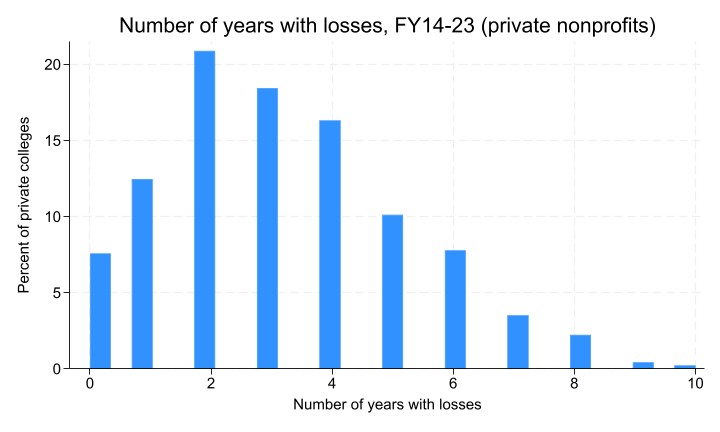
On the other hand, 27 colleges posted losses in eight or more years. Notably, five of these colleges (bolded) have closed or announced closures in the last year or so, and another one (Bacone College in Oklahoma) is not currently offering classes. While some institutions can withstand consistent losses through one-time donations or activities that are not well captured on balance sheets, it is difficult for most colleges. Take for example Judson Universitty in Illinois, which has lost money in eight of the last ten years. Their IRS Form 990 filings show that net assets have declined from more than $44 million in the early 2010s to just under $27 million today—not a good trend.
| Name | State | Losses |
| Polytechnic University of Puerto Rico-Orlando | FL | 10 |
| Roberts Wesleyan University | NY | 10 |
| Trinity International University-Florida | FL | 9 |
| Cambridge College | MA | 9 |
| Fontbonne University | MO | 9 |
| Bethany College | WV | 9 |
| Golden Gate University | CA | 8 |
| Pacific Union College | CA | 8 |
| Polytechnic University of Puerto Rico-Miami | FL | 8 |
| Hawaii Pacific University | HI | 8 |
| Judson University | IL | 8 |
| Southwestern College | KS | 8 |
| Webster University | MO | 8 |
| University of Providence | MT | 8 |
| Drew University | NJ | 8 |
| Elmira College | NY | 8 |
| Hilbert College | NY | 8 |
| St. Francis College | NY | 8 |
| The College of Saint Rose | NY | 8 |
| Yeshiva University | NY | 8 |
| Antioch College | OH | 8 |
| Lourdes University | OH | 8 |
| Bacone College (on hiatus) | OK | 8 |
| Warner Pacific University | OR | 8 |
| Cabrini University | PA | 8 |
| University of Valley Forge | PA | 8 |
| Waynesburg University | PA | 8 |
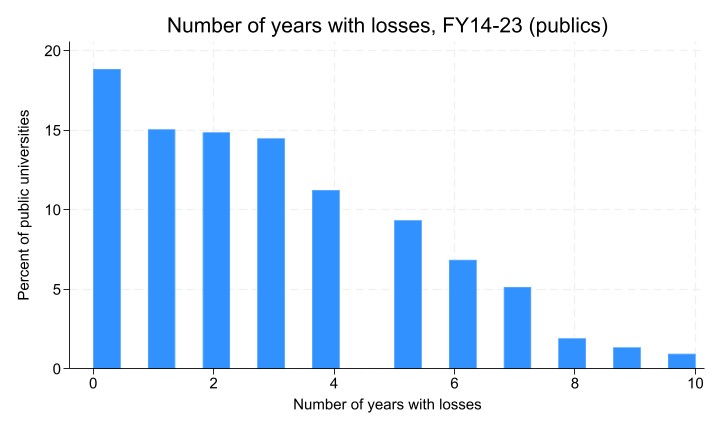
While a larger share of public universities than private colleges never posted a loss, more public universities (16 percent) lost money in at least five of the last ten years. In general, most flagship public universities did exceedingly well and many never lost money. But 22 institutions lost money in eight out of ten years, with 15 of them being located in New York. It is indeed a tough time for many regional public universities, even though they are at very low risk of closure.
| Name | State | Losses |
| University of New Hampshire at Manchester | NH | 10 |
| SUNY College of Environmental Science and Forestry | NY | 10 |
| SUNY College of Technology at Delhi | NY | 10 |
| SUNY at Fredonia | NY | 10 |
| SUNY at Purchase College | NY | 10 |
| Rutgers University-Camden | NJ | 9 |
| SUNY Buffalo State University | NY | 9 |
| SUNY College at Geneseo | NY | 9 |
| SUNY College at Potsdam | NY | 9 |
| SUNY College of Agriculture and Technology at Cobleskill | NY | 9 |
| SUNY Maritime College | NY | 9 |
| SUNY Old Westbury | NY | 9 |
| University of Hawaii-West Oahu | HI | 8 |
| Northern Illinois University | IL | 8 |
| University of Illinois Springfield | IL | 8 |
| Northern Kentucky University | KY | 8 |
| CUNY Graduate School and University Center | NY | 8 |
| College of Staten Island CUNY | NY | 8 |
| SUNY Brockport | NY | 8 |
| SUNY College of Technology at Canton | NY | 8 |
| State University of New York at Oswego | NY | 8 |
| Shippensburg University of Pennsylvania | PA | 8 |
In addition to new finance data, there are also new data on fall enrollments and staffing levels. I encourage researchers, policymakers, and practitioners to take a look through the data to learn more about the current (well, as current as possible given data lags) state of higher education.

 Robert Kelchen
Look at the SUNYs! Sheesh.
How can a state maintain the total number of public institutions! Particularly those which are geographically close to each other and the challenge of and for the local community colleges…something has to giv
Additional insight can be gained by looking not only at the number of years schools reported losses but their overall return on expenses during this period. As one example, I looked at schools in the Division III Southern Athletic Association. Two schools, Hendrix and Centre, show losses for five years, but Centre is in a far superior position, with 10-year net revenues of $190.1M (representing 22.3% of total expenses) as compared to Hendrix, whose 10-year net was $34.6M (6.2% of total expenses).
At the other end there are schools which achieved over 40% return over expenses during this period. The names aren’t too surprising; Williams (MA), Grinnell (IA), Bowdoin (ME), Princeton, Swarthmore, McPherson (KS, an outstanding 78.3% but on fairly small turnover compared to the other schools), Amherst (MA), Claremont McKenna, Goldey-Beacom DE (again, on very small turnover), and Notre Dame (the ND). No doubt at least some of these gains represent major fundraising campaigns substantially completed during the period. Williams’ gains came despite losses in four of the ten years.
Thanks for providing this look into the data (and for the effort involved in collecting it).
Wonderful work. I would be very interested to see if there is a similar trend for public and private high schools, if such a thing exists