The View from a Closed Campus

Quite a bit of my research and public writing in the last few years has been on the topic of college closures and institutions in financial distress. I’m also a bit on the nerdy side, as evidenced by the fact that I am still trying to figure out who sent us a Stata onesie when our first child arrived several years ago. So it’s not a surprise that I jumped on the opportunity to be able to visit the former Iowa Wesleyan University while taking a family trip this summer.

A bit of the backstory on Iowa Wesleyan: it was founded in 1842 in Mount Pleasant, Iowa as the first co-educational private institution west of the Mississippi River. After Parsons College in nearby Fairfield suddenly collapsed and closed in 1973, it was the only traditional four-year institution within a 50-mile radius. And the two closest larger institutions (the University of Iowa and Truman State University in Missouri—my alma mater) are relatively selective, leaving Iowa Wesleyan with a market niche.

But as the tri-state area of southeast Iowa, northeast Missouri, and western Illinois saw a decline in the number of high school graduates, the university struggled. The university received $26 million in a US Department of Agriculture loan to help avoid a closure in 2018 (helped by the Secretary of Agriculture’s wife being on the board. But even as enrollment increased (thanks to athletics), tuition revenue did not. A last-ditch appeal to Iowa’s governor for $12 million failed, and the college closed in 2023; the campus then went to the USDA as its main creditor.

Figuring out what to do with a closed college campus is always a challenge, as these campuses are built for a particular purpose and deferred maintenance is often an issue. Campuses in rural areas face particular concerns, as it is much harder to attract a buyer when there is a smaller population base nearby. Mount Pleasant was fortunate to find several buyers for parts of the campus when the USDA put it up for sale. The primary owner of the campus is the local school district, which bought athletic facilities and an auditorium. The district is also considering putting an elementary school on the site to use existing facilities as much as possible.

Here are some pictures of the campus, and a big thank you to P.E.O. International (my wife is a member of this group that supports women’s education) for the opportunity to tour the campus’s oldest building. The campus grounds are neat and tidy, but there are certainly signs of deferred maintenance issues throughout.

The Iowa Wesleyan signs have been replaced with signs for the local school district.

The main quad of campus. It still looks like a great place to hang out.

The original building on IWU’s campus. It is stately, but also has maintenance issues.
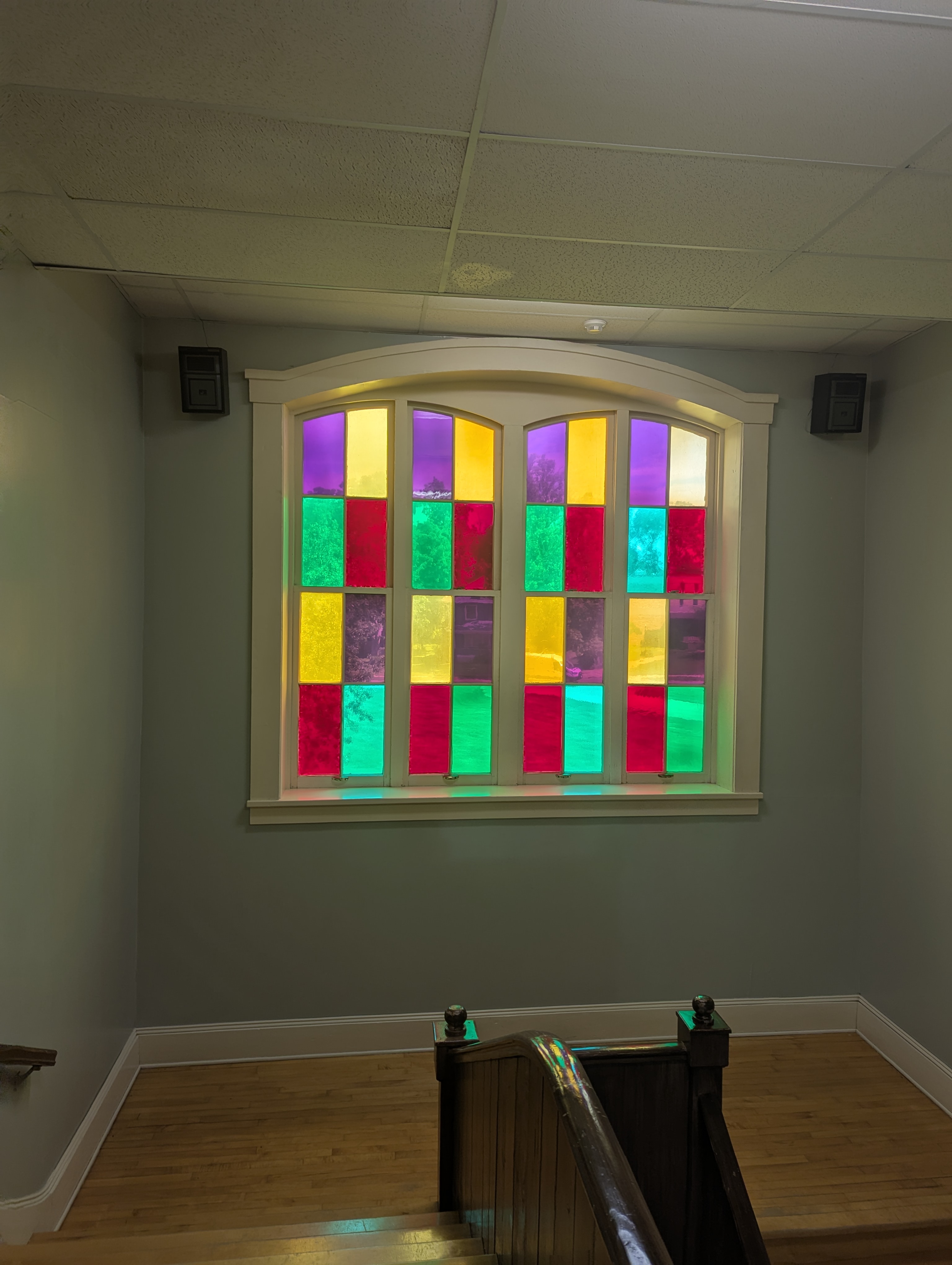
Stained glass windows just don’t exist like this any more.
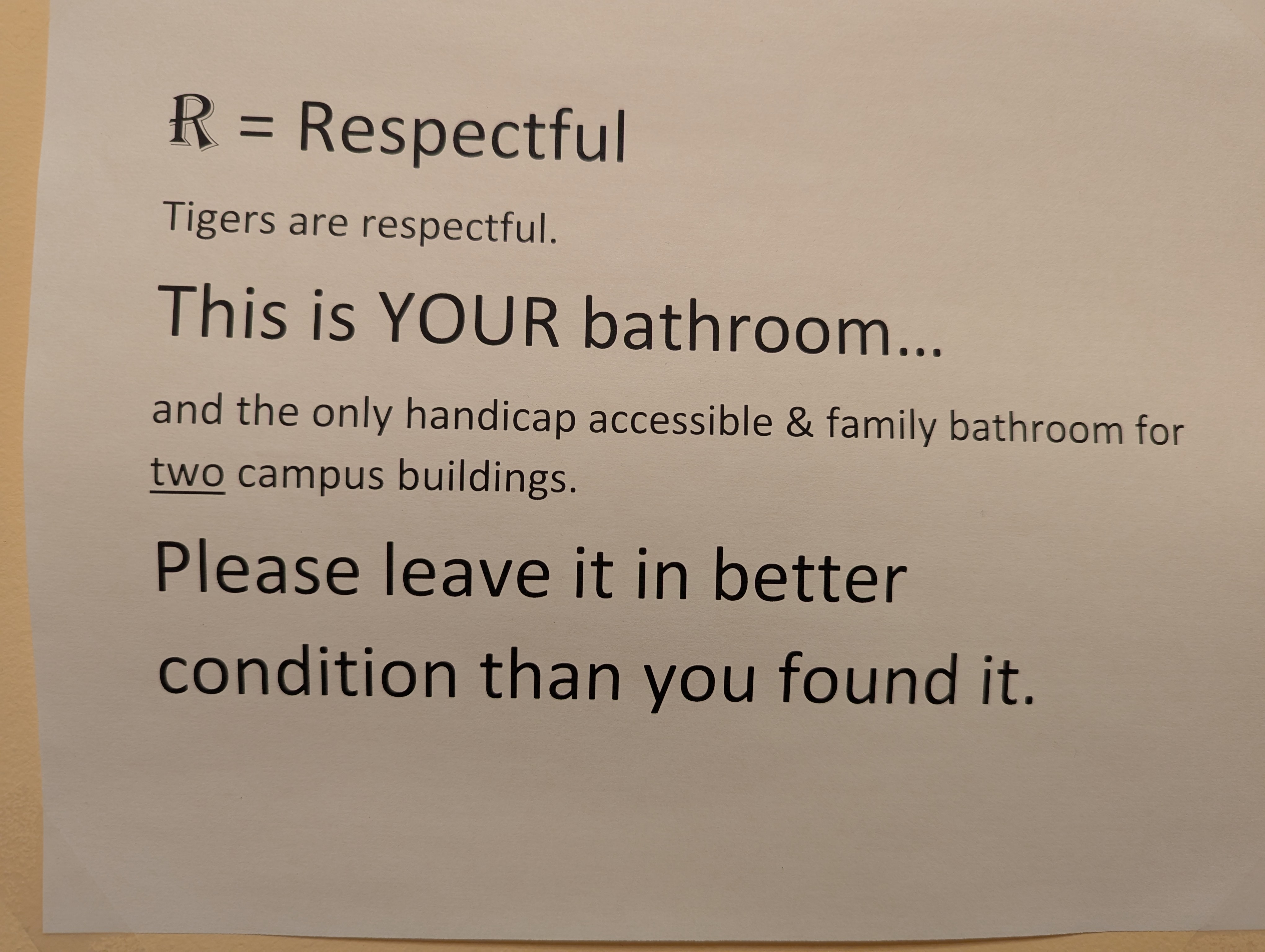
Providing a sense of the facilities challenges of a campus that is well over 100 years old.

And as an aside, a Google search for Iowa Wesleyan shows the following website as the top result. Note the .com on the website and the random international phone number (from India) at the bottom right corner. It looks like a fraud.

The admissions page is actually active, but it seems even more dubious than the rest of the site. Someone duplicated the website for their own uses.

Which Colleges Always Lose Money?

It is safe to say that there is a lot of concern right now about the financial viability of higher education. And while I think fewer colleges are going to close than pundits predict (and check out my recent NBER working paper on factors associated with college closures), it is still going to be a bumpy ride as colleges try to cut costs after efforts to increase revenue are unsuccessful.

By far, the most popular piece on my blog in 2024 (representing nearly one-fourth of all traffic to my website) was a fairly quick look at which private colleges consistently lost money over the last decade. Now that a new year of data on institutional finances (through Fiscal Year 2023) came out through the Integrated Postsecondary Education Data System, I am revisiting this and also including public universities.

I looked at the operating margins (revenues minus expenses) private nonprofit colleges and public universities for the past ten years (Fiscal Years 2014 through 2023). This analysis included 938 private and 525 public institutions in the 50 states and Washington, DC and excluded colleges with any missing data, two-year institutions, or special-focus institutions based on the most recent Carnegie classifications.

You can download the dataset here, with highlighted private colleges having closed since IPEDS data were collected.

The first takeaway is that the share of private colleges with losses varies much more than the share of public institutions, and this is driven by a combination of investment returns at private institutions and the backstop that state funding provides for public universities. More than four in ten private colleges posted a loss in Fiscal Year 2023—twice the rate of public universities. Since the beginning of the pandemic, the percentage of public universities with revenues failing to match expenditures has been cut in half. Federal covid relief funds are now gone, however, and state budgets look wobbly.

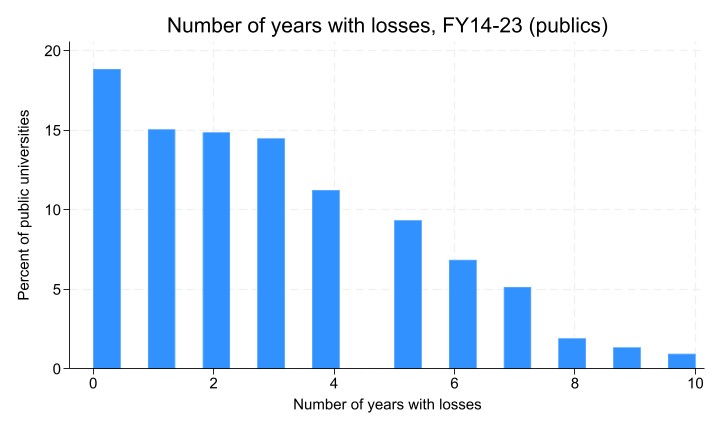
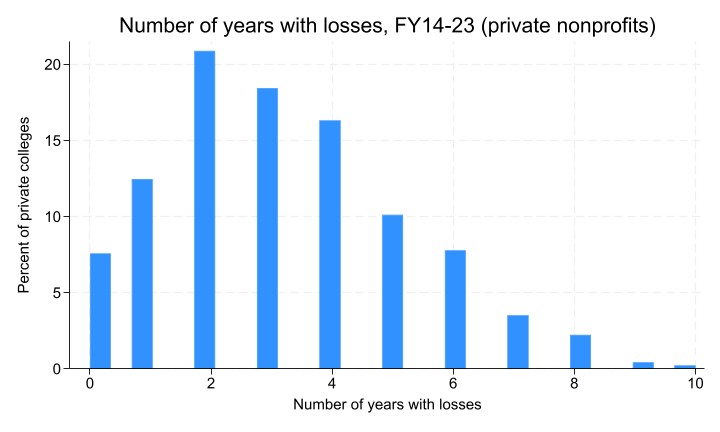
The two figures below show the number of years in the last decade that both private and public universities posted losses. Most private colleges saw surpluses more often than deficits, with only 14 percent of institutions losing money in more than five years. Seventy-one private colleges never posted a loss during this period, and they are generally less-selective institutions such as Miles College in Alabama, Dordt University in Iowa, and the University of Northwestern in Minnesota (the better-known Northwestern in Illinois posted losses in three years when the stock market went down). A few better-known private universities that managed to stay in the black every year included Southern Methodist University, Liberty University, Southern New Hampshire University, and the University of Pennsylvania.

On the other hand, 27 colleges posted losses in eight or more years. Notably, five of these colleges (bolded) have closed or announced closures in the last year or so, and another one (Bacone College in Oklahoma) is not currently offering classes. While some institutions can withstand consistent losses through one-time donations or activities that are not well captured on balance sheets, it is difficult for most colleges. Take for example Judson Universitty in Illinois, which has lost money in eight of the last ten years. Their IRS Form 990 filings show that net assets have declined from more than $44 million in the early 2010s to just under $27 million today—not a good trend.

NameStateLosses
Polytechnic University of Puerto Rico-OrlandoFL10
Roberts Wesleyan UniversityNY10
Trinity International University-FloridaFL9
Cambridge CollegeMA9
Fontbonne UniversityMO9
Bethany CollegeWV9
Golden Gate UniversityCA8
Pacific Union CollegeCA8
Polytechnic University of Puerto Rico-MiamiFL8
Hawaii Pacific UniversityHI8
Judson UniversityIL8
Southwestern CollegeKS8
Webster UniversityMO8
University of ProvidenceMT8
Drew UniversityNJ8
Elmira CollegeNY8
Hilbert CollegeNY8
St. Francis CollegeNY8
The College of Saint RoseNY8
Yeshiva UniversityNY8
Antioch CollegeOH8
Lourdes UniversityOH8
Bacone College (on hiatus)OK8
Warner Pacific UniversityOR8
Cabrini UniversityPA8
University of Valley ForgePA8
Waynesburg UniversityPA8

While a larger share of public universities than private colleges never posted a loss, more public universities (16 percent) lost money in at least five of the last ten years. In general, most flagship public universities did exceedingly well and many never lost money. But 22 institutions lost money in eight out of ten years, with 15 of them being located in New York. It is indeed a tough time for many regional public universities, even though they are at very low risk of closure.

NameStateLosses
University of New Hampshire at ManchesterNH10
SUNY College of Environmental Science and ForestryNY10
SUNY College of Technology at DelhiNY10
SUNY at FredoniaNY10
SUNY at Purchase CollegeNY10
Rutgers University-CamdenNJ9
SUNY Buffalo State UniversityNY9
SUNY College at GeneseoNY9
SUNY College at PotsdamNY9
SUNY College of Agriculture and Technology at CobleskillNY9
SUNY Maritime CollegeNY9
SUNY Old WestburyNY9
University of Hawaii-West OahuHI8
Northern Illinois UniversityIL8
University of Illinois SpringfieldIL8
Northern Kentucky UniversityKY8
CUNY Graduate School and University CenterNY8
College of Staten Island CUNYNY8
SUNY BrockportNY8
SUNY College of Technology at CantonNY8
State University of New York at OswegoNY8
Shippensburg University of PennsylvaniaPA8

In addition to new finance data, there are also new data on fall enrollments and staffing levels. I encourage researchers, policymakers, and practitioners to take a look through the data to learn more about the current (well, as current as possible given data lags) state of higher education.

How Many Colleges Really Close Each Year?

College closures are getting quite a bit of attention right now—and for good reason. When a college closes suddenly, students are much less likely to complete their studies and employees have a difficult time finding comparable jobs. And the uptick in the number of college closures in the last year or two has been obvious to nearly everyone in higher education.

But how many colleges really close each year? The Wall Street Journal recently led off a story with a statement that more than 500 four-year private nonprofit colleges closed in the last decade, and Inside Higher Ed covered a National Center for Education Statistics report that highlighted that nearly 100 colleges closed in the 2023-24 academic year.

While I greatly appreciate Higher Ed Dive’s running list of college closures, the two more definitive sources for college closures come from the U.S. Department of Education’s Integrated Postsecondary Education Data System (IPEDS) and Postsecondary Education Participants System (PEPS). However, both of these sources need to be interpreted with caution due to how data are reported. I discuss my recommendation for using IPEDS and PEPS below, and see this spreadsheet for the data that I refer to throughout the piece.

IPEDS

IPEDS has a rough measure of college closures in its Directory Information data collection, which is updated annually. The relevant variable is whether an institution is active in the current year, with the possible answers of “yes” or “no: closed, combined, or out-of-scope.” The challenge here is that a substantial number of colleges included under “no” fall under the combined and out-of-scope categories without any disruption to students. Combined institutions can be the result of one college acquiring another, but it can also be an administrative consolidation for reporting purposes that does not change anything for students. An out-of-scope college may choose to opt out of federal Title IV financial aid programs while remaining open; this is primarily the case among for-profit colleges.

In the 2023-24 academic year, I count 70 primarily postsecondary institutions (IPEDS also includes some vocational training programs that are mainly secondary schools, but I exclude them here) that left the IPEDS universe. A complete list of these apparent closures can be found in the first tab of this spreadsheet.

Some of the institutions are clearly closures (such as Finlandia University in Michigan and Medaille University in New York), but others are administrative consolidations. For example, 11 of the 70 “closures” are community colleges in Connecticut, which recently moved to a single-institution model with 12 branch campuses (no campuses were closed).

Similar examples of administrative consolidations are visible at public colleges in Tennessee and Vermont. The private nonprofit closures are primarily freestanding institutions, while quite a few for-profit college closures include multiple branches closing at the same time. Overall, it appears that roughly 40 unique institutions (excluding branches) actually closed in 2023-24, and they are divided between for-profit and nonprofit colleges.

On the other hand, 56 colleges joined the IPEDS universe in the 2023-24 academic year (the second tab of the spreadsheet). They are primarily small, vocationally focused for-profit colleges that frequently cycle in and out of operation. But I did notice Northeastern University Oakland on the list of newly opened colleges using the same IPEDS UnitID as Mills College. It is relatively uncommon for private nonprofit colleges to open and receive federal financial aid, but it occasionally happens in special-focus fields such as health sciences and technical education.

PEPS

If you have read to this point in a pretty technical blog post, you have some pep in your step. Federal Student Aid updates the PEPS data page weekly with a list of every college that closes. That sounds great—until you go and download the spreadsheet. This behemoth (accessible by downloading the closed school search file) includes more than 20,000 college closures since the mid-1980s.

That number of closures seems a bit high since there are only about 6,000 colleges receiving federal financial aid in the United States at this point. The reason is that PEPS tracks the closure of every single physical campus location in the United States, as well as foreign locations of American-based or Title IV-eligible institutions. Let’s look at 2024 PEPS data, which I included in the third tab of the spreadsheet.  

PEPS lists 81 closures in 2024, with the most recent closure being on August 9. But as the below picture shows, many of these closures are of small branch campuses. For example, Saint Louis University closed small sites in Jefferson City, Dallas, and Houston. Johns Hopkins University closed seven sites in Texas, for crying out loud! Other closures are real and meaningful, such as Goddard College and UW-Oshkosh’s Fond du Lac campus (which was a freestanding institution until several years ago).

The way to identify a main campus closure is through examining the Office of Postsecondary Education ID (OPEID) number. If the number starts with a zero and ends in 00, that is a main campus. Any OPEID that ends in something other than 00 (or starts with a number other than zero) is a branch campus. Many of these branches often enroll a small number of students and come and go regularly, although a few are more notable. Thirty-two of the 81 closures to this point in 2024 have been main campuses, while the rest were branch campuses.

So how many colleges really close each year? It depends a lot on what you consider to be a college. But I would contend that quite a few of the colleges listed in federal data as closing either did not actually close or served a minuscule number of students at offsite locations. This does not make the closure of main campuses less concerning, but it’s important to have a clear sense of the numbers before engaging in policy discussions.

Which Private Colleges Always Lose Money?

I write this piece with the sounds of excavators and dump trucks in the background, as we are getting the 30-year-old pool at our house replaced this month. Pools should last a lot longer than that, but the original owner of the house decided to save money by installing the pool on top of a pile of logs and stumps left over from clearing the land. As those logs settled and decayed, the pool began to leak and we are left with a sizable bill to dig everything out and do things right. Even though we budgeted for this, it is still painful to see every load of junk exit and every load of gravel enter what I am calling the money pit.

On the higher education front, it has been a week with several announced or threatened closures. On Monday, the University of Wisconsin-Milwaukee announced that it would close its Waukesha branch campus, marking at least the fourth of the 13 former University of Wisconsin Colleges to close in the last several years. Fontbonne University in St. Louis also announced its closure on Monday, although they get a lot of credit from me for giving students and at least some employees more than a year to adjust. Today, Northland College in Wisconsin announced that it will close at the end of this academic year unless they can raise $12 million—one-third of their annual budget—in the next three weeks. Closures just keep dripping out, and I am really concerned about a late wave of closures this spring once colleges finally get FAFSA information from the U.S. Department of Education.

The two topics blended together for me (along with my students’ budget analyses being due on Friday) on my run this morning, and I quickly jotted down the gist of this post. The coverage of both Fontbonne and Northland focused on the number of years that they had lost money, so I used IPEDS data to take a look at the operating margins (revenues minus expenses) private nonprofit colleges for the past ten years (2012-13 to 2021-22). This analysis included 924 institutions in the 50 states and Washington, DC and excluded colleges with any missing data or special-focus institutions based on the most recent Carnegie classifications.

You can download the dataset here, with highlighted colleges having closed since IPEDS data were collected.

The first thing is that the share of colleges with losses varied considerably across years, and a high share of losses is driven by investment losses. But with the exception of the pandemic-aided 2020-21 year, the next lowest year of operating losses was 2013-14 (9%). 2021-22 saw two-thirds of colleges post an operating loss as pandemic aid began to fade and investments had a rough year.

YearOperating loss (pct)
2012-1311.8
2013-149.1
2014-1531.6
2015-1656.2
2016-1712.8
2017-1820.4
2018-1937.2
2019-2043.8
2020-213.5
2021-2267.2

Below is the distribution of the number of years that each college posted an operating loss. Seventy-nine colleges never lost money, and most of these institutions have small endowments but growing enrollment. The modal college had an operating loss in three years, and 90% of colleges at least broke even in five years out of the last decade.

On the other hand, 19 colleges posted losses in eight or more years. Notably, nine of these colleges have closed in the last year or so, compared to nine of the other 905 colleges. (Let me know if I’m missing any obvious closures!) The list of colleges with eight or more closures is below, and closed/closing colleges are bolded.

NameStateLosses
Polytechnic University of Puerto Rico-OrlandoFL10
Roberts Wesleyan UniversityNY10
Trinity International University-FloridaFL9
Iowa Wesleyan UniversityIA9
Cambridge CollegeMA9
Fontbonne UniversityMO9
Medaille UniversityNY9
Bethany CollegeWV9
American Jewish UniversityCA8
Polytechnic University of Puerto Rico-MiamiFL8
Hawaii Pacific UniversityHI8
Great Lakes Christian CollegeMI8
Alliance UniversityNY8
Cazenovia CollegeNY8
Yeshiva UniversityNY8
Bacone College [not enrolling students]OK8
University of Valley ForgePA8
Cardinal Stritch UniversityWI8
Alderson Broaddus UniversityWV8

On a related note, I wrote a piece for the Chronicle of Higher Education that reviews a new book that makes the case for more colleges declaring financial exigency in order to cut academic programs. I think that it is more important than ever for faculty, staff, and students to have a sense of the financial health of their college by being equipped to read budget documents and enrollment projections. That is crucial in order for shared governance to have a chance of working in difficult situations and to help avoid money pit situations like the one in my own backyard.