
Time is perhaps the most precious commodity in existence. No matter who you are, there are only 24 hours in a day—and I sincerely hope that it is not your goal to work excessive and sometimes dangerous hours like Silicon Valley tech workers, junior Wall Street investment bankers, or China’s 996 working culture. Late July also represents prime summer vacation season for many Americans, whether it be through taking a week off for a longer trip or honoring the “summer Friday” tradition that is big enough in the Northeast that a vodka company once commissioned a national poll on the topic.
I do my best to set boundaries around my work, as I love spending time with my two small children and to get outside as much as possible. For example, I try to be home for breakfast and supper every day when I am in town and I only work on weekends when the kids are asleep. This limits my available work time to about 55 hours per week, which is actually a bit below what typical faculty members self-report.
Because my research is in areas that are hot topics (yay for higher education finance!) and I am in a field with relatively few senior faculty who have not been pulled into research full-time, I get asked by journalists, policymakers, junior scholars, and members of the public for my time in addition to the typical requests to review manuscripts for journals or write external letters for tenure and promotion. Just to provide an example, I spent last Friday afternoon heading out of town with my family for our first real vacation with the kids. I received three media inquiries between 3:00 and 5:00 that afternoon and an additional one over the weekend. I was able to squeeze in responses to everyone, which took some juggling.
But even with lots of juggling, there is still no way that I can handle all of the requests that come in. After receiving several requests on short notice while being out of town, I wrote a LinkedIn post with a standard response that I have developed and it took off. It is a real struggle to write a standard response that also seems somewhat personable, to say the least.
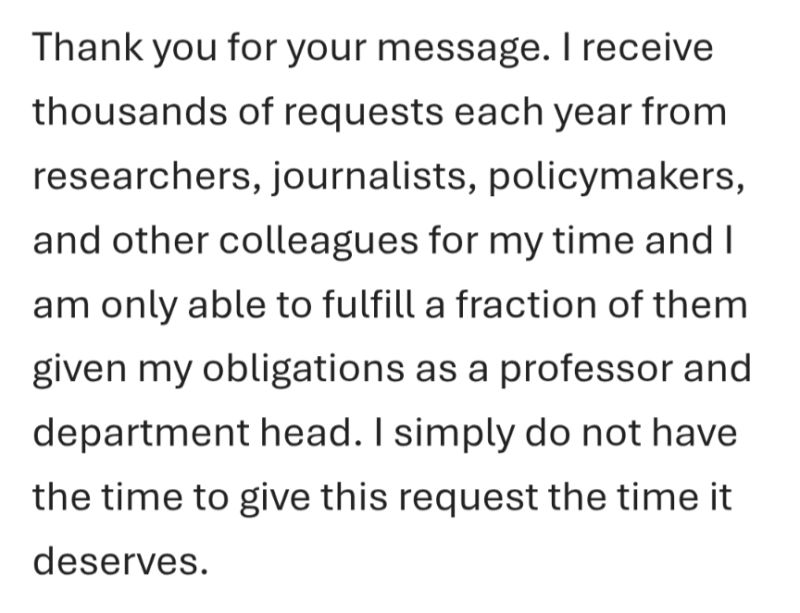
I am also wrestling with how to allocate time to the next ask of so many people: if I cannot help them, can I point them to others who can? In some cases, I know the right person to assist and can easily refer—although others have the same or worse bandwidth concerns that I have. But in other cases, it would take a substantial amount of my time to come up with some other good references.
Friends and colleagues, what are your recommendations for kindly saying no to requests? I wish that I had better answers, especially after thinking about this topic a lot over the last few months.


You hire a secretary. If you’re DEO, why isn’t your office staff screening your external requests? If there’s such a flood of them, and your profile’s of benefit to the institution, maybe you get a line for a part-time person as well.
amy