
Ten years ago this week, I was at the Association for the Study of Higher Education conference in Columbus, Ohio when Donald Trump was elected president in a result that devastated many in my field. The conference went on as scheduled, but quite a few presenters had a hard time continuing with their sessions. I was sitting in the back of the conference writing a quick piece at the request of The Chronicle of Higher Education about what Trump’s surprising victory meant for higher education.
I write today from the 2026 ASHE conference in San Juan, Puerto Rico, where the mood is likely to be much more jubilant among a group of 1,600 researchers and practitioners. A picture from my morning run captures the outcome nicely; while there are still quite a few races to be called as of this writing, there was a blue wave that has been unseen in generations.
Virginia Foxx, longtime chair of the House Education and the Workforce Committee (which will be renamed Education and Labor in January with Democrats taking control) is trailing in a potential recount.
Ohio’s GOP trifecta is broken and Wisconsin established a Democratic trifecta after a long period of Republican legislative control.
Democrats won the Texas House as well as the governor’s mansion.
The Mississippi Senate race is too close to call.
Democrats will end up with between 54 and 56 seats in the Senate, and it’s possible that Lisa Murkowski (R-AK) switches parties.

Here are my quick takeaways about the implications of the 2026 midterm election results for higher education over the next two years, as the 2028 presidential campaign begins today. First, at the federal level.
Can the GOP Congress get anything done during the lame duck session? The next two months are the last chance for Republicans in Washington to pass a partisan reconciliation bill that can enshrine GOP priorities. The One Big Beautiful Bill Act, which massively changed federal student loans, was a reconciliation bill. Defeated Republicans may be more interested in finding new jobs than staying in Washington to pass legislation, meaning that Democrats may have an attendance advantage in the House. I also cannot rule out the possibility of a strategic Supreme Court retirement and quick replacement before January, which would tie up floor time in the Senate. I do not expect major action, but the Trump administration is likely to push.
Will there be a federal government shutdown? With Democrats in firm control of the House and Senate and a feisty new group of progressives coming to Washington, expect Trump’s veto pen to be busy enough that he may want to invest in an autopen. These are prime conditions for a government shutdown, which can work in the Trump administration’s favor due to the possibility of executive actions from the Office of Management and Budget. Expect Republicans to also focus on the deficit now that they are out of power, which is both a crucial issue for the country and one that the party in power typically ignores in favor of their own policy priorities.
Will key White House and Department of Education staffers head for the exits? With a greatly diminished Department of Education, a majority of policy work is being done by a small group of individuals. While the Trump administration can continue to move work forward through the regulatory agenda, Congressional oversight is likely to increase and there will be no supportive legislation. These staffers are going to be in demand for 2028 Republican presidential campaigns and may get pulled in by red states. Top talent often leaves the federal government as the lame duck period nears, and a hostile Congress will accelerate this trend. This will limit the administration’s ability to use its available powers.
There are also going to be consequential implications of the midterm elections for states. Just look at this map of state partisan control after Democrats made major gains.
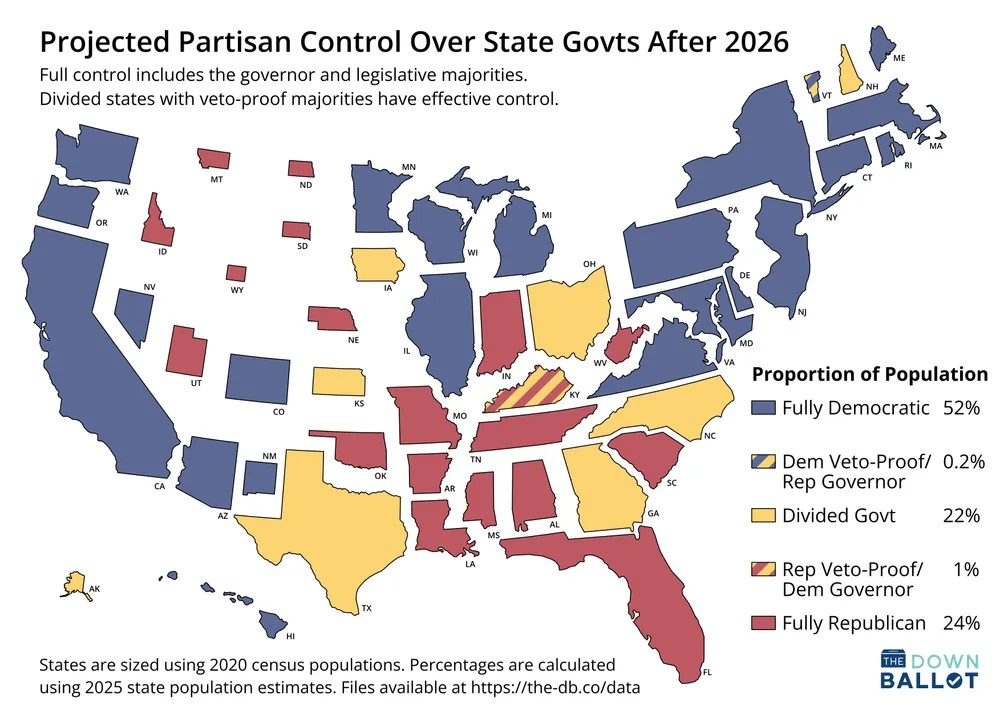
Here are my state-level takeaways and questions:
How many university presidents and civics institute leaders will be looking for new jobs? University presidents (and to a lesser extent, community college presidents) have become political appointments. In Texas, the governor appoints—and the state Senate confirms—the trustees who select presidents; this model is also present in many other states. With a Democratic governor and a Republican senate, future appointments in Texas will be interesting. I am watching Texas, Ohio, and Iowa in particular due to their new Democratic governors following active efforts to reshape public higher education. There will be intense pressure to replace conservative politicians in higher education leadership, and I hope that Democratic politicians do not replace them.
Which governors see themselves as presidential candidates? And will higher education be a presidential campaign issue? I expect no shortage of Democratic candidates in 2028, especially after the path to victory for Democrats became a lot more clear. Anyone running for president may choose to make higher ed a campaign issue, similar to what some Republican governors have done. And after the shellacking in Washington, sitting Republican governors just became stronger presidential candidates in 2028. The challenge there is that the two highest-profile Republican governors (Abbott in Texas and DeSantis in Florida) are leaving office due to a defeat and term limits. The GOP bench is inexperienced, but continuing to highlight higher education reform could help.
What will happen to state funding for higher education? State funding increases have slowed to below the rate of inflation, and this trend is likely to continue as state tax revenue stagnates and states are being asked to take on additional costs for food assistance and healthcare from the federal government. Democrats in Washington are likely to try to reverse the federal cuts, but a veto pen may await. New Democratic governors may be more supportive of higher education (although Gov. Abbott in Texas substantially increased funding), but they will also be facing pressures to focus on K-12 education or social services on a limited budget. I do not expect Democratic gains to lead to meaningful changes in state funding as a result.
Today kicks off the 2028 presidential campaign, which is the first truly open race on both sides since 2016. Education was the top priority of two percent of 2026 voters, but higher education can still be a salient campaign issue. Expect think tanks, advocates, and potential candidates to be putting forward ideas, as there is never a dull moment in higher education.


