What a Second Trump Administration May Mean for Higher Education

For the last two presidential transitions, I have written pieces about what the new president (Trump in 2016 and Biden in 2020) may mean for higher education. My expectations back in 2016 were the following:

  • He would not repeal the Department of Education. (He never seriously tried.)
  • Tuition-free public college was dead. (True at the federal level, but state-level programs grew following Tennessee’s lead.)
  • He talked about income-driven repayment changes and going back to having private banks guarantee loans. (Neither happened, although he did pause payments during the pandemic.)
  • There would be fewer regulations and an accountability reprieve for the for-profit college sector. (True.)

After four years of President Trump in power, the higher education community has a better sense of what is coming than we did back in 2016. Here are some of the key things that I am watching over the next several months and years.

(1) The subtitle for my piece on the incoming Biden administration was, “If the Democrat wins, he will have to govern by executive order, much as his predecessor did.” That is not going to be as easy this time around. One of conservatives’ biggest Supreme Court wins recently was the overturning of the Chevron precedent that will result in less authority for federal agencies to enact regulations. For at least the next four years, this is going to bite the Trump administration right in the behind. Unless…

(2) Political appointees try acting through issuing directives that are implemented before courts can step in, hoping that they will be unwilling to unwind something that is already being done. It hearkens back to the alleged quote from Andrew Jackson: The Chief Justice “has made his decision; now let him enforce it.” A frequent refrain among progressives over the last few years has been that the Biden administration should immediately cancel student debt, making it difficult for the debt to be reinstated later upon court order. It would not be surprising to see Trump appointees trying to score a policy win (or at least some political points with their base) in that manner. Two likely areas are around federal financial aid to so-called “woke” colleges and international student visas.

(3) While Republicans retook the Senate with at least three votes to spare, House control is still too early to tell as of this writing and is likely to be razor-thin. House Republicans had more than a few challenges in the current Congress with a slim majority, and it is going to be difficult to pass a lot of legislation when hardliners and moderates within the GOP disagree on so many things. Conservatives detest omnibus budget bills and have been pushing for 12 separate budget bills for years. But the result is usually one large bill passed in mid-December, which creates incentives for compromise. Trump has not been particularly concerned about deficits, so conservatives are unlikely to get major budget cuts.

(4) The Higher Education Act was last reauthorized in 2008. I still might retire before it happens again, and I don’t plan on going anywhere for a while. While the Department of Education is not going away anytime soon, there are enough Republicans who would rather throw out the entire department than make substantive reforms. Democrats likely prefer the status quo to any new major legislation, so we can keep waiting on reauthorization for a long time. This does not mean that some policy changes cannot happen; the major changes to the FAFSA last year came through an omnibus budget bill in 2020. But any changes will be piecemeal in the grand scheme of things.

(5) President Trump and Congressional leaders will use the bully pulpit to go after selective colleges and their leaders. Last year’s House hearings were very effective for Republicans, as they led to several presidents resigning. If something works in Washington, expect to see it again—especially as both Trump and Vance are products of those institutions. Community colleges and regionally-focused public and private institutions are likely to fly under the radar, as going after them will not generate media attention. But I would not want to be a president of a blue-state flagship university or an elite private college right now, and any leader who is not a white man is likely to face additional scrutiny if last year’s hearings were a guide.

(6) Keep a close eye on who ends up at the Department of Education. Most of the commentary out there about potential Cabinet secretaries barely even mentions ED, but he still needs to identify someone to run the agency on an acting basis. Betsy DeVos is off the table for a second term because she resigned in the aftermath of January 6, and this is a job that many conservatives do not aspire to reach. A name that I am watching is Oklahoma’s state superintendent of education, Ryan Walters, as he tried to get Trump-branded Bibles into public school classrooms and supports the elimination of the Department of Education. Will K-12 or higher education be the focus? I have long contended that higher ed is the area of greatest importance for a Secretary of Education, but a focus on social issues may change that.

Higher education was in for a challenging period regardless of who was elected, thanks to growing skepticism over the value of a college education, increasing political polarization by educational attainment, and the state of federal student loans. This week’s election just magnified all of those concerns. Buckle up, folks…it’s going to be a bumpy ride.

Documenting the Growth of Responsibility Center Management Budget Models in Public Higher Education

As most of higher education is concerned about their financial position, a growing number of colleges are trying to encourage academic units to generate additional revenues and cut back on expenses. One popular way of doing this is through responsibility center management (RCM) budget models, which base a portion of a unit’s budget on their ability to effectively generate and use resources.[1]

Both universities that I have worked at (Seton Hall and Tennessee) have adopted variations of RCM budget models, and there is a lot of interest—primarily at research universities—in pursuing RCM. Having been through RCM, I am quite interested in the downstream implications of RCM on how leaders of institutions and units behave. There are a couple of good scholarly articles about the effects of RCM that I use when I teach higher education finance, but they are based on a small number of fairly early adopters and the findings are mixed.

One of my current research projects is examining the growth of master’s degree programs (see our recent policy brief), and I have a strong suspicion that institutions adopting RCM budget models are more likely to launch new programs as units try to gain additional revenue. My sense is that there have been a lot of recent adopters, but the best information out there about who has adopted RCM comes from slides or information provided by consulting firms (which often are not under contract by the time the model is supposed to be fully implemented). This led me to spot check a few institutions commonly listed on charts, and some of them appear to have either never gotten past the planning stage or quietly moved to another budget model.

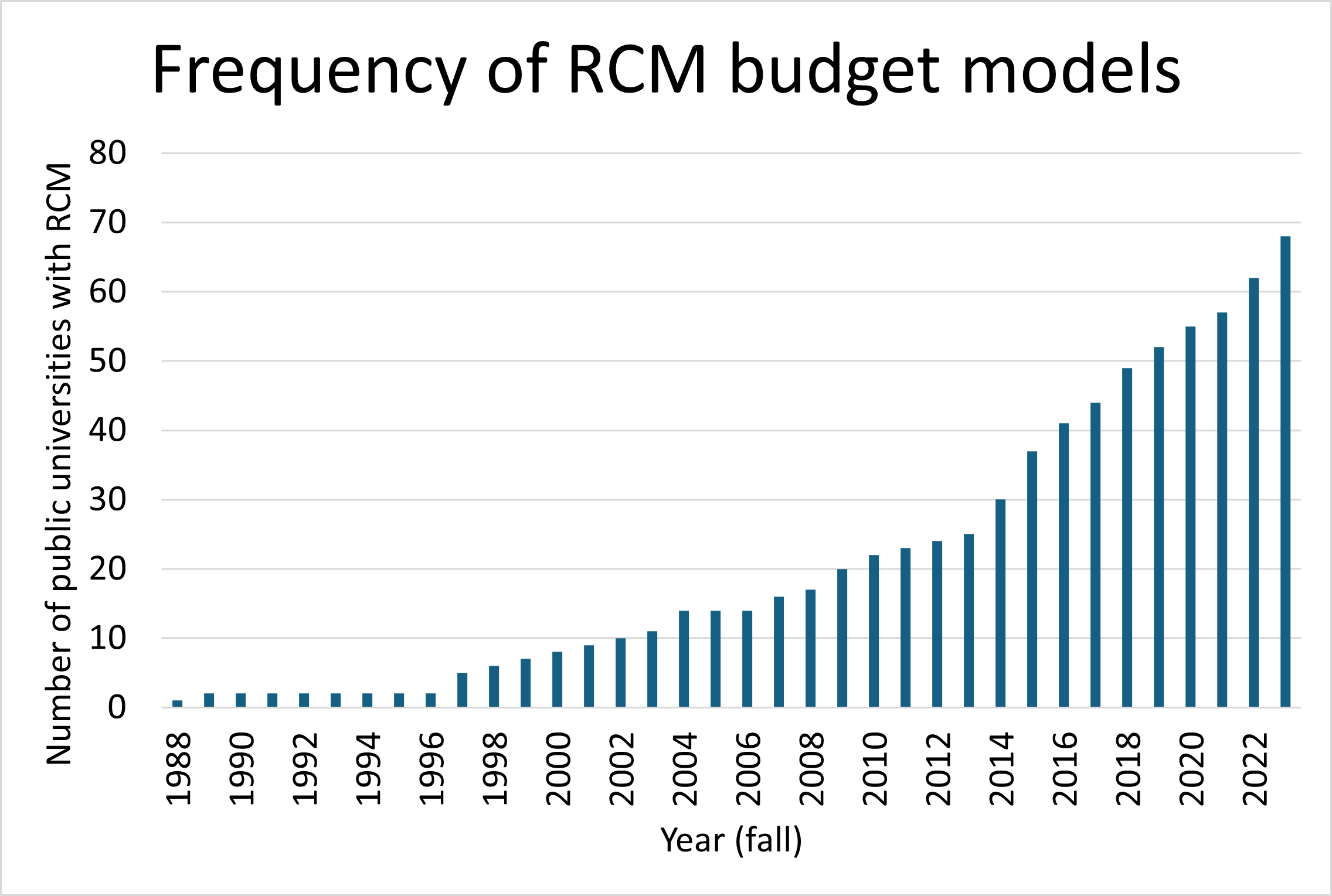
My outstanding research assistant Faith Barrett and I went through documents from 535 public universities (documents from private colleges are rarely available) to collect information on whether they had announced a move to RCM, actually implemented it, and/or abandoned RCM to return to a centralized budget model.[2] The below figure summarizes the number of public universities that had active, implemented RCM budget models for each year between 1988 and 2023.[3]

There has been a clear and steady uptick in the number of public universities with active RCM models, reaching 68 by 2023. Most of this increase has happened since 2013, when just 25 universities used RCM. Only seven universities that fully implemented RCM fully abandoned the model based on publicly available documents (Central Michigan, Ohio, Texas Tech, Illinois-Chicago, Oregon, and South Dakota), although quite a few colleges have backed off how much money flows through RCM.

Additionally, a number of universities publicly announced plans to move to RCM before apparently abandoning them before implementation. Some examples include Missouri, Nebraska, and Wayne State. This is notable because these are often included on consultants’ slide decks as successful moves to RCM.

Here is the list of universities that had fully implemented RCM by fall 2023. If you see any omissions or errors, please let me know!

NameState
Auburn UniversityAL
University of Alabama at BirminghamAL
University of ArizonaAZ
University of California-DavisCA
University of California-Los AngelesCA
University of California-RiversideCA
University of Colorado BoulderCO
University of Colorado Denver/Anschutz Medical CampusCO
University of DelawareDE
University of Central FloridaFL
University of FloridaFL
Georgia Institute of Technology-Main CampusGA
Iowa State UniversityIA
University of IowaIA
Boise State UniversityID
Idaho State UniversityID
University of IdahoID
University of Illinois ChicagoIL
University of Illinois Urbana-ChampaignIL
Ball State UniversityIN
Indiana University-BloomingtonIN
Indiana University-Purdue University-IndianapolisIN
Kansas State UniversityKS
University of KansasKS
Northern Kentucky UniversityKY
Western Kentucky UniversityKY
University of BaltimoreMD
University of Michigan-Ann ArborMI
University of Michigan-DearbornMI
Western Michigan UniversityMI
University of Minnesota-Twin CitiesMN
University of Missouri-Kansas CityMO
The University of MontanaMT
North Dakota State University-Main CampusND
University of North DakotaND
University of New Hampshire-Main CampusNH
Rutgers University-CamdenNJ
Rutgers University-New BrunswickNJ
Rutgers University-NewarkNJ
University of New Mexico-Main CampusNM
Kent State University at KentOH
Miami University-HamiltonOH
Miami University-MiddletownOH
Miami University-OxfordOH
Ohio State University-Main CampusOH
University of Cincinnati-Main CampusOH
Oregon State UniversityOR
Southern Oregon UniversityOR
Pennsylvania State University-Main CampusPA
Temple UniversityPA
University of Pittsburgh-Pittsburgh CampusPA
College of CharlestonSC
University of South Carolina-ColumbiaSC
East Tennessee State UniversityTN
Tennessee Technological UniversityTN
The University of Tennessee-KnoxvilleTN
University of MemphisTN
The University of Texas at ArlingtonTX
The University of Texas at San AntonioTX
University of UtahUT
George Mason UniversityVA
University of Virginia-Main CampusVA
Virginia Commonwealth UniversityVA
University of VermontVT
Central Washington UniversityWA
University of Washington-Bothell CampusWA
University of Washington-Seattle CampusWA
University of Wisconsin-MadisonWI

[1] This is also called responsibility centered management, and I cannot for the life of me figure out which one is preferred. To-may-to, to-mah-to…

[2] RCM can be designed with various levels of centralization. Pay attention to the effective tax rates that units pay to central administration—they say a lot about the incentives given to units.

[3] This excludes so-called “shadow years” in which the model was used for planning purposes but the existing budget model was used to allocate resources.

How Many Colleges Really Close Each Year?

College closures are getting quite a bit of attention right now—and for good reason. When a college closes suddenly, students are much less likely to complete their studies and employees have a difficult time finding comparable jobs. And the uptick in the number of college closures in the last year or two has been obvious to nearly everyone in higher education.

But how many colleges really close each year? The Wall Street Journal recently led off a story with a statement that more than 500 four-year private nonprofit colleges closed in the last decade, and Inside Higher Ed covered a National Center for Education Statistics report that highlighted that nearly 100 colleges closed in the 2023-24 academic year.

While I greatly appreciate Higher Ed Dive’s running list of college closures, the two more definitive sources for college closures come from the U.S. Department of Education’s Integrated Postsecondary Education Data System (IPEDS) and Postsecondary Education Participants System (PEPS). However, both of these sources need to be interpreted with caution due to how data are reported. I discuss my recommendation for using IPEDS and PEPS below, and see this spreadsheet for the data that I refer to throughout the piece.

IPEDS

IPEDS has a rough measure of college closures in its Directory Information data collection, which is updated annually. The relevant variable is whether an institution is active in the current year, with the possible answers of “yes” or “no: closed, combined, or out-of-scope.” The challenge here is that a substantial number of colleges included under “no” fall under the combined and out-of-scope categories without any disruption to students. Combined institutions can be the result of one college acquiring another, but it can also be an administrative consolidation for reporting purposes that does not change anything for students. An out-of-scope college may choose to opt out of federal Title IV financial aid programs while remaining open; this is primarily the case among for-profit colleges.

In the 2023-24 academic year, I count 70 primarily postsecondary institutions (IPEDS also includes some vocational training programs that are mainly secondary schools, but I exclude them here) that left the IPEDS universe. A complete list of these apparent closures can be found in the first tab of this spreadsheet.

Some of the institutions are clearly closures (such as Finlandia University in Michigan and Medaille University in New York), but others are administrative consolidations. For example, 11 of the 70 “closures” are community colleges in Connecticut, which recently moved to a single-institution model with 12 branch campuses (no campuses were closed).

Similar examples of administrative consolidations are visible at public colleges in Tennessee and Vermont. The private nonprofit closures are primarily freestanding institutions, while quite a few for-profit college closures include multiple branches closing at the same time. Overall, it appears that roughly 40 unique institutions (excluding branches) actually closed in 2023-24, and they are divided between for-profit and nonprofit colleges.

On the other hand, 56 colleges joined the IPEDS universe in the 2023-24 academic year (the second tab of the spreadsheet). They are primarily small, vocationally focused for-profit colleges that frequently cycle in and out of operation. But I did notice Northeastern University Oakland on the list of newly opened colleges using the same IPEDS UnitID as Mills College. It is relatively uncommon for private nonprofit colleges to open and receive federal financial aid, but it occasionally happens in special-focus fields such as health sciences and technical education.

PEPS

If you have read to this point in a pretty technical blog post, you have some pep in your step. Federal Student Aid updates the PEPS data page weekly with a list of every college that closes. That sounds great—until you go and download the spreadsheet. This behemoth (accessible by downloading the closed school search file) includes more than 20,000 college closures since the mid-1980s.

That number of closures seems a bit high since there are only about 6,000 colleges receiving federal financial aid in the United States at this point. The reason is that PEPS tracks the closure of every single physical campus location in the United States, as well as foreign locations of American-based or Title IV-eligible institutions. Let’s look at 2024 PEPS data, which I included in the third tab of the spreadsheet.  

PEPS lists 81 closures in 2024, with the most recent closure being on August 9. But as the below picture shows, many of these closures are of small branch campuses. For example, Saint Louis University closed small sites in Jefferson City, Dallas, and Houston. Johns Hopkins University closed seven sites in Texas, for crying out loud! Other closures are real and meaningful, such as Goddard College and UW-Oshkosh’s Fond du Lac campus (which was a freestanding institution until several years ago).

The way to identify a main campus closure is through examining the Office of Postsecondary Education ID (OPEID) number. If the number starts with a zero and ends in 00, that is a main campus. Any OPEID that ends in something other than 00 (or starts with a number other than zero) is a branch campus. Many of these branches often enroll a small number of students and come and go regularly, although a few are more notable. Thirty-two of the 81 closures to this point in 2024 have been main campuses, while the rest were branch campuses.

So how many colleges really close each year? It depends a lot on what you consider to be a college. But I would contend that quite a few of the colleges listed in federal data as closing either did not actually close or served a minuscule number of students at offsite locations. This does not make the closure of main campuses less concerning, but it’s important to have a clear sense of the numbers before engaging in policy discussions.

More Research on Heightened Cash Monitoring

As the academic summer quickly wraps up (nine-month faculty contracts at Tennessee begin on August 1), I am working on wrapping up some research projects while also simultaneously preparing for new ones. One of the projects that is near completion (thanks to Arnold Ventures for their support of this work) is examining the prevalence and implications of the federal government’s heightened cash monitoring (HCM) policy in higher education.

In the spring, I shared my first paper on the topic, which examined whether HCM placement was associated with changes to institutional financial patterns or student outcomes. We found generally null findings, which matches much of a broader literature on the effects of accountability in higher education that are not directly tied to the loss of federal financial aid. In this post, I am sharing two more new papers.

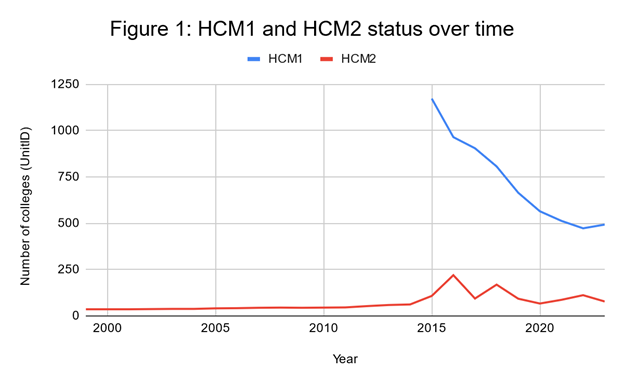
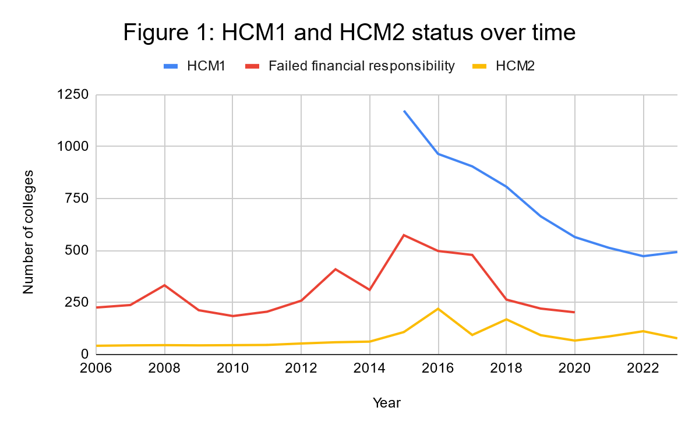
The first paper descriptively examines trends in HCM status over time, the interaction with other federal accountability policies, and whether colleges placed on HCM tend to close. There are two levels of HCM: HCM1 requires additional oversight, while the more severe HCM2 requires colleges to pay out money to students before being reimbursed by Federal Student Aid. As shown below, there was a spike in usage of HCM2 status around 2015, which was also the first year that HCM1 data were made publicly available by the Department of Education.

Colleges end up on HCM1 and HCM2 for much different reasons. The less severe HCM1 is dominated by colleges with low financial responsibility scores, while more serious accreditation and administrative capacity concerns are key reasons for HCM2 placement. Additionally, colleges on HCM2 tend to close at higher rates than colleges on HCM1.

The second paper builds on the other research from this project to examine whether student enrollment patterns are affected by signals of institutional distress. The motivation for this work is that in an era of heightened concerns about the stability of colleges, students may seek to enroll elsewhere if a college they are attending (or considering attending) displays warning signs. On the other hand, colleges may redouble their recruitment efforts to try to dig themselves out of the financial hole.

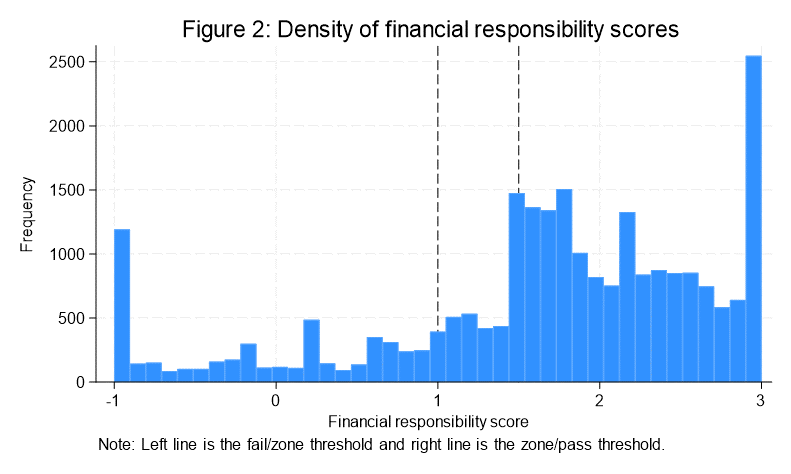
We examined these questions using two different accountability thresholds. The first was to compare colleges on HCM2 to colleges with a failing financial responsibility score, as HCM2 is a much smaller list of colleges and comes with restrictions on institutional operations. The second was to compare colleges that just failed the financial responsibility metric to colleges that were in an oversight zone that allowed them to avoid being placed on HCM1 if they posted a letter of credit with the Department of Education. As the below figure shows, there is not a huge jump in the number of colleges that barely avoided failing (the left line)—and that allows for the use of a regression discontinuity design.

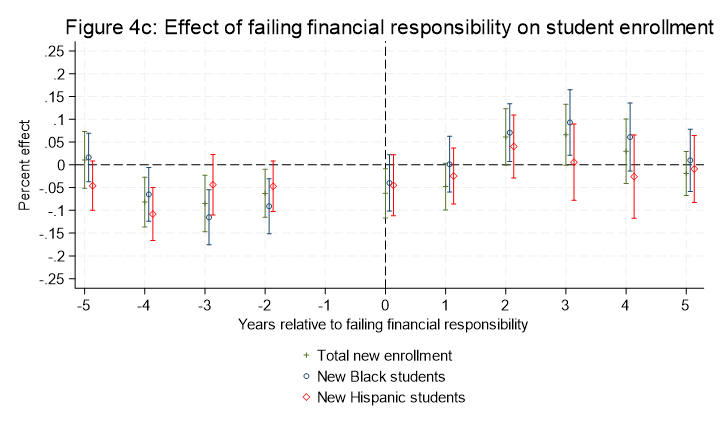
After several different analyses, the key takeaway is that students did not respond to bad news about their college’s situation by changing their enrollment patterns. If anything, enrollment may have increased slightly in some cases following placement on HCM2 or receiving a failing financial responsibility score (such as in the below figure). This finding would be consistent with students never hearing about this news or simply not having other feasible options of where to attend. I really wonder if this changes in the future as more attention is being paid to the struggles of small private colleges in particular.

I would love your feedback on these papers, as well as potential journals to explore. Thanks for reading!

Academics, Beware Fake Quotes!

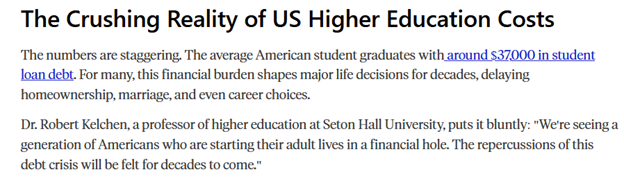
Because I do research on issues related to higher education, I talk quite a bit with reporters. It is one of my favorite things to do, as it helps connect with policymakers and the general public and also helps to sharpen my research and teaching. But because I get pulled in so many directions and it often takes weeks (if not months) for quotes to be published, I sometimes forget what I say by the time that I read the resulting publication. That’s okay—things normally turn out just fine.Today, I had a new experience. I received a Google alert for a quote that I had in a publication called “Town and Tourist” that I had never heard of. It was the following:

I am used to shady publications that directly copy articles from legitimate news sources immediately after publication (Inside Higher Ed and The New York Times seem to get this a lot), but this one stood out. The first thing that got my attention was the institutional affiliation, as I left Seton Hall for Tennessee three years ago.

The quote also didn’t quite sound like me, as I have written before about how student debt is a nuanced issue instead of being a crisis across the board. I am a blunt person, but I also choose my words carefully.

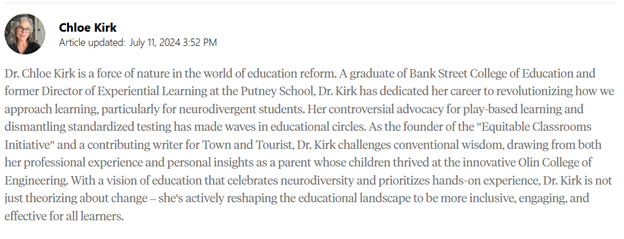
That led me to search for the quote, as ripping out of another news article would have revealed the initial source. Nothing. That led me to search for the venue and the author. A Google search did not say much about the venue, and the author did not show up at all. I then looked in the Wayback Machine at the website. As the two below screenshots show, a “College & Education” tab showed up in the last week.

Screenshots of their website last week (top) and today (bottom).

The only article in that tab has my “quote” in it. But I did not say it and the author appears to be made up. She does not show up anywhere else on the Internet and the bio implies that her doctorate is from the Bank Street College of Education—which only grants master’s degrees.

This article is likely AI-written fraud, and there is a lot of this type of garbage floating around the Internet as scammers try to optimize search engine algorithms. This also means that any academic who publishes research or talks with journalists is now at high risk of having quotes made up and attributed to them. So what can we do?

My first recommendation is to set a Google alert for yourself so you are alerted to any time your name shows up. If your name is more common, you may want to also include your organizational affiliation. My experience is that Google alerts do not catch all websites, so get in the habit of searching for your own name on a regular basis—especially if you are a higher-profile individual.

Second, depending on the severity of the issue, it may be worth consulting with your organization’s legal counsel. This obscure website is not a huge deal and they (of course) have no contact information online, but I could see other cases quickly becoming an issue.

Finally, this is likely an example of artificial intelligence making up (“hallucinating”) information. AI can have benefits, but I think that it is appropriate to view it with skepticism due to the ease of misuse.

Ten Thoughts on the Future of Higher Education Finance

Today is the first day of academic summer, which is a period of relative calm even though I am never really off as a department head. (I have a modest administrative stipend in the summer, but remain a nine-month faculty member and can devote most of my time to research.) My higher education finance class this spring was a blast, as I try to make the most of getting into the classroom on a limited basis.

On the second-to-last day of class, my students asked me to put together a lecture for the final day of class on where I see the field of higher education finance going. It was a blast to put together my version of a last lecture (don’t worry, folks…I don’t plan on going anywhere for a good while). Here are the ten thoughts that I put together on the future of higher education finance.

(1) The divide between the haves and have-nots in higher education will continue to grow. I wrote a lengthy piece for the Chronicle of Higher Education on this last summer, and the trends have not changed since then. Most flagship public universities and wealthy private colleges will do well, but everyone else will struggle.

(2) Universities will struggle to figure out how centralized budget models should be. Responsibility-centered management (RCM) budgeting, in which academic units receive revenue and pay expenses instead of running everything through central administration, have been all the rage at larger universities over the last 15 years or so. But while there is pressure to force units to be more entrepreneurial, administrators also want to keep control of institutional finances. Some universities have moved away from RCM in recent years, and I’m collecting data on that to help inform several research projects.

(3) The days of adding programs willy-nilly are over. While my notes to write this piece were sitting on my desk during finals, the Chronicle came out with a nice piece showing the growth of bachelor’s degree programs relative to total enrollment. It matches my recent work at the master’s level. But program eliminations are now a hot topic among administrators as they try to free up funds or even avoid closures. It will be much tougher to start new programs unless they require little overhead.

(4) Why would anyone want to be a college president? I say that a lot, and that was before this spring’s campus protests. At the vast majority of institutions, the financial pressures require leaders to make tough decisions. The name of the game is financial flexibility, doing things like cutting programs, limiting tenure-track faculty lines, and avoiding new facilities if at all possible. Holding the line of finances may get support from the board, but it will likely infuriate other stakeholders and potentially alienate some students.

(5) Increases in tuition revenue will be hard to come by. Outside of roughly 200 universities, higher education does not have much market power to increase tuition revenue. Sure, sticker prices may increase at some private colleges, but the tuition discount rate also keeps climbing—erasing gains in revenue. And public colleges frequently have tuition increases limited or banned by state higher education agencies or legislators. That is a tough picture for higher education as operating costs rise.

(6) How long can state funding withstand growing skepticism of higher education? Across the country, state funding for public higher education has been stronger than nearly anyone expected coming out of the pandemic. But as skepticism of higher education continues, I’m not sure how long that will continue. It is possible that states continue to support community and technical colleges or even regional public universities while being less supportive of flagship universities that are viewed as being more liberal. But if overall enrollment stays flat, it’s harder and harder to envision funding increases.

(7) What happens during the next recession? Typically, enrollment increases and state funding drops during recessions. But with public support for higher education becoming shakier, it is not clear if enrollment will increase in a meaningful way whenever the next recession hits. Enrollment has helped to stabilize institutional budgets during recessions when state funding craters, but that backstop may not be there for all institutions. Colleges that serve more adult learners may do better in this regard, but not as well as during the Great Recession.

(8) College closure rates will keep ticking up, but I still don’t expect a landslide. My go-to line on closures is that colleges are stubborn or resilient, depending on who you are talking with. But there are plenty of financial headwinds that will continue to pressure colleges. I’m quite concerned about this year’s FAFSA fiasco resulting in a number of closures this summer, but most of those colleges probably would have closed this spring under a normal FAFSA cycle. Expect closures to keep coming, but most colleges will find a way to continue on.

(9) Federal policy will be a seesaw of executive actions. The only way that Congress will be able to do anything is by squeezing legislation into a must-pass budget bill, which is how FAFSA reforms happened back in 2020. Depending on the outcome of November’s election, a lengthy government shutdown may even be in the works in the near future. So expect waves of executive action and negotiated rulemaking to continue regardless of who is in charge.

(10) College is still worth it for most students—as long as they graduate. I’m excited to teach this new article by Liang Zhang and colleagues the next time I teach the class. It shows that returns generally remain strong, but they vary by field of study (hi, gainful employment!) and softened a bit following the Great Recession. Part of the benefits of college are based on the comparison with high school graduates—a group that has done fairly well in recent years. Will that trend survive the next recession? History suggests no.

I’m excited to spend a bunch of time this summer working on several research projects. Stay tuned for some research updates and data dives throughout the summer!

New Research on Heightened Cash Monitoring

I have spent most of the last year digging into the topic of heightened cash monitoring (HCM), perhaps the federal government’s most important tool in its higher education accountability toolbox at this time. HCM places colleges’ federal financial aid disbursements under additional scrutiny in order to protect taxpayer dollars. There are two levels of scrutiny: HCM1 requires additional oversight, while the more severe HCM2 requires colleges to pay out money to students before being reimbursed by Federal Student Aid.

This seems like an obscure topic, but it affects a substantial portion of American higher education. In 2023, 493 colleges were on HCM1 and 78 colleges were on HCM2—together representing about 10% of all colleges receiving federal financial aid. And in the mid-2010s, more than 1,000 colleges were on HCM1 or HCM2 at one time.[1]

Thanks to the generous support of Arnold Ventures, my graduate research assistant Holly Evans and I dove into whether colleges responded to being placed on the more severe HCM2 status by changing their financial priorities, closing, or influencing student debt and graduation outcomes. We compared colleges placed on HCM2 to colleges that were not on HCM2, but had failed the federal financial responsibility metric (and thus also had issues identified by the federal government). Using three analytic approaches, we generally found no relationships between HCM2 status and these outcomes. It was a lot of work for no clear findings, but that is pretty typical when studying institutional responses to government policies.

Here is a copy of our working paper, which I am posting here in the hope of receiving feedback. I am particularly interested in thoughts about the analytic strategy, interpreting results, and potential journals to send this paper to. Stay tuned for more work from this project!


[1] HCM1 data were first made public in 2015 following news coverage from Inside Higher Ed, while retroactive HCM2 data were also released in 2015 with the unveiling of the modern College Scorecard.

Which Private Colleges Always Lose Money?

I write this piece with the sounds of excavators and dump trucks in the background, as we are getting the 30-year-old pool at our house replaced this month. Pools should last a lot longer than that, but the original owner of the house decided to save money by installing the pool on top of a pile of logs and stumps left over from clearing the land. As those logs settled and decayed, the pool began to leak and we are left with a sizable bill to dig everything out and do things right. Even though we budgeted for this, it is still painful to see every load of junk exit and every load of gravel enter what I am calling the money pit.

On the higher education front, it has been a week with several announced or threatened closures. On Monday, the University of Wisconsin-Milwaukee announced that it would close its Waukesha branch campus, marking at least the fourth of the 13 former University of Wisconsin Colleges to close in the last several years. Fontbonne University in St. Louis also announced its closure on Monday, although they get a lot of credit from me for giving students and at least some employees more than a year to adjust. Today, Northland College in Wisconsin announced that it will close at the end of this academic year unless they can raise $12 million—one-third of their annual budget—in the next three weeks. Closures just keep dripping out, and I am really concerned about a late wave of closures this spring once colleges finally get FAFSA information from the U.S. Department of Education.

The two topics blended together for me (along with my students’ budget analyses being due on Friday) on my run this morning, and I quickly jotted down the gist of this post. The coverage of both Fontbonne and Northland focused on the number of years that they had lost money, so I used IPEDS data to take a look at the operating margins (revenues minus expenses) private nonprofit colleges for the past ten years (2012-13 to 2021-22). This analysis included 924 institutions in the 50 states and Washington, DC and excluded colleges with any missing data or special-focus institutions based on the most recent Carnegie classifications.

You can download the dataset here, with highlighted colleges having closed since IPEDS data were collected.

The first thing is that the share of colleges with losses varied considerably across years, and a high share of losses is driven by investment losses. But with the exception of the pandemic-aided 2020-21 year, the next lowest year of operating losses was 2013-14 (9%). 2021-22 saw two-thirds of colleges post an operating loss as pandemic aid began to fade and investments had a rough year.

YearOperating loss (pct)
2012-1311.8
2013-149.1
2014-1531.6
2015-1656.2
2016-1712.8
2017-1820.4
2018-1937.2
2019-2043.8
2020-213.5
2021-2267.2

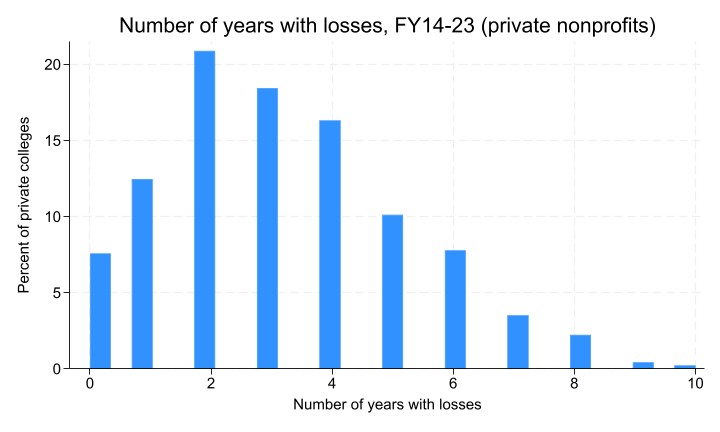
Below is the distribution of the number of years that each college posted an operating loss. Seventy-nine colleges never lost money, and most of these institutions have small endowments but growing enrollment. The modal college had an operating loss in three years, and 90% of colleges at least broke even in five years out of the last decade.

On the other hand, 19 colleges posted losses in eight or more years. Notably, nine of these colleges have closed in the last year or so, compared to nine of the other 905 colleges. (Let me know if I’m missing any obvious closures!) The list of colleges with eight or more closures is below, and closed/closing colleges are bolded.

NameStateLosses
Polytechnic University of Puerto Rico-OrlandoFL10
Roberts Wesleyan UniversityNY10
Trinity International University-FloridaFL9
Iowa Wesleyan UniversityIA9
Cambridge CollegeMA9
Fontbonne UniversityMO9
Medaille UniversityNY9
Bethany CollegeWV9
American Jewish UniversityCA8
Polytechnic University of Puerto Rico-MiamiFL8
Hawaii Pacific UniversityHI8
Great Lakes Christian CollegeMI8
Alliance UniversityNY8
Cazenovia CollegeNY8
Yeshiva UniversityNY8
Bacone College [not enrolling students]OK8
University of Valley ForgePA8
Cardinal Stritch UniversityWI8
Alderson Broaddus UniversityWV8

On a related note, I wrote a piece for the Chronicle of Higher Education that reviews a new book that makes the case for more colleges declaring financial exigency in order to cut academic programs. I think that it is more important than ever for faculty, staff, and students to have a sense of the financial health of their college by being equipped to read budget documents and enrollment projections. That is crucial in order for shared governance to have a chance of working in difficult situations and to help avoid money pit situations like the one in my own backyard.

My 2024 Higher Education Finance Reading List

As a department head, I typically only teach one class per year. This spring, I get to teach my PhD class in higher education finance again—the eighth time that I have taught it in my eleven-year faculty career. Each time, I have updated the readings considerably as the field is moving quickly and I figure out what works best for the students. I use articles, working papers, news coverage, and other online resources to provide a current look at the state of higher education finance.

The format that I have taught the class using has also changed frequently over time due to what works best for the program and other events of the past several years. Here are reading lists from previous years and how I have taught the class:

Summer 2023: Accelerated five-week format, mix of asynchronous and online synchronous

Spring 2022: Online synchronous, meeting one evening per week

Spring 2020: Met one Saturday per month, started out in person but moved to Zoom halfway through due to the pandemic

Fall 2017: In person, meeting one evening per week

This spring, I am back to teaching the class in person one evening per week for the first time in nearly seven years. Here is the reading list I am assigning my students for the course. I link to the final versions of the articles whenever possible, but those without access to an academic library should note that earlier versions of many of these articles are available online via a quick Google search.

The higher education finance landscape and data sources

Chetty, R., Friedman, J. N., Saez, E., Turner, N., & Yagan, D. (2017). Mobility report cards: The role of colleges in intergenerational mobility. Working paper. (link)

Schanzenbach, D. W., Bauer, L., & Breitwieser, A. (2017). Eight economic facts on higher education. The Hamilton Project. (link)

Webber, D. A. (2021). A growing divide: The promise and pitfalls of higher education for the working class. The ANNALS of the American Academy of Political and Social Science, 695, 94-106. (link)

Recommended data sources:

College Scorecard: https://collegescorecard.ed.gov/ (underlying data at https://collegescorecard.ed.gov/data/)

Equality of Opportunity Project: http://www.equality-of-opportunity.org/college

IPEDS: https://nces.ed.gov/ipeds/use-the-data

NCES Data Lab: https://nces.ed.gov/datalab/index.aspx

Postsecondary Value Commission’s Equitable Value Explorer: https://www.postsecondaryvalue.org/equitable-value-explorer/

ProPublica’s Nonprofit Explorer: https://projects.propublica.org/nonprofits/

Urban Institute’s Data Explorer: https://educationdata.urban.org/data-explorer/colleges/

Institutional budgeting

Barr, M.J., & McClellan, G.S. (2010). Understanding budgets. In Budgets and financial management in higher education (pp. 55-85). Jossey-Bass. (link)

Jaquette, O., Kramer II, D. A., & Curs, B. R. (2018). Growing the pie? The effect of responsibility center management on tuition revenue. The Journal of Higher Education, 89(5), 637-676. (link)

Rutherford, A., & Rabovsky, T. (2018). Does the motivation for market-based reform matter? The case of responsibility-centered management. Public Administration Review, 78(4), 626-639. (link)

University of Tennessee System’s FY2024 budget: https://finance.tennessee.edu/budget/documents/

University of Tennessee System’s FY2022 annual financial report: https://treasurer.tennessee.edu/reports/

UTK’s Budget Allocation Model (responsibility center management) website: https://budget.utk.edu/budget-allocation-model/

Higher education expenditures

Archibald, R. B., & Feldman, D. H. (2018). Drivers of the rising price of a college education. Midwestern Higher Education Compact. (link)

Commonfund Institute (2023). 2023 higher education price index. (link)

Griffith, A. L., & Rask, K. N. (2016). The effect of institutional expenditures on employment outcomes and earnings. Economic Inquiry, 54(4), 1931-1945. (link)

Hemelt, S. W., Stange, K. M., Furquim, F., Simon, A., & Sawyer, J. E. (2021). Why is math cheaper than English? Understanding cost differences in higher education. Journal of Labor Economics, 39(2), 397-435. (link)

Korn, M., Fuller, A., & Forsyth, J. S. (2023, August 10). Colleges spend like there’s no tomorrow. ‘These places are just devouring money.’ The Wall Street Journal. (link)

The financial viability of higher education

Britton, T., Rall, R. M., & Commodore, F. (2023). The keys to endurance: An investigation of the institutional factors relating to the persistence of Historically Black Colleges and Universities. The Journal of Higher Education, 94(3), 310-332. (link)

Ducoff, N. (2019, December 9). Students pay the price if a college fails. So why are we protecting failing institutions? The Hechinger Report. (link)

Jesse, D., & Bauman, D. (2023, November 13). This small college was out of options. Will its creditors give it a break? The Chronicle of Higher Education. (link)

Massachusetts Board of Higher Education (2019). Final report & recommendations. Transitions in higher education: Safeguarding the interest of students (THESIS). (link)

Sullivan, G. W., & Stergios, J. (2019). A risky proposal for private colleges: Ten reasons why the Board of Higher Education must rethink its plan. Pioneer Institute. (link)

Tarrant, M., Bray, N., & Katsinas, S. (2018). The invisible colleges revisited: An empirical review. The Journal of Higher Education, 89(3), 341-367. (link)

State and sources of revenue

Chakrabarti, R., Gorton, N., & Lovenheim, M. F. (2020). State investment in higher education: Effects on human capital formation, student debt, and long-term financial outcomes of students. National Bureau of Economic Research Working Paper 27885. (link)

Gándara, D. (2023). “One of the weakest budget players in the state”: State funding of higher education at the onset of the COVID-19 pandemic. Educational Evaluation and Policy Analysis. (link)

Kelchen, R., Ortagus, J. C., Rosinger, K. O., Baker, D., & Lingo, M. (2023). The relationships between state higher education funding strategies and college access and success. Educational Researcher. (link)

Kunkle, K., & Laderman, S. (2023). State higher education finance: FY 2022. State Higher Education Executive Officers Association. (link)

Ortagus, J. C., Kelchen, R., Rosinger, K. O., & Voorhees, N. (2020). Performance-based funding in American higher education: A systematic synthesis of the intended and unintended consequences. Educational Evaluation and Policy Analysis, 42(4), 520-550. (link)

Tennessee’s outcomes-based funding formula: https://www.tn.gov/thec/bureaus/ppr/fiscal-policy/outcomes-based-funding-formula-resources/2020-25-obf.html

Federal sources of revenue

Bergman, P., Denning, J. T., & Manoli, D. (2019). Is information enough? The effect of information about education tax benefits on student outcomes. Journal of Policy Analysis and Management, 38(3), 706-731. (link)

Black, S. E., Turner, L. J., & Denning, J. T. (2023). PLUS or minus? The effect of graduate school loans on access, attainment, and prices. National Bureau of Economic Research Working Paper 31291. (link)

Graddy-Reed, A., Feldman, M., Bercovitz, J., & Langford, W. S. (2021). The distribution of indirect cost recovery in academic research. Science and Public Policy, 48(3), 364-386. (link)

Kelchen, R., & Liu, Z. (2022). Did gainful employment regulations result in college and program closures? Education Finance and Policy, 17(3), 454-478. (link)

Ward, J. D. (2019). Intended and unintended consequences of for-profit college regulation: Examining the 90/10 rule. Journal of Student Financial Aid, 48(3), Article 4. (link)

College pricing, tuition revenue, and endowments

Baker, D. J. (2020). “Name and shame”: An effective strategy for college tuition accountability? Educational Evaluation and Policy Analysis, 42(3), 1-24. (link)

Baum, S., & Lee, V. (2018). Understanding endowments. Urban Institute. (link)

Delaney, T., & Marcotte, D. E. (2023). The cost of public higher education and college enrollment. The Journal of Higher Education. (link)

Kelchen, R., & Pingel, S. (2023). Examining the effects of tuition controls on student enrollment. Research in Higher Education. (link)

Knox, L. (2023, December 4). Seeking an enrollment Hail Mary, small colleges look to athletics. Inside Higher Ed. (link)

Ma, J., & Pender, M. (2023). Trends in college pricing and student aid 2023. (link)

Webber, D. A. (2017). State divestment and tuition at public institutions. Economics of Education Review, 60, 1-4. (link)

Financial aid policies, practices, and impacts

Anderson, D. M., Broton, K. M., Goldrick-Rab, S., & Kelchen, R. (2020). Experimental evidence on the impacts of need-based financial aid: Longitudinal assessment of the Wisconsin Scholars Grant. Journal of Policy Analysis and Management, 39(3), 720-739. (link)

Billings, M. S., Clayton, A. B., & Worsham, R. (2022). FAFSA and beyond: How advisers manage their administrative burden in the financial aid process. Journal of Student Financial Aid, 51(2), Article 2. (link)

Dynarski, S., Page, L. C., & Scott-Clayton, J. (2022). College costs, financial aid, and student decisions. National Bureau of Economic Research Working Paper 30275. (link)

LaSota, R. R., Polanin, J. R., Perna, L. W., Austin, M. J., Steingut, R. R., & Rodgers, M. A. (2022). The effects of losing postsecondary student grant aid: Results from a systematic review. Educational Researcher, 51(2), 160-168. (link)

Page, L. C., Sacerdote, B. I, Goldrick-Rab, S., & Castleman, B. L. (2023). Financial aid nudges: A national experiment with informational interventions. Educational Evaluation and Policy Analysis, 45(2), 195-219. (link)

Student debt and financing college

Baker, D. J. (2019). When average is not enough: A case study examining the variation in the influences on undergraduate debt burden. AERA Open, 5(2), 1-26. (link)

Black, S. E., Denning, J. T., Dettling, L. J., Goodman, S., & Turner, L. (2020). Taking it to the limit: Effects of increased student loan availability on attainment, earnings, and financial well-being. American Economic Review, 113(12), 3357-3400. (link)

Boatman, A., Evans, B. J., & Soliz, A. (2017). Understanding loan aversion in education: Evidence from high school seniors, community college students, and adults. AERA Open, 3(1), 1-16. (link)

Dinerstein, M., Yannelis, C., & Chen, C. (2023). Debt moratoria: Evidence from student loan forbearance. National Bureau of Economic Research Working Paper 31247. (link)

Levine, P. B., & Ritter, D. (2023). The racial wealth gap, financial aid, and college access. Journal of Policy Analysis and Management. (link)

Free college/college promise programs

Carruthers, C. K., Fox, W. F., & Jepsen, C. (2023). What Knox achieved: Estimated effects of tuition-free community college on attainment and earnings. The Journal of Human Resources. (link)

Gándara, D., & Li, A. Y. (2020). Promise for whom? “Free-college” programs and enrollments by race and gender classifications at public, 2-year colleges. Educational Evaluation and Policy Analysis, 42(4), 603-627. (link)

Monaghan, D. B. (2023). How well do students understand “free community college”? Promise programs as informational interventions. AERA Open, 9(1), 1-13. (link)

Murphy, R., Scott-Clayton, J., & Wyness, G. (2017). Lessons from the end of free college in England. Washington, DC: The Brookings Institution. (link)

Perna, L. W., Leigh, E. W., & Carroll, S. (2018). “Free college:” A new and improved state approach to increasing educational attainment? American Behavioral Scientist, 61(14), 1740-1756. (link)

Map of college promise/free college programs (Penn AHEAD) (link)

Returns to education

Conzelmann, J. G., Hemelt, S. W., Hershbein, B. J., Martin, S., Simon, A., & Stange, K. M. (2023). Grads on the go: Measuring college-specific labor markets for graduates. Journal of Policy Analysis and Management. (link)

Darity, Jr., W. A., & Underwood, M. (2021). Reconsidering the relationship between higher education, earnings, and productivity. Postsecondary Value Commission. (link)

Deterding, N. M., & Pedulla, D. S. (2016). Educational authority in the “open door” marketplace: Labor market consequences of for-profit, nonprofit, and fictional educational credentials. Sociology of Education, 89(3), 155-170. (link)

Ma, J., & Pender, M. (2023). Education pays 2023: The benefits of higher education for individuals and society. The College Board. (link)

Webber, D. A. (2016). Are college costs worth it? How ability, major, and debt affect the returns to schooling. Economics of Education Review, 53, 296-310. (link)

Discovering Issues with IPEDS Completions Data

The U.S. Department of Education’s Integrated Postsecondary Education Data System (IPEDS) is a great resource in the field of higher education. While it is the foundation of much of my research, the data are self-reported by colleges and occasionally include errors or implausible values. A great example of some of the issues with IPEDS data is this recent Wall Street Journal analysis of the finances of flagship public universities. When their great reporting team started asking questions, colleges often said that their IPEDS submission was incorrect. That’s not good.

I received grants from Arnold Ventures over the summer to fund two new projects. One of them is examining the growth in master’s degree programs over time and the implications for students and taxpayers. (More on the other project sometime soon.) This led me to work with my sharp graduate research assistant Faith Barrett to dive into IPEDS program completions data.

As we worked to get the data ready for analysis, we noticed a surprisingly large number of master’s programs apparently being discontinued. Colleges can report zero graduates in a given year if the program still exists, so we assumed that programs with no data (instead of a reported zero) were discontinued. But we then looked at years immediately following the apparent discontinuation and there were again graduates. This suggests that programs with missing data periods between when graduates were reported are likely either a data entry error (failing to enter a positive number of graduates) or not reporting zero graduates in an active program instead of truly missing (a program discontinuation). This is not great news for IPEDS data quality.

We then took this a step further by attempting to find evidence that programs that seem to disappear and reappear actually still exist. We used the Wayback Machine (https://archive.org/web/) to look at institutional websites by year to see whether the apparently discontinued program appeared to be active in years without graduates. We found consistent evidence from websites that programs continued to exist during their hiatus in IPEDS data. To provide an example, the Mental and Social Health Services and Allied Professions master’s program at Rollins College did not report data for 2015 after reporting 25 graduates in 2013 and 24 graduates in 2014. They then reported 30 graduates in 2016, 26 graduates in 2017, 27 graduates in 2018, 26 graduates in 2019, and 22 graduates in 2020. Additionally, they had active program websites throughout the period, providing more evidence of a data error.

The table below shows the number of master’s programs (defined at the 4-digit Classification of Instructional Programs level) for each year between 2005 and 2020 after we dropped all programs that never reported any graduates during this period. The “likely true discontinuations” column consists of programs that never reported any graduates to IPEDS following a year of missing data. The “likely false discontinuations” column consists of programs that reported graduates to IPEDS in subsequent years, meaning that most of these are likely institutional reporting errors. These likely false discontinuations made up 31% of all discontinuations during the period, suggesting that data quality is not a trivial issue.

Number of active programs and discontinuations by year, 2005-2020.

YearNumber of programsLikely true discontinuationsLikely false discontinuations
200520,679195347
200621,167213568
200721,326567445
200821,852436257
200922,214861352
201022,449716357
201122,816634288
201223,640302121
201324,148368102
201424,76631189
201525,17041097
201625,80836166
201726,33534435
201826,80438441
201927,572581213
202027,88374223

For the purposes of our analyses, we will recode years of missing data for these likely false discontinuations to have zero graduates. This likely understates the number of graduates for some of these programs, but this conservative approach at least fixes issues with programs disappearing and reappearing when they should not be. Stay tuned for more fun findings from this project!

There are two broader takeaways from this post. First, researchers relying on program-level completions data should carefully check for likely data errors such as the ones that we found and figure out how to best address them in their own analyses. Second, this is yet another reminder that IPEDS data are not audited for quality and quite a few errors are in the data. As IPEDS data continue to be used to make decisions for practice and policy, it is essential to improve the quality of the data.