Clinton’s New College Compact Plan Explained

This article was originally published on The Conversation.

Ahead of the Democratic National Convention – on July 5 – Hillary Clinton announced a set of new proposals on higher education. Key measures included eliminating college tuition for families with annual incomes under US$125,000 and a three-month moratorium on federal student loan payments.

Clinton’s original plan had called for the federal government and states to fund public colleges so students wouldn’t have to borrow to cover tuition if they worked at least 10 hours per week.

The revised higher education plan represents a clear leftward shift and is likely an effort to solidify her support among still-skeptical young supporters of Bernie Sanders.

As a researcher of higher education finance, my question is whether these proposals, estimated to cost $450 billion over the next 10 years, will benefit enough of the over 10 million college-going voters struggling to repay loans.

How student loan interest rates work

Typically, students pay interest rates set by Congress and the president on their federal student loans.

Over the last decade, interest rates for undergraduate students have fluctuated between 3.4 percent and 6.8 percent. Rates for federal PLUS loans have ranged from 6.3 percent to 8.5 percent. Federal PLUS loans require a credit check and are often cosigned by a parent or spouse. Federal student loans do not have those requirements.

While students pay this high a rate of interest, rates on 15-year mortgages are currently below three percent.

Several private companies have entered the student loan market.
Application form image via www.shutterstock.com

It is also important to note the role of private loan companies that have recently entered this market. In the last several years, private companies such as CommonBond, Earnest and SoFi as well as traditional banks have offered to refinance select students’ loans at interest rates that range from two percent to eight percent based on a student’s earnings and their credit history.

However, unlike federal loans (which are available to nearly everyone attending colleges participating in the federal financial aid programs), private companies limit refinancing to students who have already graduated from college, have a job and earn a high income relative to the monthly loan payments.

Analysts have estimated that $150 billion of the federal government’s $1.25 trillion student loan portfolio – or more than 10 percent of all loan dollars – is likely eligible for refinancing through the private market – much of it likely for graduate school.

Many Democrats, such as Senator Elizabeth Warren of Massachusetts, have pushed for all students to receive lower interest rates on their federal loans for years. Republican nominee Donald Trump too has questioned why the federal government profits on student loans – although whether the government actually profits is less clear.

Issues with refinancing of loans

Interest rates on student loans were far higher five to 10 years ago (ranging from 6.8 percent to 8.5 percent based on the type of loan). Allowing students to refinance at current rates ranging from 3.76 percent to 6.31 percent would mean that some students could possibly lower their monthly payments.

But the question is, how many students will benefit from the refinance?

Struggling borrowers are likely the ones with least debt.
Robert Galbraith/Reuters

Students with the most debt are typically college graduates and are the least likely to struggle to repay their loans. In addition, they can often refinance through the private market at rates comparable to what the federal government would offer.

Struggling borrowers, on the other hand, already have a range of income-driven repayment options through the federal government that can help them manage their loans. Some of their loans could also be forgiven after 10 to 25 years of payments.

Furthermore, the majority of the growth in federal student loans is now in income-driven plans, making refinancing far less beneficial than it would have been 10 years ago. Under income-driven plans, monthly payments are not tied to interest rates.

So, on the face of it, allowing students to refinance federal loans would appear to be beneficial. But, in reality, because of the growth of private refinancing for higher-income students and the availability of income-driven plans for lower-income students, relatively few students would likely benefit.

Why implementing a moratorium will be hard

On the proposed three-month moratorium, Clinton has said she could proceed on it via executive action as soon as she takes office – potentially making it the most important part of her plan.

During these three months, the Department of Education and companies servicing student loans would reach out to borrowers to help them enroll in income-driven plans that would reduce monthly payments.

So, would a moratorium on student loan payments help struggling borrowers?

The challenge is that reaching out to each and every one of the estimated 41.7 million students with federal student loans in a three-month period would be a Herculean task given the Department of Education’s available resources.

Currently, about one-fifth of the federal government’s student loan portfolio, or $260 billion is in deferment or forbearance, meaning that students are deferring payments until later.

To put this another way, about 3.5 million loans are at least 30 days behind on payments, and eight million loans are in default. This could mean that those students haven’t made a payment in at least a year.

Just trying to contact 3.5 million students in a three-month window would be a difficult proposition, let alone contacting the millions of additional students who are putting off payments until later.

Currently eight million loans are in default.
Andrew Burton/Reuters

There are also other issues that Department of Education staffers and loan servicers must deal with that may be more important than an overall repayment moratorium.

Nearly 60 percent of students who were enrolled in income-driven repayment plans fail to file the annual paperwork. That paperwork is necessary if students are to stay in those programs. And failure to do so results in many students facing higher monthly payments.

Focus needed on most in need students

In my view, Clinton’s proposals of allowing students to refinance their loans at lower rates through the federal government and a three-month moratorium on payments are unlikely to benefit that many students.

Hopefully, the Clinton campaign will focus later versions of the proposal on borrowers most in need of assistance. If not, this could present an opportunity for the Trump campaign to release a coherent higher education agenda.

The Conversation

The Tradeoffs of Making Private Student Loan Debt Dischargeable in Bankruptcy

There is an old adage dating back to the 1700s that the two most certain things in life are death and taxes. But for families with certain types of student loans, having to make payments on their loans is another certainty. Students used to be able to discharge educational loans in bankruptcy, but that ability was first restricted in 1976 before being fully eliminated for federal loans by 1998 and private student loans in 2005. The growth of income-driven repayment programs for federal loans reduces the need to discharge these loans in bankruptcy, as payments would instead be zero if a student signs up for this plan and earns below the poverty line.1 But private loans, which are about $10 billion per year, generally do not offer income-based repayment options.

Neal Hutchens of the University of Mississippi and Richard Fossey of the University of Louisiana have an interesting new piece up at The Conversation that argues that private student loan debt should once again be dischargeable in bankruptcy. They contend that more students should be able to meet the “undue hardship” test for paying off private loans, which includes both having low income and making a good-faith effort to repay loans. Senate Democrats, such as Elizabeth Warren of Massachusetts, have pushed for making private loans dischargeable in bankruptcy, and the Obama Administration has expressed interest in the idea.

But making private student loans dischargeable in bankruptcy would likely come with two main drawbacks for borrowers. The first one is that private lenders would significantly increase their standard for creditworthiness, thus rejecting students who need money for college but do not (and their co-signer does not) have outstanding credit. The second one is that interest rates would rise to take into account the increased risk that borrowers do not repay their loans. Currently, the terms on private loans are generally comparable to PLUS loans. If a student gets denied a PLUS loan (or a college doesn’t package a PLUS loan into a student’s financial aid package), the terms on private loans may become so bad that students and parents don’t wish to consider this option—even with the protection that discharging a loan in bankruptcy would offer.

The traditional market for private student loans is at a crossroads right now, with the terms on many types of federal student loans getting much better in recent years while the growing student loan refinancing market and the potential for income share agreements have the potential to threaten traditional lenders’ business models. But in the meantime, advocates for allowing students to discharge private loans in bankruptcy need to carefully consider the tradeoff between protecting some of the most vulnerable students who fall upon hard times and potentially restricting access to needed credit for other students to attend college. Which of these two factors is more important? It’s hard to tell at this time, but both need to be carefully considered by policymakers.

———————————————————————————————————-

1 Parent PLUS loans qualify for a far less generous income-driven repayment plan than all other federal loans, but payments would still be zero if the parent earned below the federal poverty line

Are Income Share Agreements a Good Way to Pay for College?

This article was originally published on The Conversation. Read the original article.

Millions of Americans are struggling to pay for college. Nearly 10 million students and their families took out almost $100 billion in student loans from the federal government in the 2014-15 academic year, pushing outstanding student loan debt to more than $1.2 trillion by the end of 2015.

The traditional way to repay student loans is to make the same monthly payment each month for 10-20 years, similar to how mortgages work. But this isn’t always the best setup for students, particularly as college doesn’t always pay off immediately in terms of increased earnings.

Newly released government data show that many students are having difficulty repaying their loans after leaving college. About 40 percent of students had not been able to pay any part of the principal within three years of entering repayment.

A new idea in paying for college in the United States is Income Share Agreements (ISAs), in which students agree to pay a percentage of their future income to a private company or lender in exchange for additional money to cover college expenses.

What is an income share agreement and is it a viable option for students?

ISA and past efforts

ISAs function similarly to certain types of federal loans, which allow students to tie their student loan payments to their income.

However, the amount that undergraduates can borrow under income-based repayment plans isn’t always enough to pay for college. The typical college student straight out of high school can borrow only $31,000 from the federal government for college with a current interest rate of 4.29 percent. This means many students may need to turn to expensive private loans as an alternative.

And here is where an ISA can help. Technically, ISAs are not loans since students don’t have to pay any money back if their earnings are not adequate. This means that if students don’t make money, they could pay back less than what they took out in loans. Instead of interest rates, lenders offer students contracts with the percentage of future earnings paid to the ISA provider and the time period based on a student’s major, year in school and amount borrowed.

ISAs have been in use in Latin America for more than a decade with providers such as Lumni financing the college educations of thousands of students. In the United States, there have been a few small efforts to introduce ISAs, but they have largely been unsuccessful.

In 2014, Senator Marco Rubio (R-Florida) and Congressman Tom Petri (R-Wisconsin) introduced legislation for an income share repayment option, with a similar bill introduced in 2015 by Representatives Todd Young (R-Indiana) and Jared Polis (D-Colorado). Lawmakers in Oregon too have been pushing a similar program called Pay it Forward. However, none of these attempts worked.

Purdue plan

More recently, in a first-of-its-kind development, Purdue University launched an Income Share Agreement plan “Back a Boiler” (originally “Bet on a Boiler”) program to help juniors and seniors pay for college. This name plays on Purdue’s mascot of the Boilermaker, a vehicle outfitted to look like the 19th-century steam engines that boilermakers built throughout the country, which fits the STEM-heavy university well.

Under the Purdue plan, students would be offered a contract that would specify, based on their major, what percentage of their earnings would be paid and for how many years. Students can receive money to cover any remaining financial need after grants and scholarships, with payment terms based on the total amount of money needed.

For example, a student majoring in biological engineering and expecting to graduate in 2018 would pay 3.32 percent of her income to Purdue for 96 months after graduation in exchange for $10,000 today, while an elementary education major would pay 4.97 percent of his income back for 116 months after graduation.

Students who make less than $20,000 per year will not need to pay anything back. Their maximum lifetime payment is capped at 2.5 times the initial amount of money provided.

One size does not fit all

Although some students could benefit from ISAs, they certainly aren’t for everyone.
So, who should consider income share agreements?

In my view, income share agreements make the most sense for three groups of students.

First, students in need of additional funds beyond federal loans should consider ISAs as a potential option. Second, since ISAs are technically not loans, they may appeal to students who are particularly averse to taking on debt to pay for college. Loan aversion is particularly common among minority and first-generation students. So a product that doesn’t come with fixed payments might benefit these students.

Finally, not all students can access federal loans. About one million students attend community colleges that do not participate in the federal student loan program. Federal loans also aren’t available for educational opportunities such as bar exam prep for law students or “boot camp” courses designed to teach students particular skills outside the traditional college setting.

ISAs might be particularly well-suited to these types of programs that are closely tied to employment.

Not for high-income earners

Who might not be the right fit?

Students who don’t need to borrow beyond the $31,000 in federal loans for a bachelor’s degree are better off with federal loans.

This is particularly true for students who plan to work in public service fields and could benefit from the federal government’s Public Service Loan Forgiveness program, that can forgive debt not repaid after 10 years. The terms for ISAs likely aren’t as favorable, as private lenders may offer students contracts of longer than 10 years in order to at least break even. The 40 percent of students unable to pay down the principal on their loans are unlikely to get terms as good as with federal loans.

Students who think they’ll make a lot of money after college may not want to consider the ISAs either. ISAs require students to pay a fixed percentage of their income. So, they can be an expensive proposition for students who do really well even if the terms are better than for other majors.

These students would be better off taking on federal and private loans and then consider joining the growing number of students who are getting their loans refinanced by a new generation of private lenders, who are willing to give borrowers with successful careers loans on lower interest.

In theory, ISAs have a market, but whether students take up this new product will determine its success.

The Conversation

Which Colleges’ Students Use Income-Driven Repayment Plans? We Don’t Know

The Obama Administration has made expanding access to income-driven repayment (IDR) plans for federal student loans a key part of its higher education policy agenda. The U.S. Department of Education now offers four different IDR plans, all of which allow former students to tie their payments to their income instead of the traditional system of fixed monthly payments. The newest plan, Revised Pay as You Earn (REPAYE), allows millions of students with federal loans to pay 10% of their income above 150% of the federal poverty line—which can represent a significant decline in monthly payments for students with modest incomes relative to their debt burdens.

As IDR plans have become more generous, more students have signed up for these plans. In the third quarter of Fiscal Year 2013, only $72.3 billion in Direct Loans was tied to income-based plans while $247.3 billion was tied to a traditional payment plan. By the first quarter of Fiscal Year 2016, the amount of loans in IDR tripled to $232.5 billion, while the amount in traditional payment plans increased to $353.3 billion—meaning that a majority of additional Direct Loan debt was being repaid via income-driven plans. Data released by the White House show that about one-fifth of students are enrolled in IDR as of early 2016, double the rate of just two years ago.

Income-driven repayment plans likely benefit two different types of students. The first group of students includes those for whom college simply didn’t work out in terms of increasing their earnings potential. IDR is an important safety net for these students, as it helps to insure against the risk of high student loan payments relative to one’s income. Given that students with less than $5,000 in debt are nearly twice as likely to default on their loans than those with more than $100,000 in debt, the availability of IDR should help these students the most.

But a second group of students appears to be the more common users of income-driven plans—graduate students in relatively low-wage fields, particularly those who qualify for the Public Service Loan Forgiveness (PSLF) program that limits payments to a 10-year period instead of 20-25 years for those working for a qualifying nonprofit or public-sector organization. Jason Delisle of New America (who is moving to the American Enterprise Institute soon) has repeatedly raised concerns about the fiscal impacts of IDR for graduate students, noting that the typical borrower in PSLF has between $60,000 and $70,000 in debt and graduate programs have incentives to further raise tuition as the typical student won’t pay back the additional dollars borrowed. Georgetown Law School actually did this by creating a Loan Repayment Assistance Program that covered the loan payments of students who worked in public service and made less than $75,000 per year.

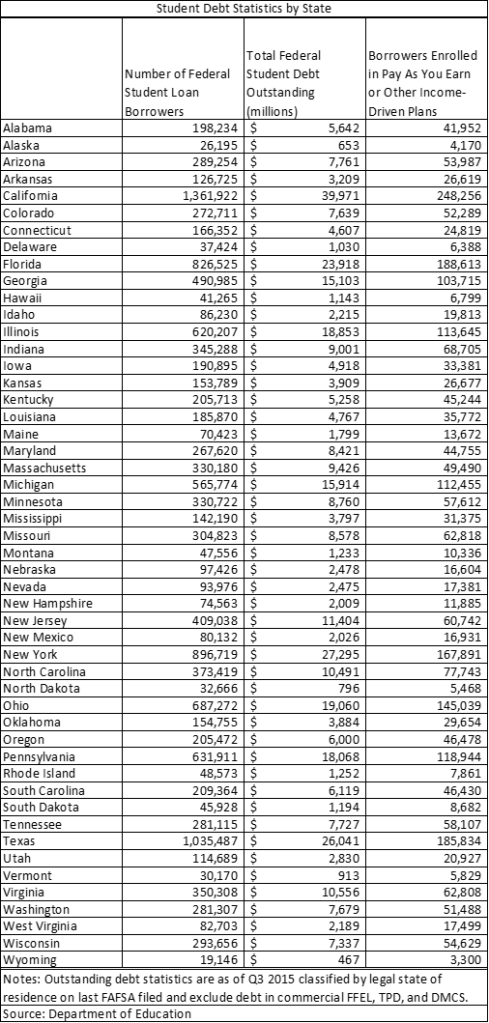
Given the rising cost of IDR programs, it would be useful to know which colleges encourage their students to enroll in income-driven plans or provide assistance to help navigate an often-complex process to annually certify their income. And it would be even more helpful to get this information broken down for undergraduate and graduate students, as the types of students enrolled in IDR likely differ across these two groups. Yet, as with many other important issues (such as graduation rates for Pell Grant recipients or the default rates on PLUS loans), this information is not yet available to the taxpaying public. The White House did release the following chart last week of the number of borrowers in IDR by state, but this chart (released as a picture instead of a spreadsheet!) doesn’t get at the behaviors of individual colleges while also excluding Washington, DC:

state_idr

The Department of Education’s Office of Federal Student Aid has the ability to release data on which colleges’ students use income-based repayment plans and whether those students are undergraduates with low earnings who are hard on their luck or grad students with lots of debt but incomes at or above the national average. Releasing these data would help inform conversations about the value of IDR plans and what colleges and loan servicers can do to help enroll the neediest students in these programs.

Comments on New America’s Financial Aid Reform Plan

In the last few years, there have been a dizzying number of proposals put forth to reform the complex and confusing system of student financial aid in the United States. From a series of 16 proposals released in the 2012-13 academic year through the Gates Foundation’s Reimagining Aid Design and Delivery project to Sara Goldrick-Rab and Nancy Kendall’s proposal for a free two-year public college option to a host of financial aid reforms proposed by the 2016 presidential candidates, there is no shortage of ideas to reform financial aid. (And I’ve got plenty of ideas of my own.)

The newest thoughtful proposal to add to the mix comes from New America’s education team, many of whom have significant experience in state and/or federal higher education policy. In this proposal, “Starting from Scratch: A New Federal and State Partnership in Higher Education,” the New America team proposes completely throwing out the current federal financial aid system and replacing it with a federal/state partnership with maintenance of effort requirements for states and accountability requirements for colleges while requiring colleges and states to cover students’ unmet financial need. Below, I summarize some of the key pieces of the proposal that I like, some that I dislike, and some that require a lot of additional thought.

Things I like

(1) Unlike some of the other financial aid proposals out there, the New America proposal has provisions to go beyond public colleges and universities to cover at least a segment of private nonprofit and for-profit colleges. This is an important recognition, as all colleges that currently receive federal financial aid are public in one sense of the word. A financial aid system that only supports students attending public colleges could result in a stampede to public institutions, which could be a problem in states with historically small public sectors (such as in the Northeast).

(2) Plowing funds currently spent on tax credits and deductions into student financial aid isn’t a new idea (and New America raised it in 2013), but it makes perfect sense. Research has shown that tax credits and deductions have no effect on college enrollment or completion, likely because the money gets to students well after enrollment (assuming they remember to claim the funds on their tax return).

(3) I’m glad to see the New America team questioning the current definitions of both the cost of attendance (COA) and the expected family contribution (EFC). As I’ve shown in research with Sara Goldrick-Rab and Braden Hosch, the non-tuition portions of the COA are determined by colleges and vary drastically within the same geographic area. The EFC has been criticized as being an outdated formula that doesn’t adequately reflect a family’s ability to pay. I’d like to see New America dig in deeper on both of these areas.

Things I don’t like

(1) I’m generally uncomfortable with the idea of ‘maintenance of effort’ proposals that require states to keep a certain level of funding per full-time equivalent (FTE), as the New America plan does. As I’ve written about before, states tend to think about funding in terms of overall funding amounts (not on a per-FTE basis) because they don’t directly control enrollment levels. If this program shifts a larger percentage of enrollment to public colleges, required state funding levels for higher education will rise at the same time states are already legally or constitutionally required to fund other priorities. I also think that maintenance of effort requirements will result in states lobbying Congress to defeat this proposal (and I also think that states would opt out despite the authors’ insistence that it wouldn’t happen).

(2) I don’t like states choosing which colleges could receive financial aid under the partnership model. I would rather see all colleges that meet quality and accountability thresholds receive funding regardless of their state affiliation or tax status. It may very well be the case that fewer for-profits or private nonprofits meet the threshold, but as long as the threshold is justified, I’m fine with that. But excluding all non-public institutions immediately (and at the whim of state policymakers) doesn’t make sense to me.

(3) I’m concerned about getting rid of federal loans to cover the EFC, while simultaneously placing additional regulations on private loans. This could result in students not being able to get access to credit at reasonable interest rates, as private lenders may choose to not offer loans when students can discharge them via bankruptcy. I would much rather see an income share agreement or income-based repayment model encouraged for private loans in this case, as this gives both students and lenders some level of protection.

Unclear

(1) The New America proposal calls for states to have a larger role in holding colleges accountable for their outcomes. This makes sense for colleges that just operate in one state, but is far trickier for colleges that operate in multiple states. If this were to happen, groups like the National Council for State Authorization Reciprocity Agreements (NC-SARA) would become even more important.

(2) I’m concerned that colleges would try to game the funding system on account of the requirement that 25% of students qualify for Pell Grants under the current EFC formula. If a college already has 30% of students receiving Pell Grants and has funding tied to meeting outcomes, it suddenly has an incentive to recruit a few more higher-income students with a higher likelihood of graduation. Research that I’ve done with my Seton Hall colleague Luke Stedrak (look for it soon in the Journal of Education Finance) shows that colleges in states subject to performance-based funding received less Pell funding that colleges not subject to performance funding after controlling for a host of other characteristics. It might be worth tweaking the system to reduce the possibility of gaming.

I’d love to hear your thoughts on New America’s discussion-worthy proposal. Drop me a note or leave a comment below!

Comments on the Bush Higher Education Proposal

The three Democratic candidates for president all released their plans for higher education fairly early in the campaign cycle, with Sen. Clinton, Gov. O’Malley, and Sen. Sanders’s plans all including some variation of tuition-free or debt-free public college. These plans are all likely dead on arrival in Congress due to their price tags ($350 billion for the Clinton plan) and the high probability that Republicans hold the House of Representatives through 2020, but the candidates deserve credit for making higher education a key part of their domestic policy platforms.

On the Republican side, higher education has been much less important during the campaign, with only Sen. Rubio having a framework (with a good number of components that may enjoy bipartisan support) in place for higher education before now. But Gov. Bush’s newly released proposal for education reform (as summarized in this piece written by Jason Delisle and Andrew Kelly, two informal advisors to the Bush campaign and people I greatly respect) reflects the most detailed proposal from any of the Republican candidates. (Gov. Bush’s summary on Medium is available here.) And like Rubio’s plan, there are components that will likely get bipartisan support in Congress—while other parts are likely to face opposition from within his own party. Below are the key planks of Bush’s higher education platform, along with my comments on whether they are likely to be effective and feasible.

Proposal 1: Replace the current financial aid system with education savings accounts and a line of credit. If one thing unites all presidential candidates, it’s that the Free Application for Federal Student Aid needs to be either incredibly simple or eliminated. The Bush proposal would replace the FAFSA for most students with an education savings account based on the tax code. All students would get a $50,000 line of credit (roughly the same as what independent students can borrow for a bachelor’s degree today), and low-income students would get an additional account with need-based aid based on their family’s income in high school. Adults would also qualify for grant aid, likely by filling out some new version of the FAFSA. Tax credits would also disappear in the Bush proposal, which will probably upset some people although they have not been proven to induce students to enroll in or graduate from college.

This proposal represents a modest—but likely helpful—improvement over the current system for undergraduate students. This would give students at least some additional flexibility in using their financial aid, with the potential for students to accelerate their progress by taking summer courses that would not be aid-eligible under current rules. Getting students information about their likely aid eligibility in eighth grade is a plus, as shown in my research. But I’d like to see students get money deposited in their account at a slightly earlier age to make the commitment seem more tangible.

It appears that the $50,000 line of credit will be the new lifetime limit for federal student loans. For undergraduate students, this makes a lot of sense. The typical student with debt has between $30,000 and $35,000 in debt for a bachelor’s degree, so $50,000 seems like a reasonable upper bound for most students. However, it doesn’t look like graduate students would qualify for additional credit—which could curtail enrollment in master’s degree programs or doctoral programs in less-lucrative fields. This could create an opportunity for the expanded use of income share agreements with the private sector.

Proposal 2: Impose “risk sharing” on federal student loan dollars by holding colleges responsible for a portion of loans that are not repaid. The general principal of risk sharing makes sense—if a college’s former students can’t pay the bills, then the college should be responsible for partially reimbursing taxpayers. And the idea has at least some bipartisan support, as evidenced by 2015 legislation introduced by Senators Hatch (R) and Shaheen (D). But putting together a risk sharing proposal that doesn’t punish colleges for serving at-risk students while protecting taxpayer funds is far more difficult than it would first appear. I’ve tangled with some of these issues in my prior work (see my proposed framework for a risk sharing system), and the Bush team will have to do the same if their candidate pulls off an improbable comeback.

Proposal 3: Allow new providers to receive federal financial aid dollars. Right now, students can take their federal financial aid dollars to any of the approximately 7,500 colleges and universities nationwide that are eligible for and participate in programs under Title IV of the Higher Education Act. Conservatives have frequently called for other non-college providers (such as boot camps, apprenticeship programs, and single-course providers) to be eligible for federal financial aid to promote competition and potentially place downward pressure on the price tag of traditional programs. However, making this sort of change would likely require a significant overhaul of the current accreditation system, which has been deemed a cartel by some Republicans.

Bush’s proposal echoes these calls, but also proposes that prior learning assessments qualify for federal financial aid. This would allow students to use Pell Grant or student loan dollars to pay for taking tests such as the College Level Examination Program (CLEP) that can result in college credit if a student can demonstrate subject mastery. It could also potentially be used to help pay for portfolio assessments of previous academic or work experience, which can cost hundreds of dollars at some colleges. Even if the entire accreditation system isn’t blown to smithereens, a relatively modest change of allowing vetted prior learning assessment providers to accept federal aid would benefit students.

Proposal 4: Get outcome data into the hands of students and families. Florida has one of the most comprehensive education data systems in the country, allowing students and their families to access detailed data on earnings by field of study. The Bush proposal calls for each state to develop a similar system in order to provide outcome data to the public. However, given the way the pendulum has swung regarding student privacy (a substantial part of both the GOP and Democratic primary bases), it will be difficult to include incentives or sanctions that would encourage states to develop these databases. But even if such a proposal were to be adopted, it’s far from clear whether 50 separate databases would make more sense from a logistical or privacy perspective than a federal College Scorecard with program-level data.

Proposal 5: Reform the student loan repayment system. Both Republicans and Democrats seem to be moving toward a consensus that income-based repayment models (where loan payments are tied to a former student’s income and debt burden) are superior to the traditional 10-year fixed payment plan. Bush’s plan would make income-based repayment the only option for new borrowers, with payments equal to 1% of income per each $10,000 borrowed for up to 25 years, with the maximum lifetime payment being $17,500 per $10,000 borrowed. His proposal would also encourage current borrowers to shift into income-based repayment, which is currently a headache for many students. Although people will likely disagree with the exact terms Bush’s proposal sets forth, the general principles match up with conservative proposals as well as President Obama’s REPAYE program.

Although Gov. Bush is badly lagging in the polls, his campaign’s higher education proposals are serious, generally well-considered (although lacking for most details), and represent an important starting point for federal higher education policy discussions. Given that large infusions of federal funds into higher education are unlikely regardless of who becomes the next President, some pieces in the Bush plan (such as increased flexibility in how students use Pell Grants) are worth considering as low-cost plans that have the potential to positively impact students. Other ideas (such as risk sharing) sound promising in principle, but have the potential to do harm if they are improperly implemented. But even if the Bush campaign doesn’t make it past the first few primary states, many of the ideas included in the plan should be strongly considered by other candidates.

Should States Offer Student Loan Refinancing Programs?

As outstanding student loan debt has roughly tripled in the past decade to reach $1.2 trillion, many people have pushed for measures that would reduce the repayment burden on former students. In the last few years, there were efforts to stop subsidized student loan interest rates from doubling (which were largely successful) and more generous income-based repayment programs on federal loans, as well as efforts for tuition-free and/or debt-free public college that have taken center stage in the Democratic presidential primary.

The latest effort to reduce debt burdens has been allowing students to refinance their student loan debt at a lower rate. Private companies such as SoFi and Earnest are expected to refinance between $10 billion and $20 billion in loans in the next few years, primarily of well-paid professionals who are extremely unlikely to default on their obligations. (By doing this, loans become private—so this isn’t a great idea for people who would qualify for Public Service Loan Forgiveness.) But for people who have lots of debt and a steady job, refinancing can save tens of thousands of dollars.

Spurred by the #InTheRed hashtag on Twitter and support from some leading Democrats, the next move is to consider allowing all students to refinance their loans through the government. Any legislation in Congress to do so is unlikely to go anywhere with Republican control and concerns about increasing the deficit. As a result, efforts have moved to the state level, with at least seven states having adopted refinancing plans for some loans and others considering plans. But is this a good policy to explore?

While states are free to do whatever they want—particularly if they issued the loans instead of the federal government—I view state refinancing efforts as an inefficient way to help struggling borrowers. Sue Dynarski at the University of Michigan sums up my concerns nicely in 140 characters:

Essentially, further subsidizing interest rates rewards borrowers with larger debt burdens (particularly those with graduate degrees who rarely default on loans) at the expense of students with debt but no degree represents a transfer of resources from lower-income to higher-income families. For a group that draws most of its support from the Left, supporting regressive taxation like this is rather surprising. Additionally, to keep the price tag down, some states are heavily restricting who can refinance and acting more like private companies. Minnesota, for example, will only allow graduates to refinance—and only in that case if they have a good credit score or a co-signer. This could potentially help keep some talented graduates in state, but the magnitude of the benefit is often outweighed by differences in income taxes, property taxes, or job offers across states.

I would encourage states to take whatever money they plan to use on refinancing loans and directing it toward grant aid for students from lower-income families who have stopped out of college and wish to return. Scarce resources should be directed toward getting students through college at a reasonable price instead of trying to make graduates’ payments slightly lower later on.

How Well Do Default Rates Reflect Student Loan Repayment?

This post initially appeared at the Brown Center Chalkboard blog.

The U.S. Department of Education released new data this week on colleges’ cohort default rates (CDR)—reflecting the percentage of a college’s former students with federal student loans who entered repayment in Fiscal Year 2012 and defaulted by the end of Fiscal Year 2014. The average CDR dropped to 11.8 percent in Fiscal Year 2012, down from 13.7 percent in FY 2011 and 14.7 percent in FY 2010. Eight colleges had a CDR over 30 percent for three consecutive years, subjecting them to the loss of all federal financial aid dollars. Over 100 additional colleges had a CDR over 30 percent in the 2012 cohort, putting them at risk of losing funds if their performance does not improve.

Yet although CDRs are important for accountability purposes, they do not necessarily reflect whether students are repaying their loans.  As of June 30, 2015, just over half of the $623 billion in Direct Loans made to students who have entered repayment are in current repayment. In addition to the $48 billion in loans in default, an additional $63 billion are more than 30 days delinquent and $180 billion are in deferment and forbearance. Deferment and forbearance are not always bad things, as students can qualify for either by being in the military or pursuing graduate studies. However, students can also request deferment and forbearance for economic hardship, while interest still accrues. The presence of income-based repayment plans, in which students making below 150 percent of the federal poverty line can make no payments while still remaining current on their loan, further complicates any analyses. All of these complications make cohort default rates a weak metric of whether students are actually paying back their loans.

Are students repaying their loans? A look using College Scorecard data

The Department of Education’s recent release of College Scorecard data provides new insights into whether students are repaying their loans, while also allowing for comparisons to be made to the current CDR metric. The Scorecard contains a new measure of the percentage of students whose student loan balance was lower than when entering repayment, which reflects the percentage of students who have been able to pay down at least some principal.

Using this new metric on declining student loan balances to compare with colleges’ CDRs, I come to three new findings.  Please note that for the purposes of this blog post, I consider the three-year cohort default rate for students who entered repayment in FY 2011 compared to the one-year and three-year repayment rates for students who entered repayment in FY 2010 and 2011. The key findings are below.

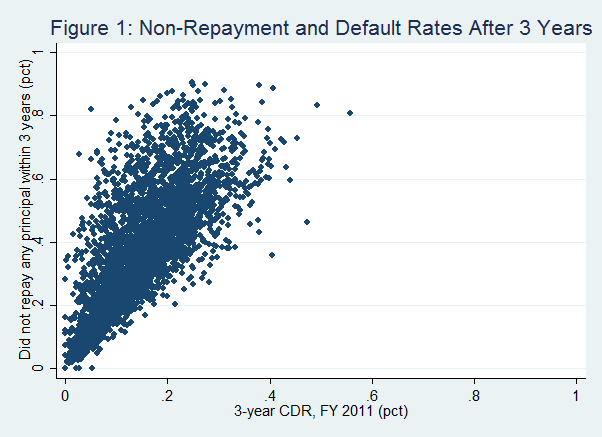
(1) Cohort default rates substantially underestimate the percent of students who have been unable to lower their loan balances. Of the nearly 5,700 colleges with data on both CDRs and repayment rates, the median college had a 14.9 percent three-year CDR while 40.8 percent of students did not repay any principal in the first three years after leaving college. This means that one in four exiting students was not in default, yet did not make a dent in their loan balance in the first three years after entering repayment. Figure 1 below shows the relationship between CDRs and repayment rates. A low CDR for a college is associated with higher rates of repayment (with a correlation coefficient of 0.76), but there are plenty of exceptions. For example, 25 percent of the colleges with default rates below 10% had more than one-fourth of all students failing to repay any principal.

brookings_fig1

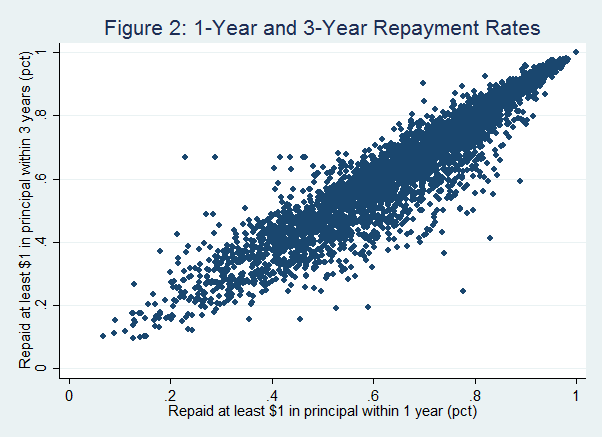
(2) The percentage of students paying down principal doesn’t change much between one year and three years since entering repayment. One year after entering repayment, 62.8 percent of students at the median college had paid down at least $1 in principal, though that percentage dipped slightly to 59.2 percent within three years (see Figure 2 for the distribution of repayment rates). This drop is likely due to some students either falling behind on their payments while enrolled in the standard repayment plan as well as payments under income-based plans being insufficient to cover accumulating interest. In either case, stagnant or falling repayment rates should raise red flags regarding students’ ability to eventually pay off the loan within 10-20 years.

brookings_fig2


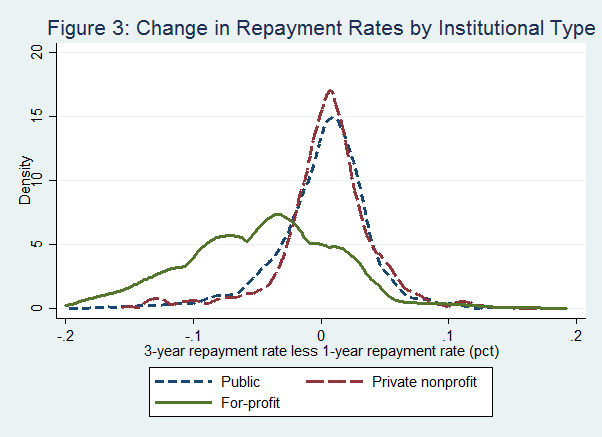
(3) As a whole, repayment outcomes make a turn for the worse at for-profit colleges compared with public or private nonprofit colleges. This can be best illustrated by showing the difference in repayment rates between one and three years of entering repayment by institutional type. As Figure 3 below shows, for-profit colleges tended to have lower repayment rates after three years than one year, a red flag that their borrowers are not doing well, while public and private nonprofit colleges saw similar repayment rates over time. Only one in four for-profit colleges had more students paying down principal three years after completion, which points to potential problems for students and taxpayers alike. Although for-profit colleges have somewhat lower CDRs than community colleges, community colleges do not see drops in the repayment rates that exist in the for-profit sector.

brookings_fig3

The new loan repayment rate data provides an additional tool   for policymakers to use when holding colleges accountable for their performance. Although this metric represents a substantial improvement over CDRs by including students who are struggling to make payments, the presence of income-based repayment plans (where students can stay current on their loans by making small payments if their income is sufficiently low) complicates any accountability efforts. Further research is needed to examine the implications of income-based repayment programs on principal repayment rates.

Comments on the New College Scorecard Data

The Obama Administration’s two-year effort to develop a federal college ratings system appeared to have hit a dead-end in June, with the announcement that no ratings would actually be released before the start of the 2015-2016 academic year. At that point in time, Department of Education officials promised to instead focus on creating a consumer-friendly website with new data elements that had never before been released to the public. I was skeptical, as there were significant political hurdles to overcome before releasing data on employment rates, the percentage of students paying down their federal loans, and graduation rates for low-income students.

But things changed this week. First, a great new paper out of the Brookings Institution by Adam Looney and Constantine Yannelis showed trends in student loan defaults over time—going well beyond the typical three-year cohort default rate measure. They also included earning data, something which was not previously available. But, although they made summary tables of results available to the public, these tables only included a small number of individual institutions. It’s great for researchers, but not so great for students choosing among colleges.

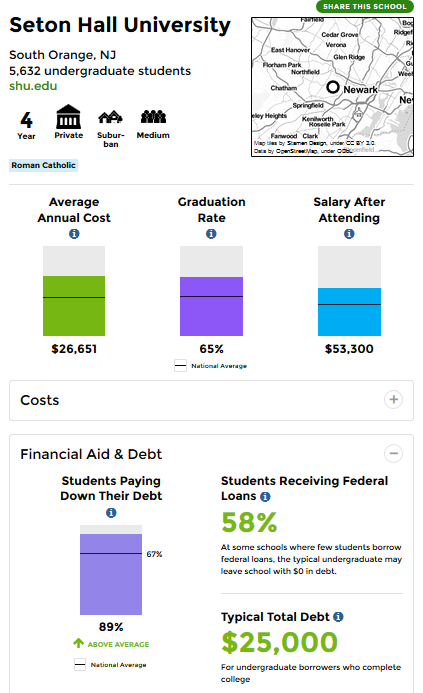
The big bombshell dropped this morning. In an extremely rare Saturday morning release (something that frustrates journalists and the higher education community to no end), the Department of Education released a massive trove of data (fully downloadable!) underlying the new College Scorecard. The consumer-facing Scorecard is fairly simple (see below for what Seton Hall’s entry looks like), and I look forward to hearing about whether students and their families use this new version more than previous ones. I also recommend ProPublica’s great new data tool for low-income students.

shu

But my focus today is on the new data. Some of the key new data elements include the following:

  • Transfer rates: The percentage of students who transfer from a two-year to a four-year college. This helps community colleges, given their mission of transfer, but still puts colleges at a disadvantage if they serve a more transient student body.
  • Earnings: The distribution of earnings 10 years after starting college and the percentage earning more than those with a high school diploma. This comes from federal tax return data and is a huge step forward. However, given very reasonable concerns about a focus on earnings hurting colleges with public service missions, there is also a metric for the percentage of students making more than $25,000 per year. Plenty of people will focus on presenting earnings data, so I’ll leave the graphics to others. (This is a big step forward over the admirable work done by Payscale in this area.)
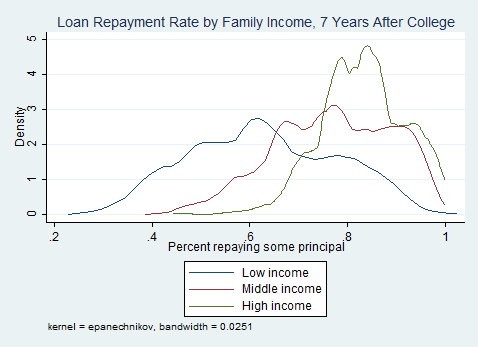
  • Student loan repayment: The percentage of students (both completers and non-completers) who are able to pay down some principal on loans within a certain period of time. Seven-year loan repayment data are available, as illustrated here:

loan_repayment

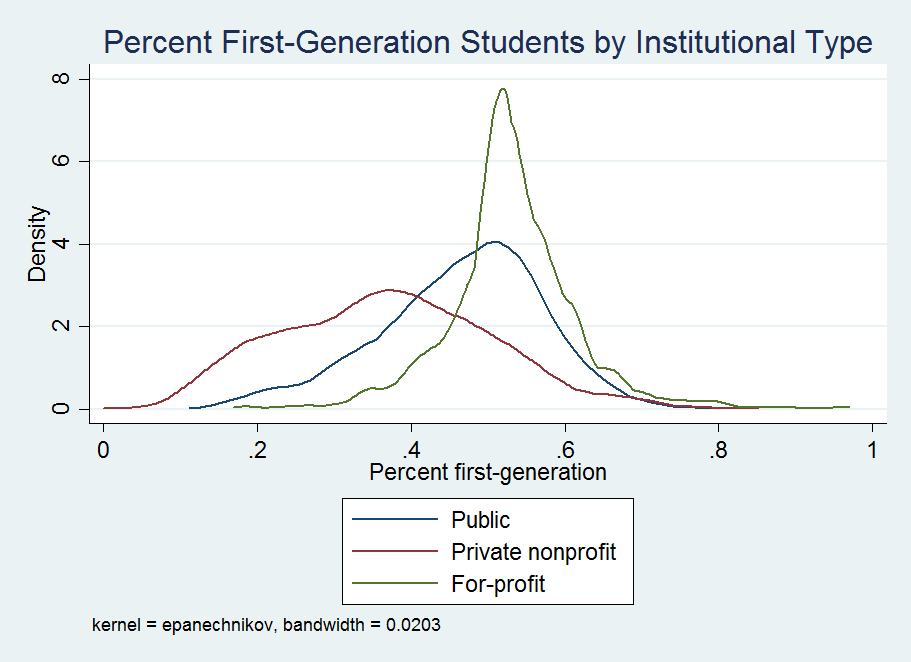
In the master data file, many of these outcomes are available by family income, first-generation status, and Pell receipt. First-generation status is a new data element to be made available to the public; although the question is on the FAFSA, it’s never been made available to researchers. For those who are curious, here’s what the breakdown of the percentage of first-generation students (typically defined as students whose parents don’t have a bachelor’s degree) by institutional type:

firstgen

There are a lot of data elements to explore here, and expect lots of great work from the higher education research community in upcoming months and years using these data. In the short term, it will be fascinating to watch colleges and politicians respond to this game-changing release of outcome data on students receiving federal financial aid.

Who Would Use Income Share Agreements to Pay for College?

This post first appeared at the Brookings Institution’s Brown Center Chalkboard blog.

In response to concerns over the rising price of college and increasing amounts of student loan debt, the Obama Administration has worked to expand income-based repayment programs for those with federal student loans. In late 2015 or early 2016, the U.S. Department of Education will likely allow students with any federal loans to enroll in a more-generous version of income-based repayment that would cap monthly payments at 10 percent of discretionary income (i.e., earnings above 150 percent of the federal poverty line) for 20 years for undergraduate students and 25 years for graduate students, with any remaining balances forgiven by the federal government.

Although this new version of income-based repayment has the potential to benefit up to six million Americans with student loan debt, concerns have been raised about this more generous program. First, the price tag is estimated at $15.3 billion over 10 years, or roughly 5 percent of forecasted Pell Grant expenditures during this period. Second, graduate students, who are more likely to have six-figure student loan debt and enroll in income-based repayment programs at higher rates, will see more benefits than undergraduate students with smaller amounts of debt but worse career options. Finally, as more students enroll in income-based repayment plans, colleges have fewer reasons to control costs due to students’ ability to access credit.

An interesting alternative to federal student loans that has emerged in recent years has the potential to shift the financial risk of paying for college away from the federal government and students, instead placing the risk in the private sector. Income share agreements (ISA) function somewhat similarly to income-based repayment plans, as students pledge to pay a predetermined percentage of their annual income in exchange for funds to pay for college. However, unlike federal income-based repayment plans, the percentage of income and the length of the repayment period are negotiated between a private investor and the student instead of being the same across all students. Students who major in economically desirable fields, such as engineering and business, at top colleges are likely to get better repayment terms than students majoring in less-profitable but socially important fields, such as education and nursing, at more typical colleges.

Given the current generosity of income-based repayment programs—and the likelihood that the federal government loses money on many students today—I have to wonder how many students would use ISAs once potential legal issues around their operation in the United States are resolved. Students in less-lucrative fields or those who plan to work in public service careers are unlikely to get better terms from the private sector than the federal government. These students would be likely to continue using federal student loans, although it is possible that ISAs could partially replace Parent PLUS loans as a financing source should parents not want to take out loans for their children when ISAs are available.

This leaves two groups of students who are likely to be interested in ISAs. The first group is those students who are either attending colleges that do not offer their students federal loans (primarily for-profit colleges and community colleges), or those attending short-term training programs such as coding ‘boot camps’ that do not currently qualify for federal student aid. Something in the neighborhood of two million students attend these colleges and programs, which results in a fairly sizable market. However, all of these programs tend to be relatively inexpensive, meaning that the per-student profit for an ISA provider will be fairly small.

The group of students who would be more lucrative for ISA providers would be those students enrolled in profitable degree programs at traditional undergraduate and graduate institutions. Because these programs tend to be expensive, the contract would need to be designed so the provider could make a profit on a large initial investment. However, students could lock in paying a lower percentage of their income than what they would expect to pay under income-based repayment if their expected earnings are high enough.

But students with high expected incomes may stay away from ISAs because they may expect to pay more in an ISA than under the standard federal repayment plan (a fixed monthly payment over 10 years). It would be difficult for ISA providers to undercut the federal government’s price in today’s environment of reasonably low interest rates, but it could be possible for students who have the highest likelihood of graduating and making a large salary because of the relatively low risk these students represent to a provider. Additionally, the presence of post-graduation private loan refinancing options such as Earnest and SoFi give successful graduates a way to lower their loan payments without giving up a share of their income.

Income share agreements have the potential to create another option for students looking to pay for college while seeking assurances they will not be overwhelmed by future payments. However, given the current generosity of federal income-based repayment programs and the likely hesitation of those who expect six-figure salaries to sign away a percentage of their income for years to come, the market for these programs may be somewhat limited. However, the federal government should encourage the development of private ISA providers in order to give students as many options as possible to finance their education while setting reasonable parameters for their operation that protect students from fraud and abuse.