
Public Higher Education is Splitting in Two

Even though there have been longstanding ideological differences across states, higher education leadership was largely insulated against these differences over the last half-century. Yes, they popped up in meaningful ways on topics such as South African divestment, affirmative action, and antiwar protests, but it was possible for university leaders to move from red states to blue states and vice versa. It helped to share the state’s political leanings, but it was generally not a requirement.

The last month has clearly shown that potential presidents now must pass an ideological litmus test in order to gain the favor of governing boards and state policymakers. Here are three examples:

  • Santa Ono’s hiring at Florida was rejected by the system board (after being approved by the campus board) due to his previous positions in favor of diversity initiatives and vaccine mandates. He tried to pivot his views, but it was not enough for Republican appointments on the board.
  • Six red states, led by Florida and North Carolina, are seeking to launch a new accreditor to break free from their longtime accreditor (which was the only major institutional accreditor to never have a DEI requirement, although their diversity page is now blank). Florida Governor Ron DeSantis used his press conference to go on a tirade against higher education, but the North Carolina system’s statement was more cautious, focused on academic quality.
  • The Trump administration’s Justice Department effectively forced out University of Virginia president James Ryan over his alleged noncompliance in removing diversity initiatives from campus. This effort was successful because Virginia’s Republican governor also supported removal and has the ability to push the institution’s governing board to take action.

While there has been a long history of politicians across the ideological spectrum leading universities (such as Mitch Daniels at Purdue, John King at the State University of New York, and Dannel Molloy at Maine), these politicians have generally set aside most of their ideological priors that are not directly related to running an institution of higher education. But now a growing number of states are expecting their campus presidents to be politicians that are perfectly aligned with their values.

There are two clear takeaways from recent events. The first is that college presidents are now political appointments in the same way that a commissioner of education or a state treasurer would be in many states. Many boards will be instructed (or decide by themselves) to only hire people who are ideologically aligned to lead colleges—and to clean house whenever a new governor comes into power. The median tenure of a college president is rapidly declining, and expect that to continue as more leaders get forced out. Notably, by threatening to withhold funding, governors do not even have to wait for the composition of the board to change before forcing a change in leadership. New presidents will respond by requesting higher salaries to account for that risk.  

Second, do not expect many prominent college presidents to switch from red states to blue states or vice versa. (It may still happen among community colleges, but even that will be more difficult). The expectations of the positions are rapidly diverging, and potential leaders are going to have to choose where they want to be. Given the politics of higher education employees, blue-state jobs may be seen as more desirable. But these positions often face more financial constraints due to declining enrollments and tight state budgets, in addition to whatever else comes from Washington. Red-state jobs may come with more resources, but they also are likely to come with more strings attached.

It is also worth noting that even vice president and dean positions are likely to face these same two challenges due to presidential transitions and the desire of some states to clean house within higher education. That makes the future of the administrative pipeline even more challenging.  
What a Second Trump Administration May Mean for Higher Education

For the last two presidential transitions, I have written pieces about what the new president (Trump in 2016 and Biden in 2020) may mean for higher education. My expectations back in 2016 were the following:

  • He would not repeal the Department of Education. (He never seriously tried.)
  • Tuition-free public college was dead. (True at the federal level, but state-level programs grew following Tennessee’s lead.)
  • He talked about income-driven repayment changes and going back to having private banks guarantee loans. (Neither happened, although he did pause payments during the pandemic.)
  • There would be fewer regulations and an accountability reprieve for the for-profit college sector. (True.)

After four years of President Trump in power, the higher education community has a better sense of what is coming than we did back in 2016. Here are some of the key things that I am watching over the next several months and years.

(1) The subtitle for my piece on the incoming Biden administration was, “If the Democrat wins, he will have to govern by executive order, much as his predecessor did.” That is not going to be as easy this time around. One of conservatives’ biggest Supreme Court wins recently was the overturning of the Chevron precedent that will result in less authority for federal agencies to enact regulations. For at least the next four years, this is going to bite the Trump administration right in the behind. Unless…

(2) Political appointees try acting through issuing directives that are implemented before courts can step in, hoping that they will be unwilling to unwind something that is already being done. It hearkens back to the alleged quote from Andrew Jackson: The Chief Justice “has made his decision; now let him enforce it.” A frequent refrain among progressives over the last few years has been that the Biden administration should immediately cancel student debt, making it difficult for the debt to be reinstated later upon court order. It would not be surprising to see Trump appointees trying to score a policy win (or at least some political points with their base) in that manner. Two likely areas are around federal financial aid to so-called “woke” colleges and international student visas.

(3) While Republicans retook the Senate with at least three votes to spare, House control is still too early to tell as of this writing and is likely to be razor-thin. House Republicans had more than a few challenges in the current Congress with a slim majority, and it is going to be difficult to pass a lot of legislation when hardliners and moderates within the GOP disagree on so many things. Conservatives detest omnibus budget bills and have been pushing for 12 separate budget bills for years. But the result is usually one large bill passed in mid-December, which creates incentives for compromise. Trump has not been particularly concerned about deficits, so conservatives are unlikely to get major budget cuts.

(4) The Higher Education Act was last reauthorized in 2008. I still might retire before it happens again, and I don’t plan on going anywhere for a while. While the Department of Education is not going away anytime soon, there are enough Republicans who would rather throw out the entire department than make substantive reforms. Democrats likely prefer the status quo to any new major legislation, so we can keep waiting on reauthorization for a long time. This does not mean that some policy changes cannot happen; the major changes to the FAFSA last year came through an omnibus budget bill in 2020. But any changes will be piecemeal in the grand scheme of things.

(5) President Trump and Congressional leaders will use the bully pulpit to go after selective colleges and their leaders. Last year’s House hearings were very effective for Republicans, as they led to several presidents resigning. If something works in Washington, expect to see it again—especially as both Trump and Vance are products of those institutions. Community colleges and regionally-focused public and private institutions are likely to fly under the radar, as going after them will not generate media attention. But I would not want to be a president of a blue-state flagship university or an elite private college right now, and any leader who is not a white man is likely to face additional scrutiny if last year’s hearings were a guide.

(6) Keep a close eye on who ends up at the Department of Education. Most of the commentary out there about potential Cabinet secretaries barely even mentions ED, but he still needs to identify someone to run the agency on an acting basis. Betsy DeVos is off the table for a second term because she resigned in the aftermath of January 6, and this is a job that many conservatives do not aspire to reach. A name that I am watching is Oklahoma’s state superintendent of education, Ryan Walters, as he tried to get Trump-branded Bibles into public school classrooms and supports the elimination of the Department of Education. Will K-12 or higher education be the focus? I have long contended that higher ed is the area of greatest importance for a Secretary of Education, but a focus on social issues may change that.

Higher education was in for a challenging period regardless of who was elected, thanks to growing skepticism over the value of a college education, increasing political polarization by educational attainment, and the state of federal student loans. This week’s election just magnified all of those concerns. Buckle up, folks…it’s going to be a bumpy ride.

The Potential Implications of Shorter Bachelor’s Degree Programs

I have been around higher education long enough that relatively few things would jolt me fully awake at 4:45 in the morning, which is typically when I read the news before getting out of bed for my daily workout. The news in last Friday’s Inside Higher Ed about the Northwest Commission on Colleges and Universities approving applications from two colleges to offer bachelor’s degree programs of between 90 and 94 credits instead of the typical 120 is exactly that. This would allow full-time students to more easily complete bachelor’s degrees in three years, although I expect more part-time students to take up these programs.

After reading this news, I immediately started thinking about the implications for the higher education ecosystem. (I do some of my best thinking while exercising.) Here are my thoughts after taking some more time to digest the issue.

Other accreditors will be pressured to follow suit. With the end of regional accreditation boundaries during the Trump administration, a few colleges have voluntarily turned to accreditors that have historically not served their area. And the U.S. Department of Education just cleared the first Florida public college to start the process of moving to a different accreditor following the state’s law that public institutions change accreditors every cycle. This means that any accreditor that does not follow with a process to allow for shorter degrees runs the risk of losing institutions to an accreditor that is willing to do so, and some states are likely to pressure colleges to switch to more amenable accreditors. But…

Will the U.S. Department of Education respond? During the Biden administration’s war of words with Florida regarding accreditation, ED posted a piece putting a stake in the ground against accreditation shopping. The Department of Education could potentially issue guidance saying that degrees shorter than historical norms would place accreditors under additional scrutiny, or this issue could come up when the federal National Advisory Committee on Institutional Quality and Integrity reviews accreditors. If ED responds, expect lawsuits as well as a great deal of pressure to state exactly how many credits must be required for a particular credential.

This upends the intricate network of cross-subsidies in higher education. It is a well-known fact within higher education industry insiders that certain activities subsidize others. For example, lower-division courses tend to subsidize upper-division courses and humanities and social science courses tend to subsidize laboratory science courses. Shorter bachelor’s degree programs in professional fields will cut the number of general education or elective courses that disproportionately come from lower-cost fields of study. It’s not just the lost tuition dollars that will affect colleges—it’s that the average cost of instruction per credit hour will likely rise.

This will primarily affect programs and colleges serving a larger share of adult learners. I don’t think that selective liberal arts colleges and flagship public universities will be cutting bachelor’s degrees too far below 120 credit hours unless state legislatures change funding models to require it. But students who are not looking for the traditional residential experience will be clamoring for quicker and cheaper options, and colleges that serve these students will follow suit. This will place pressures on the finances of colleges that are often struggling, but they will likely choose shorter programs over losing students entirely. Another item worth watching is whether there is a push to shorten master’s degrees to fewer than 30 credits. This could play out across most universities given fierce competition in this area.

Transfer students will see fewer benefits. It may become possible for a student who starts at a particular college to finish a bachelor’s degree in 90 credits by reducing general education credits. But since the number of credits within a major is less likely to change, transfer students will not benefit as much. Transfer students already frequently see a large number of credits not transfer in a way that helps them complete, and reducing general education credits may even make this worse.

I will be keeping a close eye on how this situation develops over the next few years, as it is potentially one of the biggest changes to occur in the last decade.

Will Republicans Try to End the Federal Student Loan Program?

Multiple news outlets are reporting that the Biden administration will announce a fifth extension of the federal student loan repayment pause that began in March 2020 shortly, with this extension going through the end of August 2022. This news doesn’t seem to make anyone truly happy, with borrower advocates and many progressives advocating for an extension through the end of 2022 and/or outright student debt forgiveness. On the right, conservatives are unhappy with continuing to kick the repayment can down the road when the economy is strong and a sizable share of borrowers could resume repayment (with or without income-driven repayment).

At this point, it seems more likely than not to me that the Biden administration will not resume student loan repayment during its time in office. There is almost no chance that the administration will restart payments in August as Democrats face a challenging midterm election and need every vote that they can get from their base and younger voters. Then 2023 starts the next presidential election cycle. If Biden and/or Harris want to run for office, resuming payments is a terrible way to position themselves in a Democratic primary.

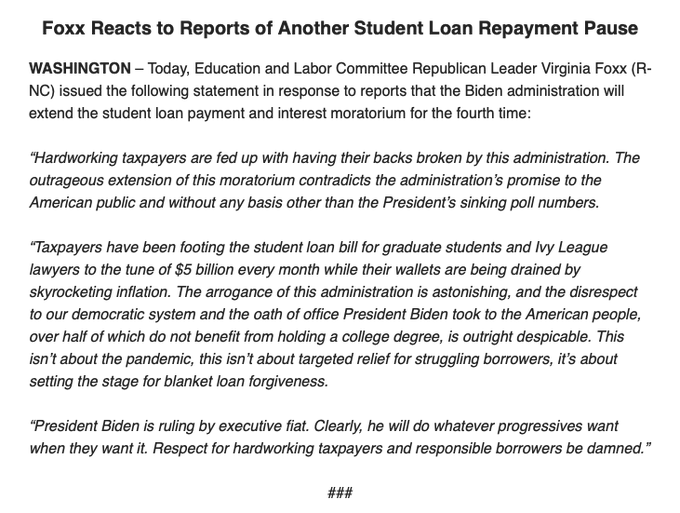
Meanwhile, Republicans are stewing. Rep. Virginia Foxx, ranking member of the House Education and Labor Committee, had this to say (h/t Michael Stratford of Politico):

If Republicans take control of Congress in the November elections, I fully expect a serious effort to stop issuing federal student loans framed around statements like that from Rep. Foxx. 2023 is a great time for Republicans to make this play, as somewhere between ten and 250 Republicans in the House and Senate seem likely to run for president in 2024 and this is great messaging in a GOP primary. Additionally, a certain Biden veto makes this a vote with no real consequences, allowing people to vote yes without cutting off access to federal loans. There is a realistic chance that legislation would pass Congress while not becoming law.

Fast forward to 2025. If Republicans take control of the White House along with Congress, then they have to either put up or shut up about this issue. On health care, Republicans largely shut up because they could not agree on a replacement for the Affordable Care Act. The same may well happen about federal student loans, with a few moderate Republicans stopping passage to protect students and/or their own political careers in swing districts. Possible replacements include education savings accounts, income share agreements (a la Jeb Bush), or simply turning the issue over to colleges and states to figure out.

Do I think that Republicans will end federal student loans? Probably not, but I also didn’t expect payments to still be paused in April 2022 when I first suggested a pause on March 18, 2020. The more likely outcome is efforts to limit graduate and professional student borrowing to reduce the federal loan portfolio without affecting the most vulnerable undergraduates.

Why the Next Secretary of Education Should Come from Higher Ed

Elizabeth Warren is one of several Democratic presidential candidates who is highlighting education as a key policy issue in their campaigns. A few weeks after announcing an ambitious proposal to forgive nearly half of all outstanding student debt and strip for-profit colleges’ access to federal financial aid (among other issues), she returned to the topic in advance of a town hall event with the American Federation of Teachers in Philadelphia. In a tweet, Warren promised that her Secretary of Education would be a public school teacher.

This would be far from unprecedented: both Rod Paige (under George W. Bush) and John King (under Barack Obama) were public school teachers. But if Warren or any other Democrat wants to influence American education to the greatest extent possible, the candidate should appoint someone from higher education instead of K-12 education. (The same also applies to Donald Trump, who apparently will need a new Secretary of Education if he wins a second term.) Below, I discuss a few reasons why ED’s next leader should come from higher ed.

First, the Every Student Succeeds Act, signed into law in 2015, shifted a significant amount of power from ED to the states. This means that the federal government’s power in K-12 education has shifted more toward the appropriations process, which is controlled by Congress. Putting a teacher in charge of ED may result in better K-12 policy, but the change is likely to be small due to the reduced amount of discretion.

Meanwhile, on the higher education side of the ranch, I still see a comprehensive Higher Education Act reauthorization as being unlikely before 2021—even though Lamar Alexander is promising a bill soon. I could see a narrowly-targeted bill on FAFSA simplification getting through Congress, but HEA reauthorization is going to be tough in three main areas: for-profit college accountability, income-driven student loan repayment plans, and social issues (Title IX, campus safety, and free speech). Warren’s proposal last month probably makes HEA reauthorization tougher as it will pull many Senate Democrats farther to the left.

This means that ED will continue to have a great amount of power to make policy through the negotiated rulemaking process under the current HEA. Both the Obama and Trump administrations used neg reg to shape policies without going through Congress, and a Democratic president is likely to rely on ED to undo Trump-era policies. Meanwhile, a second-term Trump administration will still have a number of loose ends to tie up given the difficulty of getting the sheer number of regulatory changes through the process by November 1 of this year (the deadline to have rules take effect before the 2020 election).

I fully realize that promising a public school teacher as Secretary of Education is a great political statement to win over teachers’ unions—a key ally for Democrats. But in terms of changing educational policies, candidates should be looking toward higher education veterans who can help them reshape a landscape in which there is more room to maneuver.

Why Negotiated Rulemaking Committees Should Include a Researcher

The U.S. Department of Education officially unveiled on Monday the membership committees for its spring 2019 negotiated rulemaking sessions on accreditation and innovation. This incredibly ambitious rulemaking effort includes subcommittees on the TEACH Grant, distance education, and faith-based institutions and has wide-ranging implications for nearly all of American higher education. If all negotiators do not reach consensus on a given topic (the most likely outcome), ED can write regulations as it sees fit. (For more on the process, I highly recommend Rebecca Natow’s great book on negotiated rulemaking.)

The Department of Education is tasked with selecting the membership of negotiated rulemaking committees and subcommittees by choosing from among people who are nominated to participate by various stakeholders. Traditionally, ED has limited the positions to those who are representing broad sectors of institutions (such as community colleges) or affected organizations (like accrediting agencies). But given the breadth of the negotiations, I felt that it was crucial for at least one researcher to be a negotiator.

I heard from dozens of people both online and offline in support of my quixotic effort. But ED declined to include any researchers in this negotiated rulemaking session, which I find to be a major concern.

Why is the lack of an academic researcher such a big deal? First of all, it is important to have an understanding of how colleges may respond to major changes in federal policies. Institutional stakeholders may have a good idea of what their college might do, but may be hard to honestly explain unintended consequences when all negotiations are being livestreamed to the public. Including a researcher who is not representing a particular sector or perspective provides the opportunity for someone to speak more candidly without the potential fear of reprisal.

Additionally, the Department of Education’s white papers on reform and innovation (see here and here) did not demonstrate full knowledge of the research on the areas to be negotiated. As I told The Chronicle of Higher Education:

“In general, ED didn’t do an awful job describing the few high-quality studies that they chose to include, but they only included a few quality studies alongside some seemingly random websites. If one of my students turned in this paper as an assignment, I would send it back with guidance to include more rigorous research and fewer opinion pieces.”

Including a researcher who knows the body of literature can help ensure that the resulting regulations have a sound backing in research. This is an important consideration given that the regulations can be challenged for either omitting or misusing prior research, as is the case with Sandy Baum’s research and the gainful employment regulations. Including a researcher can help ED get things right the first time.

In the future, I urge the Department of Education to include a spot in negotiated rulemaking committees for a researcher. This could be done in conjunction with professional associations such as the American Educational Research Association or the Association for Education Finance and Policy. This change has the potential to improve the quality of regulations and reduce the potential that regulations must be revised after public comment periods.

The only alternative right now is for someone to show up in Washington on Monday morning—the start of the semester for many academics—and petition to get on the committee in person. While I would love to see that happen, it is not feasible for most researchers to do. So I wish negotiators the best in the upcoming sessions, while reminding the Department of Education that researchers will continue to weigh in during public comment periods.

Which Strings Will States Attach to Free College Programs?

There is plenty of uncertainty about exactly how the upcoming midterm elections (enough nasty campaign ads already, everyone!) will shake out at the state and federal levels. Regardless of the outcomes, the idea of tuition-free college will continue to be discussed across both conservative and liberal states. But one thing is becoming clear: states are exploring a range of restrictions as they begin to adopt programs. In this post, I discuss some of the restrictions in today’s programs (see this Education Trust report for a more thorough treatment from an advocacy perspective) and some of the restrictions that I would not be surprised to see going forward.

Currently, there are four types of restrictions that exist across many current and proposed programs. The first one is the type of institution that students can attend. Most tuition-free college programs cover community colleges only due to the higher price tag of covering four-year colleges. (New York’s Excelsior program skirts this somewhat by not covering fees, which are substantial in the state.)

The second restriction is based on family income, since the last-dollar nature of tuition-free college programs means that programs become much more expensive up the income distribution. New Jersey’s new program, which covers tuition and fees at 13 of the state’s 19 community colleges, set an income cutoff of $45,000 per year to stretch limited state funds. But the state set up an income cap that low to allow for two other common restrictions (the age of the student and enrollment intensity) not to apply there. Other states, however, limit their programs to full-time students straight out of high school (and this is also common for standard grant aid programs).

Two other restrictions have popped up in a small number of states, and I would not be surprised to see them expand to other states that are considering tuition-free college programs. The programs in New York and Rhode Island require students to stay in state after college for a number of years or the grant converts into a loan (the dreaded “groan” in financial aid lingo). A few other states, such as Kentucky, have discussed limiting tuition-free programs to certain high-demand majors to better meet state workforce needs. This is similar to how some states provide additional money in their performance-based funding systems for each STEM major who graduates.

The intersection of the power of the phrase “free college” and concerns about the state’s return on investment is likely to result in even more restrictions appearing in states’ new programs. West Virginia saw a proposed program pass the state Senate (but see no action in the House) in 2018 that would have included both a residency requirement and a drug test requirement—something that does not apply to other types of financial aid the state gives. Students would have had to pay for the drug test, which would have kept down the price tag.

While I was on a panel on free college at the Brookings Institution earlier this fall, one idea came to my mind during the discussion. I said that I would not be surprised to see legislators propose that free college come with a clawback provision that pulls the money back if a student does not graduate within a certain number of years. This would be an incredibly painful provision for students who do not finish college for a variety of reasons, but it would be popular among budget hawks. States are also likely to set high initial academic requirements in the future (such as high school grades and ACT/SAT scores), essentially turning existing merit aid programs into new “free college” programs.

The 2019 legislative season is likely to bring dozens of free college proposals of various types across states, even as higher education policy gridlock remains likely in Washington. My request for states is that they be open to having their programs, particularly those with new restrictions, be evaluated by researchers so they can be improved going forward as needed.

Will The K-12 Teacher Walkouts Affect Public Higher Education?

Perhaps the most interesting education policy development to this point in 2018 has been the walkouts by public school teachers in three states (Kentucky, Oklahoma, and West Virginia) that have resulted in thousands of schools being closed as teachers descended on statehouses to demand better pay. These job actions (which are technically not strikes in some states due to labor laws, but operate in the same way) have been fairly successful for teachers to this point. West Virginia teachers received a five percent pay increase to end their walkout, while Oklahoma teachers received a pay increase of about $6,000. Kentucky teachers had rather limited success, while Arizona is on the verge of a teacher walkout later this week.

Given the success of these walkouts in politically conservative states, it is reasonable to expect K-12 public school teachers in other states to adopt the same tactics to increase their salaries or education funding in general. But what might these walkouts mean for public higher education? I present four possible scenarios below.

Scenario 1: Future K-12 teacher walkouts are ineffective. It’s probably safe to say that legislators in other states are strategizing about how to respond to a potential walkout in their state. If legislators do not want to increase K-12 education spending and can maintain a unified front, it’s possible that protests die out amid concerns that closing schools for days at a time hurts students. In that case, expect no implications for public higher education.

Scenario 2: Public college employees join the walkout movement. Seeing the victories that K-12 teachers have scored, faculty and staff walk out at public colleges in an effort to secure more higher education funding. While this could theoretically work, public support is likely to be much weaker for colleges and universities than K-12 teachers. Republicans in particular now view college professors far more skeptically than Democrats, while the two parties view K-12 public schools similarly. So this probably won’t work too well in conservative states.

Scenario 3: Future K-12 teacher walkouts are effective—and paid for by tax increases. Oklahoma paid for its increase in teacher salaries by increasing taxes in a number of different areas, although teachers wanted a capital gains tax exemption to be eliminated. This probably reduces states’ ability to raise additional revenue in the future—which could affect public colleges—but the immediate effects on public colleges should be pretty modest.

Scenario 4: Future K-12 teacher walkouts are effective—and paid for by reducing state spending in other areas. This is the nightmare scenario for public higher education. Higher education has traditionally been used as the balancing wheel in state budgets, with the sector being the first to experience budget cuts due to the presence of tuition-paying students. Therefore, in a zero-sum budget game without tax increases, more K-12 spending may come at the expense of higher education spending. West Virginia paid for its teacher pay increase this year in part by cutting Medicaid spending, but don’t expect most states to take that path in the longer term.

To sum up, the higher education community should be watching the K-12 walkouts very closely, as they could affect postsecondary students and faculty. And there may end up being some difficult battles in tax-averse states between K-12 and higher education advocates about how to divide a fixed amount of funds among themselves.

Why Accountability Efforts in Higher Education Often Fail

This article was originally published at The Conversation.

As the price tag of a college education continues to rise along with questions about academic quality, skepticism about the value of a four-year college degree has grown among the American public.

This has led both the federal government and many state governments to propose new accountability measures that seek to spur colleges to improve their performance.

This is one of the key goals of the PROSPER Act, a House bill to reauthorize the federal Higher Education Act, which is the most important law affecting American colleges and universities. For example, one provision in the act would end access to federal student loans for students who major in subjects with low loan repayment rates.

Accountability is also one of the key goals of efforts in many state legislatures to tie funding for colleges and universities to their performance.

As a researcher who studies higher education accountability – and also just wrote a book on the topic – I have examined why policies that have the best of intentions often fail to produce their desired results. Two examples in particular stand out.

Federal and state failures

The first is a federal policy that is designed to end colleges’ access to federal grants and loans if too many students default on their loans. Only 11 colleges have lost federal funding since 1999, even though nearly 600 colleges have fewer than 25 percent of their students paying down any principal on their loans five years after leaving college, according to my analysis of data available on the federal College Scorecard. This shows that although students may be avoiding defaulting on their loans, they will be struggling to repay their loans for years to come.

The second is state performance funding policies, which have encouraged colleges to make much-needed improvements to academic advising but have not resulted in meaningful increases in the number of graduates.

Based on my research, here are four of the main reasons why many accountability efforts fall short.

1. Competing initiatives

Colleges face many pressures that provide conflicting incentives, which in turn makes any individual accountability policy less effective. In addition to the federal government and state governments, colleges face strong pressures from other stakeholders. Accrediting agencies require colleges to meet certain standards. Faculty and student governments have their own visions for the future of their college. And private sector organizations, such as college rankings providers, have their own visions for what colleges should prioritize. (In the interest of full disclosure, I am the methodologist for Washington Monthly magazine’s college rankings, which ranks colleges on social mobility, research and service.)

As one example of these conflicting pressures, consider a public research university in a state with a performance funding policy that ties money to the number of students who graduate. One way to meet this goal is to admit more students, including some who have modest ACT or SAT scores but are otherwise well-prepared to succeed in college. This strategy would hurt the university in the U.S. News & World Report college rankings, which judge colleges in part based on ACT/SAT scores, selectivity and academic reputation.

Research shows that students considering selective colleges are influenced by rankings, so a university may choose to focus on improving their rankings instead of broadening access in an effort to get more state funds.

2. Policies can be gamed

Colleges can satisfy some performance metrics by gaming the system, instead of actually improving their performance. The theory behind many accountability policies is that colleges are not operating in an efficient manner and that they must be given incentives in order to improve their performance. But if colleges are already operating efficiently – or if they do not want to change their practices in response to an external mandate – the only option to meet the performance goal may be to try to game the system.

An example of this practice is with the federal government’s student loan default rate measure, which tracks the percentage of borrowers who default on their loans within three years of when they are supposed to start repaying their loans. Colleges that are concerned about their default rates can encourage students to enroll in temporary deferment or forbearance plans. These plans result in students owing more money in the long run, but also they push the risk of default outside the three-year period that the federal government tracks, which essentially lets colleges off the hook.

3. Unclear connections

It’s hard to tie individual faculty members to student outcomes. The idea of evaluating teachers based on their students’ outcomes is nothing new; 38 states require student test scores to be used in K-12 teacher evaluations, and most colleges include student evaluations as a criterion of the faculty review process. Tying an individual teacher to a student’s achievement test scores has been controversial in K-12 education, but it is far easier than identifying how much an individual faculty member contributes to a student’s likelihood of graduating from college or repaying their loans.

For example, a student pursuing a bachelor’s degree will take roughly 40 courses during their course of study. That student may have 30 different professors over four or five years. And some of them may no longer be employed when the student graduates. Colleges can try to encourage all faculty to teach better, but it’s difficult to identify and motivate the worst teachers because of the elapsed time between when a student takes a class and when he or she graduates or enters the workforce.

4. Politics as usual

Even when a college should be held accountable, politics often get in the way. Politicians may be skeptical of the value of higher education, but they will work to protect their local colleges, which are often one of the largest employers in their home states. This means that politicians often act to stop a college from losing money under an accountability system.

The ConversationTake for example Senate Majority Leader Mitch McConnell, R-Ky., who was sympathetic to the plight of a Kentucky community college with a student loan default rate that should have resulted in a loss of federal financial aid. He got a provision added to the recent federal budget agreement that allowed only that college to appeal the sanction.

A Poor Way to Tie the Pell Grant to Performance

“Groan” is a word that is typically used to describe something that is unpleasant or bad. But in the language of student financial aid, “groan” has a second meaning—a grant that converts to a loan if students fail to meet certain criteria. The federal TEACH Grant to prospective teachers and New York’s Excelsior Scholarship program both have these clawback requirements, and a 2015 GAO report estimated that one-third of TEACH Grants had already converted into loans for students who did not teach in high-need subjects in low-income schools for four years.

Republican Reps. Francis Rooney (FL) and Ralph Norman (SC) propose turning the Pell Grant into a groan program through their Pell for Performance Act, which would turn Pell Grants into unsubsidized loans if students fail to graduate within six years. While I understand the representatives’ concerns about students not graduating (and thus reducing—but not eliminating—the return on investment to taxpayers), I see this bill as a negative for students and taxpayers alike.

Setting aside the merits of the idea for a minute, I’m deeply skeptical that the Department of Education and student loan servicers can accurately manage such a program. With a fair amount of difficulty managing TEACH Grants and income-driven repayment plans, I would expect a sizable number of students to incorrectly have Pell Grants convert to loans (and vice versa). I appreciate these two representatives’ faith in Federal Student Aid and servicers to get everything right, but that is a difficult ask.

Moving on to the merits of the idea, I am concerned about the implications of converting Pell Grants to a loan for students who left college because they got a job. Think about this for a minute—a community college student who has completed nearly all of her coursework gets a job offer with family-sustaining wages. She now faces a tough choice: forgo a good, solid job until she completes (and hope she can get another one) or take the job and owe an additional $10,000 to the federal government? If one of the purposes of higher education is to help students move up the economic ladder, this is a bad idea.

This could also have additional negative ramifications for students who stop out of college due to family issues, the need to support a family, or simply realizing that they weren’t college ready at the time. Asking a 30-year-old adult to repay additional student loans (when he may have left in good standing) under this groan program would probably reduce the number of working adults who go back and finish their education.

If the representatives’ concern is that students make very slow progress through college and waste taxpayer funds, a better option would be to gradually ramp up the current performance requirements for satisfactory academic progress. These requirements, which are typically defined as a 2.0 GPA and completing two-thirds of attempted credits, already trip up a significant share of students. But on the other hand, research by Doug Webber of Temple University and his colleagues finds significant economic benefits to students who barely keep a 2.0 GPA and are thus able to stay in college.

Finally, although I think this proposal is shortsighted, I have to chuckle at a take going around on social media noting that one of the representatives owns a construction company that helped build residence halls. Wouldn’t that induce a member of Congress to support policies that get more students into college (and create demand for his company’s services)? It seems like he is going against his best interest if this legislation scares students away from attending college.