New Data on Heightened Cash Monitoring and Accountability Policies

Earlier this week, I wrote about the U.S. Department of Education’s pending release of a list of colleges that are currently subject to heightened cash monitoring requirements. On Tuesday morning, ED released the list of 556 colleges (updated to 544 on Friday), thanks to dogged reporting by Michael Stratford at Inside Higher Ed (see his take on the release here).

My interest lies in comparing the colleges facing heightened cash monitoring (HCM) to two other key accountability measures: the percentage of students who default on loans within three years (cohort default rates) and an additional measure of private colleges’ financial strength (financial responsibility scores). I have compiled a dataset with all of the domestic colleges known to be facing HCM, their cohort default rates, and their financial responsibility scores.

That dataset is available for download on my site, and I hope it is useful for those interested in examining these new data on federal accountability policies. I will have a follow-up post with a detailed analysis, but at this point it is more important for me to get the data out in a convenient form to researchers, policymakers, and the public.

DOWNLOAD the dataset here.

Why is it So Difficult to Sanction Colleges for Poor Performance?

The U.S. Department of Education has the ability to sanction colleges for poor performance in several ways. A few weeks ago, I wrote about ED’s most recent release of financial responsibility scores, which require colleges deemed financially unstable to post a bond with the federal government before receiving financial aid dollars. ED can also strip a college’s federal financial aid eligibility if too high of a percentage of students default on their federal loans, if data are not provided on key measures such as graduation rates, or if laws such as Title IX (prohibiting discrimination based on sex) are not followed.

The Department of Education can also sanction colleges by placing them on Heightened Cash Monitoring (HCM), requiring additional documentation and a hold on funds before student financial aid dollars are released. Corinthian Colleges, which partially collapsed last summer, blames suddenly imposed HCM requirements for its collapse as they were left short on cash. Notably, ED has the authority to determine which colleges should face HCM without relying upon a fixed and transparent formula.

In spite of the power of the HCM designation, ED has previously refused to release a list of which colleges are subject to HCM. The outstanding Michael Stratford at Inside Higher Ed tried to get the list for nearly a year through a Freedom of Information Act request (which was mainly denied due to concerns about hurting colleges’ market positions), finally making this dispute public in an article last week. This sunlight proved to be a powerful disinfectant, as ED relinquished late Friday and will publish a list of the names this week.

The concerns about releasing HCM scores is but one of many difficulties the Department of Education has had in sanctioning colleges for poor performance across different dimensions. Last fall, the cohort default rate measures were tweaked at the last minute, which had the effect of allowing more colleges to pass and retain access to federal aid. Financial responsibility scores have been challenged over concerns that ED’s calculations are incorrect. Gainful employment metrics are still tied up in court, and tying any federal aid dollars to college ratings appears to have no chance of passing Congress at this point. Notably, these sanctions are rarely due to direct concerns about academics, as academic matters are left to accreditors.

Why is it so difficult to sanction poorly-performing colleges, and why is the Department of Education so hesitant to release performance data? I suggest three reasons below, and I would love to hear your thoughts in the comments section.

(1) The first reason is the classic political science axiom of concentrated benefits (to colleges) and diffuse costs (to students and the general public). Since there is a college in every Congressional district (Andrew Kelly at AEI shows the median district had 11 colleges in 2011-12), colleges and their professional associations can put forth a fight whenever they feel threatened.

(2) Some of these accountability measures are either all-or-nothing in nature (such as default rates) or incredibly costly for financially struggling colleges (HCM or posting a letter of credit for a low financial responsibility score). More nuanced systems with a sliding scale might make some sanctions possible, and this is a possible reform under Higher Education Act reauthorization.

(3) The complex relationship between accrediting bodies and the Department of Education leaves ED unable to directly sanction colleges for poor academic performance. A 2014 GAO report suggested accrediting bodies also focus more on finances than academics and called for a greater federal role in accreditation, something that will not sit well with colleges.

I look forward to seeing the list of colleges facing Heightened Cash Monitoring be released later this week (please, not Friday afternoon!) and will share my thoughts on the list in a future piece.

The FY 2016 Obama Budget: A Few Surprises

The Obama Administration released their $3.999 trillion budget proposal for Fiscal Year 2016, and the higher education portion of the budget was largely as expected. Some proposals, such as increasing research funding, providing a bonus pool of funds for colleges with high graduation rates, and reallocating the Supplemental Educational Opportunity Grant to be based on current financial need instead of an antiquated formula, were repeats from previous years. Others, such as the idea of tuition-free community college, had already been sketched out. And one controversial proposal—the plan to tax new 529 college savings plans—had already been nixed, but remained in the budget document due to a “printing deadline.”

But the budget proposal (the vast majority of which is dead on arrival in a GOP Congress thanks to differences in viewpoints and preferred budget levels) did have some surprising details. The three most interesting higher education-related details are below.

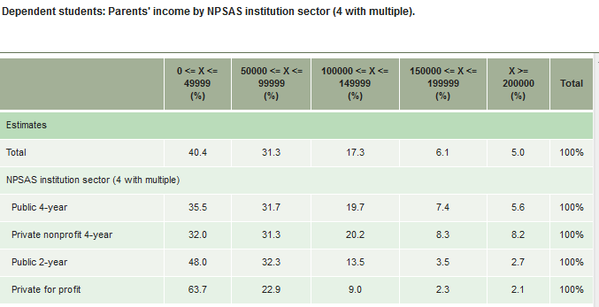
(1) “Universal” free community college isn’t exactly universal. Pages 59 and 60 of the education budget proposal noted that students with a family Adjusted Gross Income of over $200,000 would be ineligible for tuition-free community college. Although this detail was apparently decided before the program was announced, the Obama Administration for some reason chose to hide that detail from the public until Monday. As the picture shows below, only 2.7% of dependent community college students had family incomes above $200,000 in 2011-12 (data from the National Postsecondary Student Aid Study).

income

But in order to get family income, students have to file the FAFSA. Research by Lyle McKinney and Heather Novak suggests that 42% of low-income community college students didn’t file the FAFSA in 2007-08, meaning that something big needs to be done to get these students to file. Requiring the FAFSA also means that noncitizens typically would not qualify for free community college, something that is likely to upset advocates for “dreamer” students (but make many on the Right happy).

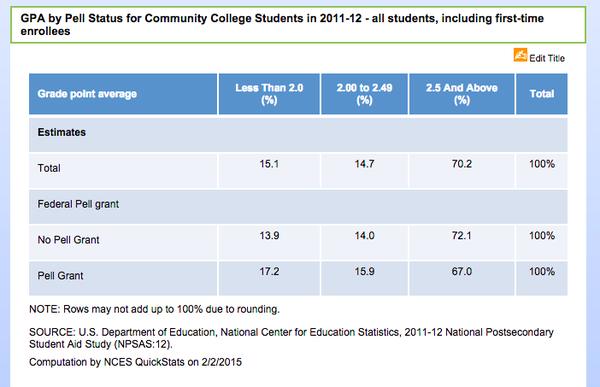
Additionally, as Susan Dynarski at the University of Michigan pointed out, the GPA requirements (a 2.5 instead of a 2.0) make a big difference. In 2011-12, 15.9% of Pell recipients had GPAs between a 2.0 and 2.49, meaning they would not qualify for free community college.

gpa


(2) Asset questions may be off the FAFSA. The budget document called for the following changes to the FAFSA, including the elimination of assets (thanks to Ben Miller at New America for the screenshot):

fafsa


Getting rid of assets won’t affect most families, as research by Susan Dynarski and Judith Scott-Clayton shows. But it does matter more to selective colleges, more of which might turn to additional financial aid forms like the CSS/PROFILE to get the information they want. Policymakers should take the benefits of FAFSA simplicity as well as the potential costs to students of additional forms into account.

(3) Mum’s the word on college ratings. After last year’s budget featured $10 million for the development of the Postsecondary Institution Ratings System (PIRS), this year’s budget had no mention. Inside Higher Ed reported that ratings will be developed using existing funds and using existing personnel. Will that slow down the development of ratings? Given the slow progress at this point, it’s hard to argue otherwise.

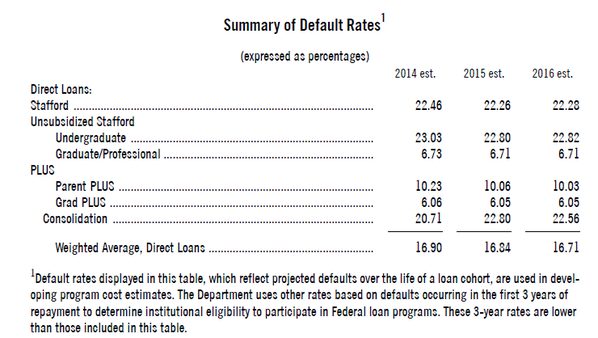
Finally, the budget document also contained details about the “true” default rate for student loans, using the life of the loan instead of the 3-year default window used for accountability purposes. The results aren’t pretty for undergraduate students, with default rates pushing 23% on undergraduate Stafford loans. But default rates for graduate loans hover around 6%-7%, which is roughly the interest rates many of these students face.

default


What are your thoughts on the President’s budget proposal for higher education? Please share them in the comments section.

Comments on President Obama’s State of the Union Higher Education Proposals

As President Obama enters the last two years of his presidency, he has made higher education one of the key points in his policy platform. The announcement of a plan to give students two years of free tuition at community colleges has gotten a great deal of attention, even though a lot of details are still lacking. (See my analysis of the plan here.) In an unusual Saturday night release, the Obama Administration laid out some details of its tax proposals that will be further elaborated in Tuesday’s State of the Union Address.

Many of the tax provisions will either directly affect higher education, or they will impact students and their families who are currently struggling to pay for college. Here is a quick overview of the provisions:

  • Expand the Earned Income Tax Credit, which goes to lower-income families with some wage income. This credit is fully refundable, meaning that families can benefit even if they don’t have a tax liability to offset with a credit (meaning that negative effective tax rates can result).
  • Expand and streamline the Child and Dependent Care Tax Credit, which is designed to offset high costs of child care. This could help the growing number of students who have children.
  • Consolidate the tuition and fees deduction and Lifetime Learning Credit into a streamlined and expanded American Opportunity Tax Credit, and making the AOTC permanent (it is set to expire in 2017). The AOTC would be set at $2,500 per year for five years and would be indexed for inflation. The AOTC would also be expanded to cover part-time students and the refundable portion would increase from $1,000 to $1,500. Finally, Pell Grant funds received would not count toward the AOTC. The AOTC expansion would be partially covered by reducing tax incentives for 529 and Coverdell savings plans.
  • Eliminate any taxes on any student loan balances forgiven after making the full 20 years of payment under income-based repayment plans. Right now, students are scheduled to be taxed on any balances—although few (if any) students have actually faced the tax burden at this point. This would partially be paid for by getting rid of the student loan interest deduction; essentially, students would lose any tax benefits for paying interest during the life of the loan, but they could benefit at the end of the payment period.

Although the exact costs of each of these proposals will not be known until the President releases his budget document later this spring, it appears that much of the revenue needed to pay for these expanded programs will come from higher taxes on higher-income individuals and large financial companies. Those tax increases are extremely unlikely to be passed by a Republican Congress, but some of the individual tax credit proposals may still be considered with funding coming from other sources.

Putting concerns about feasibility and funding aside, there are some things to like about the President’s proposals, while there are other things not to like. I’m generally not a fan of tax credits for higher education, as it is far less efficient to give students and their families money months after enrollment instead of when they actually need it the most. A great new National Bureau of Economic Research working paper by George Bulman and Caroline Hoxby examined the effectiveness of federal higher education tax credits and found essentially no impacts of tax credits on enrollment or persistence rates. It would be far better to give students a smaller grant at enrollment than a larger grant later on, but that is unlikely to ever happen due to the political popularity of tax credits on both sides of the aisle.

But I do like the part of the proposal that cuts the student loan interest deduction and directs the savings toward addressing the ticking time bomb of the loan forgiveness tax. The interest deduction is complicated, making it less likely to be claimed by lower-income households. Additionally, making interest partially tax-deductible could be seen as encouraging students to borrow more, potentially putting upward pressures on tuition. That is a difficult claim to verify empirically, but it is something that is often mentioned in discussions about college prices.

Regardless of whether any of these proposals become law, it is exciting to see so much discussion of higher education finance and policy at this point. Hopefully, there will be additional proposals coming from both sides of the political aisle that will help students access and complete high-quality higher education.

Thoughts on President Obama’s “Free Community College” Proposal

(NOTE: Updated 1/9/15 11 AM ET with discussion of state performance-based funding and maintenance of effort requirements.)

Two weeks in advance of the State of the Union Address, President Obama unveiled a proposal for tuition-free community college that is getting a great deal of attention. The plan, which was influenced by a “Free Two-Year College Option” paper by Sara Goldrick-Rab and Nancy Kendall, calls for the federal government to fund three-fourths of the cost of tuition and fees while states fund the remainder. The student is then responsible for covering other costs that go along with college attendance, such as books and living expenses.

This is an ambitious and complicated proposal that requires a fiscal outlay and Congressional approval. As a researcher at the intersection of financial aid and accountability policies, there are some things to like about the proposal, but there are also some significant concerns. Below, I list some of the pros and cons of the tuition-free community college proposal, as well as some potential items that can best be classified as “mixed” at this point:

Pros:

  • This sends a clear message that community college is an affordable option for all students. Even though tuition and fees make up a small portion of the total cost of attendance—and it is unclear if all students will see additional savings from this plan—telling students early on that tuition will be free may induce more to prepare for college and eventually enroll.
  • This could potentially encourage students to switch from expensive for-profit colleges to less-expensive community colleges for an associate’s degree. This would reduce their debt burden and maybe encourage them to pursue further education if desired.
  • This program will likely be targeted toward middle-income families who do not qualify for the Pell Grant, but cannot readily afford to pay several thousand dollars out of pocket each year for college. This group is key in building public support for higher education. (I don’t think it would affect the college choices of high-income families, who typically chose four-year institutions.)
  • Covering half-time students in addition to full-time students is a plus, although it remains to be seen whether half-time students would be eligible for additional years at a lower enrollment intensity.

Cons

  • The neediest students may not benefit as much from this plan as a straightforward increase to the Pell Grant, as some funds will go to students without financial need. At this point, it sounds like the proposal is NOT a last-dollar scholarship, meaning that all students will get at least some money. But while this is less efficient than increasing the Pell, the broad-based nature of the plan could gain additional political support.
  • If enough students switch from private to public colleges, the additional demand would force states and localities to undertake expensive capital building projects. This could also place additional strain on state financial aid programs.
  • The promise to cover three-fourths of tuition could encourage states and colleges to raise their tuition in order to qualify for more funds. Ideally, the legislation will have some sort of mechanism to prevent outright gaming, but community colleges in high-tuition states will effectively get more money than those in low-tuition states (often with a better history of state and local support). The state/federal/institutional interactions deserve careful scrutiny.
  • In order to qualify for the funds, states must allocate at least some appropriations based on performance instead of enrollment. This sounds like a good thing, but there are two problems. First, measuring performance is difficult–even with respect to graduation rates at community college. Second, as shown in research by Nick Hillman and David Tandberg, it is far from clear that performance-based funding policies improve student outcomes.

Mixed or unclear

  • Students must enroll half-time and earn at least a 2.5 GPA in order to qualify for free tuition. That is a step up from current rules for satisfactory academic progress for the Pell Grant, which typically requires a 2.0 GPA. It may help students be more serious about their studies, but it could also cut off struggling students who need additional support.
  • Requiring the state to fund the remaining cost of tuition could cut out the role of the local community college district. While some states have centralized funding structures for community colleges, others rely on local districts to fund their own college. Moving to a system of state-funded community colleges could help reduce massive funding inequities across districts, but it could reduce taxpayer support for higher education if they do not want their funds going elsewhere.
  • The plan calls for community colleges to work on transfer agreements with public four-year colleges and universities, which is a good thing. But I’d like to see the plan encourage collaboration with other regionally accredited institutions, including reputable private nonprofit and for-profit colleges.
  • The requirement that states maintain their effort for other sectors of higher education may induce some states to not participate. Additionally, if students shift from the four-year sector to two-year colleges, it’s not clear how “effort” should be defined.

We don’t know all of the details about the plan yet, but it is certain to generate a great deal of discussion in Washington and around the country. I’m looking forward to the conversation!

What Will the College Opportunity Summit Mean for Higher Education?

Today, the White House is hosting a second College Opportunity Summit, following up on a summit held in January that was roundly criticized for focusing on elite institutions. Both this summit and the previous summit involved colleges and other organizations making pledges designed to improve college access and completion rates, particularly for underrepresented populations and in STEM. The first round of pledges (and progress made) and the second round of pledges can both be found on the White House’s website.

Several hundred people, including administrators, policy analysts, and researchers, are at today’s summit, which has the potential to generate useful discussions. But it could also be the case that the discussion turns into a stereotypical academic conference, where a lot of items are discussed but no action is ever taken. So what could the summit mean for higher education?

The first thing that jumps out from the list of pledges is the sheer number. The list contains over 600 actions that colleges, associations, and other organizations plan to take—which is admirable. But as a researcher, two key questions should be considered:

(1) Would colleges and organizations have adopted these policies even without a formal pledge? In research language, this is known as the counterfactual—considering what would have happened in the absence of the policy being studied. This list could represent a list of things that colleges already planned to do (but they get good PR and tickets to the White House tree lighting), or this could be a result of colleges setting new goals as a result of the White House’s call for commitments. When considering the impact of this summit, researchers should talk to some college administrators (while promising confidentiality) to see if the pledges were policies already being planned or a new development.

(2) Will these pledges improve student outcomes? This involves thinking carefully about program design and data collection, so it is possible to use experimental or quasi-experimental methods combined with in-depth interviews in order to examine program impacts and potential moderating and mediating factors. The Institute for Education Sciences announced an additional $10 million in funding for postsecondary research, but that amount won’t make much of a difference as funding an intervention and conducting an evaluation can easily cost several million dollars.

I hope the summit helps colleges and organizations develop partnerships similar to the University Innovation Alliance, the Student Achievement Measure, and other organizations that link colleges with similar goals to each other. But it’s worth keeping in mind that many of these pledges are likely things that colleges planned to do anyway.

Gainful Employment and the Federal Ability to Sanction Colleges

The U.S. Department of Education’s second attempt at “gainful employment” regulations, which apply to the majority of vocationally-oriented programs at for-profit colleges and certain nondegree programs at public and private nonprofit colleges, was released to the public this morning. The Department’s first effort in 2010 was struck down by a federal judge after the for-profit sector challenged a loan repayment rate metric on account of it requiring additional student data collection that would be illegal under current federal law.

The 2014 measure was widely expected to contain two components: a debt-to-earning s ratio that required program completers to have annual loan debt be less than 8% of total income or 20% of “discretionary income” above 150% of the poverty line, and a cohort default rate measure that required fewer than 30% of program borrowers (regardless of completion status) to default on federal loans in less than three years. As excellent articles on the newly released measure in The Chronicle of Higher Education and Inside Higher Ed this morning detail, the cohort default rate measure was unexpectedly dropped from the final regulation. This change in rules, Inside Higher Ed reports, would reduce the number of affected programs from 1,900 to 1,400 and the number of affected students from about one million to 840,000.

There will be a number of analyses of the exact details of gainful employment over the coming days (I highly recommend anything written by Ben Miller at the New America Foundation), but I want to briefly discuss on what the changes to the gainful employment rule mean for other federal accountability policies. Just over a month ago, the Department of Education released cohort default rate data, but they tweaked a calculation at the last minute that had the effect of allowing more colleges to get under the 30% default rate threshold at least once in three years to avoid sanctions.

The last-minute changes to both gainful employment and cohort default rate accountability measures highlight the political difficulty of the current sanctioning system, which is on an all-or-nothing basis. When the only funding lever the federal government uses is so crude, colleges have a strong incentive to lobby against rules that could effectively shut them down. It is long past time for the Department of Education to consider sliding sanctions against colleges with less-than-desirable outcomes if the goal is to eventually cut off financial aid to the poorest performing institutions.

Finally, the successful lobbying efforts of different sectors of higher education make it appear less likely that the Obama Administration’s still-forthcoming Postsecondary Institution Ratings System (PIRS) will be able to tie financial aid to college ratings. This measure still requires Congressional approval, but the Department of Education’s willingness to propose sanctions has been substantially weakened over the last month. It remains to be seen if the Department of Education under the current administration will propose how PIRS will be tied to aid before the clock runs out on the Obama presidency.

Quick Thoughts on the Ryan Higher Education Budget Discussion Draft

Representative Paul Ryan (R-WI) released a proposal called Expanding Opportunity in America this morning, which covered topics including social benefits, the Earned Income Tax Credit, education, criminal justice, and regulatory reform. My focus is on the higher education section, starting on page 44.

First of all, I’m glad to see a discussion of targeting federal funds right at the start of the higher education section. Ryan notes concerns about subsidies going to students who don’t need them (such as education tax credits going to households making up to $180,000 per year) and the large socioeconomic gaps in college completion. This is important to note for both economic efficiency and targeting middle-income voters.

The policy points are below:

  • Simplify the FAFSA. Most policymakers like this idea at this point, but the question is how to do so. The document doesn’t specify how it should be simplified, or if it should go as far as the Alexander/Bennet proposal to knock the FAFSA back to two questions. Ryan supports getting information about aid available to students in eighth grade and using tax data from two years ago (“prior prior year”) to determine aid eligibility, both of which make great sense. I’ve written papers on both early aid commitment and prior prior year.
  • Reform and modernize the Pell program. Ryan is concerned about the fiscal health of the Pell program and is looking for ways to shore up its finances. He raises the idea of using the Supplemental Educational Opportunity Grant (SEOG)—a Pell supplement distributed by campuses—to help fund Pell. I’ve written a paper about how SEOG and work-study allocations benefit very expensive private colleges over colleges that actually serve Pell recipients. It’s a great idea to consider, but parts of One Dupont just may object. Ryan also suggests allowing students to use their Pell funds however they want (effectively restoring the summer Pell Grant), something which much of the higher education community supports.
  • Cap federal loans to graduate students and parents. This will prove to be a controversial recommendation, with the possibility of interesting political bedfellows. While many are concerned about rising debt and the fiscal implications, there are different solutions. The Obama Administration has instead proposed capping forgiveness at $57,500, while letting students borrow more. I’m conflicted as to what the better path is. Is it better to shift students to the private loan market to get any additional funds, or should they get loans with lower interest rates through the federal government that may result in a fiscal train wreck if loan forgiveness isn’t capped? The Ryan proposal has the potential to help slow the growth in college costs, but potentially at the expense of some students’ goals.
  • Consider reforms to the TRIO programs. TRIO programs serve low-income, first-generation families, but Ryan notes that there isn’t a lot of evidence supporting these programs. I admittedly don’t know as much about TRIO as I should, but I like the call for additional research before judging their effectiveness.
  • Expand funding for federal Work-Study programs. The proposal increases work-study funds through allowing colleges to keep expiring Perkins Loans funds instead of returning them to the federal government. This is the wrong way to proceed because Perkins allocations (and current work-study allocations) are also correlated with the cost of attendance. I would rather see a redistribution of work-study funds based on Pell Grant receipt instead of by cost of attendance, as I’ve noted previously.
  • Build stronger partnerships with post-secondary institutions. Most of this is empty platitudes toward colleges, but the last sentence is critical: “Colleges should also have skin in the game, to further encourage their commitment to outcome-based learning.” There seems to be some support on both sides of the aisle for holding institutions accountable for their performance through methods such as partial responsibility for loan defaults, tying financial aid to outcomes, or college ratings, but an agreement looks less likely at this point.
  • Reform the accreditation process. Ryan supports Senator Lee (R-UT)’s proposal to allow accreditors to certify particular courses instead of degree programs. This is a good idea in general, but the political landscape gets much trickier due to the existence of MOOCs, for-profit colleges (and course providers), and the power of the current higher education lobby. I’ll be interested to see how this moves forward.

Overall, the tenets of the proposal seem reasonable and some parts are likely to get bipartisan support. The biggest questions remaining are whether the Senate will be okay with the House passing Higher Education Act reauthorization components piecemeal (as they are currently doing) and what funding levels will look like for particular programs. In any case, these ideas should generate useful discussions in policy and academic circles.

State Financial Aid Application Deadlines—A Lousy Rationing Tool

Financial aid reform has become a hot political topic in Washington as of late, with legislation introduced or pending from Senate Democrats, House Republicans, and the bipartisan pair of Senators Lamar Alexander (R-TN) and Michael Bennet (D-CO). (Here is a nice summary of the pieces of legislation from the National College Access Network.) All three of the proposals support the use of “prior prior year” or PPY, which would advance the financial aid application timeline by up to one year. Given the bipartisan support, this policy change may end up happening.

PPY could affect the deadlines for state financial aid applications in ways that could help some students and hurt others. (It could also affect institutional deadlines, but that’s a topic for another post.) Some state aid deadlines listed on the FAFSA are currently well before tax day on April 15, making it difficult for students to take advantage of the IRS Data Retrieval Tool that automatically populates the FAFSA with income tax data but takes up to three weeks to process. For example, five states (Illinois, Kentucky, North Carolina, Tennessee, and Vermont) recommend filing “as soon as possible” after January 1 in order to get funds before they run out. At least 15 states currently have deadlines before March 2, nearly six months before the start of the following academic year.

The below table shows the percentage of all students who filed the FAFSA in the 2012-13 academic year (the most recent year with complete data available) by March 31 and June 30 by state and dependency status. There are two notes with the table. First, it only includes states with deadlines listed on the FAFSA, as other states are either unknown or on a first-come, first-served basis. Second, application data by state are only available by quarter at this point, although the good folks at Federal Student Aid have told me they hope to release data every month in the future.

Percent of FAFSAs Filed by State, Date, and Dependency Status
Applications Filed by 3/31 Applications Filed by 6/30
State Deadline Dependent Indep. Dependent Indep.
IL 1/1 65% 39% 83% 64%
KY 1/1 63% 40% 80% 64%
NC 1/1 54% 33% 79% 61%
TN 1/1 59% 36% 81% 63%
VT 1/1 70% 39% 87% 66%
CT 2/15 66% 35% 85% 63%
ID 3/1 61% 39% 80% 65%
MD 3/1 67% 41% 83% 64%
MI 3/1 61% 35% 80% 60%
MT 3/1 62% 40% 81% 64%
OK 3/1 47% 30% 74% 59%
OR 3/1 67% 50% 82% 71%
RI 3/1 75% 50% 87% 69%
WV 3/1 72% 40% 86% 63%
CA 3/2 68% 43% 81% 65%
IN 3/10 82% 53% 89% 69%
FL 3/15 43% 30% 72% 60%
KS 4/1 57% 33% 80% 61%
MO 4/2 56% 34% 81% 63%
DE 4/15 51% 28% 82% 60%
ND 4/15 45% 30% 78% 61%
ME 5/1 72% 45% 89% 70%
MA 5/1 65% 36% 87% 66%
PA 5/1 55% 34% 86% 65%
AZ 6/1 45% 29% 73% 59%
NJ 6/1 53% 29% 83% 62%
IA 6/6 58% 32% 83% 62%
AK 6/30 51% 32% 75% 58%
DC 6/30 60% 33% 84% 62%
LA 6/30 31% 25% 74% 58%
NY 6/30 51% 30% 79% 62%
SC 6/30 43% 28% 76% 59%
MS 9/15 37% 25% 69% 56%
MN 10/1 44% 24% 77% 57%
OH 10/1 58% 34% 81% 62%

Source: Federal Student Aid data.

Among the 17 states with stated deadlines before March 31, Indiana students were the most likely to file by March 31 (with a March 10 deadline) and Florida students were the least likely to file (with a March 15 deadline). The differences (82% vs. 43% for dependent students and 53% vs. 30% for independent students) reflect the universality of Indiana’s state financial aid program compared to the much more targeted Florida program. In all states, dependents were far more likely to file by March 31 than independents, meaning that independent students were much less likely to even be considered for state financial aid programs. Students were more likely to file by March 31 in states with earlier aid deadlines, as evidenced by a correlation coefficient of about -0.55 for both independent and dependent students.

By June 30, all but three states (Mississippi, Minnesota, and Ohio) have had their state aid deadlines, but only about 81% of dependent and 63% of independent students have filed their FAFSA by that point. Some of these students may choose to enroll in college for the spring semester only, but many are still planning to enroll in the fall semester. These students can still receive federal financial aid, but will miss out on state aid. The correlation between state aid deadlines and the percent of applications received by June 30 is lower, on the order of -0.4.

So what does this mean? About 20% of dependent and 35% of independent students are likely to miss all state application deadlines under current rules, and about 60% of independent students currently miss state aid deadlines before March 31. These students are likely to have more financial need than earlier applicants, but are left out—as shown by recent research. A shift to PPY is likely to move up these state deadlines as states are unlikely to provide more money to student financial aid. The deadlines serve as a de facto rationing tool.

There are better ways to allocate these funds. Instead of using a first-come, first-served model by setting an artificially early deadline, states could give smaller awards to more students or assign grants via lottery to all students who apply before the start of the fall semester (say, August 1). Susan Dynarski made an important point regarding the current system on Twitter:

States need to consider whether their current application deadlines are shutting out students with the greatest financial need, and whether a move to PPY at the federal level will affect their plans. It is abundantly clear that the current system can be improved upon, and I hope states act to do so.

The Ticking Student Loan Time Bomb: The Forgiveness Tax

What to do about the rising amount of student loan debt has recently taken center stage in domestic policy discussions, as the average student who completes a bachelor’s degree and takes out debt now has a student loan burden of around $30,000. Media reports love focusing on those with much larger amounts of debt—who tend to either have graduate degrees or went to colleges with high costs of attendance—but these students are a minority. The past week has seen proposals by members of Congress and President Obama to reduce the burden on those who leave college with debt. Below are summaries of the three main proposals and what they mean for students and taxpayers.

Proposal 1: President Obama’s extension of more generous income-based repayment (IBR) terms. He signed an executive order authorizing the Department of Education to enter the federal rulemaking process in order to extend IBR terms that apply to current Direct Loan borrowers retroactively for those who borrowed before 2007 or those who have not borrowed since 2011. Once approved (no sooner than 2015), borrowers could pay 10% of their discretionary income over 20 years instead of 15%. This proposal has gained support from many in the higher education community, but there are concerns about costs and whether the President has the authority to act without Congressional approval.

Proposal 2: Sen. Warren (D-MA)’s proposal to refinance student loans. She has introduced multiple proposals to lower interest rates, including one to lower rates to 0.75% (which I called “a folly”). Her most recent proposal would allow students to refinance federal and some private loans at the current subsidized Stafford loan interest rate (3.86%). President Obama endorsed the plan when he signed his executive order, but the likelihood of the plan passing is fairly low. It is expected to cost about $55 billion (a number highly dependent on how many borrowers actually refinance), and is paid for by a surtax on millionaires. While passing the Democrat-controlled Senate is possible, it is unlikely to pass the GOP-controlled House.

Proposal 3: Sen. Warner (R-VA)’s and Thune (R-SD)’s proposal to allow employers to contribute pre-tax dollars to help repay employees’ loans. This proposal came as a surprise, particularly the provision that borrowers would have to refinance in the private market before participating in the program. No cost information is currently available to the best of my knowledge, and this proposal is unlikely to pass.

While all three of these proposals could help at least some borrowers in the short run, none of them do anything to affect the main reason behind the growth in student loans: the rising cost of college. If anything, making it easier to repay loans has the potential to increase college costs as colleges’ incentives to reduce costs are decreased. This fits in with the “Bennett Hypothesis,” in which increases in federal financial aid are associated with increased costs. (Evidence to support the hypothesis is mixed.)

Making IBR programs more generous could have serious long-run implications for millions of students. Under current law, students in IBR programs (excluding those in the Public Service Loan Forgiveness program) will face a tax bill for any balance forgiven at the end of the loan (typically 10-25 years). President Obama did not mention that when signing the executive order, even though it is likely that many borrowers will face a substantial tax burden when their loan is forgiven. If a remaining balance of $30,000 is forgiven (on the low end of the likely distribution), the borrower can face a tax burden of $10,000.

The issue of the forgiveness tax has not yet reached center stage, but will do so in the next few years as the first wave of IBR borrowers begin to reach the end of the repayment period. Congress needs to clarify whether the forgiveness tax will remain in place in order to give borrowers as much information as possible. Congress can choose to eliminate the tax, but the loss of revenue must be offset elsewhere in the federal budget through spending cuts or tax increases. Or they can keep the tax, but could consider spreading out the burden over multiple years.

Thinking about the long-term implications of loan forgiveness under IBR is not sexy, and it is not a topic that will resonate with many voters at this point in time. But politicians need to consider the ticking time bomb and how to best defuse it before more Americans enroll in IBR.