Blog (Kelchen on Education)

Is Administrative Bloat Really a Big Problem?

I usually begin talks on my book Higher Education Accountability with a discussion of why accountability pressures now are stronger than ever for much of nonprofit higher education. Not surprisingly, one of the key reasons that I discuss is the rising price tag of a college education. I usually get at least one question from audience members in every talk about the extent to which administrative bloat in higher education is driving up college prices. I have written before about how difficult it is to pin the rising cost of providing a college education on any given factor, but I am diving in deeper on the administrative bloat concern in this post.

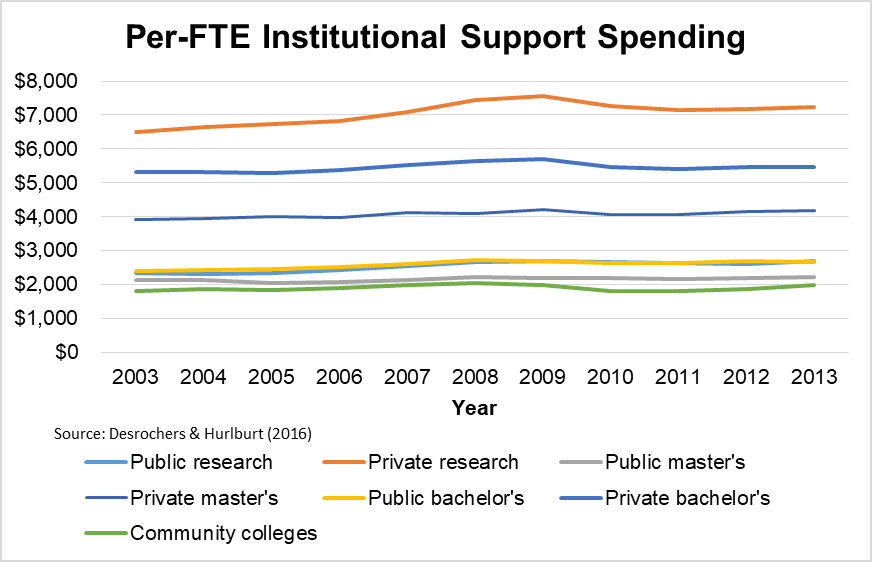
First, let’s take a look at trends in administrative expenditures and staffing over the last decade or two. Here are charts on inflation-adjusted per-FTE expenditures for instruction, academic support, institutional support, and student services between 2003 and 2013 (courtesy of Delta Cost Project analyses). The charts show that spending on student services and academic support increased faster than both inflation and instructional expenditures, while institutional support expenditures (the IPEDS expenditure category most closely associated with administration) increased about as fast as instructional expenditures.

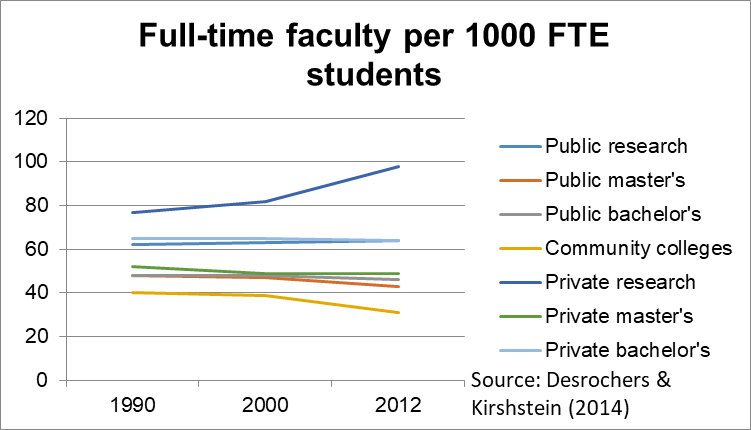
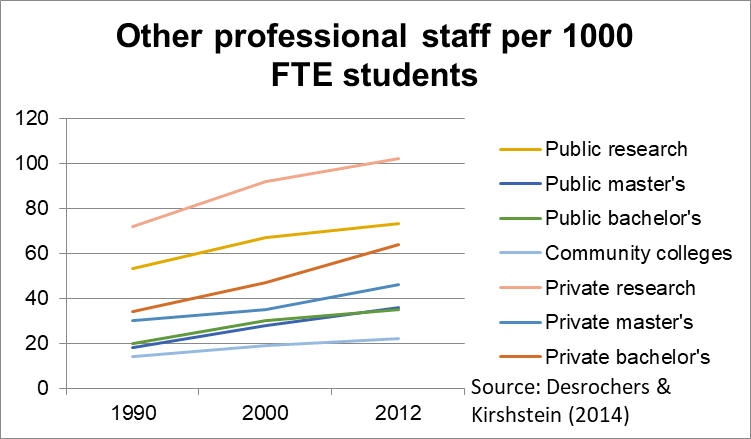
Turning to staffing trends, I again use Delta Cost Project data to look at the ratios of full-time faculty, part-time faculty, administrators, and staff per 1,000 FTE students. In general, the ratio of full-time faculty and administrators per 1,000 students held fairly constant across time in most sections of higher education. However, the ratio of part-time faculty and professional staff members (lower-level administrators) increased markedly across higher education.

The data suggest that there has not been a massive explosion of high-level administrators, but there has been substantial growth in low- to mid-level academic support and student services staff members. What might be behind that growth in professional staff members? I offer two potential explanations below.

Explanation 1: Students need/want more services than in the past. As most colleges have enrolled increasingly diverse student bodies and institutions respond to pressures to graduate more students, it’s not surprising that colleges have hired additional staff members to assist with academic and social engagement. Students have also demanded additional services, such as more staff members to support campus diversity initiatives. (Lazy rivers and climbing walls could factor in here, but there are limited to such a small segment of higher education that they’re likely to be a rounding error in the grand scheme of things.)

Explanation 2: Staff members are doing tasks that faculty members used to do, which may not necessarily be a bad thing. A good example here is academic advising. Decades ago, it was far more common for faculty members to advise undergraduate students from their first year on. But over the years, professional academic advisers have taken on these responsibilities at many campuses, leaving faculty members to advise juniors and seniors within a major. To me, it seems logical to allow lower-paid professional advisers to work with first-year and second-year students, freeing up the time of higher-paid faculty members to do something else such as teach or do research. (I also have a strong hunch that professional advisers are better at helping students through general education requirements than faculty members, but I’d love to see more research on that point.)

In summary, there are lots of gripes coming from both faculty members and the public about the number of assistant and associate deans on college campuses. But most of the growth in non-faculty employees is among lower-level student and academic affairs staff members, not among highly-paid deans. There is still room for a robust debate about the right number of staff members and administrators, but claims of massive administrative bloat are not well-supported across all of higher education.

It’s hard to believe that a faculty member is writing this, but I do feel that most administrators do serve a useful purpose. As I told The Chronicle of Higher Education in a recent interview (conducted via e-mail while I was waiting for a meeting with an associate dean—I kid you not!), “Faculty do complain about all of the assistant and associate deans out there, but this workload would otherwise fall on faculty. And given the research, teaching, and service expectations that we face, we can’t take on those roles.”

Will The K-12 Teacher Walkouts Affect Public Higher Education?

Perhaps the most interesting education policy development to this point in 2018 has been the walkouts by public school teachers in three states (Kentucky, Oklahoma, and West Virginia) that have resulted in thousands of schools being closed as teachers descended on statehouses to demand better pay. These job actions (which are technically not strikes in some states due to labor laws, but operate in the same way) have been fairly successful for teachers to this point. West Virginia teachers received a five percent pay increase to end their walkout, while Oklahoma teachers received a pay increase of about $6,000. Kentucky teachers had rather limited success, while Arizona is on the verge of a teacher walkout later this week.

Given the success of these walkouts in politically conservative states, it is reasonable to expect K-12 public school teachers in other states to adopt the same tactics to increase their salaries or education funding in general. But what might these walkouts mean for public higher education? I present four possible scenarios below.

Scenario 1: Future K-12 teacher walkouts are ineffective. It’s probably safe to say that legislators in other states are strategizing about how to respond to a potential walkout in their state. If legislators do not want to increase K-12 education spending and can maintain a unified front, it’s possible that protests die out amid concerns that closing schools for days at a time hurts students. In that case, expect no implications for public higher education.

Scenario 2: Public college employees join the walkout movement. Seeing the victories that K-12 teachers have scored, faculty and staff walk out at public colleges in an effort to secure more higher education funding. While this could theoretically work, public support is likely to be much weaker for colleges and universities than K-12 teachers. Republicans in particular now view college professors far more skeptically than Democrats, while the two parties view K-12 public schools similarly. So this probably won’t work too well in conservative states.

Scenario 3: Future K-12 teacher walkouts are effective—and paid for by tax increases. Oklahoma paid for its increase in teacher salaries by increasing taxes in a number of different areas, although teachers wanted a capital gains tax exemption to be eliminated. This probably reduces states’ ability to raise additional revenue in the future—which could affect public colleges—but the immediate effects on public colleges should be pretty modest.

Scenario 4: Future K-12 teacher walkouts are effective—and paid for by reducing state spending in other areas. This is the nightmare scenario for public higher education. Higher education has traditionally been used as the balancing wheel in state budgets, with the sector being the first to experience budget cuts due to the presence of tuition-paying students. Therefore, in a zero-sum budget game without tax increases, more K-12 spending may come at the expense of higher education spending. West Virginia paid for its teacher pay increase this year in part by cutting Medicaid spending, but don’t expect most states to take that path in the longer term.

To sum up, the higher education community should be watching the K-12 walkouts very closely, as they could affect postsecondary students and faculty. And there may end up being some difficult battles in tax-averse states between K-12 and higher education advocates about how to divide a fixed amount of funds among themselves.

Why ACICS Will Likely Close Soon

The Accrediting Council for Independent Colleges and Schools (ACICS) has had a rather eventful last few years. The onetime accreditor of ITT Tech, Corinthian Colleges, and hundreds of other vocationally-focused colleges (primarily in the for-profit sector) was stripped of its ability to recognize colleges for federal financial aid purposes by the U.S. Department of Education in December 2016. This meant that 269 ACICS-accredited colleges serving 527,000 students had 18 months (until June 12, 2018) to find a new accreditor or their students would no longer have access to federal grants or student loans.

While ACICS-accredited colleges scrambled to find a new accreditor, ACICS sued the U.S. Department of Education in federal court on the grounds that their accreditation was unfairly terminated. In late March, a federal judge agreed with ACICS that there had been a procedural violation and sent the case back to the Department of Education to be reconsidered. Secretary of Education Betsy DeVos took a different view than former Secretary John King, announcing last week that ACICS would be allowed to become a recognized accreditor once again while ED continues to review the case.

Secretary DeVos’s decision gives ACICS at least a temporary reprieve by resetting the clock on how long ACICS-recognized colleges can receive federal financial aid—and this not surprisingly resulted in howls of protest from representatives of liberal-leaning organizations. But although ACICS will continue to exist in the short term, I expect that ACICS will no longer exist in five years. I explain the two reasons for my prediction below.

First, most ACICS-accredited colleges have already moved to another accreditor or are in the process of doing so. A Center for American Progress analysis shows that just 19 of the 269 colleges that were a part of ACICS are likely still open and have not made a clear move toward another accreditor. A number of colleges have already closed, while others are well on the road to accreditation. The 19 colleges that will likely stick with ACICS have about 25,000 students—making it financially difficult for ACICS to continue with such a small membership.

Second, I don’t think that ACICS’s reputation can ever recover from the experience of having accredited ITT Tech and Corinthian and then having its federal recognition stripped by the Obama administration. Although ACICS has a goal of being “a leader among accreditors,” any college that seeks ACICS accreditation is taking a sizable risk at this point. Blue-state attorneys general will likely continue to investigate ACICS given their longstanding opposition to the body, and future Democratic presidents may try to derecognize ACICS in an effort to undo the Trump administration’s actions. Large for-profits are also likely to avoid ACICS due to concerns from shareholders, and smaller for-profits may not be enough for the organization to make ends meet.

As far as I know, ACICS may be making real strides toward raising their standards and improving student outcomes. But any efforts they are undertaking are likely to be in vain as colleges try to find a safer harbor, resulting in their eventual collapse.

New Higher Education Policy Voice: Dominique Baker

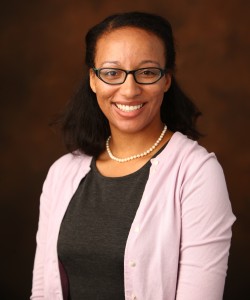
Dominique Baker (@bakerdphd) is a second-year assistant professor of education policy at Southern Methodist University, where her research focuses on student financial aid and equity in higher education. A prolific scholar (her CV is available here), her work addresses policy-relevant topics in a way that should be the goal of every assistant professor. (Also, SMU does a great job highlighting the research of their faculty members, which is a nice model for other universities to follow.) Her work is informed by her time working in college access, including one year in the Virginia College Advising Corps and three years in the admissions office at the University of Virginia. Her experience working with students from lower-income families led her to do research on student financial aid and allows her to bring real-world experience to studying the topic.

Along with my Seton Hall colleague Richard Blissett—another great junior faculty member—Dominque published an article in The Journal of Higher Education examining potential factors associated with the development of student diversity movements on college campuses. The article got quite a bit of media coverage, including a piece in The Chronicle of Higher Education. Dominique also published a great article in The ANNALS of the American Academy of Political and Social Science with Will Doyle of Vanderbilt examining whether community college students who borrow have different academic trajectories than those who do not. They find a relatively small negative relationship between borrowing and long-term credit attainment, which adds to an interesting literature on the effects of debt.

Note: This is the final installment in the New Higher Education Policy Voices series for 2018. Please keep sending along recommendations for great people to keep an eye on, as I hope to do another series in the future. Here are the other individuals in this series:

Chris Marsicano, Vanderbilt University

Denisa Gándara, Southern Methodist University

Ellie Bruecker, University of Wisconsin-Madison

Oded Gurantz, Stanford University (University of Missouri-Columbia in fall 2018)

Amy Li, University of Northern Colorado

Benjamin Skinner, University of Virginia

Kelly Rosinger, Penn State University

The Potential Role of States in Setting Living Allowance Estimates

For most American college students, the non-tuition portions of the cost of attendance (room and board, books and supplies, and a miscellaneous expenses category) are larger than tuition and fees. Colleges can set these estimates as they deem fit, and previous research by me, Sara Goldrick-Rab of Temple University, and Braden Hosch of Stony Brook University shows a large amount of variation in living allowances among colleges in the same geographic area. This means that similar students can access different amounts of financial aid—and that colleges with the same tuition price can look much different in a range of accountability measures.

As the U.S. Department of Education currently does not provide guidance for colleges in setting these allowances (and Higher Education Act reauthorization looks increasingly unlikely in 2018), it is worth exploring whether states should step in and provide some assistance for their public colleges and universities. In the two blog posts below, I teamed up with David Tandberg of the State Higher Executive Officers Association and Sarah Pingel of Education Commission of the States to further examine the topic.

Detailed post (with data on variations within and across states)

Summary post

We would love to hear your thoughts on this issue, so send them along!

The 2018 Net Price Madness Bracket

Every year, I take the 68 teams in the NCAA Division I men’s basketball tournament and fill out a bracket based on colleges with the lowest net price of attendance (defined as the total cost of attendance less all grant aid received). My 2017, 2016, 2015, 2014 and 2013 brackets are preserved for posterity—and often aren’t terribly successful on the hardwood. My 2015 winner (Wichita State) won two games in the tournament, while prior winners New Orleans (2017), Fresno State (2016), Louisiana-Lafayette (2014), and North Carolina A&T (2013) emerged victorious for having the lowest net price but failed to win a single game. But at least West Virginia (a regional champion last year) won two games, so maybe there is some hope for this method.

I created a bracket using 2015-16 data (the most recent available through the U.S. Department of Education for the net price of attendance for all first-time, full-time students receiving grant aid I should note that these net price measures are far from perfect—the data are now three years old and colleges can manipulate these numbers through the living allowance portion of the cost of attendance. Nevertheless, they provide some insights regarding college affordability—and they may not be a bad way to pick that tossup 8/9 game that you’ll probably get wrong anyway.

The final four teams in the bracket are the following, with the full dataset available here:

East: Cal State-Fullerton ($8,170)

West: UNC-Chapel Hill ($10,077)

South: Wright State ($14,464)

Midwest: New Mexico State ($10,213)

Kudos to Cal State-Fullerton for having the lowest net price for all students ($8,170), with an additional shout-out to UNC-Chapel Hill for having the lowest net price among teams that are likely to make it to the final weekend of basketball ($10,077). (Also, kudos to the North Carolina system for having two universities in the last eight.)

Additionally, although I didn’t do a bracket for students in the lowest family income category (below $30,000) this year, the University of Michigan has the lowest net price in that category (at $2,660). Although Michigan doesn’t serve that many low-income students, a new program (designed in part by all-star Michigan economist Susan Dynarski) guarantees four years of free tuition for in-state students with family incomes below $65,000. That’s a good step for a wealthy public university to take.

New Higher Education Policy Voice: Kelly Rosinger

Kelly Rosinger (@kelly_rosinger) is a first-year assistant professor in the Department of Education Policy Studies at Penn State University. Before that, she was an Institute of Education Sciences postdoc at the University of Virginia, where she worked with Ben Castleman’s Nudge4 team applying behavioral interventions to improve the college choice process. An expert in experimental and quasi-experimental research methods, Kelly’s work focuses on the barriers students face on the way to and through college and the impact of policies and interventions aimed at helping students navigate college decisions. Her work influenced by her experience working in admissions at the University of Georgia.

Kelly has a new article in press at Education Finance and Policy that reports findings from a field experiment and quasi-experiment examining the impact of a recent federal policy effort to simplify financial aid award offers on borrowing. The study shows that the informational intervention reduced borrowing at colleges enrolling high shares of Pell recipients and underrepresented minority students, suggesting such interventions may be particularly salient to students who face greater informational barriers to college. She also co-authored an article in Educational Evaluation and Policy Analysis (which was just republished in a high-profile book) examining whether test-optional admissions practices at elite liberal arts colleges actually result in a more diverse student body. You can hear Kelly discuss the research on the Matt Townsend Show. They found that at those particular colleges, test-optional practices did not increase diversity.

New Research on Equity Provisions in State Performance Funding Policies

Previous versions of state performance-based funding (PBF) policies were frequently criticized for encouraging colleges to simply become more selective in order to get more state funding (see a good summary of the research here). This has potential concerns for equity, as lower-income, first-generation, adult, and racial/ethnic minority students often need additional supports to succeed in college compared to their more advantaged peers.

With the support of foundations and advocacy organizations, the most recent wave of state PBF policies has often included provisions that encourage colleges to enroll traditionally underrepresented students. For example, Indiana now gives $6,000 to a college if a low-income student completes a bachelor’s degree; while this is far less than the $23,000 that the college gets if a student completes their degree in four years, it still provides an incentive for colleges to change their recruitment and admissions practices. Today, at least sixteen states provide incentives for colleges to serve underrepresented students.

Given the growth of these equity provisions, it is not surprising that researchers are now turning their attention to these policies. Denisa Gandara of SMU and Amanda Rutherford of Indiana University published a great article in Research in Higher Education last fall looking at the effects of these provisions among four-year colleges. They found that the policies were at least somewhat effective in encouraging colleges to enroll more racial/ethnic minority and lower-income students.

As occasionally happens in the research world, multiple research teams were studying the same topic at the same time. I was also studying the same topic, and my article was accepted in The Journal of Higher Education a few days before their article was released. My article is now available online (the pre-publication version is here), and my findings are generally similar—PBF policies with equity provisions can at the very least help reduce incentives for colleges to enroll fewer at-risk students.

The biggest contribution of my work is how I define the comparison group in my analyses. The treatment group is easy to define (colleges that are subject to a PBF policy with equity provisions), but comparison groups often combine colleges that face PBF without equity provisions with colleges that are not subject to PBF. By dividing those two types of colleges into separate comparison groups, I can dig deeper into how the provisions of performance funding policies affect colleges. And I did find some differences in the results across the two comparison groups, highlighting the importance of more nuanced comparison groups.

Much more work still needs to be done to understand the implications of these new equity provisions. In particular, more details are needed about which components are in a state’s PBF system, and qualitative work is sorely needed to help researchers and policymakers understand how colleges respond to the nuances of different states’ policies. Given the growing group of scholars doing research in this area, I am confident that the state of PBF research will continue to improve over the next few years.

Why Accountability Efforts in Higher Education Often Fail

This article was originally published at The Conversation.

As the price tag of a college education continues to rise along with questions about academic quality, skepticism about the value of a four-year college degree has grown among the American public.

This has led both the federal government and many state governments to propose new accountability measures that seek to spur colleges to improve their performance.

This is one of the key goals of the PROSPER Act, a House bill to reauthorize the federal Higher Education Act, which is the most important law affecting American colleges and universities. For example, one provision in the act would end access to federal student loans for students who major in subjects with low loan repayment rates.

Accountability is also one of the key goals of efforts in many state legislatures to tie funding for colleges and universities to their performance.

As a researcher who studies higher education accountability – and also just wrote a book on the topic – I have examined why policies that have the best of intentions often fail to produce their desired results. Two examples in particular stand out.

Federal and state failures

The first is a federal policy that is designed to end colleges’ access to federal grants and loans if too many students default on their loans. Only 11 colleges have lost federal funding since 1999, even though nearly 600 colleges have fewer than 25 percent of their students paying down any principal on their loans five years after leaving college, according to my analysis of data available on the federal College Scorecard. This shows that although students may be avoiding defaulting on their loans, they will be struggling to repay their loans for years to come.

The second is state performance funding policies, which have encouraged colleges to make much-needed improvements to academic advising but have not resulted in meaningful increases in the number of graduates.

Based on my research, here are four of the main reasons why many accountability efforts fall short.

1. Competing initiatives

Colleges face many pressures that provide conflicting incentives, which in turn makes any individual accountability policy less effective. In addition to the federal government and state governments, colleges face strong pressures from other stakeholders. Accrediting agencies require colleges to meet certain standards. Faculty and student governments have their own visions for the future of their college. And private sector organizations, such as college rankings providers, have their own visions for what colleges should prioritize. (In the interest of full disclosure, I am the methodologist for Washington Monthly magazine’s college rankings, which ranks colleges on social mobility, research and service.)

As one example of these conflicting pressures, consider a public research university in a state with a performance funding policy that ties money to the number of students who graduate. One way to meet this goal is to admit more students, including some who have modest ACT or SAT scores but are otherwise well-prepared to succeed in college. This strategy would hurt the university in the U.S. News & World Report college rankings, which judge colleges in part based on ACT/SAT scores, selectivity and academic reputation.

Research shows that students considering selective colleges are influenced by rankings, so a university may choose to focus on improving their rankings instead of broadening access in an effort to get more state funds.

2. Policies can be gamed

Colleges can satisfy some performance metrics by gaming the system, instead of actually improving their performance. The theory behind many accountability policies is that colleges are not operating in an efficient manner and that they must be given incentives in order to improve their performance. But if colleges are already operating efficiently – or if they do not want to change their practices in response to an external mandate – the only option to meet the performance goal may be to try to game the system.

An example of this practice is with the federal government’s student loan default rate measure, which tracks the percentage of borrowers who default on their loans within three years of when they are supposed to start repaying their loans. Colleges that are concerned about their default rates can encourage students to enroll in temporary deferment or forbearance plans. These plans result in students owing more money in the long run, but also they push the risk of default outside the three-year period that the federal government tracks, which essentially lets colleges off the hook.

3. Unclear connections

It’s hard to tie individual faculty members to student outcomes. The idea of evaluating teachers based on their students’ outcomes is nothing new; 38 states require student test scores to be used in K-12 teacher evaluations, and most colleges include student evaluations as a criterion of the faculty review process. Tying an individual teacher to a student’s achievement test scores has been controversial in K-12 education, but it is far easier than identifying how much an individual faculty member contributes to a student’s likelihood of graduating from college or repaying their loans.

For example, a student pursuing a bachelor’s degree will take roughly 40 courses during their course of study. That student may have 30 different professors over four or five years. And some of them may no longer be employed when the student graduates. Colleges can try to encourage all faculty to teach better, but it’s difficult to identify and motivate the worst teachers because of the elapsed time between when a student takes a class and when he or she graduates or enters the workforce.

4. Politics as usual

Even when a college should be held accountable, politics often get in the way. Politicians may be skeptical of the value of higher education, but they will work to protect their local colleges, which are often one of the largest employers in their home states. This means that politicians often act to stop a college from losing money under an accountability system.

The ConversationTake for example Senate Majority Leader Mitch McConnell, R-Ky., who was sympathetic to the plight of a Kentucky community college with a student loan default rate that should have resulted in a loss of federal financial aid. He got a provision added to the recent federal budget agreement that allowed only that college to appeal the sanction.

New Higher Education Policy Voice: Benjamin Skinner

Benjamin Skinner (@btskinner) is a first-year research assistant professor in the Curry School of Education at the University of Virginia. His research interests include quantitative methods, the geography of opportunity, and broad-access colleges. While working on his dissertation at Vanderbilt, he co-authored two great articles with his committee chair Will Doyle. The first, in Economics of Education Review, estimated the economic returns to college using geographic variation in the location of colleges to draw causal inference. The second, in The Journal of Higher Education (and an article that I use in my higher ed finance class), used a similar estimation strategy to look at the relationship between years of education and civic engagement.

Ben is perhaps best known for his incredible work with data—and for his willingness to share his code and materials with the general public. (More scholars should be doing this!) For example, the “code” page of his website includes helpful packages to help download and manage the massive College Scorecard dataset and how to work with LaTeX files. He has also put together some interesting data visualizations of college opportunity that look great and tell a compelling story. There is also quite a bit of material on his GitHub page, which is a great way to work with large data files (and something that I probably should learn at some point).