Blog (Kelchen on Education)

Understanding Financial Responsibility Scores for Private Colleges

This post originally appeared on the Brookings Institution’s Brown Center Chalkboard blog.

The stories of financially struggling private colleges, both nonprofit and for-profit, have been told in many news articles. Small private nonprofit colleges are increasing tuition discount rates in an effort to attract a shrinking pool of traditional-age students in many parts of the country, while credit rating agency Moody’s expects the number of private nonprofit college closings to triple to about 15 per year by next year. Meanwhile, the for-profit sector has seen large enrollment decreases in the last few years amid the collapse of Corinthian Colleges and the University of Phoenix’s 50 percent drop in enrollment since 2010.

In an effort to identify financially struggling colleges and protect federal investments in student financial aid, Congress requires the U.S. Department of Education to calculate financial responsibility composite scores that are designed to measure a college’s overall financial strength based on metrics of liquidity, ability to borrow additional funds if needed, and net income. Private nonprofit and for-profit colleges are required to submit financial data each year, while public colleges are excluded under the assumption that state funding makes them unlikely to become insolvent.

Though not commonly known, these financial responsibility scores have important consequences for private colleges.  Scores can range between -1.0 and 3.0, with colleges scoring at or above 1.5 being considered financially responsible and are allowed to access federal funds. Colleges scoring between 1.0 and 1.4 can access financial aid dollars, but are subject to additional Department of Education oversight of their financial aid programs. Finally, colleges scoring 0.9 or below are not considered financially responsible and must submit a letter of credit of at least 10 percent of federal student aid from the previous year and be subject to additional oversight to get access to funds. The Department of Education can also determine that a college does not meet “initial eligibility requirements due to a failing composite score” and assign it a failing grade without releasing a score to the public. In this case, a college will be immediately subject to heightened cash monitoring rules that delay the federal government’s disbursement of financial aid dollars to colleges. However, private nonprofit colleges dispute the validity of the formula, claiming it is inaccurate and does not meet current accounting standards.

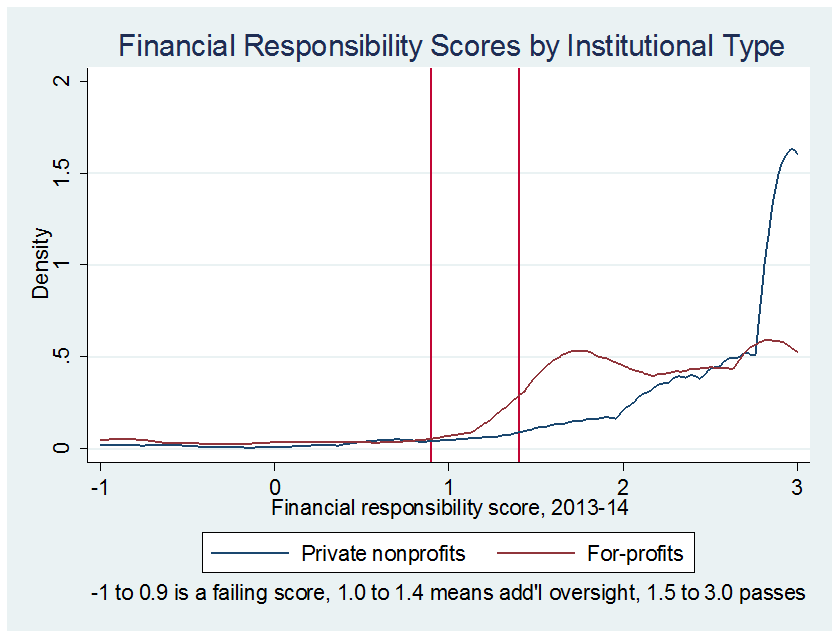
I first examined the distribution of financial responsibility scores among the 3,435 institutions (1,683 private nonprofit and 1,752 for-profit) with scores in the 2013-14 academic year, using data released to the public earlier this month. As illustrated in the figure below, only a small percentage of colleges that were assigned a score did not pass the test. In 2013-14, 203 colleges (73 nonprofit and 130 for-profit) received a failing score and an additional 136 (51 nonprofit and 85 for-profit) were in the oversight zone. Most of the colleges with failing scores are obscure institutions, such as the Champion Institute of Cosmetology in California and The Chicago School for Piano Technology. However, a few of these institutions, such as for-profit colleges Charleston School of Law, ITT Technical Institute, and Vatterott Colleges as well as nonprofit colleges Erskine College in South Carolina, Everglades University in Florida (a former for-profit) and Finlandia University in Michigan are at least somewhat better-known.

finscore_fig1

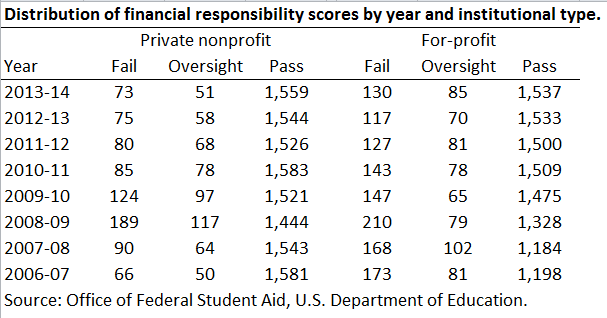
I then examined trends in financial responsibility scores since when scores were first released to the public in the 2006-07 academic year. The first finding to note in the below table is that the number of nonprofit colleges that did not pass the financial responsibility test nearly doubled between 2007-08 and 2008-09, including more than one in six institutions. Much of this increase appears to be due to the collapse in endowment values, as even a decline in a rather small endowment would affect a college’s score through reducing net income. During the same period, there was only a slight increase in the number of for-profit colleges facing additional oversight.

finscore_fig2

The second interesting trend is that in spite of concerns about the viability of small colleges with high tuition prices since the Great Recession, the number of colleges that either received a failing score or faced additional oversight has slowly declined since 2010-11. Only 12 percent of for-profits and seven percent of nonprofits failed in 2013-14, reflecting a general stabilizing trend for struggling private institutions.  Although there are certainly valid concerns about how these scores are calculated, most colleges with failing scores and some others facing additional oversight are likely on shaky financial footing. Many of these colleges with failing scores—particularly for several years in a row—will be forced to consider merging with another institution or closing their doors entirely in the near future. Other colleges closer to the passing threshold may be facing tight budgets for years to come, but their short-term viability is generally secure.

It is unlikely that a substantial number of students and families know that financial responsibility scores even exist, let alone use them in their college choice decisions. However, these scores do provide some potential insights into the financial stability of a college and could potentially be included in the new College Scorecard tool. Students who are considering attending a college that repeatedly receives a failing score should ask tough questions of college officials about whether they will be financially solvent several years from now. Policymakers should use these scores as a way to identify financially struggling institutions and provide support for ones with solid academic outcomes, while also asking tough questions about the viability of cash-strapped colleges that academically underperform similar colleges.

The 2016 Net Price Madness Bracket

Every year, I take the 68 teams in the NCAA Division I men’s basketball tournament and fill out a bracket based on colleges with the lowest net price of attendance (defined as the total cost of attendance less all grant aid received). My 2015, 2014 and 2013 brackets are preserved for posterity—and aren’t terribly successful on the hardwood. My 2015 winner (Wichita State) won two games in the tournament, while prior winners Louisiana-Lafayette and North Carolina A&T emerged victorious for having the lowest net price but failed to win a single game.

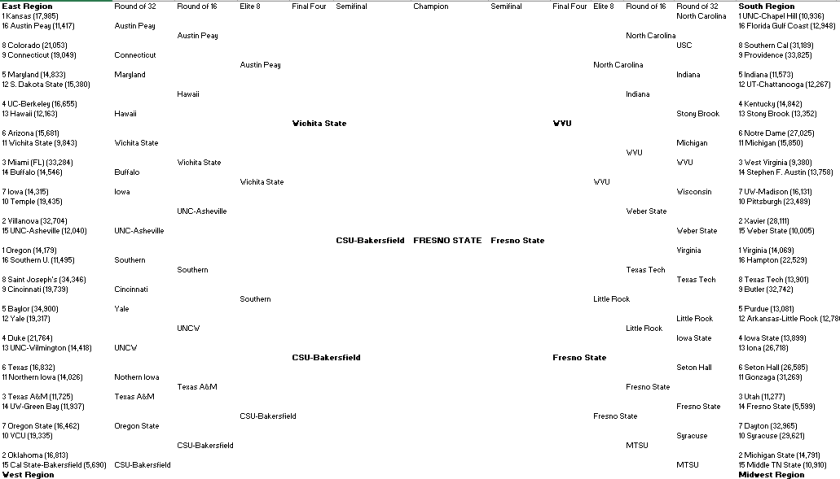
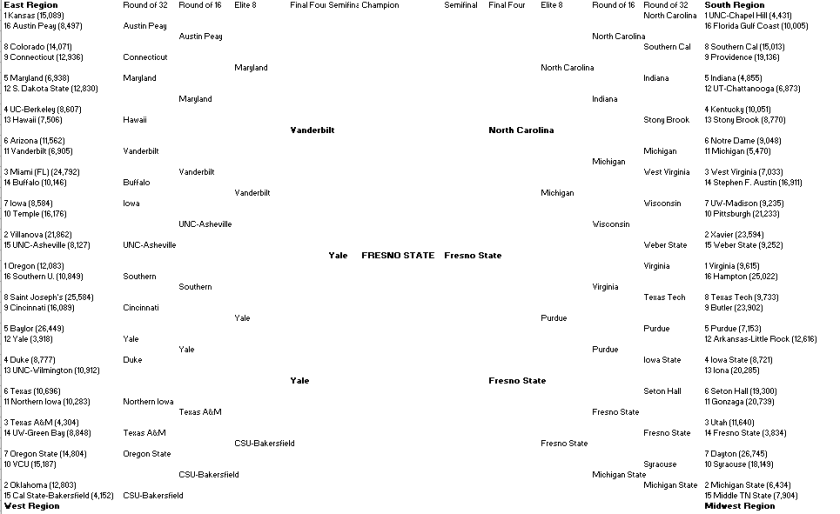
I created two brackets this year using 2013-14 data (the most recent available through the U.S. Department of Education): one for the net price of attendance for all students and one focusing on students with family incomes below $30,000 per year. The final four teams in each bracket are the following:

All student receiving aid

East: Wichita State ($9,843)

West: Cal State-Bakersfield ($5,690)

South: West Virginia ($9,380)

Midwest: Fresno State ($5,599)

netprice_all_2016

Low-income students only

East: Vanderbilt ($6,905)

West: Yale ($3,918)

South: North Carolina ($4,431)

Midwest: Fresno State ($3,835)

netprice_low_2016

A big congratulations to Fresno State and the state of California for winning this year’s edition of Net Price Madness across both categories.

What the Leading Republican Presidential Candidates Are Saying About College Affordability

With cumulative student loan debt exceeding $1.2 trillion and the average net price of college attendance continuing to rise, college affordability has become an important issue in the 2016 presidential election. Most of the attention on this topic has been in the Democratic primary, in which Vermont Senator Bernie Sanders and former Secretary of State Hillary Clinton both have ambitious plans to make public colleges either tuition-free (Sanders) or debt-free (Clinton) that have played a prominent role in their campaigns.

College affordability has played a much smaller role in the Republican primary to this point, with topics such as foreign policy and immigration getting far more attention from the candidates. Yet the rising price of college is likely to be an important issue in the general election, particularly among younger adults who tend to lean toward supporting Democratic candidates. Here, I examine the leading Republican candidates’ positions on how to make higher education more affordable for students and their families.

Donald Trump

The billionaire businessman and political novice has gained attention recently for his foray into for-profit higher education through the Trump Entrepreneur Initiative, which was previously known as Trump University before New York’s attorney general sued to stop Trump from using the term “university.” Trump is also facing lawsuits from former students who claimed that they got no value from their investment of up to $35,000 in real estate seminars.

In multiple interviews, Trump has stated his intention to either close or substantially downsize the U.S. Department of Education, although much of his rationale appears to be due to opposition to the Common Core standards at the K-12 level. In his only statement regarding higher education affordability, Trump has criticized the Department of Education for making a profit on the federal student loan program. Trump shares this view with many Democratic legislators, even though government agencies have different opinions about the profitability of student loans.

Sen. Marco Rubio

The first-term Florida senator has significant experience with higher education, having been an adjunct professor of political science at Florida International University between 2008 and 2015. In the Senate, Rubio has co-sponsored bipartisan legislation that would make income-based repayment the default option for federal student loans and would require colleges to report additional data on student outcomes. He has also co-sponsored a bipartisan bill that would open the federal financial aid program to alternative education providers that can meet certain outcome standards and gain accreditation, although he has also faced criticism for his defense of for-profit colleges whose access to federal funds has been threatened.

Rubio has also supported ideas that are likely to appeal to Republican primary voters but may not be as popular with independent-minded voters in a general election. Like Trump, Rubio has also called for the elimination of the Department of Education. Rubio has noted that some programs currently administered by the federal government should continue (such as the federal student loan program), but they could be absorbed by the Department of the Treasury or other agencies. He has sponsored legislation in the Senate to allow students to use private income share agreements, which function similarly to private loans with income-based repayment, to finance their education. This idea has been criticized as a form of indentured servitude, even though federal loans function in similar ways.

Sen. Ted Cruz

The first-term Texas senator has said relatively little about college affordability, other than noting that he just recently paid off his $100,000 in student loan debt. Like the other GOP candidates, he has called for the vast majority of the Department of Education to be eliminated. Cruz would appoint an Education Secretary whose sole goal would be to determine which programs should remain and give most funding to the states via block grants. In 2012, Cruz indicated that he would keep federal student aid funds in the federal budget, but transfer funding and authority to the states.

As Democrats will certainly keep at least 40 seats in the U.S. Senate (the minimum needed to sustain a filibuster to block legislation) and may gain a majority in this fall’s election, it doesn’t appear that the Department of Education will go away anytime soon. But if any of these three Republican candidates are elected, their actions on affordability—and the implications for both students and taxpayers—are likely to be quite different than what a Clinton or Sanders administration will be proposing.

Comments on New America’s Financial Aid Reform Plan

In the last few years, there have been a dizzying number of proposals put forth to reform the complex and confusing system of student financial aid in the United States. From a series of 16 proposals released in the 2012-13 academic year through the Gates Foundation’s Reimagining Aid Design and Delivery project to Sara Goldrick-Rab and Nancy Kendall’s proposal for a free two-year public college option to a host of financial aid reforms proposed by the 2016 presidential candidates, there is no shortage of ideas to reform financial aid. (And I’ve got plenty of ideas of my own.)

The newest thoughtful proposal to add to the mix comes from New America’s education team, many of whom have significant experience in state and/or federal higher education policy. In this proposal, “Starting from Scratch: A New Federal and State Partnership in Higher Education,” the New America team proposes completely throwing out the current federal financial aid system and replacing it with a federal/state partnership with maintenance of effort requirements for states and accountability requirements for colleges while requiring colleges and states to cover students’ unmet financial need. Below, I summarize some of the key pieces of the proposal that I like, some that I dislike, and some that require a lot of additional thought.

Things I like

(1) Unlike some of the other financial aid proposals out there, the New America proposal has provisions to go beyond public colleges and universities to cover at least a segment of private nonprofit and for-profit colleges. This is an important recognition, as all colleges that currently receive federal financial aid are public in one sense of the word. A financial aid system that only supports students attending public colleges could result in a stampede to public institutions, which could be a problem in states with historically small public sectors (such as in the Northeast).

(2) Plowing funds currently spent on tax credits and deductions into student financial aid isn’t a new idea (and New America raised it in 2013), but it makes perfect sense. Research has shown that tax credits and deductions have no effect on college enrollment or completion, likely because the money gets to students well after enrollment (assuming they remember to claim the funds on their tax return).

(3) I’m glad to see the New America team questioning the current definitions of both the cost of attendance (COA) and the expected family contribution (EFC). As I’ve shown in research with Sara Goldrick-Rab and Braden Hosch, the non-tuition portions of the COA are determined by colleges and vary drastically within the same geographic area. The EFC has been criticized as being an outdated formula that doesn’t adequately reflect a family’s ability to pay. I’d like to see New America dig in deeper on both of these areas.

Things I don’t like

(1) I’m generally uncomfortable with the idea of ‘maintenance of effort’ proposals that require states to keep a certain level of funding per full-time equivalent (FTE), as the New America plan does. As I’ve written about before, states tend to think about funding in terms of overall funding amounts (not on a per-FTE basis) because they don’t directly control enrollment levels. If this program shifts a larger percentage of enrollment to public colleges, required state funding levels for higher education will rise at the same time states are already legally or constitutionally required to fund other priorities. I also think that maintenance of effort requirements will result in states lobbying Congress to defeat this proposal (and I also think that states would opt out despite the authors’ insistence that it wouldn’t happen).

(2) I don’t like states choosing which colleges could receive financial aid under the partnership model. I would rather see all colleges that meet quality and accountability thresholds receive funding regardless of their state affiliation or tax status. It may very well be the case that fewer for-profits or private nonprofits meet the threshold, but as long as the threshold is justified, I’m fine with that. But excluding all non-public institutions immediately (and at the whim of state policymakers) doesn’t make sense to me.

(3) I’m concerned about getting rid of federal loans to cover the EFC, while simultaneously placing additional regulations on private loans. This could result in students not being able to get access to credit at reasonable interest rates, as private lenders may choose to not offer loans when students can discharge them via bankruptcy. I would much rather see an income share agreement or income-based repayment model encouraged for private loans in this case, as this gives both students and lenders some level of protection.

Unclear

(1) The New America proposal calls for states to have a larger role in holding colleges accountable for their outcomes. This makes sense for colleges that just operate in one state, but is far trickier for colleges that operate in multiple states. If this were to happen, groups like the National Council for State Authorization Reciprocity Agreements (NC-SARA) would become even more important.

(2) I’m concerned that colleges would try to game the funding system on account of the requirement that 25% of students qualify for Pell Grants under the current EFC formula. If a college already has 30% of students receiving Pell Grants and has funding tied to meeting outcomes, it suddenly has an incentive to recruit a few more higher-income students with a higher likelihood of graduation. Research that I’ve done with my Seton Hall colleague Luke Stedrak (look for it soon in the Journal of Education Finance) shows that colleges in states subject to performance-based funding received less Pell funding that colleges not subject to performance funding after controlling for a host of other characteristics. It might be worth tweaking the system to reduce the possibility of gaming.

I’d love to hear your thoughts on New America’s discussion-worthy proposal. Drop me a note or leave a comment below!

Should Students Get Admission Preferences for Community Service?

A January report called “Making Caring Common” sponsored by the Harvard Graduate School of Education and endorsed by dozens of researchers and enrollment management professionals made headlines for calling on students seeking to attend elite colleges to focus less on college preparatory tests and more on community service while in high school. (The report also called on expanding the definition of what a “good” college is, but that’s a topic for another day.)

Last weekend’s New York Times included an interesting proposal from attorney Steve Cohen in response to this report. He wrote the following:

“The best way for colleges to tell kids they truly value a concern about others and a real commitment to community service is to announce that they’ll give an admissions bump of one standard deviation to anyone who spends two years after high school doing full-time AmeriCorps-type community or military service.”

Essentially, Cohen is calling for an expansion of the ‘gap year’ between high school and college. While this sort of plan has some benefits (such as giving students a chance to mature before beginning their studies and providing potential opportunities to learn more about the world), I am skeptical that a two-year community service program would actually benefit students from lower-income families:

(1) Voluntary gap years are basically just for students from wealthy families. Although research from Sara Goldrick-Rab and Seong Wan Han shows that gap years are far more common for financially-needy students, these gap years are typically so students can transition to adulthood and pay for their education. Community service jobs are unlikely to pay the bills; AmeriCorps, for example, pays their full-time employees about $1,070 per month—far less than a full-time job flipping burgers or making biscuits. Students from wealthier families can rely on their parents to subsidize them while waiting to get into an elite college, while lower-income families may expect their college-age students to help pay the bills.

(2) Delaying enrollment for two years can hurt students when they get to college. A majority of first-time students who enroll in community college already take at least one remedial course while they are in college (remediation data at four-year colleges are tricky because some states and colleges technically do not offer remedial courses). Even among students who took college preparatory coursework, delaying enrollment by two years provides ample opportunity for many of the key math and writing skills to become rusty. This can result either in higher rates of remediation (and delaying the path to a degree) or struggling in the first year of courses (which can result in the loss of financial aid). For example, research by Robert Bozick and Stefanie DeLuca finds that delayed enrollees are less likely to earn a college degree than on-time enrollees, even after controlling for academic preparation and family income.

For these reasons, I highly doubt that giving admissions preferences to students who delay college to do community service will help non-wealthy students. However, I am intrigued by the preference for students with military experience, particularly as most elite colleges enroll few veterans. Research by Amy Lutz shows that young adults from the wealthiest family income quartile are less likely to serve in the military than those from lower-income or middle-income families. Military service also offers a better compensation package than community service, although at greater risk to the individual. These people who are willing to put their lives on the line certainly deserve special consideration in admissions, while young adults who can afford to do community service for two years likely do not.

How Colleges’ Net Prices Fluctuate Over Time

This piece first appeared at the Brookings Institution’s Brown Center Chalkboard blog.

As student loan debt has exceeded $1.2 trillion and many colleges continue to raise tuition prices faster than inflation, students, their families, and policymakers have further scrutinized how much money students pay to attend college. A key metric of affordability is the net price of attendance, defined as the total cost of attendance (tuition and fees, books and supplies, and a living allowance) less all grants and scholarships received by students with federal financial aid. The net price is a key accountability metric used in tools such as the federal government’s College Scorecard and the annual Washington Monthly college rankings that I compile. In this post, I am focusing on newly released net price data from the U.S. Department of Education through the 2013-14 academic year.

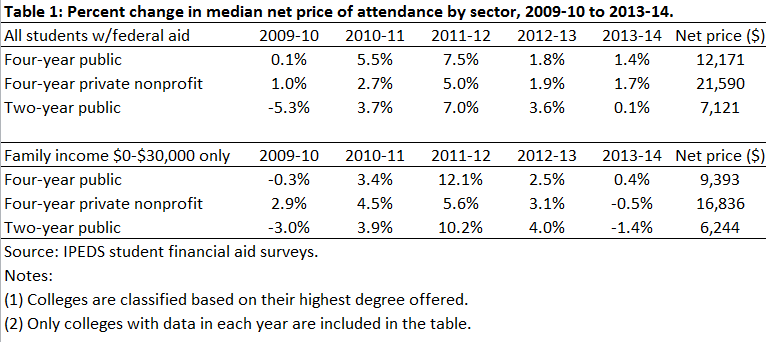
I first examined trends in net prices since the 2009-10 academic year for the 2,621 public two-year, public four-year, and private nonprofit four-year colleges that operate on the traditional academic year calendar. I do this for all students receiving federal financial aid (roughly 70% of all college students nationwide), as well as students with family incomes below $30,000 per year—roughly the lowest income quintile of students. Note that students from different backgrounds qualify for different levels of financial aid from both the federal government and the college they attend (and hence face different net prices). Table 1 shows the annual percentage changes in the median net price by sector over each of the five most recent years, as well as the median net price in 2013-14.

netprice_jan16_table1

The net price trends in the most recent year of data (2012-13 to 2013-14) look pretty good for students and their families. The median net price for all students with financial aid increased by just 0.1% at two-year public colleges, 1.4% at four-year public colleges, and 1.7% at four-year private nonprofit colleges—roughly in line with inflation. The lowest-income students saw lower net prices in 2013-14 at two-year public colleges (-1.4%) and four-year private nonprofit colleges (-0.5%) and a small 0.4% increase at four-year public colleges.

Even with one year of good news, net prices are up about 15% at four-year colleges and 10% at two-year colleges since the beginning of the Great Recession in 2009, with a slightly larger percentage increase for lower-income students. Much of this increase in net prices, particularly for lowest-income students, occurred during the 2011-12 academic year.

Although some may blame the lingering effects of the recession or reduced state funding for the increase, in my view the likely culprit appears to be changes made to the federal Pell Grant program. In 2011-12, the income cutoff for an automatic zero EFC (Expected Family Contribution, and hence automatically qualifying for the maximum Pell Grant) was cut from $31,000 to $23,000. This resulted in a 25% decline in the number of automatic zero EFC students and contributed to the average Pell award falling by $278—the first decline in average Pell awards since 2005.

I next examined potential reasons for colleges’ changes in net prices. As colleges are facing incentives to lower their net price, they can do so in three main ways. Lowering tuition prices or increasing institutional grant aid would both benefit students, but they are difficult for cash-strapped colleges to achieve.

If colleges want to lower their net price without sacrificing tuition or housing revenue, the easiest way to do so is to reduce living allowances for off-campus students. Colleges have wide latitude in setting these living allowances, and research that I’ve conducted with Sara Goldrick-Rab at Wisconsin and Braden Hosch at Stony Brook shows a wide range in living allowances within the same county. Here, I looked at whether colleges’ patterns of changing tuition and fees or their off-campus living allowance seemed to be related to their change in net price.

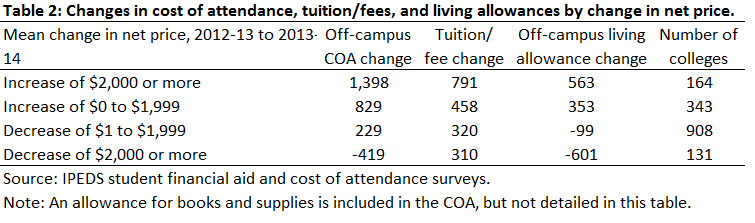
Table 2 shows the change between the 2012-13 and 2013-14 academic years in the total cost of attendance (COA), tuition and fees, and off-campus living allowances (for colleges with off-campus students), broken down by changes in the net price. Colleges with the largest increases in net price (greater than $2,000) increased their COA for off-campus students by $1,398, while colleges with smaller increases (between $0 and $1,999) increased their COA by $829. Both groups of colleges typically increased both tuition and fees and living allowances, which together resulted in the increase in COA.

netprice_jan16_table2

However, colleges with a reported decrease in net price between 2012-13 and 2013-14 had a different pattern of changes. They still increased tuition and fees, but they reduced off-campus living allowances in order to keep the cost of attendance lower. For example, the 131 colleges with a decrease in net price of at least $2,000 had average tuition increases of $310 while living allowances were reduced by $610. Some of these reductions in allowances may be perfectly reasonable (for example, if rent prices around a college fall), but others may deserve additional scrutiny.

The net price data provide useful insights regarding trends in college affordability, but students and their families should not necessarily expect the posted net price to reflect how much money they will need to pay for tuition, fees, and other necessary living expenses during the academic year. These metrics tend to be more accurate for on-campus students (as a college controls room and board prices), but everyone should also look at colleges’ net price calculators for more individualized price estimates as the net price for off-campus students in particular may not reflect their actual expenses.

Comments on the Bush Higher Education Proposal

The three Democratic candidates for president all released their plans for higher education fairly early in the campaign cycle, with Sen. Clinton, Gov. O’Malley, and Sen. Sanders’s plans all including some variation of tuition-free or debt-free public college. These plans are all likely dead on arrival in Congress due to their price tags ($350 billion for the Clinton plan) and the high probability that Republicans hold the House of Representatives through 2020, but the candidates deserve credit for making higher education a key part of their domestic policy platforms.

On the Republican side, higher education has been much less important during the campaign, with only Sen. Rubio having a framework (with a good number of components that may enjoy bipartisan support) in place for higher education before now. But Gov. Bush’s newly released proposal for education reform (as summarized in this piece written by Jason Delisle and Andrew Kelly, two informal advisors to the Bush campaign and people I greatly respect) reflects the most detailed proposal from any of the Republican candidates. (Gov. Bush’s summary on Medium is available here.) And like Rubio’s plan, there are components that will likely get bipartisan support in Congress—while other parts are likely to face opposition from within his own party. Below are the key planks of Bush’s higher education platform, along with my comments on whether they are likely to be effective and feasible.

Proposal 1: Replace the current financial aid system with education savings accounts and a line of credit. If one thing unites all presidential candidates, it’s that the Free Application for Federal Student Aid needs to be either incredibly simple or eliminated. The Bush proposal would replace the FAFSA for most students with an education savings account based on the tax code. All students would get a $50,000 line of credit (roughly the same as what independent students can borrow for a bachelor’s degree today), and low-income students would get an additional account with need-based aid based on their family’s income in high school. Adults would also qualify for grant aid, likely by filling out some new version of the FAFSA. Tax credits would also disappear in the Bush proposal, which will probably upset some people although they have not been proven to induce students to enroll in or graduate from college.

This proposal represents a modest—but likely helpful—improvement over the current system for undergraduate students. This would give students at least some additional flexibility in using their financial aid, with the potential for students to accelerate their progress by taking summer courses that would not be aid-eligible under current rules. Getting students information about their likely aid eligibility in eighth grade is a plus, as shown in my research. But I’d like to see students get money deposited in their account at a slightly earlier age to make the commitment seem more tangible.

It appears that the $50,000 line of credit will be the new lifetime limit for federal student loans. For undergraduate students, this makes a lot of sense. The typical student with debt has between $30,000 and $35,000 in debt for a bachelor’s degree, so $50,000 seems like a reasonable upper bound for most students. However, it doesn’t look like graduate students would qualify for additional credit—which could curtail enrollment in master’s degree programs or doctoral programs in less-lucrative fields. This could create an opportunity for the expanded use of income share agreements with the private sector.

Proposal 2: Impose “risk sharing” on federal student loan dollars by holding colleges responsible for a portion of loans that are not repaid. The general principal of risk sharing makes sense—if a college’s former students can’t pay the bills, then the college should be responsible for partially reimbursing taxpayers. And the idea has at least some bipartisan support, as evidenced by 2015 legislation introduced by Senators Hatch (R) and Shaheen (D). But putting together a risk sharing proposal that doesn’t punish colleges for serving at-risk students while protecting taxpayer funds is far more difficult than it would first appear. I’ve tangled with some of these issues in my prior work (see my proposed framework for a risk sharing system), and the Bush team will have to do the same if their candidate pulls off an improbable comeback.

Proposal 3: Allow new providers to receive federal financial aid dollars. Right now, students can take their federal financial aid dollars to any of the approximately 7,500 colleges and universities nationwide that are eligible for and participate in programs under Title IV of the Higher Education Act. Conservatives have frequently called for other non-college providers (such as boot camps, apprenticeship programs, and single-course providers) to be eligible for federal financial aid to promote competition and potentially place downward pressure on the price tag of traditional programs. However, making this sort of change would likely require a significant overhaul of the current accreditation system, which has been deemed a cartel by some Republicans.

Bush’s proposal echoes these calls, but also proposes that prior learning assessments qualify for federal financial aid. This would allow students to use Pell Grant or student loan dollars to pay for taking tests such as the College Level Examination Program (CLEP) that can result in college credit if a student can demonstrate subject mastery. It could also potentially be used to help pay for portfolio assessments of previous academic or work experience, which can cost hundreds of dollars at some colleges. Even if the entire accreditation system isn’t blown to smithereens, a relatively modest change of allowing vetted prior learning assessment providers to accept federal aid would benefit students.

Proposal 4: Get outcome data into the hands of students and families. Florida has one of the most comprehensive education data systems in the country, allowing students and their families to access detailed data on earnings by field of study. The Bush proposal calls for each state to develop a similar system in order to provide outcome data to the public. However, given the way the pendulum has swung regarding student privacy (a substantial part of both the GOP and Democratic primary bases), it will be difficult to include incentives or sanctions that would encourage states to develop these databases. But even if such a proposal were to be adopted, it’s far from clear whether 50 separate databases would make more sense from a logistical or privacy perspective than a federal College Scorecard with program-level data.

Proposal 5: Reform the student loan repayment system. Both Republicans and Democrats seem to be moving toward a consensus that income-based repayment models (where loan payments are tied to a former student’s income and debt burden) are superior to the traditional 10-year fixed payment plan. Bush’s plan would make income-based repayment the only option for new borrowers, with payments equal to 1% of income per each $10,000 borrowed for up to 25 years, with the maximum lifetime payment being $17,500 per $10,000 borrowed. His proposal would also encourage current borrowers to shift into income-based repayment, which is currently a headache for many students. Although people will likely disagree with the exact terms Bush’s proposal sets forth, the general principles match up with conservative proposals as well as President Obama’s REPAYE program.

Although Gov. Bush is badly lagging in the polls, his campaign’s higher education proposals are serious, generally well-considered (although lacking for most details), and represent an important starting point for federal higher education policy discussions. Given that large infusions of federal funds into higher education are unlikely regardless of who becomes the next President, some pieces in the Bush plan (such as increased flexibility in how students use Pell Grants) are worth considering as low-cost plans that have the potential to positively impact students. Other ideas (such as risk sharing) sound promising in principle, but have the potential to do harm if they are improperly implemented. But even if the Bush campaign doesn’t make it past the first few primary states, many of the ideas included in the plan should be strongly considered by other candidates.

Should States Offer Student Loan Refinancing Programs?

As outstanding student loan debt has roughly tripled in the past decade to reach $1.2 trillion, many people have pushed for measures that would reduce the repayment burden on former students. In the last few years, there were efforts to stop subsidized student loan interest rates from doubling (which were largely successful) and more generous income-based repayment programs on federal loans, as well as efforts for tuition-free and/or debt-free public college that have taken center stage in the Democratic presidential primary.

The latest effort to reduce debt burdens has been allowing students to refinance their student loan debt at a lower rate. Private companies such as SoFi and Earnest are expected to refinance between $10 billion and $20 billion in loans in the next few years, primarily of well-paid professionals who are extremely unlikely to default on their obligations. (By doing this, loans become private—so this isn’t a great idea for people who would qualify for Public Service Loan Forgiveness.) But for people who have lots of debt and a steady job, refinancing can save tens of thousands of dollars.

Spurred by the #InTheRed hashtag on Twitter and support from some leading Democrats, the next move is to consider allowing all students to refinance their loans through the government. Any legislation in Congress to do so is unlikely to go anywhere with Republican control and concerns about increasing the deficit. As a result, efforts have moved to the state level, with at least seven states having adopted refinancing plans for some loans and others considering plans. But is this a good policy to explore?

While states are free to do whatever they want—particularly if they issued the loans instead of the federal government—I view state refinancing efforts as an inefficient way to help struggling borrowers. Sue Dynarski at the University of Michigan sums up my concerns nicely in 140 characters:

Essentially, further subsidizing interest rates rewards borrowers with larger debt burdens (particularly those with graduate degrees who rarely default on loans) at the expense of students with debt but no degree represents a transfer of resources from lower-income to higher-income families. For a group that draws most of its support from the Left, supporting regressive taxation like this is rather surprising. Additionally, to keep the price tag down, some states are heavily restricting who can refinance and acting more like private companies. Minnesota, for example, will only allow graduates to refinance—and only in that case if they have a good credit score or a co-signer. This could potentially help keep some talented graduates in state, but the magnitude of the benefit is often outweighed by differences in income taxes, property taxes, or job offers across states.

I would encourage states to take whatever money they plan to use on refinancing loans and directing it toward grant aid for students from lower-income families who have stopped out of college and wish to return. Scarce resources should be directed toward getting students through college at a reasonable price instead of trying to make graduates’ payments slightly lower later on.

The 2015 “Not Top Ten” List in Higher Education

Earlier this week, I unveiled my third annual list of the year’s top higher education policy issues and events (part 1 and part 2). Now it’s time to turn to the “not top ten” list, with Kean University getting a pass this year for topping the 2014 list with its $219,000 conference table.

10. Paul Krugman writes that “debt is good” for the United States while making a sizable contribution to student loan debt. In an August New York Times piece, the Nobel prize-winning economist and CUNY professor made a case that the federal government taking on debt can be a good idea under many circumstances. While I am an economist by training, my focus here isn’t on macroeconomic policy. Rather, it’s on Krugman’s ubiquitous economics textbook that is used by thousands of students nationwide. His book costs $284 on the publisher’s website, which would soak up 20% of an average student’s book allowance if they didn’t shop around. Krugman knows the marginal cost of book production is low, so he ought to try to reduce student loan debt even a little bit by lowering his book’s price. (But, in his defense, his book is somehow cheaper than Greg Mankiw’s $388 book that has netted the former George W. Bush administration economist an estimated $42 million in royalties.)

9. The New York Times gave op-ed space to a man with three Ivy League degrees who chose to default on his student loans. Lee Siegel, who was previously known for being a cultural critic at The New Republic before being suspended for anonymously criticizing readers on his blog’s comments section, got the attention of the higher ed world and the general public for his first-person account of why he defaulted on his student loans. Apparently, he wanted to become a writer and not worry about loan payments (this was in a world before income-based repayment). Yet Siegel, who has written five books, has three Ivy League degrees and lives in tony Montclair, New Jersey (where the median selling price of a home is $615,000). Of all the takes on Siegel’s selfish move, I like Sue Dynarski’s data-driven look noting that most defaulters didn’t finish college and Jordan Weissmann’s indignation.

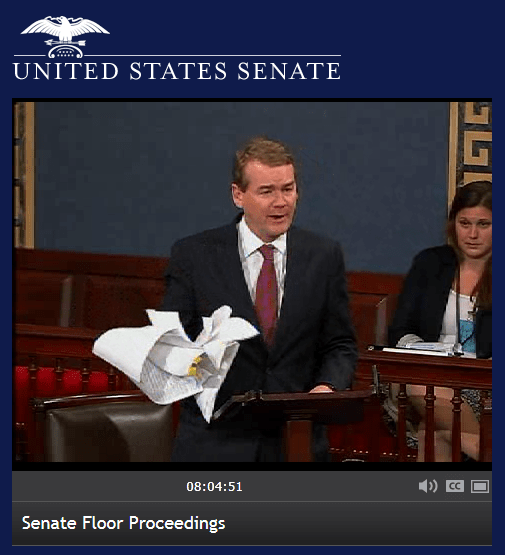
8. The paper FAFSA takes another beating. Although just 80,922 students of the nearly 21 million FAFSA filers filled out the paper version in 2014-15, the paper FAFSA has been a favorite prop of members of Congress who want to simplify the form. For example, a bipartisan bill to simplify the FAFSA sponsored by Senators Lamar Alexander (R-TN) and Michael Bennet (D-CO) resulted in quite a bit of paper FAFSA abuse—as evidenced in the picture below. Additionally, the Department of Education will no longer print the paper FAFSA in 2016, meaning that Congressional staffers will have to fire up the laser printer to produce their favorite prop.

bennet

7. Governor Scott Walker blames a “drafting error” for an attempt to remove the Wisconsin Idea from the University of Wisconsin. The Wisconsin Idea is the simple, yet transformative, idea that the boundaries of the university are the boundaries of the state. And those of us with Wisconsin ties hold this idea quite dear, regardless of political affiliation. This is why Governor Walker, who was one of the favorites for the GOP presidential nomination at the time, faced such outrage (including from me) for eliminating the public service mission of the university while adding language on workforce development (which I’m okay with). Although Walker blamed a “drafting error” for the changes, a Milwaukee Journal Sentinel investigation suggested otherwise.

6. Some colleges still won’t release graduation rate data on Pell Grant recipients. Under the 2008 amendments to the Higher Education Act, colleges are required to disclose the graduation rates of first-time, full-time students receiving federal Pell Grants to current or prospective students upon request. Yet many colleges still refuse to release their Pell graduation rates to the general public in what can be interpreted as either a stunning attempt to obfuscate outcomes or a shortcoming of institutional data systems. My hat is off to Andrew Nichols of the Education Trust, who worked long hours to compile a dataset of Pell graduation rates. But even he was only able to get data from 90% of public four-year colleges and 68% of private nonprofit colleges within a reasonable time frame, meaning that 351 colleges (including mine) didn’t respond. Colleges can—and should—do better.

5. Data misinterpretations abound. I could do a post of the top 10 ways in which analysts and/or journalists misinterpreted data in 2015, but I’ll focus on three examples here. First, when the College Scorecard earnings data came out, some media and President Obama (!) thought the data were on graduates 10 years after leaving college, not for all students 10 years after entry. Second, two prominent reports claimed that college enrollment or completion rates were far lower for lower-income than higher-income families. But as Matt Chingos and Sue Dynarski correctly note, their data source (the Current Population Survey) is inappropriate for those types of analyses. Finally, a 10-point decline in average SAT scores over the last five years brought about howls of concern about the K-12 education system from the media. A more level-headed look, from myself and others, shows that universal SAT-taking policies and demographic changes are more likely factors. I highly recommend reading the 1953 classic How to Lie with Statistics and reading the data documentation one more time.

4. Big-time athletics programs suffered from multiple scandals. Three scandals stick out from the pack here. First, the University of North Carolina at Chapel Hill was put on probation by its accreditor for allowing many student-athletes to take phony classes. The 214,000 pages of documentation from the university contain some rather ironic (and incriminating) e-mails from a former ethics professor. The University of Louisville is facing accusations that a former graduate assistant coach paid for strippers in an effort to recruit men’s basketball players. (Louisville football coach Bobby Petrino also got a $500,000 bonus this year basically for his players persisting at the minimum rate needed to be eligible for a bowl game.) Finally, Rutgers football coach Kyle Flood (who was fired at the end of a 4-8 season) was suspended for three games for talking with an adjunct professor about trying to get a player’s grade changed. College athletics can do good things for many institutions, but these three cases sure don’t help the cause.

3. The University of Florida’s online degree effort hasn’t gone as planned. State legislators are often interested in creating online degree options within their public colleges, both as an opportunity to potentially serve more students and increase revenue from lucrative out-of-state students. Arizona State University Online has done quite well, nearing 20,000 students and doing a good job attracting students from other states—most notably capacity-constrained California. But the University of Florida’s effort has been much rockier. UF entered into a massive contract with Pearson in 2013 that paid the technology giant $135 per in-state student and $765 per out-of-state student who enrolled while paying faculty $60 per student. However, efforts to increase enrollment largely failed and UF fired Pearson this fall for failing to recruit enough out-of-state students. States will keep pushing for online endeavors (which I think have promise), but getting them to scale up will be difficult.

2. Nevada higher education officials buried a report critical of how they managed community colleges. The Las Vegas Review-Journal did a great job this summer using open records laws to show how the Nevada System of Higher Education attempted to stop an independent report that made them look bad from being released. Not only did system officials try to get criticisms levied by the sharp folks at the National Center for Higher Education Management Systems to be lightened, they eventually made sure the report never went to lawmakers. Additionally, the system tried to stop UNLV to halt research that made them look bad. For trying to bury independent research, the state of Nevada gets a plum position on my list.

1. The University of Akron spent $556.40 on an olive jar for its president’s bedroom. I can’t say that I care that much for olives, but I know I’m in the minority here. But it’s really hard for a public university to justify spending $556.40 for a decorative olive jar or $838.83 for a make-up chair—even if it’s paid for by private funds. Given that Akron was already in the news for eliminating student advising jobs, cutting the baseball team, threating a $50 per-credit fee for juniors and seniors, and eliminating the university press before it was restored, spending funds on an olive jar that could be even possibly used for other purposes looks really bad. (But the jar is pretty good on Twitter.) I’ll stick to a $5 glass jar full of jellybeans, thank you very much.


Also considered: Overreactions by college protesters and legislators in response, federal data dumps on Friday and/or Saturday, accreditors on the defensive, Trump University, HRC University, outdated campus-based aid allocation formulas.

The 2015 Higher Education Top Ten List (Part 2)

Yesterday, I revealed the first half of my list of top ten higher education events of 2015. Today, I reveal the top five events from the past year, with a list of ‘not top ten’ events (events that either didn’t go as planned or don’t benefit students or the general public) to come tomorrow.

  1. Federal college ratings are dead, but the College Scorecard data represent a big step forward.

The U.S. Department of Education (ED) closed out 2014 by releasing a set of potential metrics for their much-anticipated (and much-reviled in many parts of higher education) Postsecondary Institution Ratings System. The framework at that point was so rough that I told Politico that “I’d be surprised” if any ratings were released by the Obama Administration’s goal of fall 2015. The ratings plan was pretty much dead by March, when an ED official announced that two rating systems would be created—one focused on consumer information and one focused on accountability. Given the difficulty of doing two big projects at once, it was no shock to see accountability-focused ratings dropped in June (see my full postmortem here).

Although ED had promised that additional information would be released in the College Scorecard tool, I didn’t expect the sheer magnitude of what was released on an otherwise-tranquil Saturday morning in September. The new public-facing College Scorecard site has information about typical student loan debt, the percentage of students paying down principal on their loans, and the median earnings of former students 10 years after starting college—important data points for students and the public to consider. Even more importantly, ED made up to 18 years of more detailed outcomes data downloadable online (caution: large file sizes!) for everyone to use as they see fit. These data will be used to inform policy discussions going forward, as well as to help students make better college choices (or at least avoid awful choices).

  1. The federal government erases student loan debts of some students who attended the now-closed Corinthian Colleges.

The rapid collapse of the for-profit Corinthian Colleges chain was the top higher education event on my 2014 list, but its repercussions will continue to be felt for years to come. In June, the Obama Administration announced that at least 40,000 students at Corinthian-owned Heald College could have their loans erased due to the college’s fraudulent practices. That could cost over $500 million (so far, $28 million has been forgiven), but total costs for debt forgiveness across all Corinthian campuses could reach $3.2 billion.

The big policy question going forward is whether more students who attended for-profit—or even nonprofit—colleges with dubious recruiting practices or phony job placement data will be able to have their loans forgiven by the federal government. Some Democratic senators, including liberal icon Elizabeth Warren of Massachusetts, have called for forgiveness to be extended to other large for-profit chains with practices that were allegedly similar to Heald. This would benefit tens of thousands of students, but come at a cost of billions of dollars to taxpayers as these colleges typically don’t have enough money to reimburse the federal government. This issue will continue to be important for years to come.

  1. Led by Tennessee, ‘tuition-free’ and ‘debt-free’ higher education becomes a hot political discussion.

The Tennessee Promise program, which offers tuition-free community college as well as some mentoring services to qualified recent high school graduates, has been widely hailed as a bipartisan policy success. Enrollment in Tennessee public higher education increased by 10.1% in fall 2015, with large increases at community colleges far outpacing declines at some four-year public and private colleges. This increase in enrollment is taking place even though many students receiving federal Pell Grants do not get a dime from the Tennessee Promise program, as Tennessee’s ‘last-dollar’ design means that the state picks up the tab after all other grant aid has been applied. Clearly, program messaging matters—and a clear message of affordability goes a long way.

In addition to a number of states considering tuition-free community college, the Obama Administration proposed its own version at the national level in January. This plan is quite different from the Tennessee Promise, with notable differences being that Obama’s plan is ‘first-dollar’ (supplementing instead of supplanting the Pell Grant) and includes several additional requirements on states and students. All three major Democratic candidates (Clinton, O’Malley, and Sanders) have released plans for at least some tuition-free or debt-free public higher education this year. While it’s unlikely that any of these happen at a national level due to Republican opposition and cost concerns, states may move forward with their own plans.

  1. The Department of Education adopts ‘prior prior year’ (PPY), allowing students to file for federal financial aid earlier starting next October.

Currently, students cannot file the Free Application for Federal Student Aid (FAFSA) until January 1 for attending college the following fall. This means that students often do not get any information about their Pell Grant or student loan eligibility until February or March as they wait for their final tax documentation from the prior year. This is too late to influence the college choice processes of many students attending four-year colleges, as application deadlines at somewhat selective institutions are often well before this date. Moving up the FAFSA timeline by up to one year (by using tax data from the year prior to what is currently being used) would help students get earlier information about college prices.

I’ve done a fair amount of research the past few years (thanks to generous support from the National Association of Student Financial Aid Administrators and the Gates Foundation) on the financial implications of PPY. I co-authored a report that found that PPY wouldn’t affect the Pell Grant awards of the vast majority of students, alleviating one of the key concerns against switching to PPY (the journal article version with cost estimates is available here). I’m quite happy that President Obama ordered a switch to PPY starting in fall 2016, meaning that students can file the FAFSA on October 1 instead of the following January 1. The transition in 2016 could be difficult from a technical perspective, but it’s a win for students going forward.

  1. Student protests shake up higher education in a way not seen in decades.

Any good analysis of the history of American higher education has a substantial section of the protest and free speech movements on college campuses in the 1960s. Yet, for those of us who went to college in the last 40 years, protests have been relatively few and far between (with most of these protests being focused on foreign policy endeavors). Having been in graduate school at the University of Wisconsin-Madison during the massive protests against Governor Scott Walker’s changes to collective bargaining rules, I didn’t expect to see anything of that magnitude again for years to come.

But this fall’s protests at Yale, the University of Missouri, and many other colleges around the country over concerns of racism and a lack of diversity on and near college campuses have the potential to represent a new wave of student activism. The most successful protests to this point have been at the University of Missouri, where the chancellor of the flagship Columbia campus and the president of the four-campus system both resigned under pressure from a student on a hunger strike, Mizzou’s football team, and a number of deans who wanted change. The rationales for these protests aren’t likely to go away in 2016, and there are a number of unanswered questions. Will higher education change as a result of protests? Will leaders at other campuses be forced to resign? What are the unintended consequences of the protest movement? Are there potential concerns about free speech on campuses?


Also considered: Colleges competing for athletes based in part on the cost of attendance, more colleges adopting test-optional policies for admission, ED’s release of colleges facing heightened cash monitoring, risk sharing for federal student loans, continued growth of state performance-based funding policies, new admissions coalition breaks away from the Common Application.