Blog (Kelchen on Education)

The 2015 Higher Education Top Ten List (Part 1)

Although higher education has a partially deserved reputation for being extremely slow to change, quite a bit happened in the higher education world in 2015. Below is the first half of my top ten list of most important or influential higher education events that took place in the last year, with the second half coming out tomorrow. Look for my annual list of “not top ten” events to come out later this week. As always, I’d love to hear your thoughts about the list and what I missed!

  1. Faculty teaching loads come under fire from state policymakers.

A common perception among the general public is that college faculty don’t work that much, even though small-scale surveys routinely indicate that full-time faculty often work 50+ hours per week. (I would say I fall in the 50-60 hours per week range.) However, faculty members only spend a portion of this time in the classroom—teaching three classes per semester equates to nine hours per week teaching. What takes up the rest of the time? In addition to preparing for classes and meeting with students, research and service obligations can be substantial at many colleges, particularly as research expectations are increasing at many four-year colleges. Some faculty are making rational decisions to prioritize research over teaching, as that is easier to measure and can heavily contribute to tenure decisions.

Although it’s difficult to conclude whether teaching loads have actually decreased over time (one study that said so—and still makes the rounds on the Internetwas retracted over a data error), the public perception is that faculty don’t teach enough and that they should more often focus on teaching over research. Two examples of this stand out. In Wisconsin, Governor Scott Walker recommended that the University of Wisconsin System have faculty teach one more class per semester (in addition to revising tenure rules). In Missouri, a state legislator noted that half of tenured and tenure-track faculty generated fewer than 180 credit hours per year (or roughly 30 students per semester). Should some faculty teach more? Quite possibly—but it requires a commitment to rewarding quality teaching.

  1. Income share agreements (ISAs) provide a possible new way to finance higher education, but many questions remain.

Under ISAs, students would pay a percentage of their post-college earnings to a private company in exchange for the company covering upfront educational expenses. The idea is actually pretty similar to federal income-based repayment plans for student loans (although ISA proponents insist these agreements are not loans), with the big difference being that terms of the loan will likely vary based on a student’s college of attendance, field of study, and possibly even pre-college achievements.

Although ISAs have existed in Latin America for a while now, they are still quite new in the United States. Purdue University is working to bring ISAs to their campus through a partnership with Vemo that definitely bears watching. I’ve written this year about how I think the market for ISAs will be fairly limited due to the terms on federal loans being hard to beat. However, I think Purdue’s focus on replacing PLUS and private loans with ISAs makes sense, and ISAs also have potential to help students pay for programs (such as coding boot camps) that don’t currently qualify for federal financial aid. This is a topic to watch for 2016 and beyond.

  1. Calls for accreditation reform grow louder.

Colleges currently have to have accreditation from a recognized body in order for their students to access federal financial aid dollars. However, there are concerns that accreditation is doing little to maintain academic quality. A Government Accountability Office report released in late December 2014 highlighted that colleges are more likely to lose accreditation for poor financial health than poor academic outcomes, and a high-profile Wall Street Journal piece showed that many colleges with poor graduation or default rates maintain their accreditation. Additionally, Senator Elizabeth Warren (D-MA) had a heated exchange this summer with one of the main accrediting bodies of for-profit colleges over how it could allow Corinthian Colleges to keep its accreditation in spite of many known issues.

Accreditation reform could take several paths in the next few years. One path would involve accrediting bodies heightening their standards (either voluntarily or via legislative or executive action) in order to keep the worst colleges out of the federal financial aid program. A second path would be for the federal government to take a larger role in accreditation. Instead of a rather circuitous path through the National Advisory Committee on Institutional Quality and Integrity, the federal government could directly accredit colleges. A third, and more politically feasible, path would revise the accreditation process to allow colleges to qualify based on demonstrated student learning outcomes. This has the support of Senator (and presidential candidate) Marco Rubio (R-FL) and Senator Michael Bennet (D-CO), and might be more palatable to many colleges.

  1. While Sweet Briar was saved, other private colleges are struggling.

Sweet Briar College, a women’s liberal arts college in rural Virginia, only had about 500 students last spring when its board announced the college would close. Yet the saga of its alumnae and friends to save the college (which was financially solvent at the time, but faced a bleak financial picture going forward) caught the attention of the national media. Alumnae were eventually able to keep the college open after a successful lawsuit and promises to raise millions of dollars. Enrollment was about 330 students this fall, making future recruitment efforts key to the college’s future success.

Although Sweet Briar averted closure, six private nonprofit colleges closed in 2015 according to Ray Brown’s excellent list at College History Garden. Credit rating agency Moody’s expects the rate of closure to triple by 2017, which would mean roughly 15 closures per year out of over 1,000 private institutions. Moody’s also expects about half of private colleges to see steady or declining tuition revenue after taking inflation into account. Small, less-selective colleges in areas with little population growth among traditional-age college students will continue to face pressures, but don’t count colleges out. As Sweet Briar shows, it’s very hard to kill a college.

  1. Presidential searches at the University of Iowa and the University of North Carolina system draw criticism.

Traditionally, the vast majority of college or system presidents have been academics with decades of teaching and administrative experience within higher education. But as the expectations of college presidents have morphed from being a more inward-focused leader to a champion fundraiser who can effectively lobby legislators and donors, relatively few provosts want to become presidents. This, combined with a perception that even some traditionally-qualified academics are no longer suited to run complex universities, has opened the door to more college presidents with nontraditional backgrounds.

The University of Iowa (with new president Bruce Harreld) and University of North Carolina system (with new president Margaret Spellings) both picked leaders without traditional backgrounds. Iowa’s faculty senate quickly censured Harreld, who ran Boston Market before becoming a senior executive at IBM, for making multiple errors on his resume that can either be interpreted as minor errors or a pattern of embellishing credentials. Spellings was the Secretary of Education in the George W. Bush administration, but she has not had experience as a faculty member and does not have a doctorate. The big question is whether presidents need doctorates or teaching experience to effectively lead, or whether business leaders with sharp teams around them can do a better job than traditional academics.

Nominees Wanted for the 2015 Top Ten and Not Top Ten Lists

As 2015 rapidly draws to a close, I’m looking to continue an annual tradition on this blog—two lists of the top ten and ‘not top ten’ events in the higher education world during the past year. The top ten list includes the most newsworthy events of the year, regardless of whether they are good or not for higher education or the public as a whole. 2014’s winner was the rapid downfall of Corinthian Colleges, while 2013’s winner was President Obama’s announcement of a federal college ratings system (which ended up being scuttled earlier this year).

The not top ten list also includes some events that are important and newsworthy, but the primary focus is on decisions that look pretty silly in hindsight or show the underbelly of greed and jockeying for power that is often present in higher education. Last year’s ‘winner’ was Kean University’s $219,000 conference table, while Georgetown Law ‘won’ in 2013 for its plan to vacuum up federal loan dollars and stick taxpayers with the entire bill.

I’m looking for nominees for this year’s lists, which will be posted on December 15 (top ten) and 16 (not top ten). Some items (such as the campus protests at the University of Missouri and the University of Akron’s infamous olive jar) will definitely be on one of the lists, but I’m looking for your thoughts about some of the other happenings (both serious and humorous) that happened this year. Please leave any suggestions in the comments area below or send them to me via Twitter (@rkelchen). I look forward to sharing the results!

Why is College So Expensive? (Nearly) Everyone is to Blame

“Why is college so expensive?” “Why does college cost so much?” If I had a dollar for every time I’ve been asked that type of question, I could probably pay the roughly $15,000 it takes to provide a year of college for the typical student at a four-year regional public university. This is the true cost of college—how much the college spends on a given student each year. The public is often more concerned with the price (what students and their families pay), but barring additional massive public spending on higher education, the cost of providing a college education must be brought under control in order for students to see lower price tags.

Any piece written by a member of the higher education community for the general public about college costs is likely to reach a large audience due to deep public concerns about college affordability. A recent piece in the Washington Post by Steven Pearlstein, former journalist and current professor at George Mason University, offers four potential solutions to bending the college cost curve. Below, I discuss each of his four ideas and whether they are feasible. (Note that because the focus is on reducing the cost of educating a student, state funding and additional financial aid aren’t relevant here—although they would reduce the price faced by students.)

Proposal #1: Cap administrative costs. This one seems like a no-brainer; if the goal is to educate students, more money should be spent on instruction compared to various “deanlets” and other administrators. But there are legitimate reasons for additional administrators. First, as Pearlstein notes, increasingly complex government regulations, such as for how financial aid is disbursed, do need specialized individuals. As the college-going population has become more diverse, at least some additional student services are required to serve a student body with different academic and social needs than decades ago.

However, the blame for rising administrative costs can also be shared among students and faculty in addition to administrators and regulators. Some students’ preferences for intercollegiate athletics and recreation facilities (such the infamous climbing walls and lazy rivers) also require a number of additional staff members and administrators to run these endeavors. Additionally, as Andrew Kelly of the American Enterprise Institute noted last week, even student protesters’ demands for additional services at places such as the University of Missouri and Yale could increase total costs. Faculty are also to blame—each time we give up a former part of our jobs (such as advising students, making admissions decisions, or even making copies), someone else does it.

Proposal #2: Use a year-round teaching schedule, five days per week. It’s really hard to argue that college facilities are being used in an efficient manner. Fridays tend to be ghost towns at many colleges, although many less-selective colleges do hold quite a few evening and weekend classes. But residential students tend not to like Friday classes, and faculty with demanding travel schedules also prefer to keep Fridays free for travel. I teach Monday and Wednesday evenings, and I’ll use about half of the Fridays in a given semester to go to meetings and conferences. Technology has the ability to help solve this problem through the use of hybrid classes. Faculty can teach online a few weeks each semester while they are traveling, something which I do on occasion as well as when the weather is bad.

Moving to a year-round teaching schedule, however, is likely to have significant budgetary implications. Most faculty with teaching obligations are on a 9-month or 10-month contract, meaning that they are not expected to work with students during the summer period—let alone teach. Asking faculty to teach in the summer would likely result in contracts needing to be 11 or 12 months per year, which would probably mean increased salaries. After all, if teaching is added to a professor’s schedule in the summer, she probably won’t work for free.

Proposal #3: Teach more and research less. Pearlstein notes that much research is never cited by any other academics, as well as noting that the incentive structure often favors research (which is far easier to quantify than teaching). The blame for the focus on research can be placed on both administrators and faculty, as both groups often prefer research over teaching and may both have input into the tenure and promotion process.

However, Pearlstein’s mention of research showing that “teaching loads at research universities have declined almost 50 percent in the past 30 years” is incorrect. That study, which used the National Study of Postsecondary Faculty, was rescinded in 2013 due to concerns about the wording of faculty workload questions changing during the length of the study. While it’s probably the case that faculty teaching loads at more selective institutions have declined somewhat, Pearlstein shouldn’t have used a study that was rescinded a month after it was released.

Proposal #4: Cheaper, better general education. In this section, Pearlstein pushes for more online and hybrid courses to better engage students in the material. This sounds good, but it is far from a certainty that online courses are actually less expensive than in-person courses. (Research on this is nascent and inconclusive.) Additionally, Pearlstein cites government data stating that “more than three-quarters of students at four-year colleges and universities have never taken an online or hybrid course.” As Russ Poulin at WCET notes, 27% of students took a distance education course in 2013 alone, meaning that the percentage of students with some online experience at some point in college is likely far larger than 25%. I’ll be the first to admit that general education is not my strong point as a member of the graduate faculty, but there are lots of good people working on issues of general education.

As the discussion above suggests, nearly everyone (except woefully underpaid adjuncts) is to blame for the rising costs—and prices—of a college education. The challenge is that any solution is likely to be fairly complex and involve negotiations among faculty, administrators, students, and taxpayers. This is why college costs tend to get lip service from the higher education community until revenue sources dry up. But the financial struggles of many small private colleges (let alone many cash-strapped public colleges) make cost-cutting measures necessary, and hopefully the rest of the higher education community can learn from their experiences.

Will Recent Protests Affect Higher Education Leadership?

Over the last week, much attention in the higher education world has turned to the saga of University of Missouri-Columbia graduate student Jonathan Butler, who engaged in a hunger strike in an effort to get Missouri’s system president Timothy Wolfe to resign due to a perceived lack of attention paid to racism on at the Columbia campus. His effort quickly gained attention via social media, particularly when Mizzou’s football team decided over the weekend not to play any more games until Wolfe was removed. Wolfe resigned today in the face of overwhelming pressure (including from Republican legislators), handing the protesters a huge win.

Wolfe’s speedy resignation clearly shows both the power of social media and the power of big-time college athletics. For example, Wolfe’s $459,000 salary was far less than the $1 million Mizzou would have had to pay Brigham Young University for cancelling the game, not to mention additional revenues Mizzou would have gained from a lucrative neutral-site game in Kansas City. It’s truly remarkable that arguably the two most influential college football programs of the decade are Northwestern (for its players’ attempt to unionize in recent years) and Mizzou—programs that have combined for zero conference championships since 2001.

But the Mizzou protests may have significant implications for higher education leadership going forward. New university or system presidents are being protested in Iowa and North Carolina, and Mizzou doesn’t seem that atypical among large universities in concerns about racism and leadership. Below are three main ways in which the leadership of colleges and systems may change as a result of these recent protests:


(1) Will the voices of students, faculty, staff, and the public in the presidential selection process change? One way to potentially avoid protests like in Missouri, Iowa, and North Carolina would be to give stakeholders a larger voice in the selection process of new leaders. These stakeholders often have a representative on the selection committee, but these committees are increasingly shielded from public view in order to keep candidates’ identities anonymous for as long as possible. Groups who are unhappy with current leadership may seek representation on the selection committees, which could improve the perceived legitimacy of presidential searches but result in a longer timeline for selecting new leaders.

(2) Will this change who is willing to become a college or system president? Much has been made about the protests in Iowa and North Carolina being due to the selection of non-academics as leaders, and Wolfe had no background in higher education prior to his selection. This sounds like an opportunity for academics to regain their traditional position as college presidents, but I have to wonder if your garden-variety distinguished professor is willing to take on such a high-pressure public role in light of additional protests and demands. (In addition, managing an athletic department might have just gotten more challenging.)

(3) Will future presidents demand financial protection against the risk of ouster? The typical tenure of a college president has fallen from 8.5 years in 2006 to 7 years in 2012 amid pressures from trustees, legislators, donors, and internal stakeholders. If the result of Wolfe’s ouster is additional resignation demands at other colleges, I would expect to see larger buyout packages placed into future presidents’ contracts in order to insulate leaders from the threat of losing their jobs. College football provides some good examples here, as a number of head coaches are being paid millions of dollars to simply go away.

Although it is too early to tell whether protests at other colleges will result in leaders resigning or being forced out, the potential seems to be there if stakeholders coordinate their actions around a popular cause. But these conditions have existed at many colleges for decades, so it’s unclear whether Mizzou’s successful protests are a one-time success for protesters or a start of more ousters.

Should Students in “Boot Camps” Get Federal Financial Aid?

In the last several years, a number of companies have started short-term, intensive training programs in fields such as computer programming, Web design, and business designed to give fresh college graduates the skills they need to land lucrative jobs in growing fields. These “boot camps” include offerings by start-up companies such as Dev Bootcamp, General Assembly, and Koru as well as some entries from branches of traditional colleges (such as Rutgers). This sector is rapidly growing, with one organization estimating that about 16,000 students will complete coding boot camps in 2015.

Boot camps may tout their high job placement rates, but they are not cheap for students. The typical program costs about $11,000 for an 11-week program, although shorter options are often available in some fields. Unlike for most undergraduate and graduate programs through traditional colleges, these programs are currently not eligible for federal financial aid dollars. This means that students have two options to pay for these programs: paying out of pocket or taking out a private loan. However, the U.S. Department of Education is beginning an “experimental sites” program that will allow a small number of colleges to partner with unaccredited providers like boot camps to offer courses and receive federal financial aid.

Should students in boot camp programs be able to receive federal grants and loans? The best argument toward allowing students to receive federal funds for these programs (after a careful vetting process) is that it would allow students with modest financial means and little creditworthiness of their own to easily pay for some or all of these programs. These programs tend to recruit heavily from selective colleges with fewer low-income students (see the list of Koru’s partners), where ability to pay hasn’t been such a concern to this point. But as the sector expands to include colleges with more economic diversity, financing these programs could become a problem.

On the other hand, the highly vocational nature of these programs allows for different financing structures to make sense. This can happen through private loans focused on high-quality programs, which is the goal of the partnership between private lenders Skills Fund and six boot camps. Income share agreements are also a potential fit in this area, although I do have concerns about whether successful graduates would want to give up equity in themselves rather than just make loan payments. Finally, it remains to be seen whether boot camps themselves would actually be interested in going through certification and quality assurance processes that are likely to accompany federal student aid. For example, General Assembly’s co-founder told Inside Higher Ed that he didn’t want to receive federal student aid due to concerns about federal aid leading to higher prices in the future (the so-called “Bennett Hypothesis”). Others, such as Alex Holt at New America, have concerns about additional federal oversight leading to reduced program quality and less innovation.

I’ve thought about the dueling concerns of access and flexibility regarding boot camps, and I still don’t know exactly where I stand. The good thing here is that we’re likely to have a small number of programs get access to federal financial aid, so the effects of federal funding (and rules) can be examined before opening the spigot for more interested programs. I’d love to hear your thoughts on this question below, as this is a developing issue on which research badly needs to be conducted.

How Well Do Default Rates Reflect Student Loan Repayment?

This post initially appeared at the Brown Center Chalkboard blog.

The U.S. Department of Education released new data this week on colleges’ cohort default rates (CDR)—reflecting the percentage of a college’s former students with federal student loans who entered repayment in Fiscal Year 2012 and defaulted by the end of Fiscal Year 2014. The average CDR dropped to 11.8 percent in Fiscal Year 2012, down from 13.7 percent in FY 2011 and 14.7 percent in FY 2010. Eight colleges had a CDR over 30 percent for three consecutive years, subjecting them to the loss of all federal financial aid dollars. Over 100 additional colleges had a CDR over 30 percent in the 2012 cohort, putting them at risk of losing funds if their performance does not improve.

Yet although CDRs are important for accountability purposes, they do not necessarily reflect whether students are repaying their loans.  As of June 30, 2015, just over half of the $623 billion in Direct Loans made to students who have entered repayment are in current repayment. In addition to the $48 billion in loans in default, an additional $63 billion are more than 30 days delinquent and $180 billion are in deferment and forbearance. Deferment and forbearance are not always bad things, as students can qualify for either by being in the military or pursuing graduate studies. However, students can also request deferment and forbearance for economic hardship, while interest still accrues. The presence of income-based repayment plans, in which students making below 150 percent of the federal poverty line can make no payments while still remaining current on their loan, further complicates any analyses. All of these complications make cohort default rates a weak metric of whether students are actually paying back their loans.

Are students repaying their loans? A look using College Scorecard data

The Department of Education’s recent release of College Scorecard data provides new insights into whether students are repaying their loans, while also allowing for comparisons to be made to the current CDR metric. The Scorecard contains a new measure of the percentage of students whose student loan balance was lower than when entering repayment, which reflects the percentage of students who have been able to pay down at least some principal.

Using this new metric on declining student loan balances to compare with colleges’ CDRs, I come to three new findings.  Please note that for the purposes of this blog post, I consider the three-year cohort default rate for students who entered repayment in FY 2011 compared to the one-year and three-year repayment rates for students who entered repayment in FY 2010 and 2011. The key findings are below.

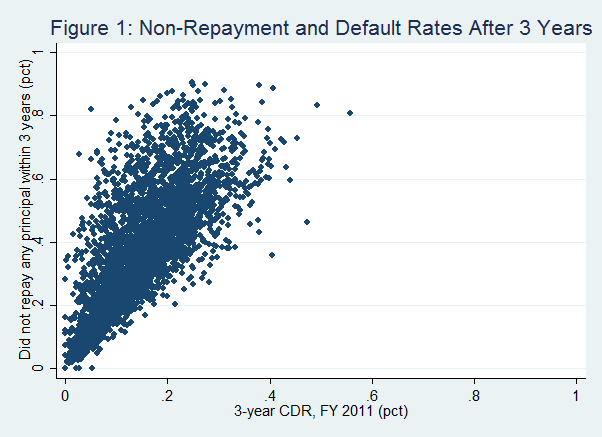
(1) Cohort default rates substantially underestimate the percent of students who have been unable to lower their loan balances. Of the nearly 5,700 colleges with data on both CDRs and repayment rates, the median college had a 14.9 percent three-year CDR while 40.8 percent of students did not repay any principal in the first three years after leaving college. This means that one in four exiting students was not in default, yet did not make a dent in their loan balance in the first three years after entering repayment. Figure 1 below shows the relationship between CDRs and repayment rates. A low CDR for a college is associated with higher rates of repayment (with a correlation coefficient of 0.76), but there are plenty of exceptions. For example, 25 percent of the colleges with default rates below 10% had more than one-fourth of all students failing to repay any principal.

brookings_fig1

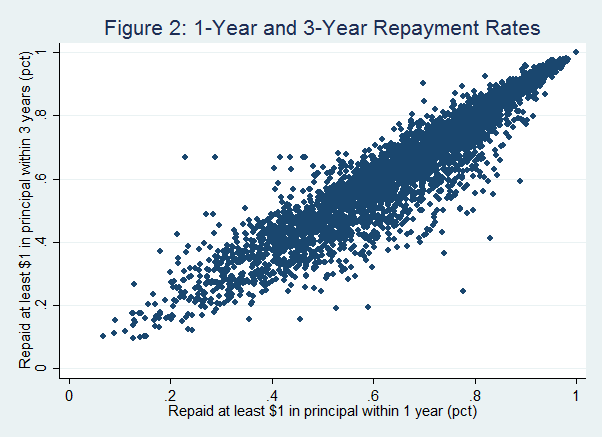
(2) The percentage of students paying down principal doesn’t change much between one year and three years since entering repayment. One year after entering repayment, 62.8 percent of students at the median college had paid down at least $1 in principal, though that percentage dipped slightly to 59.2 percent within three years (see Figure 2 for the distribution of repayment rates). This drop is likely due to some students either falling behind on their payments while enrolled in the standard repayment plan as well as payments under income-based plans being insufficient to cover accumulating interest. In either case, stagnant or falling repayment rates should raise red flags regarding students’ ability to eventually pay off the loan within 10-20 years.

brookings_fig2


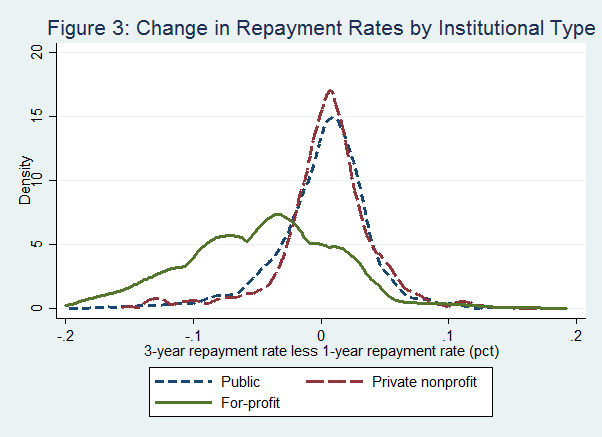
(3) As a whole, repayment outcomes make a turn for the worse at for-profit colleges compared with public or private nonprofit colleges. This can be best illustrated by showing the difference in repayment rates between one and three years of entering repayment by institutional type. As Figure 3 below shows, for-profit colleges tended to have lower repayment rates after three years than one year, a red flag that their borrowers are not doing well, while public and private nonprofit colleges saw similar repayment rates over time. Only one in four for-profit colleges had more students paying down principal three years after completion, which points to potential problems for students and taxpayers alike. Although for-profit colleges have somewhat lower CDRs than community colleges, community colleges do not see drops in the repayment rates that exist in the for-profit sector.

brookings_fig3

The new loan repayment rate data provides an additional tool   for policymakers to use when holding colleges accountable for their performance. Although this metric represents a substantial improvement over CDRs by including students who are struggling to make payments, the presence of income-based repayment plans (where students can stay current on their loans by making small payments if their income is sufficiently low) complicates any accountability efforts. Further research is needed to examine the implications of income-based repayment programs on principal repayment rates.

Which Colleges Enroll First-Generation Students?

The higher education world is abuzz over the Obama Administration’s Saturday morning release of a new College Scorecard tool (and underlying trove of data). In my initial reaction piece, I discussed some of the new elements that are available for the first time. Earnings of former students are getting the most attention (and have been frequently misinterpreted as being the earnings of graduates only), but today I am focusing on a new data element that should be of interest to students, researchers, and policymakers alike.

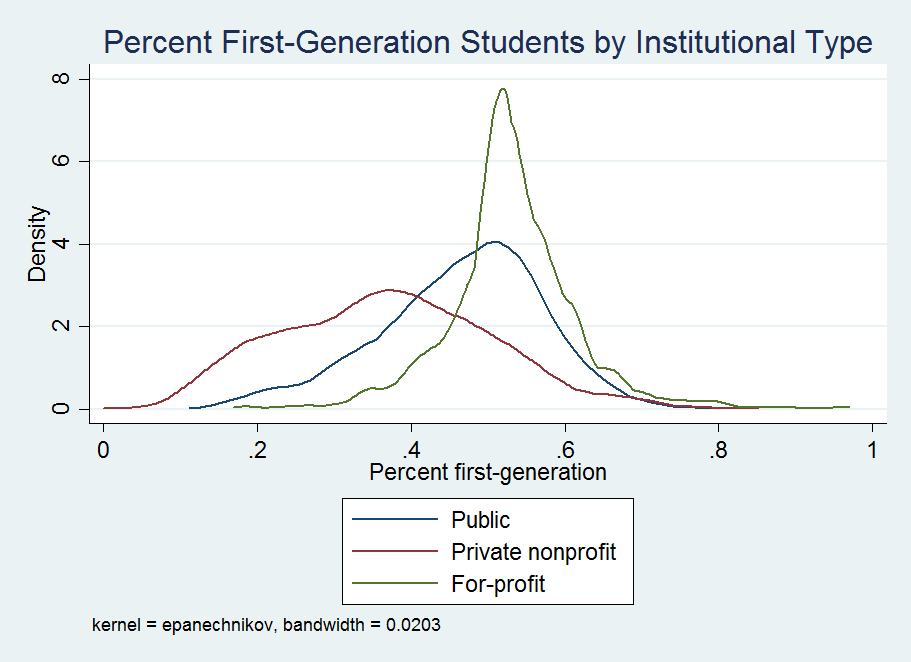
The Free Application for Federal Student Aid has included a question about the highest education level of the student’s parent(s), but this information was never included in publicly available data. (And, yes, the FAFSA application period will be moved up three months starting in 2016—and my research on the topic may have played a small role in it!) In my blog post on Saturday, I showed the distribution of the percentage of first-generation students (as defined as not having a parent with at least some college) among students receiving federal financial aid dollars. Here it is again:

firstgen

I dug deeper into the data to highlight the ten four-year public and private nonprofit colleges with the lowest and highest percentages of first-generation students (among those receiving federal aid) in 2013. The results are below:

Four-year private nonprofit colleges with the fewest first-generation students, 2013.
Name Pct First Gen
California Institute of Technology 5.9
Wheaton College (IL) 8.3
Oberlin College (OH) 8.5
Elon University (NC) 8.6
Dickinson College (PA) 9.0
Macalester College (MN) 9.1
University of Notre Dame (IN) 9.7
Carnegie Mellon University (PA) 9.8
Hobart William Smith Colleges (NY) 9.8
Rhode Island School of Design 10.6
Source: College Scorecard/NSLDS.
Note: Only includes students receiving Title IV aid, excludes specialty colleges.
Four-year public colleges with the fewest first-generation students, 2013.
Name Pct First Gen
College of William and Mary (VA) 13.2
University of Vermont 14.1
Georgia Institute of Technology 16.5
University of North Carolina School of the Arts 17.4
University of Virginia 17.6
New College of Florida 18.0
University of Michigan-Ann Arbor 18.0
SUNY College at Geneseo 18.4
Clemson University 18.5
University of Wisconsin-Madison 19.1
Source: College Scorecard/NSLDS.
Note: Only includes students receiving Title IV aid, excludes specialty colleges.

Just 5.9% of students receiving federal financial aid at the California Institute of Technology were defined as first-generation in 2013, and eight other private nonprofit colleges were under 10% (including Oberlin, Notre Dame, and Carnegie Mellon). The lowest public college was the College of William and Mary, where just 13% of students were first-generation. Several flagships check in on the list, including Vermont, Virginia, Michigan, and Wisconsin (where I got my PhD).

The list of colleges with the highest percentage of first-generation students is quite different:

Four-year private nonprofit colleges with the most first-generation students, 2013.
Name Pct First Gen
Colorado Heights University 75.6
Beulah Heights University (GA) 66.0
Heritage University (WA) 64.3
Grace Mission University (CA) 64.1
Hodges University (FL) 63.3
Humphreys College (CA) 60.5
Selma University (AL) 59.8
Mid-Continent University (KY) 59.7
Sojourner-Douglass College (MD) 59.2
University of Rio Grande (OH) 58.5
Source: College Scorecard/NSLDS.
Note: Only includes students receiving Title IV aid, excludes specialty colleges.
Four-year public colleges with the most first-generation students, 2013.
Name Pct First Gen
Cal State University-Los Angeles 64.0
Cal State University-Dominguez Hills 60.2
Cal State University-Stanislaus 60.2
Cal State University-San Bernardino 59.4
Cal State University-Bakersfield 58.2
University of Texas-Pan American* 56.9
University of Arkansas at Monticello 56.1
University of Texas at Brownsville* 55.2
Cal State University-Fresno 53.4
Cal State University-Northridge 53.1
Source: College Scorecard/NSLDS.
Note: Only includes students receiving Title IV aid, excludes specialty colleges.
* These two colleges are now UT-Rio Grande Valley as of Sept. 1.

Six private nonprofit and three public four-year colleges had at least three-fifths of their federal aid recipients classified as first-generation students, ten times the rate of Caltech. The top-ten lists for both public and private colleges include many minority-serving institutions, as well as a good chunk of the Cal State University System. These engines of social mobility deserve credit, as do some flagship institutions that do far better than average in enrolling first-generation students. UC-Berkeley, where 37% of aided students are first-generation, also deserves special commendation.

There are a lot of great data elements present in the College Scorecard data that go beyond earnings. I hope that they get attention from researchers and are disseminated to the public.

Comments on the New College Scorecard Data

The Obama Administration’s two-year effort to develop a federal college ratings system appeared to have hit a dead-end in June, with the announcement that no ratings would actually be released before the start of the 2015-2016 academic year. At that point in time, Department of Education officials promised to instead focus on creating a consumer-friendly website with new data elements that had never before been released to the public. I was skeptical, as there were significant political hurdles to overcome before releasing data on employment rates, the percentage of students paying down their federal loans, and graduation rates for low-income students.

But things changed this week. First, a great new paper out of the Brookings Institution by Adam Looney and Constantine Yannelis showed trends in student loan defaults over time—going well beyond the typical three-year cohort default rate measure. They also included earning data, something which was not previously available. But, although they made summary tables of results available to the public, these tables only included a small number of individual institutions. It’s great for researchers, but not so great for students choosing among colleges.

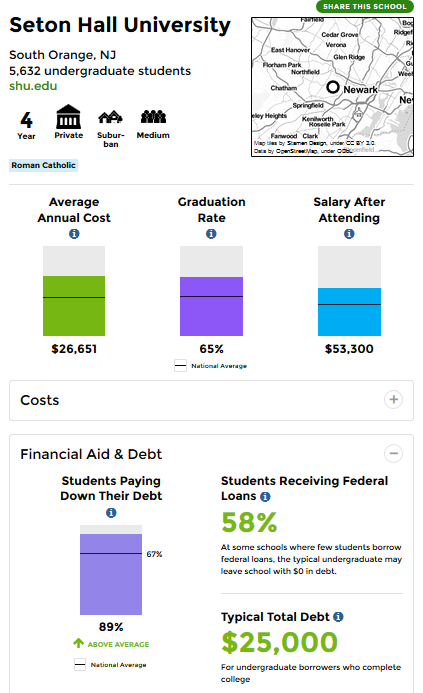
The big bombshell dropped this morning. In an extremely rare Saturday morning release (something that frustrates journalists and the higher education community to no end), the Department of Education released a massive trove of data (fully downloadable!) underlying the new College Scorecard. The consumer-facing Scorecard is fairly simple (see below for what Seton Hall’s entry looks like), and I look forward to hearing about whether students and their families use this new version more than previous ones. I also recommend ProPublica’s great new data tool for low-income students.

shu

But my focus today is on the new data. Some of the key new data elements include the following:

  • Transfer rates: The percentage of students who transfer from a two-year to a four-year college. This helps community colleges, given their mission of transfer, but still puts colleges at a disadvantage if they serve a more transient student body.
  • Earnings: The distribution of earnings 10 years after starting college and the percentage earning more than those with a high school diploma. This comes from federal tax return data and is a huge step forward. However, given very reasonable concerns about a focus on earnings hurting colleges with public service missions, there is also a metric for the percentage of students making more than $25,000 per year. Plenty of people will focus on presenting earnings data, so I’ll leave the graphics to others. (This is a big step forward over the admirable work done by Payscale in this area.)
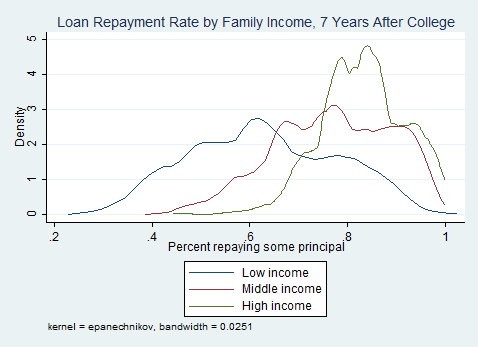
  • Student loan repayment: The percentage of students (both completers and non-completers) who are able to pay down some principal on loans within a certain period of time. Seven-year loan repayment data are available, as illustrated here:

loan_repayment

In the master data file, many of these outcomes are available by family income, first-generation status, and Pell receipt. First-generation status is a new data element to be made available to the public; although the question is on the FAFSA, it’s never been made available to researchers. For those who are curious, here’s what the breakdown of the percentage of first-generation students (typically defined as students whose parents don’t have a bachelor’s degree) by institutional type:

firstgen

There are a lot of data elements to explore here, and expect lots of great work from the higher education research community in upcoming months and years using these data. In the short term, it will be fascinating to watch colleges and politicians respond to this game-changing release of outcome data on students receiving federal financial aid.

New Paper and Testimony on Risk Sharing

The concept of risk sharing, in which colleges are held at least partially financially responsible for the outcomes of their students, has become a hot topic of political discussion in recent months. The idea has gained bipartisan support–in least in theory–as presidential candidates Hillary Clinton and Scott Walker have both supported the basic principles of risk sharing. Yet by potentially penalizing colleges with high student loan default rates, risk sharing systems have the incentive to reduce access to higher education while not actually incentivizing colleges to improve.

With generous support from the Lumina Foundation, I set out to sketch out a risk sharing system with the goal of increasing accountability for poor outcomes while recognizing differences in the types of students colleges serve. I released the resulting paper this week and testified in front of the U.S. Department of Education’s Advisory Committee on Student Financial Assistance on the topic. (My testimony is below.) I welcome your comments on risk sharing, as the goal of this paper and testimony is to advance a thoughtful conversation on what a fair and effective system could look like.

For more reading on risk sharing, I highly recommend the thoughtful takes of the American Enterprise Institute’s Andrew Kelly and Temple University’s Doug Webber.


Testimony to the Advisory Committee on Student Financial Assistance

Hearing on Higher Education Act Reauthorization

Robert Kelchen

Good afternoon, members of the Advisory Committee on Student Financial Assistance, Department of Education officials, and other guests. My name is Robert Kelchen and I am an assistant professor in the Department of Education Leadership, Management and Policy at Seton Hall University. All opinions expressed in this testimony are my own, and I thank the Committee for the opportunity to present.

My testimony today will be on the topic of risk sharing in higher education, which is typically defined as holding colleges financially accountable for their students’ performance. It is a topic that has been discussed by politicians on both sides of the aisle, including legislation recently introduced by Republican Senator Orrin Hatch and Democratic Senator Jeanne Shaheen that would require colleges to pay a percentage of students’ loans that were not paid on in the previous year.[1] But simple risk sharing proposals like this provide colleges with incentives to reduce borrowing by either leaving the Direct Loan program or reducing non-tuition expense allowances included in the cost of attendance.

In a recently-released policy paper funded by the Lumina Foundation, I introduced a risk sharing proposal that attempts to hold colleges accountable for their performance with respect to both Pell Grant and federal student loan dollars.[2] My proposal would reward colleges for strong performance on Pell Grant success and student loan repayment rates, while requiring colleges with weaker performance to pay a penalty to the Department of Education from a source other than institutional aid dollars.

The federal government’s portion of my proposed risk-sharing system would have three main components:

  • First, penalties or rewards for Pell Grant recipients’ performances would be separate from penalties or rewards for student loan performance. This would end the current situation in which colleges face incentives to opt out of federal student loans in order to protect Pell Grant dollars.[3]
  • Second, the federal government would provide better tracking and reporting of outcomes for students receiving federal financial aid. The set of metrics available to examine performance is extremely limited, and could be improved by either overturning the ban on federal student unit record data systems or committing to providing additional subgroup performance information using IPEDS and the National Student Loan Data System.
  • Third, in order to make more accurate comparisons about student loan performance across campuses, federal guidelines for how the non-tuition components of the cost of attendance are defined would be helpful. Research has found large variations in the off-campus room and board and other expense allowances, which are determined by individual colleges, within a given metropolitan area.[4] Colleges need to be placed on a more level playing field for accountability purposes.

Colleges would be required to meet three criteria to receive Title IV funds:

  • First, colleges must agree to put “skin in the game” by being willing to match a percentage of Title IV loan or grant aid with institutional funds if their performance falls below a specified benchmark.
  • Second, colleges must participate in the Federal Direct Loan program in order for their students to receive Pell Grant dollars, giving students access to credit while not directly putting Pell dollars at risk.
  • Third, colleges must be willing to meet heightened accreditation and consumer information provision standards.

Colleges’ performance would be compared to similar institutions using peer groups based on the characteristics of students served, types of degrees and certificates offered, and the level of resources different colleges possess. Notably, by using institutional selectivity, per-student revenues, and endowment values as grouping characteristics, a college would be compared to more selective colleges if it tried to become more selective—limiting its ability to game the system.

The Pell Grant portion of risk sharing would be based on outcomes such as Pell recipients’ retention rates, graduation rates, transfer rates, and the number of graduates. Colleges with performance a certain percentage below the peer group average would have to pay a penalty equal to a percentage of Pell funds awarded out of their own budget, while colleges a certain percentage above the average would receive a bonus to use to supplement need-based financial aid programs.

The student loan portion of risk sharing would be based on outcomes such as cohort default rates 3-5 years after entering repayment, the percent of students current on their payments, and the percentage of students making payments of at least $1 of principal. I would also include PLUS loans in the risk sharing metric. Colleges performing substantially above the peer group average would get additional work-study funds, while colleges performing substantially below average would face a penalty.

The implementation of any risk sharing proposal must be carefully considered in order to avoid perverse incentives and to gain support from colleges and policymakers. Lessons from state performance-based funding program show that implementing over a period of several years is important, as is some method for colleges to limit penalties until they can change their organization.[5] Colleges that can present clear plans for improvement that are supported by their accreditor should be able to get reduced penalties and logistical support from the federal government for a limited period of time.

Thank you once again for the opportunity to present and I look forward to answering any questions.

[1] Student Protection and Success Act (S. 1939, introduced August 5, 2015). http://www.shaheen.senate.gov/imo/media/doc/Student%20Protection%20and%20Sucess%20Act.pdf.

[2] The paper is available at http://www.luminafoundation.org/resources/proposing-a-federal-risk-sharing-policy.

[3] Hillman, N. W. (2015). Cohort default rates: Predicting the probability of federal sanctions. Educational Policy, 29(4), 559-582. Hillman, N. W., & Jaquette, O. (2014). Opting out of federal student loan programs: Examining the community college sector. Paper presented at the Association for Education Finance and Policy annual conference, San Antonio, TX.

[4] Kelchen, R., Hosch, B. J., & Goldrick-Rab, S. (2014). The costs of college attendance: Trends, variation, and accuracy in institutional living cost allowances. Madison, WI: Wisconsin HOPE Lab.

[5] For example, see Dougherty, K. J., & Natow, R. S. (2015). The politics of performance-based funding: Origins, discontinuations, and transformations. Baltimore, MD: Johns Hopkins Press.

Do SAT-Mandatory States Explain Declining Scores?

Yesterday, I wrote about how it was likely the case that some of the decline in SAT scores  was due to states and districts requiring students to take the SAT. At the request of several esteemed readers, I did a back-of-the-envelope calculation to see how much of the change in SAT scores over the last five years is due to states requiring all students to take the SAT (hat tip to Kan-Ye Test (love the name!) for pointing me to the data). Between 2011 and 2015, Delaware, the District of Columbia, and Idaho moved from having some of their students take the SAT (14,765) to having all of their students (32,236) take the SAT. Meanwhile, the average SAT score fell from 1500 to 1490.

Based on 2011 state-by-state data, I recalculated average 2015 SAT scores while substituting 2011 participation levels and scores for 2015  levels and scores in those three states. Erasing the additional 17,471 test-takers (and their average SAT of 1292) from those three states was enough to raise the average SAT score of 1.6 million other test-takers by 2.1 points. These three states explain approximately 21% of the decline in SAT scores, as outlined below.

Required SAT states explain at least 21% of the decline in SAT scores since 2011
States Num. students Avg. SAT
DC, DE, & ID (2011) 14,765 1445
DC, DE, & ID (2015) 32,236 1362
All others (2015) 1,614,887 1493
Total (using ’11 DC, DE, & ID) 1,629,652 1492
Total (using ’15 DC, DE, & ID) 1,647,123 1490

I’d still love to see the College Board pull out data from the districts which moved to require the SAT, as it’s entirely possible that half of the decline in SAT scores could just be due to students who were required to take the test. They’ve got the data, and I hope they take a look!