Blog (Kelchen on Education)

The Joys of Teaching

It’s been a busy couple of weeks since my last post. Much of my time has been spent completing revisions to my dissertation after my defense last month. I deposited the final version of the dissertation with the University of Wisconsin late last week, which means that I have completed my doctoral degree (although I won’t get a paper diploma until October or November). I am now done with graduate school and rapidly making the transition to my next stage in life.

I accepted a position this spring with Seton Hall University in South Orange, New Jersey, as an assistant professor of higher education in the Department of Education Leadership, Management, and Policy. When visiting the university on my flyout, I was impressed with both the focus on teaching and the quality of the graduate students and faculty. Although I certainly enjoy doing research, I could have had the freedom to research many topics of interest in non-university positions—or even worked for one of the university research centers around the country. My insistence on the academic path was driven by my desire to teach, as well as to do research.

While I know that not all university faculty members truly enjoy teaching, it is rare that someone will actually state their dislike in public. This is why I found a piece in last week’s Chronicle of Higher Education to be extremely interesting. In that piece, an associate professor in the humanities (writing under a pseudonym) detailed why he/she has disliked teaching in the past. The article did not state the type of institution (teaching or research intensive) that the professor teaches at, but is still disconcerting nonetheless. I am concerned about what happens to students in classes that faculty don’t like to teach—particularly large, introductory courses at research institutions.

I’m looking forward to spending part of my summer preparing materials for my courses in the next academic year. And if I ever say that I dislike teaching in general, please remove me from the profession.

The Great Student Loan Interest Rate Debate

As I write this post, the House of Representatives is currently debating the future of student loan interest rates. Under current law, the rates on subsidized Stafford loans for undergraduates (the rates which get the most attention) will double on July 1 from 3.4% to 6.8% without Congressional action. The same debate was held last year under the same parameters, but Congress and the President agreed to extend interest rates for an additional year.

There have been a wide range of proposals put forth regarding plans to address the interest rate cliff, an outstanding summary of which was written by Libby Nelson in Inside Higher Ed. (In addition to the plans listed in that article, some Senate Democrats have supported a two-year extension to current law in order to allow for the Higher Education Act to be reauthorized.) Most proposals move to tie interest rates to the market—represented here by borrowing costs for the federal government—but the plans vary widely in their ideas of what the relevant market should be.

Proposals put forth by the Obama Administration and House and Senate Republicans all tie interest rates to long-term Treasury bills, but vary in their other features. (I’ve previously written on the Obama Administration’s proposal.) While the President has threatened to veto the common House GOP proposal over certain aspects, there is enough common ground here to reach an agreement.

However, proposals put forth by certain Democratic senators, particular Sen. Elizabeth Warren from Massachusetts, confuse long-term lending risks with short-term credit markets. She has proposed tying student loan interest rates (which are repaid for at least ten years once a student leaves college) to the interest rate the Federal Reserve charges banks for very short-term borrowing. Jason Delisle of the New America Foundation, hardly a bastion of conservatism, crushes her argument in a great piece of writing. He notes the confusion between short-term and long-term rates, as well as accounting for the probability of default. I would also note that if Congress wishes to help make college more affordable, it’s a better idea to give the funds upfront to students than to lower interest rates later on–long after the enrollment decisions have been made.

The federal government should move toward some sort of a market-based strategy for interest rates with certain student protections. This would allow for the costs of student loans to be more adequately reflected in the federal budget. (And if interest rates get too high, maybe it’s a reminder for Congress and the President to produce a balanced budget!) With that being said, I would still expect to see a short-term extension of the current interest rates as Congress may end up deadlocked on this issue until the Higher Education Act is reauthorized.

More on Rate My Professors and the Worst Universities List

It turns out that writing on the issue of whether Rate My Professors should be used to rank colleges is a popular topic. My previous blog post on the topic, in which I discuss why the website shouldn’t be used as a measure of teaching quality, was by far the most-viewed post that I’ve ever written and got picked up by other media outlets. I’m briefly returning to the topic to acknowledge a wonderful (albeit late) statement released by the Center for College Affordability and Productivity, the data source which compiled the Rate My Professors (RMP) data for Forbes.

The CCAP’s statement notes that the RMP data should only be considered as a measure of student satisfaction and not a measure of teaching quality. This is a much more reasonable interpretation, given the documented correlation between official course evaluations and RMP data—it’s also no secret that certain disciplines receive lower student evaluations regardless of teaching quality. The previous CBS MoneyWatch list should be interpreted as a list of schools with the least satisfied students before controlling for academic rigor or major fields, but that doesn’t make for as spicy of a headline.

Kudos to the CCAP for calling out CBS regarding its misinterpretation of the RMP data. Although I think that it is useful for colleges to document student satisfaction, this measure should not be interpreted as a measure of instructional quality—let alone student learning.

Net Price and Pell Enrollment: The Good and the Bad

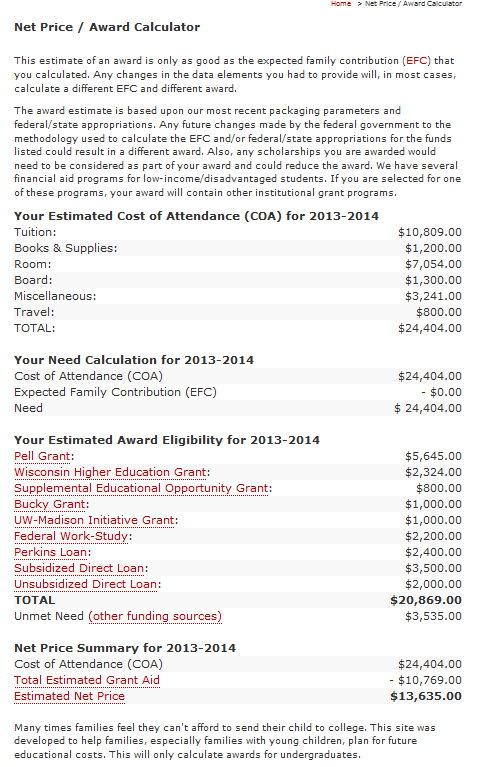
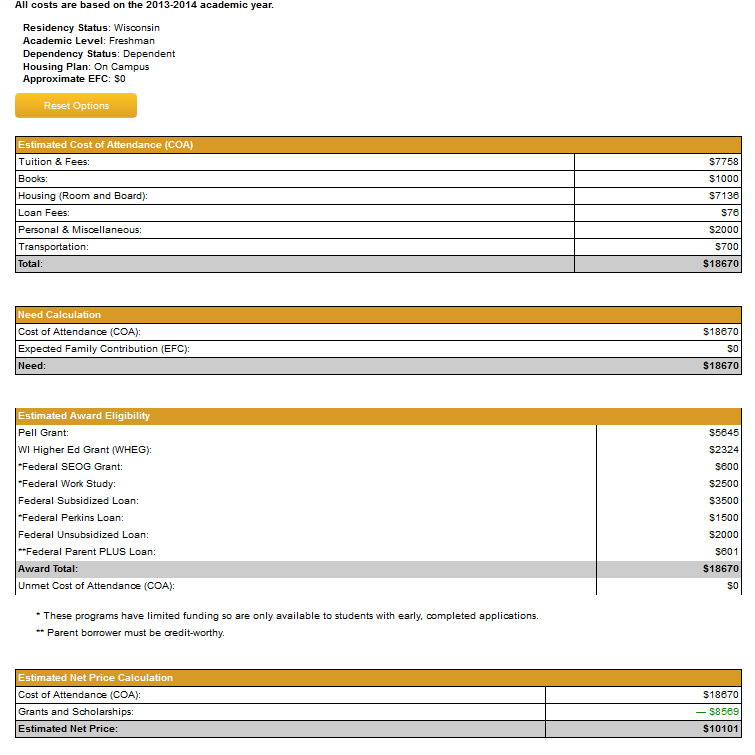
I am thrilled to see more researchers and policymakers taking advantage of the net price data (the cost of attendance less all grant aid) available through the federal IPEDS dataset. This data can be used to show colleges which do a good job keeping the out-of-pocket cost low either to all students who receive federal financial aid, or just students from the lowest-income families.

Stephen Burd of the New America Foundation released a fascinating report today showing the net prices for the lowest-income students (with household incomes below $30,000 per year) in conjunction with the percentage of students receiving Pell Grants. The report lists colleges which are successful in keeping the net price low for the neediest students while enrolling a substantial proportion of Pell recipients along with colleges that charge relatively high net prices to a small number of low-income students.

The report advocates for more of a focus on financially needy students and a shift to more aid based on financial need instead of academic qualifications. Indeed, the phrase “merit aid” has fallen out of favor in a good portion of the higher education community. An example of this came at last week’s Education Writers Association conference, where many journalists stressed the importance of using the phrase “non-need based aid” instead of “merit aid” to change the public’s perspective on the term. But regardless of the preferred name, giving aid based on academic characteristics is used to attract students with more financial resources and to stay toward the top of prestige-based rankings such as U.S. News and World Report.

While a great addition to the policy debate, the report deserves a substantial caveat. The measure of net price for low-income students only does include students with a household income below $30,000. This does not perfectly line up with Pell recipients, who often have household incomes around $40,000 per year. Additionally, focusing on just the lowest income bracket can result in a small number of students being used in the analysis. In the case of small liberal arts colleges, the net price may be based on fewer than 100 students. It can also result in ways to game the system by charging much higher prices to families making just over $30,000 per year—a potentially undesirable outcome.

As an aside, I’m defending my dissertation tomorrow, so wish me luck! I hope to get back to blogging somewhat more frequently in the next few weeks.

How Not to Rate the Worst Professors

I was surprised to come across an article from Yahoo! Finance claiming knowledge of the “25 Universities with the Worst Professors.” (Maybe I shouldn’t have been surprised, but that is another discussion for another day.) The top 25 list includes many technology and engineering-oriented institutions, as well as liberal arts colleges. I am particularly amused by the inclusion of my alma mater (Truman State University) at number 21, as well as my new institution starting next fall (Seton Hall University) at number 16. Additionally, 11 of the 25 universities are located in the Midwest, with none in the South.

This unusual distribution immediately led me to examine the methodology of the list, which comes from Forbes and CCAP’s annual college rankings. The worst professors list is based on Rate My Professor, a website which allows students to rate their instructors on a variety of characteristics. For the rankings, a mix of the helpfulness and clarity measures is used in conjunction with partially controlling for a professor’s “easiness.”

I understand their rationale for using Rate My Professor, as it’s the only widespread source of information about faculty teaching performance. I’m not opposed to using Rate My Professor as part of this measure, but controlling for grades received and the course’s home discipline is essential. At many universities, science and engineering courses have much lower average grades, which may influence students’ perceptions of the professor. The same is true at certain liberal arts colleges.

The course’s home discipline is currently in the Rate My Professor data, and I recommend that Forbes and CCAP weight results by discipline in order to more accurately make comparisons across institutions. I would also push them to aggregate a representative sample of comments for each institution, so students can learn more about what students think beyond a Likert score.

Student course evaluations are not going away (much to the chagrin of some faculty members), and they may be used in institutional accountability systems as well as a very small part of the tenure and promotion process. But like many of the larger college rankings, Forbes/CCAP’s work results in at best an incomplete and at worst a biased comparison of colleges. (And I promise that I will work hard on my helpfulness and clarity measures next fall!)

All Quiet on the Blogging Front

This blog has been fairly quiet through the month of April, a notable difference from my goal of writing about two posts per week. While I greatly enjoy being able to write my thoughts on timely issues in the higher education world, there are times when my day job doesn’t readily allow for time necessary to think through and write a post—let alone keep up with the news. But I do want to take a few minutes to share the reasons why I’ve been so busy, as well as why May will likely be a fairly slow month on this blog.

First of all, I’m preparing to defend my dissertation (three essays on higher education policy) toward the end of next week. The last few weeks have been fairly frantic as I’ve made substantial changes to two chapters before I sent them to my committee last week. Although there will certainly be a lot of changes required after my defense, it feels great to be ready to defend. I will be happy to share the dissertation chapters with anyone who is interested after final revisions have been made.

At the end of this week, I am flying to California to give a presentation at the annual Education Writers’ Association seminar at Stanford University. I was asked to give a talk on my research in the area of input-adjusted metrics in measuring institutional effectiveness, and particularly how adjusting for cost changes the ordering of institutions. This talk will be in front of a large group of journalists who cover education on a regular basis, which is a neat opportunity.

Finally, on the teaching front, I am giving my final lecture of the semester tomorrow on accountability and performance measures to a mixed undergraduate/grad student class on debates in higher education policy. I’ve really enjoyed giving several previous lectures, and this one has particular meaning to me as it is something that is both very policy-relevant and fun to teach.

I hope to get a post or two up sometime in the next two weeks, so please send along any ideas that you would like for me to explore in future posts. Until then, it’s back to the fun world of cleaning and coding administrative datasets!

Why Expanding Student Loan Interest Deductions is Unwise

The United States Congress has rarely met a change to the tax code that it doesn’t like. Since 2011, Congress has made nearly 5,000 changes to the tax code, making the tax code even more Byzantine and causing many Americans headaches each spring. While the exact levels and types of taxes preferred by the public tend to differ by political and economic ideologies, a general consensus exists among economists that a stable, predictable, relatively simple tax code achieves revenue goals at a reasonable cost.

Yet Congress is constantly faced with pressure to change the tax code to allow more credits and deductions to incentivize certain activities. We have certainly seen incentives in the tax code to increase educational attainment through the use of credits and deductions. These incentives have a difficult time being effective in inducing students to obtain more education because students and their families do not receive a financial benefit until well after the enrollment decision has been made, and awareness of these programs is uneven at best.

The deduction for student loan interest payments is designed to help student be able to repay their educational debt; currently, students can receive a $2,500 deduction on their taxes (if they itemize) in a given year and their income is less than $75,000 per year if single or $150,000 per year if married filing jointly. It is hard to imagine that such a program, which does not provide a financial benefit to students until after they have left college, will help increase educational attainment.

Yet Congressman Charles Rangel (D-NY), who is well-known for his 2012 censure over failing to pay taxes, has introduced the Student Loan Interest Deduction Act, which would double the tax deduction for student loan interest and get rid of the income cap for receiving the deduction. This bill has picked up the support of many higher education associations, including the American Council on Education and the National Association of Student Financial Aid Administrators, but it is an example of inefficient and misguided public policy.

Here are a few reasons why the proposed bill is poor public policy:

(1)    Students get the tax deduction years after beginning college. Yes, students with perfect information about the deduction (and who believe the policy will remain in place) will adjust their total cost of college down. But that requires a large amount of information and a low discount rate, neither of which can be assumed.

(2)    Increasing the deduction cap allows students to benefit more if they took out more debt. This can provide an additional incentive for colleges to raise their price and capture additional revenue if they think students will pay.

(3)    Getting rid of the income cap shifts the benefits more toward higher-income families, who are more likely to itemize deductions and be able to use the deduction. Advocates on the left should be particularly steamed by this point.

(4)    This acts as an additional tax on saving for college relative to borrowing, and can place families who chose not to borrow at a disadvantage.

I would prefer to see all interest deductions removed from the tax code and replaced with more efficient upfront payments. Instead of forgoing billions of dollars in revenue through tax credits and deductions, I would rather see the money used in grant programs, lowering the interest rates for federal loans, or used toward other educational improvements. Rangel’s bill just complicates the status quo and does little to actually help students afford college.

Something Old, Something New: The FY 2014 Obama Budget

Even though I know that it has no chance of being passed in anything resembling its current form, I am excited to get my hands on President Obama’s long-delayed budget for Fiscal Year 2014 (short version, long version, six-page summary of the education portion). The funding request for the Department of Education is for $71.2 billion in discretionary spending, 4.6% higher than this year’s (pre-sequester) budget; ED is unlikely to see an increase of greater than inflation this year given the current political climate.

I tweeted my way (follow me!) through some of the key points relating to higher education yesterday, and am now back with a more detailed summary of the budget. (I also recommend Libby Nelson’s excellent summary in today’s Inside Higher Ed.)This year’s theme is “something old, something new,” as many of the proposals are recycled from last year—but with one key difference that will affect millions of students.

First of all, not much changes with respect to the Pell Grant. The President proposes a $140 increase in the maximum Pell Grant to $5,785, while the program is on more solid financial footing for the next few years. He is again trying to get a higher education version of Race to the Top passed this year, which will look similar to the plan from last year. Again, there is a strong focus in the STEM fields and for program evaluation (the latter of which is welcome from my perspective). The biggest program boost I could find was to FIPSE (the Fund for the Improvement of Postsecondary Education), going from under $2.4 million to $260 million. Although it is unlikely to be adopted, it does show a commitment to demonstration projects in K-12 and higher education.

The most controversial part of the President’s budget is the proposed shift to market-based interest rates. A day after Republican Senators Coburn, Burr, and Alexander introduced a bill to tie all interest rates to the ten-year Treasury rate (currently 1.8%) plus three percentage points, the President’s budget also proposed tying interest rates to the same measure. His plan is more nuanced, with different loans having different premiums over the Treasury rate (see p. 344-350):

Subsidized Stafford: Treasury plus 0.93% (about 2.75% currently)

Unsubsidized Stafford and Perkins: Treasury plus 2.93% (about 4.75%)

PLUS: Treasury plus 3.93% (about 5.75%)

GOP plan: All loans are Treasury plus 3% (about 4.8%)

These rates are far lower than the current rates (3.4% for subsidized Stafford, 6.8% for unsubsidized Stafford, and over 8% for graduate unsubsidized loans), but do shift risk onto students as the rate for new loans would change each year. There would also be no interest rate cap, which is lamented by many advocates. (Income-based repayment provides another alternative, however.)

If either of these plans is adopted, the interest rate cliff would be eliminated as students would no longer have to wait on Congress to know their rates. However, students are likely to see rates rise as Treasury yields return toward their historical norm. The Congressional Budget Office predicts that 10-year Treasury notes will yield 5.2% by 2018, which would put unsubsidized loans just over 8%. (This is still lower than the recent rate for unsubsidized graduate loans, with which I am quite familiar.) If rates go higher than that, I expect Congress to enact an interest rate cap in several years.

The federal budget process does not move quickly, especially with a divided Congress. While I do not expect large increases in the Department of Education’s budget, I am optimistic that a market-based solution to interest rates will be adopted in order to provide more certainty in the short run and to bring graduate loan rates closer to what the private market would otherwise offer.

Should Students Take a Common Summer MOOC?

For many years, a substantial number of colleges have asked their incoming students to all read the same book as a part of student orientation. For example, the University of Wisconsin-Madison’s Go Big Read program asked students last year to read “Radioactive: A Tale of Love and Fallout” by Lauren Redniss. And when I was a freshman in college at Truman State University, my common read was “The Souls of Black Folk” by W.E.B. Du Bois.

While I enjoyed my common reading experience, I have to wonder if alternative methods could be used to heighten student engagement. The great amount of recent discussion about MOOCs (massively open online courses) leads me to think that a small number of innovative colleges should assign their students a common MOOC instead of a common book. While a MOOC may be more work than reading a book, it has the potential to better prepare students for their future college experiences.

A common MOOC should have the same properties of a successful common read. It must be accessible to the typical student, yet be challenging enough to stimulate discussion and get students acclimated to college-level coursework. It should also reach students across a large number of majors and interests. While colleges may want to develop their own MOOC for this purpose, here are a few courses which could stimulate interesting discussion:

Generating the Wealth of Nations

Maps and the Geospatial Revolution

TechniCity” (how cities are changing)

While I hold no great hopes that MOOCs will completely transform higher education, I think the technology can help at least some students. And a common summer MOOC may be one way to do so, assuming issues of Internet accessibility can be addressed.

Recent Trends in Student Net Price

In the midst of the current economic climate and the rising sticker price of attending college, more people are paying attention to the net price of attendance. The federal government collects a measure of the net price of attendance in its IPEDS database, which is calculated as the total cost of attendance (tuition, fees, room and board, and other expenses) less any grant aid received. Since the 2008-2009 academic year, they have collected the average net price by family income among students who receive federal financial aid. In this post, I examine the trends in net price data by type of institution (public, private nonprofit, and for-profit) among four-year colleges and universities (n=1753).

The first figure shows the average net price that families faced in the 2010-11 academic year (the most recent year available) by family income bracket. This nicely shows the prevalence of tuition discounting models, in which institutions charge a fairly high sticker price and then discount that price with grant aid. (Part of the discount in the lowest two brackets is also state and federal need-based grant aid.)

figure1_netprice

The next figure shows the net price trends over the period from 2008-09 through 2010-11 for the lowest (less than $30,000 per year) family income bracket.

figure2_netprice

It is worth noting that the public and for-profit sectors largely held the net price for students from the lowest-income families constant over the three-year period (0.6% and -3.2%, respectively), while nonprofit colleges increased the net price by 5.6% during this time. This might show an institutional commitment to keeping the net price relatively low for the neediest students, but also keep in mind that the maximum Pell Grant increased from $4,041 to $5,273 during this period. Colleges may not have changed their effort, but instead relied on additional federal student aid. The uptick in the net price at private nonprofit universities may have been a function of pressures on endowments that restricted institutional financial aid budgets.

The final figure shows the net price trends for the highest family income bracket (more than $110,000 per year)—among students who received federal financial aid.

figure3_netprice

Three observations jump out here. First of all, the net prices for nonprofit and for-profit universities are nearly identical for the highest-income students. This shows the financial model for nonprofit education, in which “full-pay” students are heavily recruited in order to pay the bills and to help fund other students. Second, the average net price at public universities increased by 9.4% during this period for the highest income students, compared to only 4.6% at nonprofit and 0.4% at for-profit institutions. As per-student state appropriations declined during this period, public institutions relied more on tuition increases and recruiting out-of-state and foreign students if at all possible. Finally, the flat net price profile of for-profit colleges across the income distribution is worth emphasizing. It seems like these colleges have reached a point at which additional increases in the price of attendance will result in net revenue decreases.

I would love to hear your feedback on these figures, as well as suggestions for future analyses using the net price data. I am eagerly awaiting the 2011-12 net price data, but that may not be available until this fall.