Blog (Kelchen on Education)

Do Presidential Debates Increase Student Applications?

Tonight is the first presidential debate of the 2016 general election season, and this clash between Democrat Hillary Clinton and Republican Donald Trump could top 100 million viewers. (I won’t be one of them, as I’m teaching tonight.) The host site, Hofstra University, is actually the second choice—as Wright State University pulled out over the high price tag this summer. Hofstra is paying about $5 million to host the debate, with the costs generally covered through three donors.

Hosting a presidential debate is undoubtedly a great public relations opportunity for a university, similar to making a big run in the NCAA basketball tournament or making a big football bowl game. Some research has shown that big-time athletics success is associated with increased student applications in the following year, so the media circus following a presidential debate (Hofstra is trending on Twitter as I write this post) could have similar results.

Hofstra also hosted a presidential debate in 2012, so I looked at what happened to the number of applications they received before and after the debate compared to their defined group of peer institutions. The data are below:

Name 2011-12 2012-13 2013-14 Pct increase, 2012-13 to 2013-14
Adelphi University 8278 9184 8654 -5.8%
American University 18706 17039 17545 3.0%
Boston University 38275 41802 44006 5.3%
Drexel University 48450 40586 43945 8.3%
Fordham University 31792 34070 36189 6.2%
George Washington University 21433 21591 21756 0.8%
Hofstra University 18909 21376 22733 6.3%
Ithaca College 13436 13813 15658 13.4%
LIU Post 7369 7209 6001 -16.8%
Marist College 11399 11466 10351 -9.7%
New York University 41243 42807 45779 6.9%
Northeastern University 43255 44208 47364 7.1%
Pace University-New York 10623 11778 12885 9.4%
Quinnipiac University 18651 18825 20699 10.0%
Seton Hall University 6436 10180 10735 5.5%
St John’s University-New York 54871 52972 51634 -2.5%
Syracuse University 25884 25790 28269 9.6%


Hofstra did see a 6.3% increase in applications between 2012-13 and 2013-14, compared to a 4.6% increase across its peer institutions. But other peers, such as Ithaca, Quinnipiac, Syracuse, and Pace saw even larger increases. So it appears that the debate brought plenty of pride to Hofstra, but there was not an unusual jump in applications after the debate aired.

Students Shouldn’t Be Terrified of Borrowing for College

I wrote the below letter to the editor of the Star-Ledger, New Jersey’s largest newspaper, in response to a truly woeful editorial piece that they recently published on student loan debt. (Note: They eventually ran the letter, but here is a slightly revised version for your enjoyment.)

—————————————————————————

As a college professor who researches the implications of student loan debt, I was dismayed to read the Star-Ledger Editorial Board’s recent piece titled “Why we should all be terrified of student loans.” Yes, the $1.25 trillion in outstanding student loan debt is a concern, but the typical amount borrowed for a bachelor’s degree is more manageable—about $30,000 per student. Students who borrow from the federal government can also enroll in income-driven repayment programs that allow them to make small or no payments if their income is low.

The “terrified” headline has the potential to scare students and their families away from making a worthwhile investment in college. Research shows that low-income, first-generation, and minority students are particularly averse to borrowing for college, even when borrowing a reasonable amount of money would help them attend and graduate college. Students and their families should be careful about taking on too much debt, particularly from programs like New Jersey’s state student loan system that do not allow payments to be tied to the student’s income. But students should not be terrified of taking out modest loans from the federal government to make college a reality.

How Did ITT Tech’s Outcomes Compare to Other For-Profit Colleges?

Last week, ITT Technical Institute announced that it would close all of its colleges, affecting approximately 40,000 students and 8,000 employees. This closure was expected after the chain of for-profit colleges stopped enrolling new students in late August after the U.S. Department of Education cut off federal financial aid dollars for new students a few days earlier. This closure, which could cost taxpayers up to $400 million through forgiven loans, has generally been celebrated by those on the political left while conservatives and those in the for-profit sector are concerned that the federal government is trying to severely restrict the for-profit college industry.

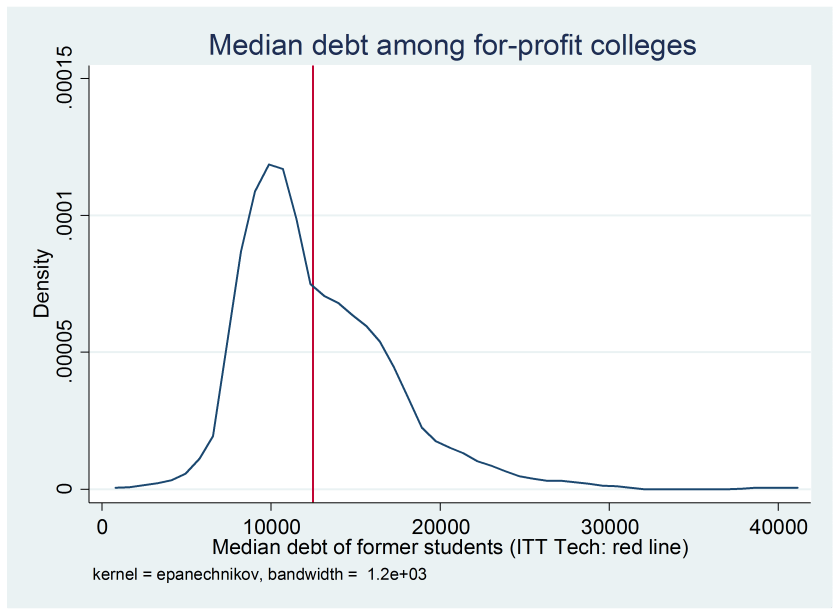
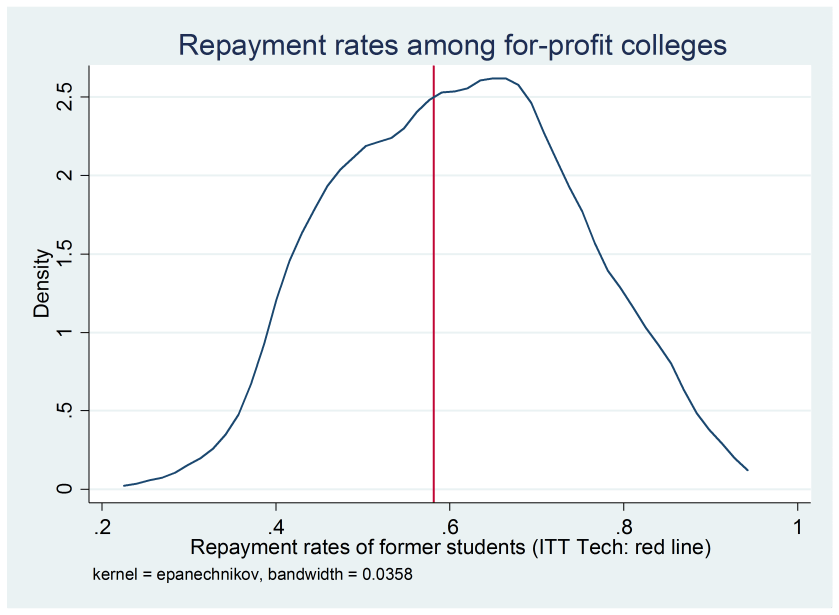
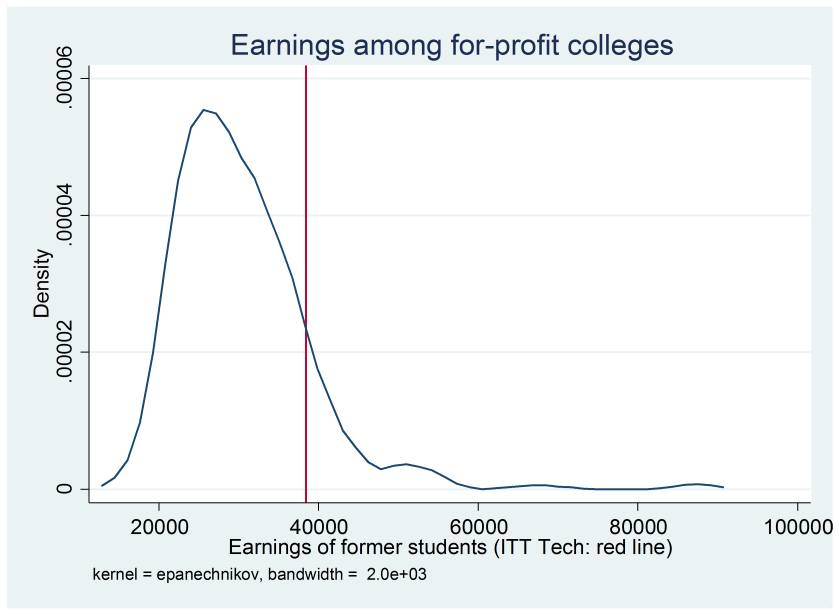
Given that some of the concerns about ITT Tech were about poor student outcomes, I examined ITT Tech’s outcomes relative to other degree-granting for-profit colleges on three important metrics: median debt burdens of former students who took out loans, the percentage of students seven years after entering repayment, and median earnings of former students ten years after entering college.1 I restricted my analysis to the 415 degree-granting for-profit colleges that reported data on all three of the outcomes, combining branch campuses that reported the same outcomes as other colleges in the same system.2

Median debt

The median debt burden of all former ITT Tech borrowers was $12,473 (as indicated by the red line on the below chart), slightly above the median amount of $11,993. This suggests that among for-profit colleges granting associate and/or bachelor’s degrees, ITT Tech’s debt burden was fairly typical.

itt_fig1

Loan repayment rates

Seven years after entering repayment, 58.2% of former ITT Tech students paid down at least $1 in principal on their federal student loans. This is slightly worse than the median rate of 61.3% across similar for-profit colleges.

itt_fig2

Earnings

On this metric, ITT Tech looks pretty good relative to other for-profit colleges. ITT Tech students who received federal financial aid had median earnings of $38,400 ten years after college entry, well above the median of $29,200 and close to the 90th percentile among similar institutions. However, these data are based on students who entered college in the early 2000s, when ITT Tech looked much different than it did in recent years.

itt_fig3

Based on financial outcomes, ITT Tech’s former students (at least those who enrolled at least several years ago) did as well or better than other for-profit colleges. This does lend some credence to defenders of ITT Tech who were concerned about the Department of Education targeting the institution. However, others have noted that ITT Tech’s closure may have been self-inflicted through an ill-advised private loan program that led to fraud charges. In any case, other for-profit college chains are likely to face additional scrutiny in the future—from politicians and accreditors alike.

——————————————————————————————————–

1 I did not examine graduation rates, as many for-profit colleges have very few students in the first-time, full-time cohort of students that are currently used to calculate graduation rates for the federal government.

2 ITT Tech had 143 branch campuses in the College Scorecard data, and 141 of them had the same reported outcomes. I analyzed those campuses as a single institution, dropping the two small campuses that had different reported outcomes.

ACT Scores Fell Last Year. Relax!

As a shareholder of the Green Bay Packers, I keep an eye on what Butte Community College’s most famous student-athlete has to say. Packers quarterback Aaron Rodgers famously told fans in “Packer-land” in 2014 to “R-E-L-A-X” after the team got off to an uncharacteristically slow 1-2 start. Fans relaxed after the team went 11-2 the rest of the way in the regular season as Rodgers played like his regular self.

In the education policy niche of the world, few things get people more upset than declining standardized test scores. Last year, I wrote about the fuss about SAT scores declining—and how at least part of that decline is due to more students taking the test instead of the American education system failing young adults. Now it’s ACT’s turn to release their newest scores—and my message again is R-E-L-A-X.

Between 2015 and 2016, average ACT scores declined from 21.0 to 20.8 nationwide, the lowest score in at least five years. But as the now-dominant test in the United States (much to the surprise of many folks who grew up on a coast where the SAT is still common), the percentage of students taking the ACT rose from 52% in 2012 to 59% in 2015 and 64% this year. This sharp increase in ACT takers is in large part due to more states requiring all students to take the ACT as a graduation requirement. In 2016, all graduating high school seniors took the ACT in 18 states, up from 13 states in 2015.

The five states that required all students to take the ACT for the first time in 2016 all saw large decreases in their average scores, as shown below. Wisconsin, Missouri, and Minnesota all had about 75% of their students taking the ACT in 2015 and had drops of about 1.5-1.7 points when all students took the test, with South Carolina having a drop of 1.9 points as the last 38% of students took the test. Nevada had a decline of 3.3 points in 2016, but the percentage of students taking the ACT more than doubled.

State Pct tested (2016) Avg score (2016) Pct tested (2015) Avg score (2015)
Nevada 100 17.7 40 21.0
South Carolina 100 18.5 62 20.4
Wisconsin 100 20.5 73 22.2
Missouri 100 20.2 77 21.7
Minnesota 100 21.1 78 22.7


Among the other 45 states that had very small changes in ACT participation rates, the average change in scores at the state level (not weighted for size) was effectively zero. So R-E-L-A-X about test score declines when they are due to more students taking the test (some of whom won’t be going to college, anyway) instead of collegegoing students suddenly performing worse.

Income-Driven Repayment Plans Continue to Grow

The traditional way to repay federal student loans was for students to pay back their loans over a ten-year period of time, generally by making the same payment each month. But as student loan debt has generally risen over time (although falling ever so slightly in the most recent quarter), paying off larger loans in a short period of time has become more difficult for many borrowers. This has made income-driven repayment plans, expanded during both the Bush and Obama Administrations, an appealing option for more students (although the future price tag of the programs is something to watch closely in the future).

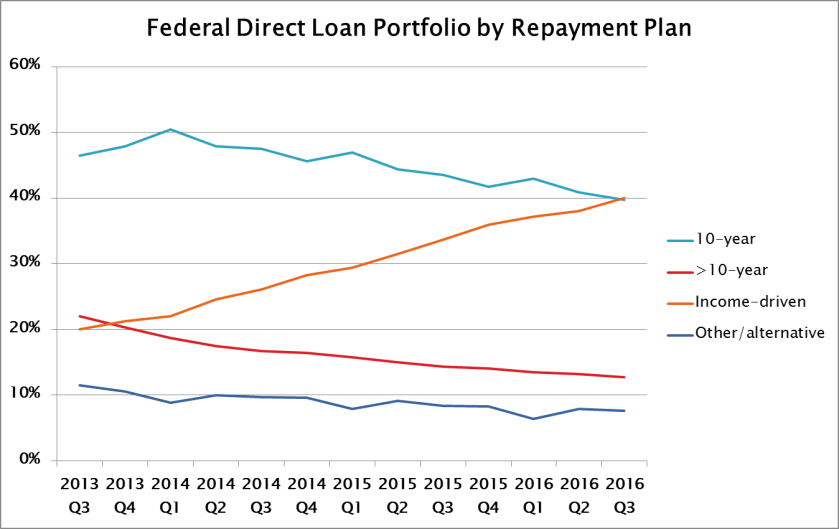
The U.S. Department of Education recently released new data (updated every three months) on the federal student loan portfolio showing the growth in income-driven plans. The chart below shows the percentage of dollars in the Direct Loan program that are in one of four broad categories: 10-year payment plans not tied to income, longer payment plans not tied to income, income-driven plans, and miscellaneous plans that don’t fit well in any of the above three categories.1

repay_aug16

Since 2013 (when repayment plan data first became available), the federal government’s holdings in the Direct Loan program have risen from $361 billion to $673 billion. The amount of loans in the standard ten-year repayment plan rose from $168 billion to $267 billion during this time, but the amount in income-driven plans rose from $72 billion to $269 billion in just three years. Income-driven plans now make up 40.0% of all Direct Loan dollars, while 39.7% of dollars are now in ten-year plans.

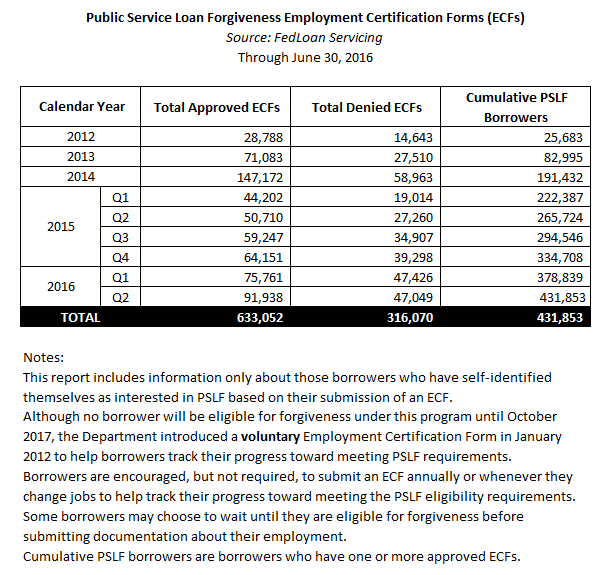
The Department of Education also released data for the first time on the number of students seeking employment certification in the Public Service Loan Forgiveness (PSLF) program, which will allow students working in approved fields to make ten years of payments instead of 20-25 years under other income-driven plans. While students aren’t officially in PSLF until they complete ten years of payments (the first students will do so in October 2017), this is an interesting measure of potential interest in PSLF. The below figure (from Federal Student Aid) shows the number of students who have submitted employment certification forms in possible preparation for receiving PSLF.

ecf_aug16

Notably, about one-third of all requests have been denied to this date, suggesting that quite a few students will get an unpleasant surprise when they go apply for PSLF in the next few years. But at least 430,000 students look to be on track for PSLF at this point—a number that is likely a significant understatement of the number of applications that the federal government will receive.


1 The Direct Loan program represents about 90% of all loans held by the federal government. The other 10% are in the older Federal Family Education Loan (FFEL) program, which has not disbursed new loans in years but has about one-third of its loan dollars in income-based plans. I excluded FFEL here because repayment plan data are only available for 2016.

On Student Loan Debt and Negative Wealth

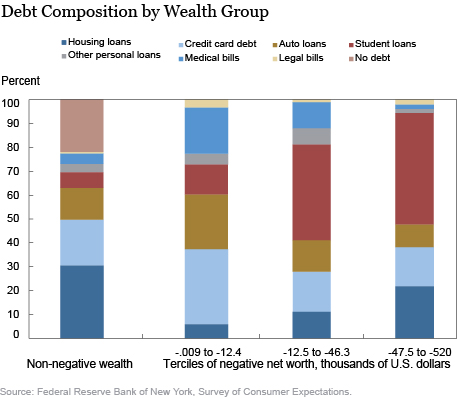
A recent analysis by economists at the Federal Reserve Bank of New York looked at the approximately 14% of American households that had negative wealth in 2015 and pointed out student loan debt as a key driver of negative wealth. As a key figure from the report (which is reprinted below) shows, student loan debt is responsible for between 40% and 50% of total negative wealth among households with a net worth of below -$12,500.

nyfed

This isn’t a tremendously surprising finding, although it’s always helpful to document something intuitive with actual data (although self-reported data always come with caveats). Student loans are one of the few types of debt aside from medical or legal bills that can be taken on in large amounts without having outstanding credit or collateral. Credit card debt is another way to take on debt, but most people with negative wealth won’t be able to access large lines of credit this way. It’s also possible to be underwater on a house (by owing more than its current value), but this affects a relatively small percentage of households.

The authors of the analysis then wrote the following about the implications of student loan debt:

“It is likely that the steady growth in student debt and borrowing, combined with the very slow rate of student loan repayment we have documented elsewhere, has materially contributed and will continue to contribute to negative household wealth and wealth inequality.”

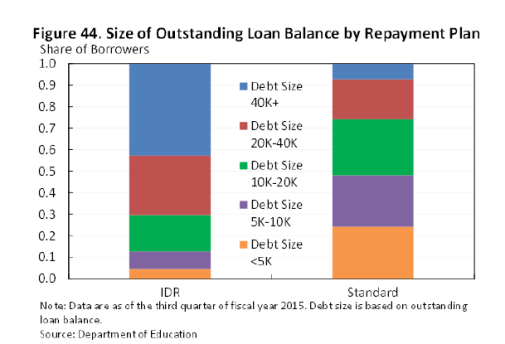
As I told Inside Higher Ed in their summary of the analysis, I only partially agree with that assessment. The challenge with this analysis is that it combines students who completed and did not complete a degree (likely due to sample size issues, as the dataset includes questions about educational attainment). As the authors note, households with a bachelor’s degree or higher and negative net worth tend to have a young head of household. For example, my household is just now leaving negative net worth territory, five years after our head of household completed law school.1 Paying off student loan debt is difficult, but the rapid growth in takeup of income-driven repayment plans among high-debt individuals (as shown in this recent White House report and in the chart below) has the potential to reduce this burden.

cea

I’m far more concerned about the implications for wealth inequality among students who did not complete a degree and are unaware of income-driven repayment options. Although there are positive economic returns on average for students who attend college but do not graduate, they are far smaller than students who finish. A better measure of wealth inequality would look at how wealth progresses over a ten-year window after a student leaves college. If he or she is able to repay loans and build assets, the picture is far less bleak than if a student still has negative wealth due to student loans and other types of debt.

———————————————————————————————————

1 In 2016, the term “head of household” is outdated. In households where both adults work, it’s far from clear who should be the head and who isn’t. It would be better to know the highest educational attainment of either of the adults.

Clinton’s New College Compact Plan Explained

This article was originally published on The Conversation.

Ahead of the Democratic National Convention – on July 5 – Hillary Clinton announced a set of new proposals on higher education. Key measures included eliminating college tuition for families with annual incomes under US$125,000 and a three-month moratorium on federal student loan payments.

Clinton’s original plan had called for the federal government and states to fund public colleges so students wouldn’t have to borrow to cover tuition if they worked at least 10 hours per week.

The revised higher education plan represents a clear leftward shift and is likely an effort to solidify her support among still-skeptical young supporters of Bernie Sanders.

As a researcher of higher education finance, my question is whether these proposals, estimated to cost $450 billion over the next 10 years, will benefit enough of the over 10 million college-going voters struggling to repay loans.

How student loan interest rates work

Typically, students pay interest rates set by Congress and the president on their federal student loans.

Over the last decade, interest rates for undergraduate students have fluctuated between 3.4 percent and 6.8 percent. Rates for federal PLUS loans have ranged from 6.3 percent to 8.5 percent. Federal PLUS loans require a credit check and are often cosigned by a parent or spouse. Federal student loans do not have those requirements.

While students pay this high a rate of interest, rates on 15-year mortgages are currently below three percent.

Several private companies have entered the student loan market.
Application form image via www.shutterstock.com

It is also important to note the role of private loan companies that have recently entered this market. In the last several years, private companies such as CommonBond, Earnest and SoFi as well as traditional banks have offered to refinance select students’ loans at interest rates that range from two percent to eight percent based on a student’s earnings and their credit history.

However, unlike federal loans (which are available to nearly everyone attending colleges participating in the federal financial aid programs), private companies limit refinancing to students who have already graduated from college, have a job and earn a high income relative to the monthly loan payments.

Analysts have estimated that $150 billion of the federal government’s $1.25 trillion student loan portfolio – or more than 10 percent of all loan dollars – is likely eligible for refinancing through the private market – much of it likely for graduate school.

Many Democrats, such as Senator Elizabeth Warren of Massachusetts, have pushed for all students to receive lower interest rates on their federal loans for years. Republican nominee Donald Trump too has questioned why the federal government profits on student loans – although whether the government actually profits is less clear.

Issues with refinancing of loans

Interest rates on student loans were far higher five to 10 years ago (ranging from 6.8 percent to 8.5 percent based on the type of loan). Allowing students to refinance at current rates ranging from 3.76 percent to 6.31 percent would mean that some students could possibly lower their monthly payments.

But the question is, how many students will benefit from the refinance?

Struggling borrowers are likely the ones with least debt.
Robert Galbraith/Reuters

Students with the most debt are typically college graduates and are the least likely to struggle to repay their loans. In addition, they can often refinance through the private market at rates comparable to what the federal government would offer.

Struggling borrowers, on the other hand, already have a range of income-driven repayment options through the federal government that can help them manage their loans. Some of their loans could also be forgiven after 10 to 25 years of payments.

Furthermore, the majority of the growth in federal student loans is now in income-driven plans, making refinancing far less beneficial than it would have been 10 years ago. Under income-driven plans, monthly payments are not tied to interest rates.

So, on the face of it, allowing students to refinance federal loans would appear to be beneficial. But, in reality, because of the growth of private refinancing for higher-income students and the availability of income-driven plans for lower-income students, relatively few students would likely benefit.

Why implementing a moratorium will be hard

On the proposed three-month moratorium, Clinton has said she could proceed on it via executive action as soon as she takes office – potentially making it the most important part of her plan.

During these three months, the Department of Education and companies servicing student loans would reach out to borrowers to help them enroll in income-driven plans that would reduce monthly payments.

So, would a moratorium on student loan payments help struggling borrowers?

The challenge is that reaching out to each and every one of the estimated 41.7 million students with federal student loans in a three-month period would be a Herculean task given the Department of Education’s available resources.

Currently, about one-fifth of the federal government’s student loan portfolio, or $260 billion is in deferment or forbearance, meaning that students are deferring payments until later.

To put this another way, about 3.5 million loans are at least 30 days behind on payments, and eight million loans are in default. This could mean that those students haven’t made a payment in at least a year.

Just trying to contact 3.5 million students in a three-month window would be a difficult proposition, let alone contacting the millions of additional students who are putting off payments until later.

Currently eight million loans are in default.
Andrew Burton/Reuters

There are also other issues that Department of Education staffers and loan servicers must deal with that may be more important than an overall repayment moratorium.

Nearly 60 percent of students who were enrolled in income-driven repayment plans fail to file the annual paperwork. That paperwork is necessary if students are to stay in those programs. And failure to do so results in many students facing higher monthly payments.

Focus needed on most in need students

In my view, Clinton’s proposals of allowing students to refinance their loans at lower rates through the federal government and a three-month moratorium on payments are unlikely to benefit that many students.

Hopefully, the Clinton campaign will focus later versions of the proposal on borrowers most in need of assistance. If not, this could present an opportunity for the Trump campaign to release a coherent higher education agenda.

The Conversation

Proposed Student Finance Regulations May Hamper Small Institutions

This post originally appeared on the Brookings Institution’s Brown Center Chalkboard blog.

In June, the U.S. Department of Education released a 530-page set of proposed regulations on the topic of ‘defense to repayment.’ Although this sounds like an obscure topic (and reading the document is no picnic!), these proposed rules, if adopted, could allow students to be able to have their student loan debt forgiven if colleges misrepresented themselves to students. The Department of Education is currently working through this process for former Corinthian Colleges students, and tens of thousands more students could be eligible under the proposed rules.

Although forgiving student loans has the potential to benefit many financially struggling students, this will likely come at a significant cost to taxpayers. The official cost estimate of the proposed rules is between $199 million and $4.23 billion, which reflects both the number of colleges expected to be subject to the regulations and the large amount of uncertainty in the final number of students affected. To guard taxpayer dollars, the Department of Education is also proposing increasing the number of reasons for which colleges will have to post letters of credit—bonds that the federal government can keep if a college closes in order to compensate former students.

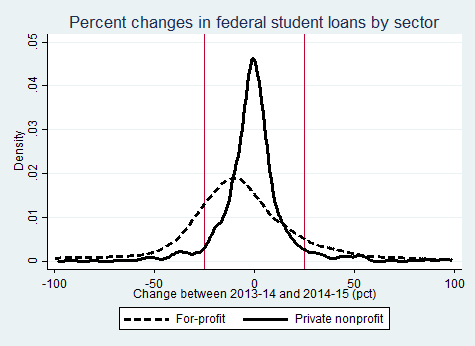
Currently, colleges have to post a letter of credit if they have a low financial responsibility score or if there are serious governance or fraud concerns. But these proposed rules would extend posting letters of credit to private nonprofit and for-profit colleges that have “significant fluctuations” in their Pell Grant and student loan awards, with the definition of “significant” left to the Department of Education to determine. However, on page 358 of the proposed rules, the Department of Education noted that 991 of 3,590 private nonprofit and for-profit colleges had a change in student loan volume of 25% or more between the 2013-14 and 2014-15 academic year. I use this 25% change as a guide in this analysis, as well as looking at the changes in dollar values.

I used data from the Office of Federal Student Aid’s Title IV volume reports to look at the number of colleges with large changes in their Pell Grant and student loan awards between 2013-14 and 2014-15, with my sample consisting of 3,575 colleges that received Pell Grant and/or student loan dollars in both years.1 Of these colleges, 1,088 (30%) had at least a 25% change in Pell Grant or student loan dollars during this period. Much of this rate is driven by for-profit colleges, of which 43% saw large changes; just 15% of nonprofit colleges had similar changes.

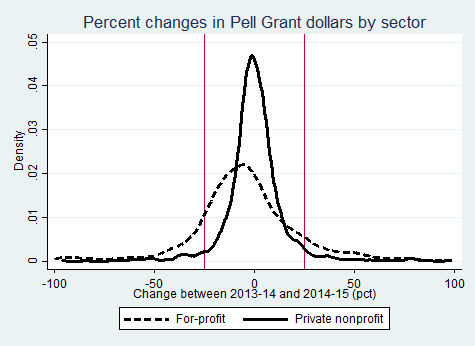
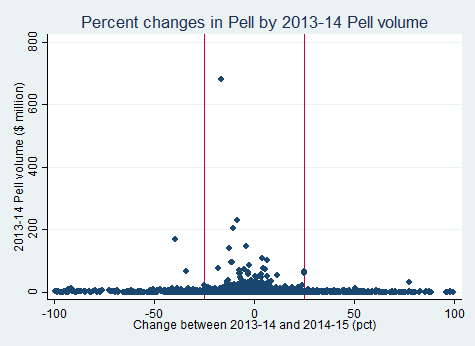
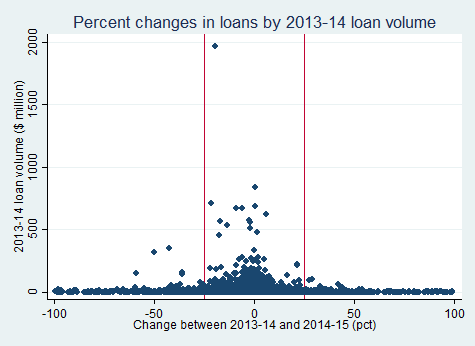
The tendency of for-profit colleges to have larger percentage changes in both Pell Grant and student loan awards can be seen in the below two charts, with the two red vertical lines representing changes of -25% and 25% between 2013-14 and 2014-15. It is also worth noting that the typical for-profit college saw a sizable decline in both types of aid, while the typical nonprofit college had little to no change in aid. This can be attributed to the rapid decline in enrollment at for-profit colleges over the past several years.

defrepay_fig1

defrepay_fig2

The drawback of using a metric based on the percent change in aid awarded is that very small institutions can have large percentage changes with relatively small dollar changes. The next two charts show that the vast majority of colleges with changes above 25% had relatively small amounts of federal aid in 2013-14. The median college with a change that could subject them to a letter of credit had about $250,000 in Pell Grant revenue or $550,000 in student loan revenue, which explains all of the dots right along the axis in the charts.

defrepay_fig3defrepay_fig4

There were a small number of colleges with both sizable amounts of federal student aid in 2013-14 and large changes between 2013-14 and 2014-15. Ten colleges had more than $10 million in Pell Grants and a 25% change the following year, of which only two (nonprofit Southern New Hampshire University and for-profit United Education Institute) had gains. The eight colleges with large losses in Pell awards were all for-profits, and seven are now closed or under new ownership. The only one that is still open is Fortis College, which saw a 39% drop in Pell awards in just one year.

Colleges with large changes in Pell Grant awards, 2013-14 to 2014-15
Name For-profit? 2013-14 Pell ($mil) 2014-15 change (pct) Now closed?
Southern New Hampshire U. No 31.5 +77.2 No
United Education Institute (UEI) Yes 10.6 50.4 No
Florida Career College Yes 22.7 -25.3 Yes
Sanford-Brown College Yes 13.1 -33.0 Yes
Heald College Yes 66.9 -34.1 Yes
Fortis College Yes 12.6 -38.9 No
Everest University Yes 169.0 -39.8 New owner
Wyotech Yes 10.3 -41.1 New owner
Drake College of Business Yes 12.3 -41.2 Yes
Anthem College Yes 11.8 -91.6 Yes


Six colleges with more than $100 million in student loans in 2013-14 had changes of more than 25% in 2014-15, with just one college (for-profit Ultimate Medical Academy) seeing an increase of at least 25%. Of the five colleges with large declines, for-profits Everest University (now under new ownership) and Heald College (now closed) show up again, while nonprofits Loma Linda University, Webster University, and Southern New Hampshire University had large declines. SNHU is particularly interesting, as it saw a 77.2% increase in Pell dollars at the same time it saw a 43% drop in student loan dollars.

Colleges with large changes in student loans, 2013-14 to 2014-15
Name For-profit? 2013-14 loans ($mil) 2014-15 change (pct) Now closed?
Ultimate Medical Academy Yes 100.9 28.7 No
Webster University No 159.4 -36.0 No
Loma Linda University No 143.6 -36.0 No
Southern New Hampshire University No 346.1 -42.7 No
Everest University Yes 317.1 -50.1 New owner
Heald College Yes 150.5 -59.4 Yes


If the Department of Education sticks to the percentage change metric for examining which colleges should post letters of credit, the smallest colleges will be disproportionately affected. Meanwhile, the University of Phoenix, which received over $2.6 billion in Pell and loan revenue with declines of between 15% and 20% in both categories, would not face additional scrutiny even though more students would be affected by any changes. And by extension, more taxpayers would be liable in the case of a bailout of these students. As being unable to obtain a letter of credit may cause some colleges to close, the federal government should potentially consider a sliding scale based on a combination of initial enrollment or federal financial aid volume for considering percentage changes in aid received.

1 I was unable to perfectly match the number of colleges the Department of Education had in its analysis using publicly available data from the Office of Federal Student Aid. This likely leads me to slightly understate the number of colleges that could be affected, as the colleges not in my dataset are probably quite small or had stopped participating in federal financial aid programs during the period of analysis.

Why I Support the File Once FAFSA Act

This year will mark the biggest change to the federal financial aid process in quite a few years, with students being able to file the Free Application for Federal Student Aid (FAFSA) for the 2017-18 academic year on October 1, 2016 instead of January 1, 2017 using 2015 tax data. This change, known as prior prior year (PPY) or early FAFSA, has the potential to give more students information about their federal financial aid eligibility around when they are applying to colleges. My research on the topic (thanks to the generous support and assistance of my friends at the National Association of Student Financial Aid Administrators) found that most students will see similar Pell Grant awards under PPY than under the current system, which helped alleviate concerns about what PPY would mean for both the federal budget and financial aid offices. However, I remain concerned that colleges will not notify students of institutional aid earlier than under current rules due to concerns about their financial aid budgets.

While prior prior year is a step in the right direction for students and their families, there really isn’t a good reason why many students have to fill out the FAFSA every year. While the U.S. Department of Education claims that it takes the average student 21 minutes to file the FAFSA, this number is undoubtedly higher for students with more complex family situations or students whose parents struggle to navigate the form due to limited English proficiency or the FAFSA’s complicated instructions. As a result, an estimated 10% of Pell-eligible students who remained enrolled in college fail to refile the FAFSA.

In 2013, I wrote a piece in The Chronicle of Higher Education with Sara Goldrick-Rab (now at Temple University) titled “Change FAFSA Now.” In that piece, we argued for one-time FAFSA filing to reduce the burden on both students and the U.S. Department of Education. Today, I am happy to see a piece of legislation called the File Once FAFSA Act of 2016, introduced by Rep. Bobby Scott (D-VA), that would allow dependent Pell Grant-eligible students to file the FAFSA just once as long as they remain dependents. (Students with large changes in family income could get their expected family contribution (EFC) changed by talking with their financial aid office.)

While I am pleased to support the legislation, I would like to see two additional groups of students become eligible for a one-time FAFSA. The first group is those students who file the FAFSA just to receive a federal unsubsidized loan. All students attending participating colleges can receive these loans regardless of financial need, so making students repeatedly file the FAFSA just to get these loans makes little sense. This would be particularly beneficial for graduate students, who can no longer receive any federal subsidized loans.

The second group of students who should become eligible is independent students with dependents of their own. In the 2011-12 academic year, 61% of students in this category had an EFC of zero—reflecting a large amount of financial need. This compares to just 24% of dependent students having a zero EFC. Moreover, in a 2015 article, I showed that over 98% of independent students without dependents who had a zero EFC one year and refiled the FAFSA two years later received a Pell Grant that year. Therefore, extending the one-time FAFSA to this category of students make sense.

The idea of a one-time FAFSA should garner bipartisan support, as evidenced by a similar idea being a part of former Republican presidential candidate Jeb Bush’s higher education proposal. I welcome and support Rep. Scott’s proposal as a first step to helping more students whose family circumstances don’t change much while they are in college spend time doing something more productive than completing the FAFSA.

The U.S. Dept. of Education Should Continue to Collect Benefits Costs by Functional Expense

This is a guest post by my colleague and collaborator Braden Hosch, who is the Assistant Vice President for Institutional Research, Planning & Effectiveness at Stony Brook University. He has served in previous positions as the chief academic officer for the Connecticut Department of Education and the chief policy and research officer for the Connecticut Board of Regents for Higher Education. He has published about higher education benchmarking, and has taught about how to use IPEDS data for benchmarking, including the IPEDS Finance Survey. Email: Braden.Hosch@stonybrook.edu | Twitter: @BradenHosch

Higher education finance is notoriously opaque. College students do not realize they are not paying the same rates as the student sitting next to them in class. Colleges and universities struggle to determine direct and indirect costs of the services they provide. And policymakers (sometimes even the institutions themselves) find it difficult to understand how various revenue sources flow into institutions and how these monies are spent.

All of these factors likely contribute to marked increases in the expense of delivering higher education and point toward a need for more information about how money flows through colleges and universities. But quite unfortunately proposed changes to eliminate detail collected in the IPEDS Finance Survey about benefits costs will make it more difficult to analyze how institutions spend the resources entrusted to them. The National Center for Education Statistics should modify its data collection plan to retain breakouts for benefits costs in addition to salary costs for all functional expense categories. If you’re reading this blog, you can submit comments on or before July 25, 2016 telling them to do just that.

Background

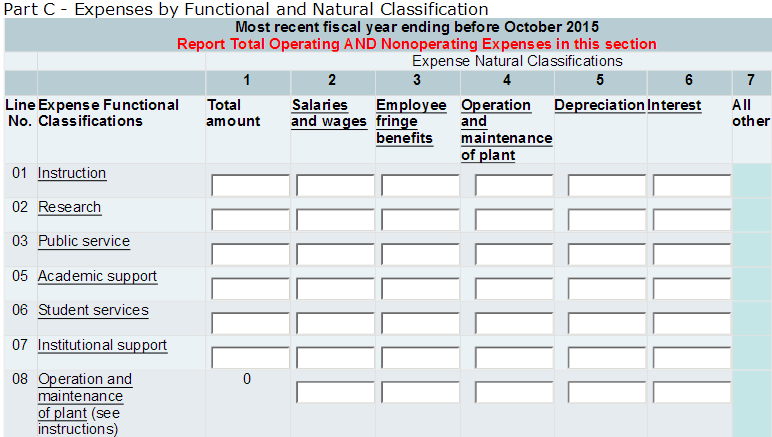
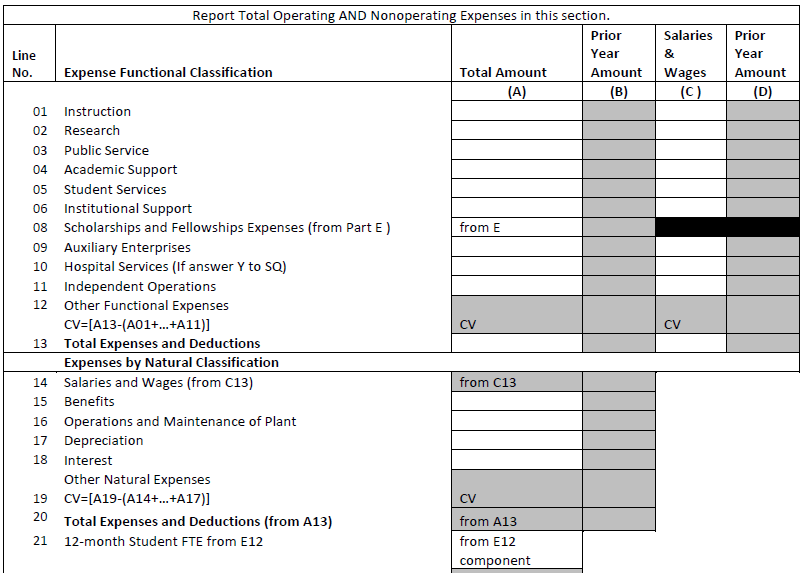
Currently, colleges and universities participating in Title IV student financial aid programs must report to the U.S. Department of Education through the Integrated Postsecondary Education Data System (IPEDS) how they spend money in functional areas such as instruction, student services, institutional support, research, etc. and separate this spending into how much is spent on salaries, benefits, and other expenses, with allocations for depreciation, operations and maintenance, and interest charges. This matrix looks something like this, with minor differences for public and private institutions:
hosch_fig1

The proposed changes, solely in the name of reducing institutional reporting burden, will significantly scale back detail by requiring institutions to report only total expenses by function and total expenses by natural classification, but will not provide the detail of how these areas intersect:
hosch_fig2

Elimination of the allocations for depreciation, interest, and operations & maintenance is a good plan because institutions do not use a consistent method to allocate these costs across functional areas. But elimination of reporting actual benefits costs for each area is problematic.

To be clear, under the proposed changes, institutions must still, capture, maintain, and summarize these data (which is where most effort lies); they are simply saved the burden of creating a pivot table and several fields of data entry.

Why does this matter?

For one thing, the Society for Human Resource Management 2016 survey shows that benefits costs have increased across all economic sectors over the past two decades. IPEDS would continue to collect total benefits costs, but without detail about the areas in which these costs are incurred, it will be impossible to determine in what areas these costs may be increasing more quickly. Thus, a valuable resource for benchmarking and diagnosis would be lost.

Additionally, without specific detail for benefits components of function expenses, the ability to control for uneven benefits costs will be lost; it would be impossible for instance to remove benefits costs from standard metrics like education and general costs or the Delta Cost Project’s education and related costs. Further, benefits costs neither are distributed uniformly across functions like instruction, research, and student services nor are distributed uniformly across sectors or jurisdictions. Thus, to understand how the money flows, at even a basic level, breaking out benefits and other expenses is critical.

Here are two quick examples.

Variation at the institution level

First, as a share of spending on instruction, benefits and other items, benefits expenses are widely variable by institution. I have picked just a few well-known institutions to make this point – it holds across almost all institutions. If spending on benefits were evenly distributed across functions, then the difference among these percentages should be zero, but in fact it’s much higher.
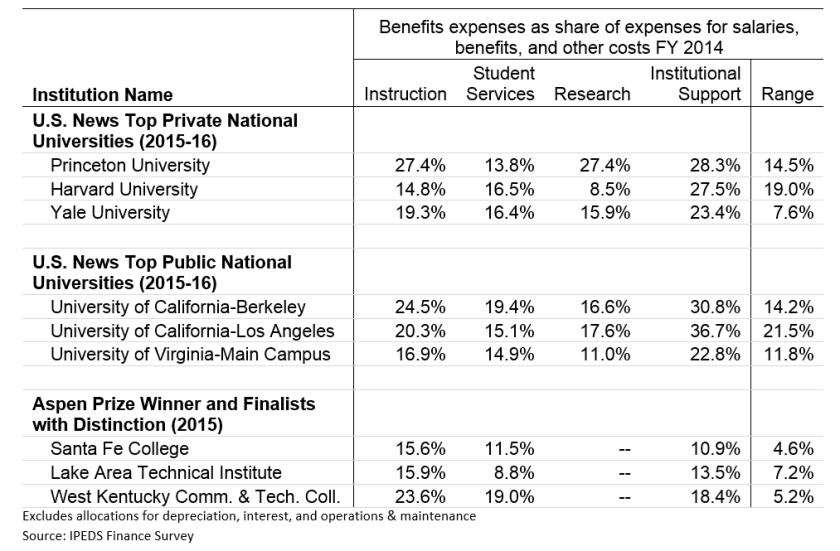
 hosch_fig3

Variation by state

Because benefits costs are currently reported separately across functions, it is possible to analyze how the benefits component of the Delta Cost Project education and related costs metric – spending on student related educational activities while setting aside auxiliary, hospital, and other non-core metrics. Overall, the Delta Cost Project also shows that benefits costs are rising, but a deeper look at the data also show wide variation by state, and in some states, this spending accounts for large amounts on a per student basis.

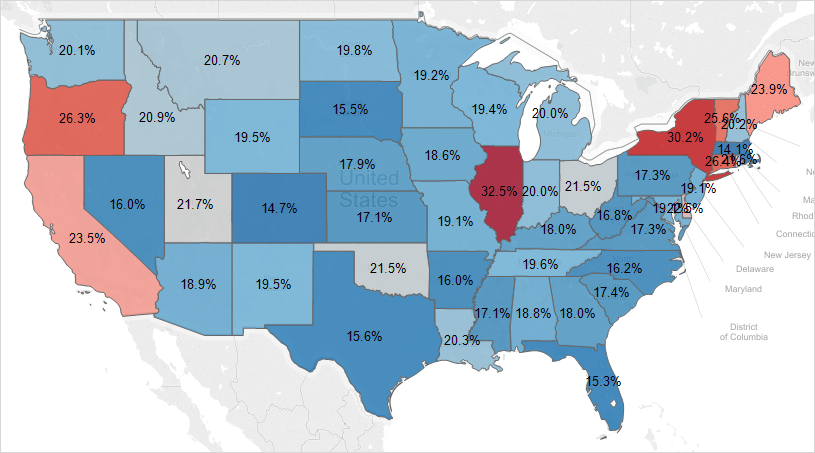
Among 4-year public universities in FY 2014, for instance, spending on benefits comprised 14.1% of E&R in Massachusetts, 20.2% in neighboring New Hampshire to the north, and 30.2% in neighboring New York to the west. The map below illustrates the extent of this variation.

Benefits as a percent of E&R spending, Public, 4-year institutions FY 2014
hosch_fig4

Excludes amounts allocated for depreciation and interest. Source Hosch (2016)

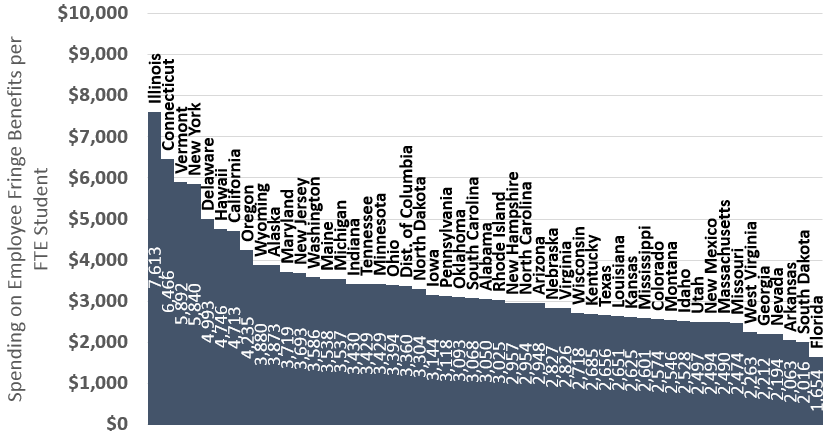
Likewise, on a per student (not per employee) basis these costs ranged from $1,654 per FTE student spent on E&R benefits in Florida, compared to $7,613 per FTE student spent on benefits in Illinois.

E&R benefits spending per FTE student, public 4-year institutions, FY 2014
hosch_fig5

Excludes amounts allocated for depreciation and interest. Source Hosch (2016)

Bottom line: variation is stark, important, and needs to be visible to understand it.

What would perhaps most difficult about not seeing benefits costs by functional area is that benefits expenses in the public sector are generally covered through states. States do not transfer this money to institutions but rather largely negotiate and administer benefits programs and their costs themselves. Even though institutions do not receive these resources, they show up on their expenses statements, and in instances like Illinois and Connecticut in the chart above, the large amount of benefits spending by institutions really reflects state activity to “catch up” on historically underfunded post-retirement benefits. To see what institutions really spend, the benefits costs generally need to be separated out from the analysis.

What you can do

Submit comments on these changes through regulations.gov. Here’s what you can tell NCES through the Federal Register:

  1. We need to know more about spending for colleges and universities, not less
  2. Reporting of functional expenses should retain a breakout for benefits costs, separate from salaries and other costs
  3. Burden to institutions to continue this reporting is minimal, since a) they report these costs now and b) the costs are actual and do not require complex allocation procedures, and c) they must maintain expense data to report total benefits costs.