How Much Did A Coding Error Affect Student Loan Repayment Rates?

Mistakes happen. I should know—I make more than my fair share of them (including on this blog). But some mistakes are a little more noticeable than others, such as when your mistake has been viewed more than a million times. That is what happened to the U.S. Department of Education recently, when they found a coding error in the popular College Scorecard website and dataset.

Here is a description of the coding error from the Department of Education’s announcement:

“Repayment rates measure the percentage of undergraduate borrowers who have not defaulted and who have repaid at least one dollar of their principal balance over a certain period of time (1, 3, 5, or 7 years after entering repayment). An error in the original college scorecard coding to calculate repayment rates led to the undercounting of some borrowers who had not reduced their loan balances by at least one dollar, and therefore inflated repayment rates for most institutions. The relative difference—that is, whether an institution fell above, about, or below average—was modest.  Over 90 percent of institutions on the College Scorecard tool did not change categories (i.e., above, about, or below average) from the previously published rates. However, in some cases, the nominal differences were significant.”

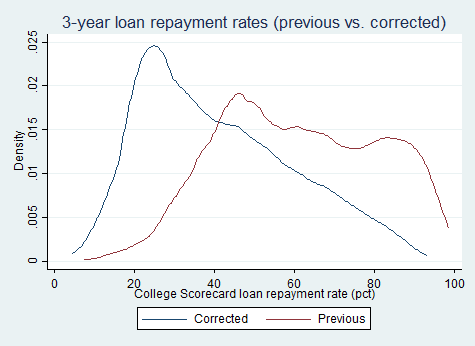
As soon as I learned about the error, I immediately started digging in to see how much it affected loan repayment rates. After both my trusty computer and I made a lot of noise trying to process the large files in a short period of time, I was able to come up with some top-level results. It turns out that the changes in loan repayment rates are very large. Three-year repayment rates fell from 61% to 41%, five-year repayment rates fell from 61% to 47%, and seven-year repayment rates fell from 66% to 57%. These changes were quite similar across sectors.

repay_fig1_jan17

Difference between corrected and previous loan repayment rates (pct).
Corrected Previous Difference N
All colleges
  3-year 41.0 61.0 -20.0 6,090
  5-year 47.1 61.1 -14.0 5,842
  7-year 56.7 66.3 -9.6 5,621
Public
  3-year 46.6 66.8 -20.2 1,646
  5-year 54.2 68.9 -14.7 1,600
  7-year 62.1 72.1 -10.0 1,565
Private nonprofit
  3-year 57.7 77.5 -19.8 1,386
  5-year 63.7 77.3 -13.6 1,375
  7-year 70.4 79.3 -8.9 1,338
For-profit
  3-year 30.5 50.4 -19.9 3,058
  5-year 35.0 48.9 -13.9 2,850
  7-year 46.9 56.5 -9.6 2,700
Source: College Scorecard.


For those who wish to dig into individual colleges’ repayment rates, here is a spreadsheet of the new and old 3, 5, and 7-year repayment rates.

Fixing the coding error made a big difference in the percentage of students who are making at least some progress repaying their loans. (And ED’s announcement yesterday that it will create a public microdata file from the National Student Loan Data System will help make these errors less likely in the future as researchers spot discrepancies.) This change is likely to get a lot of discussion in coming days, particularly as the new Congress and the incoming Trump administration get ready to consider potential changes to the federal student loan system.

How Much Do For-Profit Colleges Rely on Federal Funds?

Note: This post initially appeared on the Brookings Institution’s Brown Center Chalkboard blog.

The outgoing Obama administration placed for-profit colleges under a great deal of scrutiny. This includes gainful employment regulations that will require graduates of vocationally-oriented programs to meet debt-to-earnings requirements and borrower defense to repayment rules (which will likely be quickly abandoned by the Trump administration) designed to help students who feel they were defrauded by their college.

But special federal scrutiny of the for-profit sector has been around for decades, with one rule shaping the behavior of many colleges. This post explores the extent to which for-profit colleges rely on federal funds. It turns out that many rely heavily on these funds, although it’s not always clear what the implications are for the public.

In the 1992 Higher Education Act reauthorization, Congress included a provision that only applied to for-profit colleges, limiting the percentage of total revenue that for-profits could receive from federal grant, loan, and work-study programs to 85%. (This notably excludes veterans’ benefits, which are a large source of revenue for some colleges.) This percentage was increased to 90% in the 1998 reauthorization, which led to the rule being commonly referred to as “90/10.”

For-profit colleges that exceed 90% of their revenue from federal financial aid in two consecutive years can lose access to federal aid for the following two years. Some Democrats have tried to move back to the 85/15 rule or include veterans’ benefits in the federal financial aid portion of revenue, but these efforts will likely be unsuccessful given the support Republicans have received from for-profit colleges. Notably, some for-profits get a sizable portion of their revenue from veterans’ benefits.

I examined data from the Department of Education between the 2007-08 and 2014-15 academic years to look at how many for-profit colleges are close to the 90% threshold. As the table below shows, a sizable percentage of for-profit colleges get between 80% and 90% of their revenue from federal financial aid. In 2007-08 (the last year before the Great Recession), 23% of colleges were in this category. This rose to 35% in 2009-10 and 38% in 2011-12—the beginning of a sizable enrollment decline in the for-profit sector. As the for-profit sector contracted, the percentage of colleges receiving 80% and 90% of their revenue from federal aid fell to 29% in 2014-15. Yet very few colleges have crossed over the 90% threshold, and just two small colleges lost federal aid eligibility this year for going over 90% in two consecutive years.

Distribution of for-profit colleges’ reliance on federal financial aid dollars by year.
  Pct of total revenue from Title IV funds (number of colleges) Number of colleges
Year 0-70 70-75 75-80 80-85 85-90 90-100
2007-2008 56.9 9.1 11.2 12.5 10.3 0.1 1,831
2008-2009 46.2 12.0 13.2 15.1 13.1 0.4 1,798
2009-2010 37.5 10.9 15.8 19.8 15.5 0.5 1,884
2010-2011 39.5 11.4 14.2 17.5 16.6 0.7 1,976
2011-2012 36.5 10.7 13.6 17.6 20.2 1.4 1,999
2012-2013 37.7 11.9 14.2 15.2 19.5 1.4 1,888
2013-2014 40.5 11.7 14.4 15.1 17.6 0.7 1,888
2014-2015 45.2 12.1 12.8 15.1 13.9 0.9 1,838
Source: Office of Federal Student Aid, U.S. Department of Education.
Note: Institutions based outside the 50 United States and Washington, DC are excluded from the analyses.


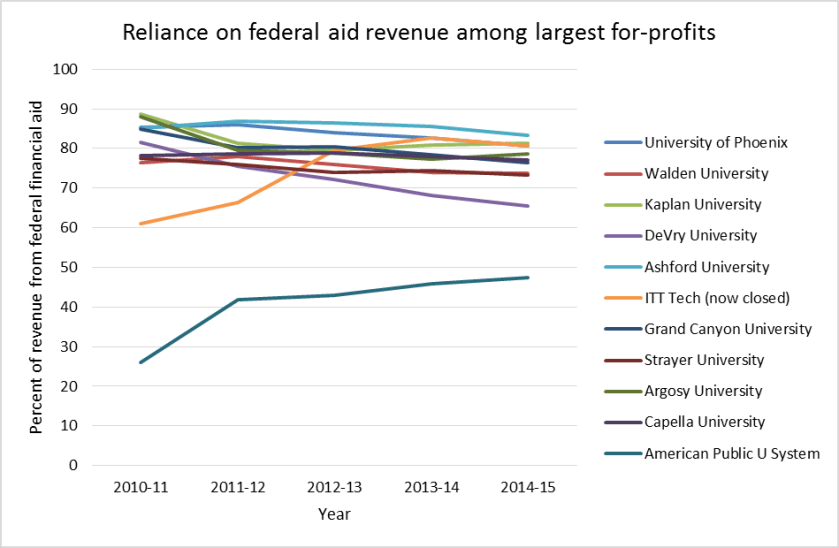
I then looked at the reliance on federal aid among the eleven for-profit colleges with at least $600 million in overall revenue in the 2013-14 academic year (as 2014-15 revenue data were incomplete as of this analysis). Most of these colleges became slightly less reliant on federal funds between 2010-11 and 2014-15, highlighted by DeVry’s drop from 81% to 66%. DeVry has notably pledged to voluntarily abide by the 85/15 rule across all of its colleges (including veterans’ benefits), so its declining reliance on federal aid is not surprising. ITT Tech saw a 20% increase in its share of revenues coming from financial aid before its closure, while Ashford, Kaplan, and Phoenix consistently remained at or above 80% across the five years. The American Public University System, which focuses on veterans, got less than half of its revenue from federal financial aid.

brookings_fig1_jan17


In December, the Department of Education worked with the Department of Defense and Department of Veterans Affairs to produce a dataset that included colleges’ revenue from various military and veterans’ benefits programs. A key finding of the departments is that an estimated 200 for-profit colleges would get more than 90% of their revenue from federal sources if all federal funds were counted, up from 17 under the current version of the 90/10 rule. In other words, roughly 200 for-profit colleges are almost entirely funded by the federal government, although some of this funding is returned to the government when students repay their loans. Yet this fact is obscured when military and veterans’ benefits are excluded from the calculations.

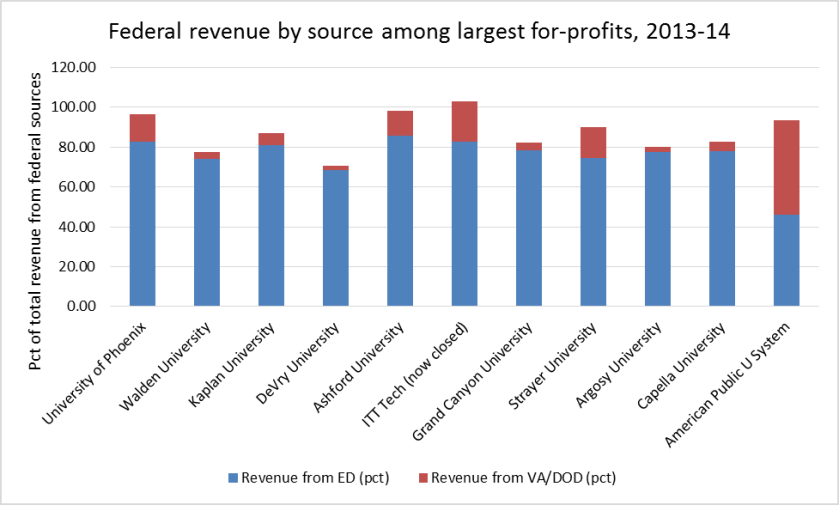
Below is a summary of the approximate revenue percentages from Department of Education and military sources for the eleven largest for-profits in the 2013-14 academic year.

brookings_fig2_jan17

Five of these top eleven colleges exceed the 90/10 rule once all federal sources are included. All for-profit colleges are estimated to have at least 70% of revenue come from federal sources.  However, this calculation may be several percent off due to differences in how each source calculates an academic year (as evidenced by ITT Tech’s 103% of revenue coming from the federal government).

The data suggest that American Public University gets more revenue from military sources than the Department of Education, while four other for-profits (Ashford, ITT Tech, Phoenix, and Strayer) got at least ten percent. From this table, it is clear that some for-profits consider military benefits as an important revenue source (others, such as DeVry and Argosy, do not).

Is it a problem that for-profit colleges generate such a large portion of their revenues from federal funds? To me, the answer is not entirely clear. A concern with many for-profit colleges’ heavy reliance on federal funds is that it signals a lack of interest from employers in these colleges’ programs. Given that many for-profit colleges were founded to train employees for specific jobs, the lack of private funding is a concern. The post-college outcomes of many for-profit colleges also deserve additional scrutiny, particularly as newly released gainful employment data show that for-profit colleges are the vast majority of institutions that failed both performance metrics.


On the other hand, the heavy reliance on federal funds also reflects the reality that for-profit colleges serve a large percentage of financially needy students. Many of these students are unable to attend college without some sort of financial assistance, whether it be the Pell Grant, student loans, or state appropriations that help to lower the price tag for college. A sizable percentage of public and private nonprofit colleges get a majority of their revenue from the federal or state governments, but they do not face the same level of public scrutiny as for-profit colleges.

Finally, it would be helpful if the Department of Education provided data on how much revenue all colleges received from military sources in addition to federal financial aid dollars. This could be used to highlight colleges that rely heavily on government funding, but it could also be used to showcase colleges that serve a particularly large percentage of active-duty military members and veterans.

Highlights from the Gainful Employment Data Release

In one of the Obama administration’s final education policy actions, the U.S. Department of Education released a long-awaited dataset of earnings and debt burdens under the gainful employment accountability regulations. These regulations, which survived several legal challenges from the for-profit college sector, require programs that are defined to be vocationally-oriented in nature (the majority of programs at for-profit colleges and a small subset of nondegree programs at public and private nonprofit colleges) to meet one of two debt-to-earnings metrics in order to continue receiving federal financial aid.

Option 1 (annual earnings): The average student loan payment of graduates in a program must be less than 8% of either mean or median earnings in order to pass. Payments between 8% and 12% of income puts programs “in the zone,” while payments above 12% of income result in a failure.

Option 2 (discretionary income): The average student loan payment of graduates in a program must be less than 20% of discretionary income (earnings above 150% of the federal poverty line) in order to pass. Payments between 20% and 30% of discretionary income puts programs “in the zone,” while payments above 30% of discretionary income result in a failure.

Any colleges that fail both metrics twice in a three-year period (using both mean and median earnings) or colleges in the oversight zone for four consecutive years are currently at risk of losing access to federal financial aid. However, both the Trump administration and Congressional Republicans have expressed interest in scrapping this accountability metric, meaning that colleges may not actually face sanctions in the future.

This data release covered 8,637 programs at 2,616 colleges, with about two-thirds of these programs being at for-profit institutions. Overall, 803 programs (9.3%) failed and 1,239 programs (14.4%) were in the oversight zone, with the remaining 76% of programs passing. As shown below, there were large differences in the pass rates by type of institution (note: the incorrect headers on the original post have been fixed). No public colleges failed (likely due to lower tuition levels because of state and local subsidies), and failure rates in the private nonprofit sector were also fairly low. Yet Harvard, Johns Hopkins, and the University of Southern California all had one program fail—leaving these prestigious institutions with some egg on their face. (UPDATE: Harvard suspended admissions for their graduate program in theater that failed gainful employment within one week of the data release.)

Distribution of gainful employment scores by sector and level.
Percentage of programs
Sector Fail Zone Pass N
Public, <2 year 0.0 0.7 99.3 293
Public, 2-3 year 0.0 0.3 99.7 1,898
Public, 4+ year 0.0 0.3 99.7 302
Private nonprofit, <2 year 0.0 10.3 89.7 78
Private nonprofit, 2-3 year 3.5 22.0 74.6 173
Private nonprofit, 4+ year 4.7 9.0 86.3 212
For-profit, <2 year 4.4 19.7 76.0 1,460
For-profit, 2-3 year 11.5 20.1 68.4 2,042
For-profit, 4+  year 22.5 21.4 56.1 2,174
Total 9.3 14.4 76.4 8,637
Source: U.S. Department of Education.
Notes:
(1) Percentages may not add up to 100 due to rounding.
(2) The “total” row excludes five foreign colleges.


For-profit colleges that only offer shorter programs (primarily certificates) did pretty well in the gainful employment metrics, with only 4% failing and 20% in the oversight zone. The worst outcomes were by far among four-year for-profit colleges, with 23% failing and 21% in the oversight zone. These poorer outcomes are not being driven by the large for-profit chains. DeVry, Kaplan, Strayer, and Phoenix combined to have just 16 programs fail, while four colleges (Vaterott, Sanford-Brown, the Art Institute of Phoenix, and Virginia College) all had at least 19 programs fail.

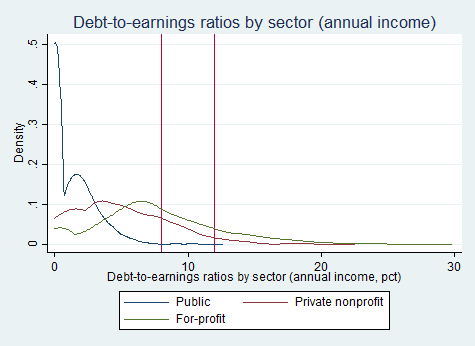
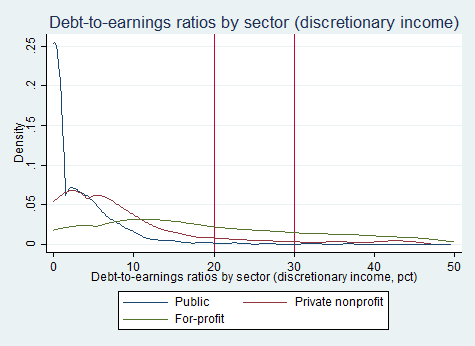
I then examined how the different sectors of colleges performed on the debt-to-earnings ratios for both annual income and discretionary income, with the distributions of ratios shown on the charts below. (Red vertical lines represent the cutoffs for being in the oversight zone (left) and failing (right).) These graphs confirm that public colleges have the lowest debt-to-earnings ratios, followed by private nonprofit colleges and for-profit colleges.

gainful_annual_jan17

gainful_disc_jan17

There are three important drawbacks of this data release that are worth emphasizing. First, 133 programs, all at for-profit colleges, are still in the process of appealing their classification (67 that failed and 66 that are in the oversight zone). Second, this only includes a small subset of programs at public and private nonprofit colleges even as similar programs are covered at for-profit colleges. For example, for-profit law schools are included in the gainful employment regulations (and the outcomes aren’t always great). But law programs at nonprofit law schools aren’t covered by the regulations, even though the goal at the end of the program is similar and many colleges expect their law schools to generate excess revenue for their university. Third, by only covering people who completed a program, colleges with low completion rates may look good even if the quality of education induces students to leave the program in disgust.

Regardless of whether federal financial aid dollars are tied to graduates’ debt-to-earnings ratios, it is important to make more program-level outcome data available to students, their families, and the general public. There have been discussions about including program-level data in the College Scorecard, but that is far from a certainty at this point. At the very least, the incoming Trump administration should propose making comparable earnings and debt available for vocationally-focused degree programs at public and private nonprofit colleges.

How to Improve Income-Driven Repayment Plan Cost Estimates

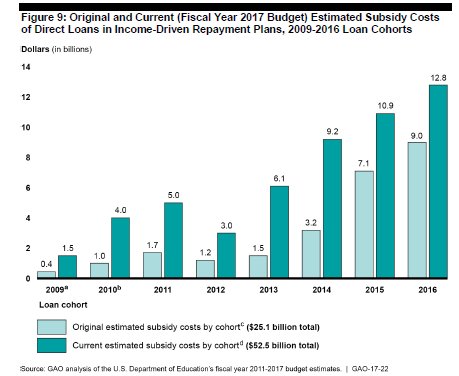
The Government Accountability Office (GAO) took the U.S. Department of Education (ED) behind the proverbial woodshed in a new report that was extremely critical of how ED estimated the cost of income-driven repayment (IDR) programs. (Senate Republicans, which asked for the report, immediately piled on.) Between fiscal years 2011 and 2017, ED estimated that IDR plans would cost $25.1 billion. The current estimated cost is up to $52.5 billion, as shown in the figure below from the GAO report.

gao_fig1

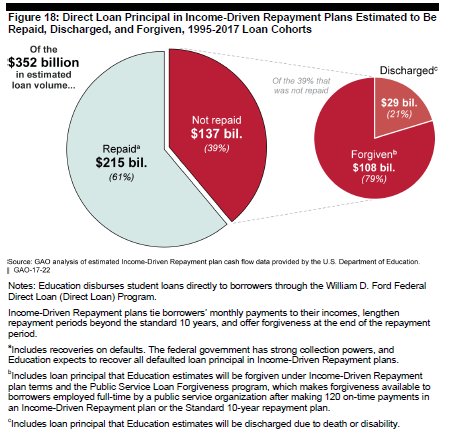
The latest estimate from the GAO—and the number that got front-page treatment in The Wall Street Journal—is that the federal government expects to forgive $108 billion of the estimated $352 billion of loans currently enrolled in income-driven repayment plans. Much of the forgiven loan balances are currently scheduled to be taxable (a political hot topic), but some currently unknown portion will be completely forgiven through Public Service Loan Forgiveness.

gao_fig2

The GAO report revealed some incredible concerns with how ED estimated program costs. Alexander Holt of New America has a good summary of these concerns, calling them “gross negligence.” In addition to the baffling choices not to even account for Grad PLUS loans in IDR models until 2015 (!) and to not assume borrowers’ incomes increased at the rate of inflation (!!), ED ran very few sensitivity analyses about how different reasonable assumptions would affect program costs. As a result, the estimates have not tracked tremendously closely with reality over the last several years.

But there are several reasonable steps that could be taken to improve the accuracy of cost estimates within a reasonable period of time. They are the following:

(1) Share the current methodology and take suggestions for improvement from the research community. This idea comes from Doug Webber, a higher ed finance expert and assistant professor at Temple University:

ED could then take one of two paths to improve the models. First, they could simply collect submissions of code from the education community to see what the resulting budget estimates look like. A second—and better—way would be to convene a working group similar to the technical review panels used to improve National Center for Education Statistics surveys. This group of experts could help ED develop a set of reasonable models to estimate costs.

(2) Make available institutional-level data on income-driven repayment takeup rates and debt burdens of students enrolled in IDR plans. This would require ED to produce a new dataset from the National Student Loan Data System, which is no small feat given the rickety nature of the data system. But, as the College Scorecard shows, it is possible to compile better information on student outcomes from available data sources. ED also released information on the number of borrowers in IDR plans by state last spring, so it’s certainly possible to release better data.

(3) Make a percentage of student-level loan data available to qualified researchers. This dataset already exists—and is in fact the same dataset that ED uses in making budget projections. Yet, aside from one groundbreaking paper that looked at loan defaults over time, no independent researchers have been allowed access to the data. Researchers can use other sensitive student-level datasets compiled by ED (with the penalty for bad behavior being a class E felony!), but not student loan data. I joined over 100 researchers and organizations this fall calling for ED to make these data available to qualified researchers who already use other sensitive data sources.

These potential efforts to involve the research community to improve budget estimates are particularly important during a Presidential transition period. The election of Donald Trump may lead to a great deal of turnover within career staff members at the Department of Education—the types of people who have the skills needed to produce reasonable cost estimates. I hope that the Trump Administration works to keep top analysts in the Washington swamp, while endeavoring to work with academics to help improve the accuracy of IDR cost projections.

Five Higher Education Suggestions for President-Elect Trump

It’s pretty safe to say that Donald Trump wasn’t the candidate of choice for much of American higher education. Hillary Clinton received nearly 100 times as much in donations from academics as Trump, and the list of academics supporting Trump doesn’t have a lot of well-known names. But the typical American saw the election in a far different way than your average New York Times reader (as evidenced by the big divide in support by educational attainment), and Trump is now the president-elect after a stunning victory.

Here are my recommendations for Trump in the realm of higher education policy as he prepares to move from Trump Tower to the White House in just over two months.

(1) The Department of Education won’t go away, but certain functions could be reassigned. Although the Republicans kept control of the House and Senate, the margins are razor-thin—perhaps a four-vote margin in the Senate and a tenuous grip on the House thanks to divides between establishment and activist Republicans. This makes getting rid of the Department of Education extremely unlikely. Some functions, such as handling student loans, could go to the Department of the Treasury. Others could possibly go to states in the form of block grants. Yet there will still be a need for some administration in Washington to handle basic functions.

(2) Reach out to career staff members at the Department of Education. Trump ran on the concept of “draining the swamp,” but replacing longtime Washington staffers all at once comes at a risk. Career staff members who have served in multiple administrations have knowledge about how programs work that is difficult to replace, so it is essential to keep some of those staff members to help ensure a smooth transition across administrations. Will longtime staffers want to work for Trump? It’s anyone’s guess, but Trump’s transition team should make a good-faith effort to reach out.

(3) Make Higher Education Act reauthorization a priority. With unified (but tenuous) Republican control, Higher Education Act reauthorization suddenly looks more plausible than it did last week. A Trump administration should focus on the HEA in an effort to govern through the legislative branch rather than using executive orders and administrative rules—policies that conservatives have despised. 2017 reauthorization is probably unlikely given the administration’s other priorities, but 2018 or 2019 could work.

(4) Make more higher education data available to the public. The Obama administration made some good strides in the area of consumer information, culminating in the College Scorecard. Yet they also didn’t make data on a range of outcomes (such as PLUS loan default rates or program-level data) available to either the public or researchers. I signed onto a letter along with over 100 researchers last month calling for the Department of Education to release additional data on the federal student loan portfolio, and the Trump administration should release the data. Even if Trump wants to back down in terms of high-stakes accountability, consumer information is important.

(5) Visit a number of colleges across the higher education spectrum. Like most presidents, Trump is a product of high-prestige colleges (attending Fordham and Penn). I’d love to see him experience the great diversity of American higher education, including rural community colleges, HBCUs, technical institutes, and the workhorse regional public university sector. I hope that some colleges extend invitations to Trump—and that he accepts them.

The Relationship Between Student Debt and Earnings

Note: This piece first appeared on the Brookings Institution’s Brown Center Chalkboard blog.

Student loan debt in the United States is now over $1.25 trillion, nearly three times as much as just a decade ago. The typical student graduating with a bachelor’s degree with debt (about 70 percent of all students) now owes between $30,000 and $40,000 for their education, about twice as much as a decade ago. Although taking on modest amounts of debt in order to pay for college is generally a good bet in the long run, colleges with similar admissions standards and resource levels leave students with different amounts of debt.

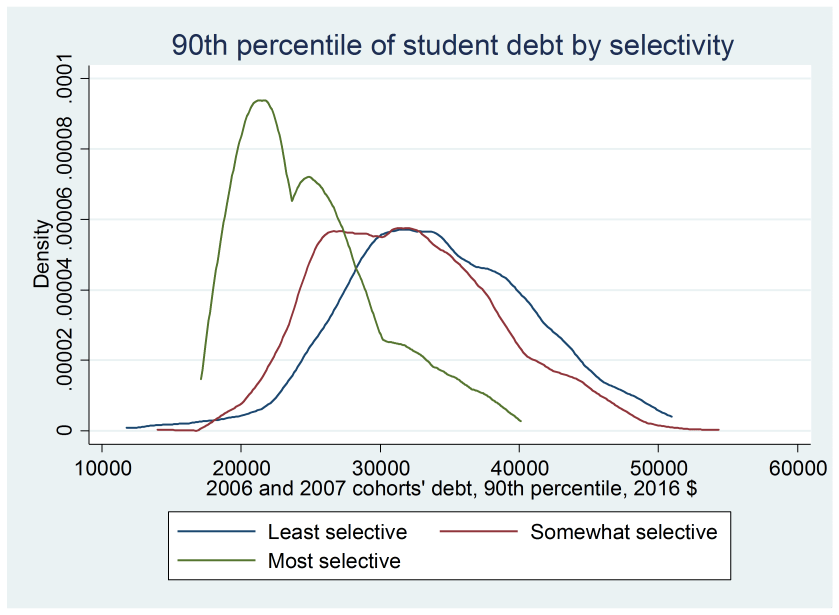
College Scorecard data highlight the large amount of variation in what high-debt undergraduate students borrow across colleges with similar admissions criteria.1 The figure below shows the distribution of the 90th percentiles of debt burdens (in 2016 dollars) for students who left 1,156 four-year public and private nonprofit colleges in 2006 or 2007, broken down into three selectivity categories.2 Not surprisingly, the most selective colleges, which have the resources to offer more scholarships and fewer students with financial need, have lower debt burdens than somewhat selective or less selective colleges. These differences in borrowing by selectivity are larger than by type of college, as median debt at public colleges was only about $2,400 more than at private nonprofit colleges.

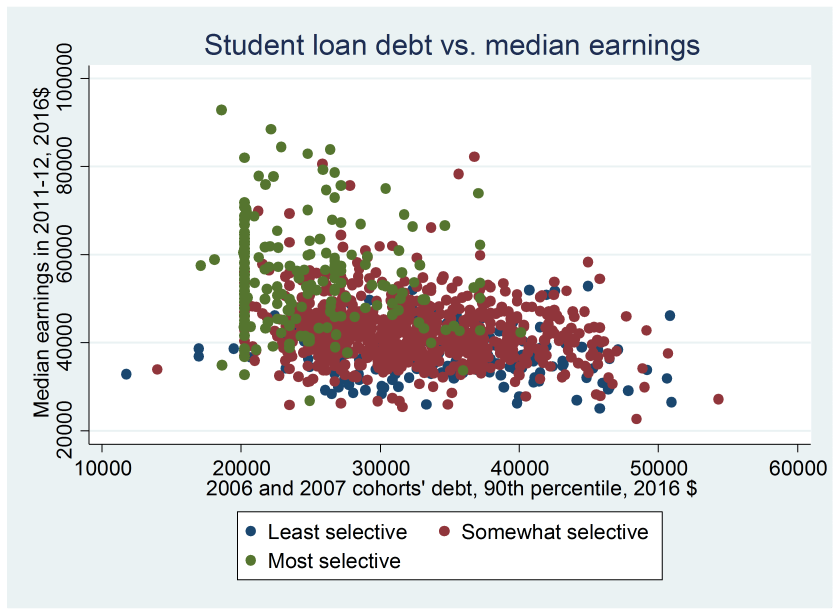
brookings_fig1_sep16Attending college and taking on $40,000 or even $50,000 in debt can be an outstanding investment in a student’s future—but only if students from that college actually end up getting good jobs. I then examined the relationship between 90th percentile debt burdens upon leaving college in 2006 and 2007 and the median earnings of students in 2011 and 2012 who began college in 2001 and 2002.3 The figure below shows that colleges that tend to have higher amounts of student debt also tend to have lower earnings in later years, which is in part due to student characteristics and their prior family income rather than the causal impact of the college. The correlation coefficient between debt and earnings is about -0.35 overall, but between -0.10 and -0.20 within each selectivity group. This suggests that colleges with higher debt burdens also have higher earnings, but much of the relationship between debt and earnings can be explained by selectivity.

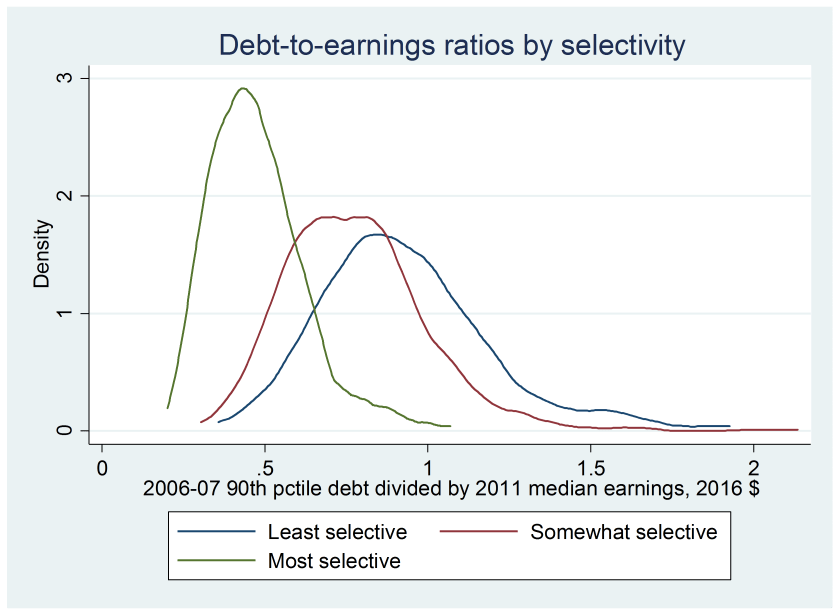
brookings_fig2_sep16An old rule of thumb in paying for college is that students should not borrow more for a bachelor’s degree than they expect to earn one year after graduation. Although the presence of income-driven repayment programs allows students to repay their federal student loans even if they make less money, the debt-to-income ratio is still a useful way to judge colleges. The final figure shows the distribution of colleges’ debt-to-income ratios using the initial debt upon leaving college for high-debt students and annual earnings approximately five years later. A ratio over 1 at this point is a major concern, as earnings should grow considerably during a student’s first few years after college.

brookings_fig3_sep16Few high-debt students at the most selective colleges likely have issues making enough money to repay their loans, as just one of the 191 colleges in this category had a debt-to-earnings ratio above 1. Just under 15 percent of the somewhat selective colleges had ratios above 1, while about one-third of the least selective colleges had ratios above 1. This reflects the fact that financially-struggling students who attend less selective colleges (roughly 13% of the undergraduates in my sample, or about 800,000 students) take on more debt and earn less money than high-debt students at highly-selective colleges.

With student debt being a growing concern among Americans and playing a key role in the presidential campaign, students and their families are wise to consider the likely return on their investment in higher education. As the data show, some colleges do leave their former students with less debt than other similar colleges. But among less-selective colleges that enroll large numbers of lower-income or minority students, some amount of debt is almost unavoidable. Students should not seek to avoid all debt, but they should be mindful that even among broad-access institutions, colleges vary in how much debt their students take on.

———————————————————-

1 Debt and earnings data from the College Scorecard combine students who graduate with those who dropped out.

2 Colleges in the Barron’s categories of special, noncompetitive, and less competitive are in my lowest selectivity tier (n=195), colleges in the competitive, competitive-plus, and very competitive categories are in the middle tier (n=770), and all others are in the highest tier (n=191).

3 The College Scorecard does not track debt burdens by when students started college (only when they left), so I estimated that students either graduated or left college in about five years.

Do Presidential Debates Increase Student Applications?

Tonight is the first presidential debate of the 2016 general election season, and this clash between Democrat Hillary Clinton and Republican Donald Trump could top 100 million viewers. (I won’t be one of them, as I’m teaching tonight.) The host site, Hofstra University, is actually the second choice—as Wright State University pulled out over the high price tag this summer. Hofstra is paying about $5 million to host the debate, with the costs generally covered through three donors.

Hosting a presidential debate is undoubtedly a great public relations opportunity for a university, similar to making a big run in the NCAA basketball tournament or making a big football bowl game. Some research has shown that big-time athletics success is associated with increased student applications in the following year, so the media circus following a presidential debate (Hofstra is trending on Twitter as I write this post) could have similar results.

Hofstra also hosted a presidential debate in 2012, so I looked at what happened to the number of applications they received before and after the debate compared to their defined group of peer institutions. The data are below:

Name 2011-12 2012-13 2013-14 Pct increase, 2012-13 to 2013-14
Adelphi University 8278 9184 8654 -5.8%
American University 18706 17039 17545 3.0%
Boston University 38275 41802 44006 5.3%
Drexel University 48450 40586 43945 8.3%
Fordham University 31792 34070 36189 6.2%
George Washington University 21433 21591 21756 0.8%
Hofstra University 18909 21376 22733 6.3%
Ithaca College 13436 13813 15658 13.4%
LIU Post 7369 7209 6001 -16.8%
Marist College 11399 11466 10351 -9.7%
New York University 41243 42807 45779 6.9%
Northeastern University 43255 44208 47364 7.1%
Pace University-New York 10623 11778 12885 9.4%
Quinnipiac University 18651 18825 20699 10.0%
Seton Hall University 6436 10180 10735 5.5%
St John’s University-New York 54871 52972 51634 -2.5%
Syracuse University 25884 25790 28269 9.6%


Hofstra did see a 6.3% increase in applications between 2012-13 and 2013-14, compared to a 4.6% increase across its peer institutions. But other peers, such as Ithaca, Quinnipiac, Syracuse, and Pace saw even larger increases. So it appears that the debate brought plenty of pride to Hofstra, but there was not an unusual jump in applications after the debate aired.

Students Shouldn’t Be Terrified of Borrowing for College

I wrote the below letter to the editor of the Star-Ledger, New Jersey’s largest newspaper, in response to a truly woeful editorial piece that they recently published on student loan debt. (Note: They eventually ran the letter, but here is a slightly revised version for your enjoyment.)

—————————————————————————

As a college professor who researches the implications of student loan debt, I was dismayed to read the Star-Ledger Editorial Board’s recent piece titled “Why we should all be terrified of student loans.” Yes, the $1.25 trillion in outstanding student loan debt is a concern, but the typical amount borrowed for a bachelor’s degree is more manageable—about $30,000 per student. Students who borrow from the federal government can also enroll in income-driven repayment programs that allow them to make small or no payments if their income is low.

The “terrified” headline has the potential to scare students and their families away from making a worthwhile investment in college. Research shows that low-income, first-generation, and minority students are particularly averse to borrowing for college, even when borrowing a reasonable amount of money would help them attend and graduate college. Students and their families should be careful about taking on too much debt, particularly from programs like New Jersey’s state student loan system that do not allow payments to be tied to the student’s income. But students should not be terrified of taking out modest loans from the federal government to make college a reality.

How Did ITT Tech’s Outcomes Compare to Other For-Profit Colleges?

Last week, ITT Technical Institute announced that it would close all of its colleges, affecting approximately 40,000 students and 8,000 employees. This closure was expected after the chain of for-profit colleges stopped enrolling new students in late August after the U.S. Department of Education cut off federal financial aid dollars for new students a few days earlier. This closure, which could cost taxpayers up to $400 million through forgiven loans, has generally been celebrated by those on the political left while conservatives and those in the for-profit sector are concerned that the federal government is trying to severely restrict the for-profit college industry.

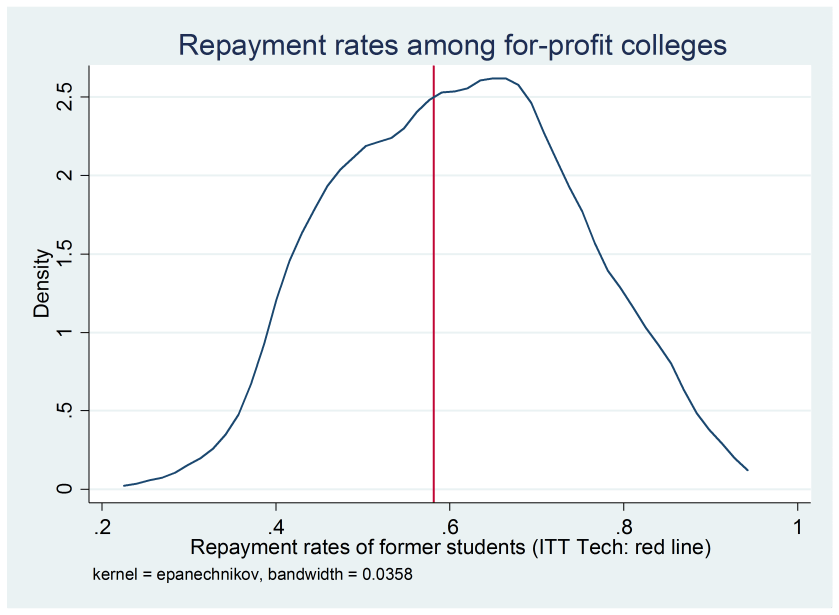
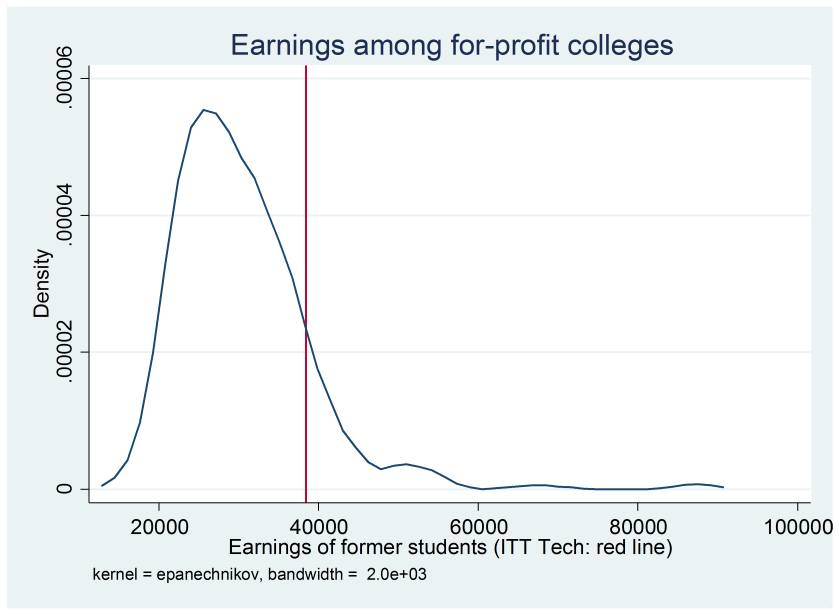
Given that some of the concerns about ITT Tech were about poor student outcomes, I examined ITT Tech’s outcomes relative to other degree-granting for-profit colleges on three important metrics: median debt burdens of former students who took out loans, the percentage of students seven years after entering repayment, and median earnings of former students ten years after entering college.1 I restricted my analysis to the 415 degree-granting for-profit colleges that reported data on all three of the outcomes, combining branch campuses that reported the same outcomes as other colleges in the same system.2

Median debt

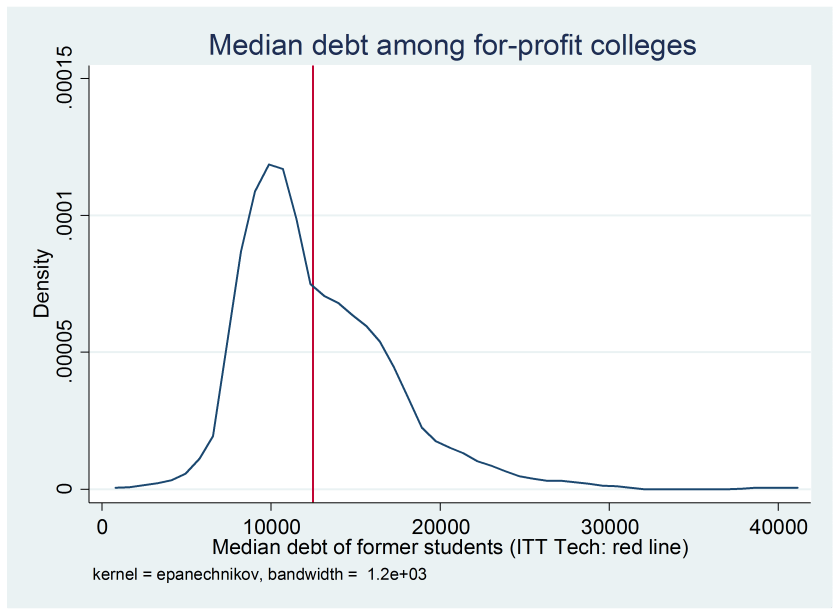
The median debt burden of all former ITT Tech borrowers was $12,473 (as indicated by the red line on the below chart), slightly above the median amount of $11,993. This suggests that among for-profit colleges granting associate and/or bachelor’s degrees, ITT Tech’s debt burden was fairly typical.

itt_fig1

Loan repayment rates

Seven years after entering repayment, 58.2% of former ITT Tech students paid down at least $1 in principal on their federal student loans. This is slightly worse than the median rate of 61.3% across similar for-profit colleges.

itt_fig2

Earnings

On this metric, ITT Tech looks pretty good relative to other for-profit colleges. ITT Tech students who received federal financial aid had median earnings of $38,400 ten years after college entry, well above the median of $29,200 and close to the 90th percentile among similar institutions. However, these data are based on students who entered college in the early 2000s, when ITT Tech looked much different than it did in recent years.

itt_fig3

Based on financial outcomes, ITT Tech’s former students (at least those who enrolled at least several years ago) did as well or better than other for-profit colleges. This does lend some credence to defenders of ITT Tech who were concerned about the Department of Education targeting the institution. However, others have noted that ITT Tech’s closure may have been self-inflicted through an ill-advised private loan program that led to fraud charges. In any case, other for-profit college chains are likely to face additional scrutiny in the future—from politicians and accreditors alike.

——————————————————————————————————–

1 I did not examine graduation rates, as many for-profit colleges have very few students in the first-time, full-time cohort of students that are currently used to calculate graduation rates for the federal government.

2 ITT Tech had 143 branch campuses in the College Scorecard data, and 141 of them had the same reported outcomes. I analyzed those campuses as a single institution, dropping the two small campuses that had different reported outcomes.

ACT Scores Fell Last Year. Relax!

As a shareholder of the Green Bay Packers, I keep an eye on what Butte Community College’s most famous student-athlete has to say. Packers quarterback Aaron Rodgers famously told fans in “Packer-land” in 2014 to “R-E-L-A-X” after the team got off to an uncharacteristically slow 1-2 start. Fans relaxed after the team went 11-2 the rest of the way in the regular season as Rodgers played like his regular self.

In the education policy niche of the world, few things get people more upset than declining standardized test scores. Last year, I wrote about the fuss about SAT scores declining—and how at least part of that decline is due to more students taking the test instead of the American education system failing young adults. Now it’s ACT’s turn to release their newest scores—and my message again is R-E-L-A-X.

Between 2015 and 2016, average ACT scores declined from 21.0 to 20.8 nationwide, the lowest score in at least five years. But as the now-dominant test in the United States (much to the surprise of many folks who grew up on a coast where the SAT is still common), the percentage of students taking the ACT rose from 52% in 2012 to 59% in 2015 and 64% this year. This sharp increase in ACT takers is in large part due to more states requiring all students to take the ACT as a graduation requirement. In 2016, all graduating high school seniors took the ACT in 18 states, up from 13 states in 2015.

The five states that required all students to take the ACT for the first time in 2016 all saw large decreases in their average scores, as shown below. Wisconsin, Missouri, and Minnesota all had about 75% of their students taking the ACT in 2015 and had drops of about 1.5-1.7 points when all students took the test, with South Carolina having a drop of 1.9 points as the last 38% of students took the test. Nevada had a decline of 3.3 points in 2016, but the percentage of students taking the ACT more than doubled.

State Pct tested (2016) Avg score (2016) Pct tested (2015) Avg score (2015)
Nevada 100 17.7 40 21.0
South Carolina 100 18.5 62 20.4
Wisconsin 100 20.5 73 22.2
Missouri 100 20.2 77 21.7
Minnesota 100 21.1 78 22.7


Among the other 45 states that had very small changes in ACT participation rates, the average change in scores at the state level (not weighted for size) was effectively zero. So R-E-L-A-X about test score declines when they are due to more students taking the test (some of whom won’t be going to college, anyway) instead of collegegoing students suddenly performing worse.