The U.S. Dept. of Education Should Continue to Collect Benefits Costs by Functional Expense

This is a guest post by my colleague and collaborator Braden Hosch, who is the Assistant Vice President for Institutional Research, Planning & Effectiveness at Stony Brook University. He has served in previous positions as the chief academic officer for the Connecticut Department of Education and the chief policy and research officer for the Connecticut Board of Regents for Higher Education. He has published about higher education benchmarking, and has taught about how to use IPEDS data for benchmarking, including the IPEDS Finance Survey. Email: Braden.Hosch@stonybrook.edu | Twitter: @BradenHosch

Higher education finance is notoriously opaque. College students do not realize they are not paying the same rates as the student sitting next to them in class. Colleges and universities struggle to determine direct and indirect costs of the services they provide. And policymakers (sometimes even the institutions themselves) find it difficult to understand how various revenue sources flow into institutions and how these monies are spent.

All of these factors likely contribute to marked increases in the expense of delivering higher education and point toward a need for more information about how money flows through colleges and universities. But quite unfortunately proposed changes to eliminate detail collected in the IPEDS Finance Survey about benefits costs will make it more difficult to analyze how institutions spend the resources entrusted to them. The National Center for Education Statistics should modify its data collection plan to retain breakouts for benefits costs in addition to salary costs for all functional expense categories. If you’re reading this blog, you can submit comments on or before July 25, 2016 telling them to do just that.

Background

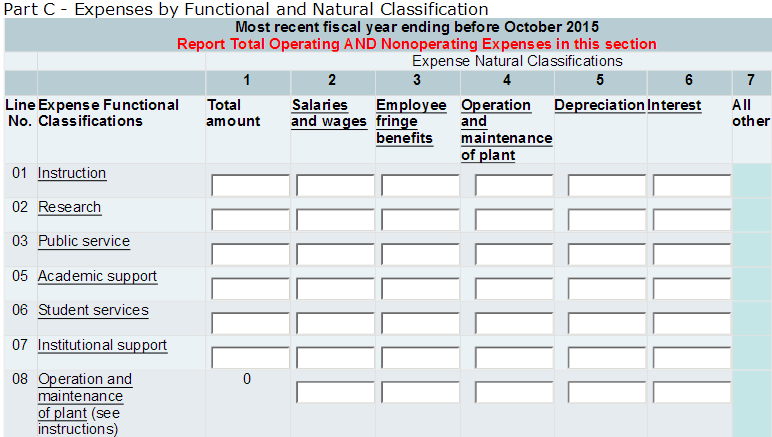
Currently, colleges and universities participating in Title IV student financial aid programs must report to the U.S. Department of Education through the Integrated Postsecondary Education Data System (IPEDS) how they spend money in functional areas such as instruction, student services, institutional support, research, etc. and separate this spending into how much is spent on salaries, benefits, and other expenses, with allocations for depreciation, operations and maintenance, and interest charges. This matrix looks something like this, with minor differences for public and private institutions:

hosch_fig1

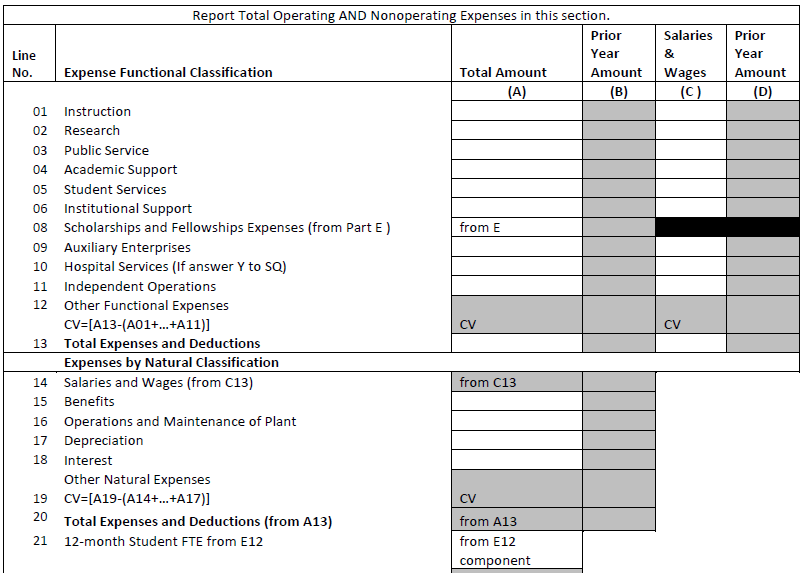
The proposed changes, solely in the name of reducing institutional reporting burden, will significantly scale back detail by requiring institutions to report only total expenses by function and total expenses by natural classification, but will not provide the detail of how these areas intersect:

hosch_fig2

Elimination of the allocations for depreciation, interest, and operations & maintenance is a good plan because institutions do not use a consistent method to allocate these costs across functional areas. But elimination of reporting actual benefits costs for each area is problematic.

To be clear, under the proposed changes, institutions must still, capture, maintain, and summarize these data (which is where most effort lies); they are simply saved the burden of creating a pivot table and several fields of data entry.

Why does this matter?

For one thing, the Society for Human Resource Management 2016 survey shows that benefits costs have increased across all economic sectors over the past two decades. IPEDS would continue to collect total benefits costs, but without detail about the areas in which these costs are incurred, it will be impossible to determine in what areas these costs may be increasing more quickly. Thus, a valuable resource for benchmarking and diagnosis would be lost.

Additionally, without specific detail for benefits components of function expenses, the ability to control for uneven benefits costs will be lost; it would be impossible for instance to remove benefits costs from standard metrics like education and general costs or the Delta Cost Project’s education and related costs. Further, benefits costs neither are distributed uniformly across functions like instruction, research, and student services nor are distributed uniformly across sectors or jurisdictions. Thus, to understand how the money flows, at even a basic level, breaking out benefits and other expenses is critical.

Here are two quick examples.

Variation at the institution level

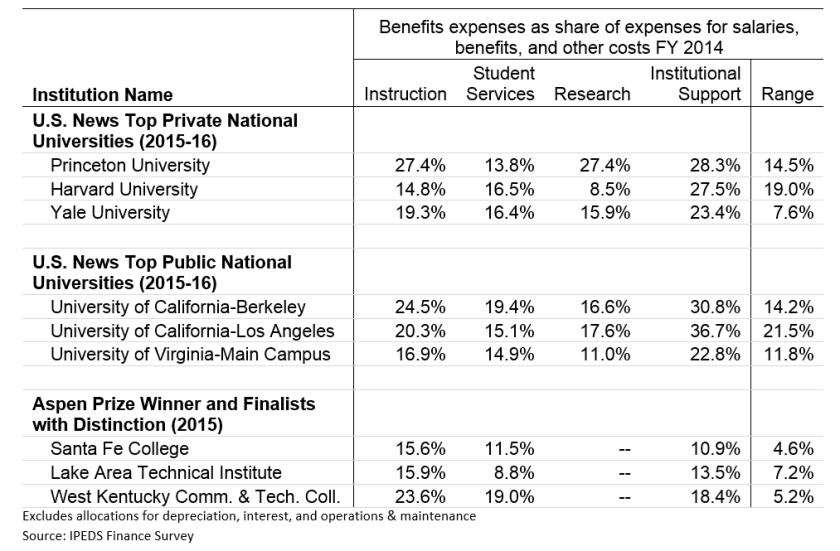
First, as a share of spending on instruction, benefits and other items, benefits expenses are widely variable by institution. I have picked just a few well-known institutions to make this point – it holds across almost all institutions. If spending on benefits were evenly distributed across functions, then the difference among these percentages should be zero, but in fact it’s much higher.

 hosch_fig3

Variation by state

Because benefits costs are currently reported separately across functions, it is possible to analyze how the benefits component of the Delta Cost Project education and related costs metric – spending on student related educational activities while setting aside auxiliary, hospital, and other non-core metrics. Overall, the Delta Cost Project also shows that benefits costs are rising, but a deeper look at the data also show wide variation by state, and in some states, this spending accounts for large amounts on a per student basis.

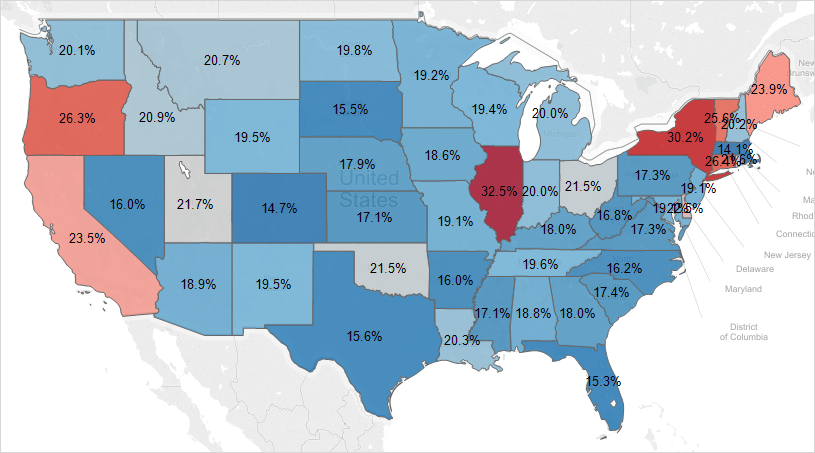
Among 4-year public universities in FY 2014, for instance, spending on benefits comprised 14.1% of E&R in Massachusetts, 20.2% in neighboring New Hampshire to the north, and 30.2% in neighboring New York to the west. The map below illustrates the extent of this variation.

Benefits as a percent of E&R spending, Public, 4-year institutions FY 2014

hosch_fig4

Excludes amounts allocated for depreciation and interest. Source Hosch (2016)

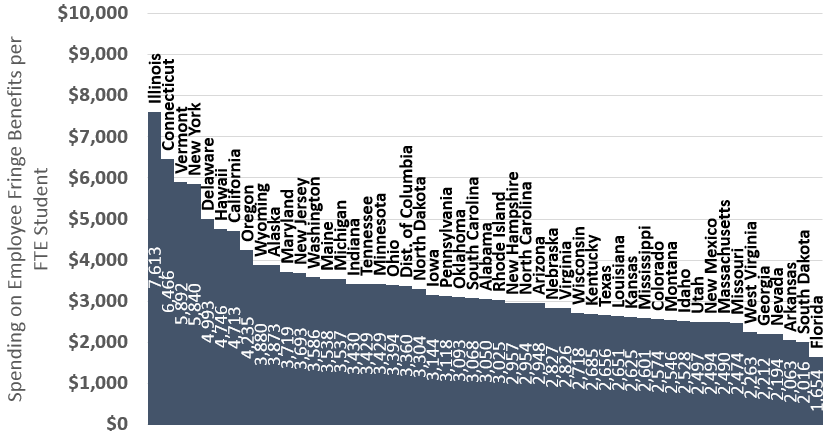
Likewise, on a per student (not per employee) basis these costs ranged from $1,654 per FTE student spent on E&R benefits in Florida, compared to $7,613 per FTE student spent on benefits in Illinois.

E&R benefits spending per FTE student, public 4-year institutions, FY 2014

hosch_fig5

Excludes amounts allocated for depreciation and interest. Source Hosch (2016)

Bottom line: variation is stark, important, and needs to be visible to understand it.

What would perhaps most difficult about not seeing benefits costs by functional area is that benefits expenses in the public sector are generally covered through states. States do not transfer this money to institutions but rather largely negotiate and administer benefits programs and their costs themselves. Even though institutions do not receive these resources, they show up on their expenses statements, and in instances like Illinois and Connecticut in the chart above, the large amount of benefits spending by institutions really reflects state activity to “catch up” on historically underfunded post-retirement benefits. To see what institutions really spend, the benefits costs generally need to be separated out from the analysis.

What you can do

Submit comments on these changes through regulations.gov. Here’s what you can tell NCES through the Federal Register:

  1. We need to know more about spending for colleges and universities, not less
  2. Reporting of functional expenses should retain a breakout for benefits costs, separate from salaries and other costs
  3. Burden to institutions to continue this reporting is minimal, since a) they report these costs now and b) the costs are actual and do not require complex allocation procedures, and c) they must maintain expense data to report total benefits costs.

Which Factors Affect Student Fees?

Tuition increases tend to get the most focus in discussions about college affordability, but a number of other factors also affect the total price tag of a college education. In addition to researching living allowances for off-campus students, I have looked into the often-confusing world of student fees at public colleges. These fees are used for a variety of purposes, such as supporting core instructional activities, funding athletics, paying for student activities, or even seismic safety. The University of California-Santa Cruz lists over 30 mandatory fees that all undergraduates must pay, ranging from $.75 per year to fund a marine discovery center to $1,020 per year for student services. At the typical four-year public college, student fees were nearly $1,300 in the 2012-13 academic year, roughly 20% of median tuition and nearly double their 1999-2000 rate after adjusting for inflation.

In a new article that was just published in The Review of Higher Education, I used a panel regression framework to explore potential institution-level and state-level factors affecting student fee levels between the 2001-02 and 2012-13 academic years.  For institution-level factors, I included tuition, the percent of nonresident students, measures of selectivity, and per-student athletics expenditures (a proxy for the magnitude of a college’s athletics program). For state-level factors, I considered appropriations and financial aid levels, economic conditions, whether a tuition or fee cap was in place, who had the ability to set tuition or fees (politicians, state or system boards, or the individual college), and partisan political control in the state.

Given that students subsidized athletics at public colleges to the tune of at least $10 billion over five years, I fully expected to find that higher per-student athletics expenditures would be associated with higher student fees. Yet after controlling for other factors, there was no significant relationship between athletics spending and fees. This could be explained by the small number of high-spending colleges in big-time conferences that come close to breaking even on athletics, or it could be due to my data ending in 2012-13 and larger increases in athletics fees occurring since then. The only significant institution-level factor was tuition—as tuition rose, fees fell. This implies that some colleges likely treat tuition and fees as interchangeable.

More of the state-level factors have statistically significant relationships with student fee levels. States that have capped fee levels do have fees about $128 lower than states without fee caps, but I also found evidence that colleges in states with tuition caps have fees $59 higher. This suggests that colleges will substitute fees for tuition where possible. If a state’s governor and/or legislature can set tuition, fees tend to be lower, but if policymakers can set fees, fees tend to be higher. Finally, partisan political control only has a small relationship with fees, as having a Republican governor is associated with slightly lower fee levels and control of the legislature was not significant.

Given the magnitude of student fees and the relatively small body of research in this area, I hope to see more studies (particularly qualitative in nature) digging into how student fees are set and how the money is supposed to be used compared to its actual uses.

Which Colleges Benefit from Counting More Graduates?

The official graduation rate that colleges must report to the U.S. Department of Education has included only first-time, full-time students who graduate from that college within 150% of normal time (three years for a two-year college or six years for a four-year college). Although part-time and non-first-time students were included in the federal government’s Integrated Postsecondary Education Data System (IPEDS) collection for the first time this year, it will still be about another year or so before those data will be available to the public. (Russell Poulin at WICHE has a nice summary of what the new IPEDS outcome measure data will mean.)

In the meantime, the Student Achievement Measure (SAM)—a coalition of organizations primarily representing public colleges and funded by the Gates Foundation and Carnegie Corporation—has developed in response to calls for more complete tracking of student outcomes. SAM has launched a public relations campaign that has been quite visible in the higher education community using the hashtag #CountAllStudents to show the number of students who aren’t captured in the current graduation rate metric. (Barack Obama and Sarah Palin are two well-known examples.)

But what can be learned from a more complete picture of graduation rates? In this blog post, I examined SAM outcome data for 54 participating colleges in four states (California, Maryland, Missouri, and South Carolina) to see the extent to which graduation rates for first-time, full-time students at four-year universities changed by counting students who transferred and graduated elsewhere as a success, as well as looking at the percentage of students still enrolled after six years. I focused on first-time, full-time students here so I could compare the current graduation rate metrics to alternative metrics; completion rates for part-time students can be a topic for another day. The data can be downloaded here, and a summary is below.

Average graduation rate for first-time, full-time students at the same university within six years: 57%

Average graduation rate for first-time, full-time students anywhere within six years (SAM): 66%

Gain from SAM metric: 9%

Still enrolled anywhere, but no bachelor’s degree: 15%

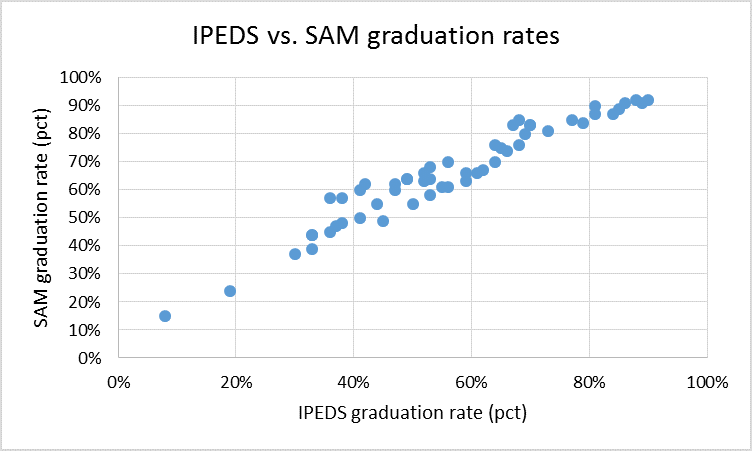
The first figure below shows the distribution of IPEDS and SAM graduation rates, and it shows that they are pretty strongly related. The correlation between the two graduation rates is 0.966, which is a nearly-perfect relationship.

ipeds_sam_fig1

But colleges with lower IPEDS graduation rates did tend to gain more from the SAM graduation rate than those with higher graduation rates, as shown below. Six colleges with IPDS graduation rates between 35% and 70% had at least 15% of students graduate from another college, including five of the six universities participating in SAM from South Carolina. On the other hand, UCLA (with a 90% graduation rate in IPEDS) gained just 2% from the SAM metric. This suggests that a more complete definition of a graduate will help to at least slightly narrow graduation rate gaps.

ipeds_sam_fig2

It is also stunning to see the percentage of students who were still enrolled in college after six years. While the average college in my sample had 15% of its first-time, full-time students still plugging away somewhere, most of the less-selective colleges with higher percentages of lower-income and minority students still had at least 20% of students still enrolled. The new IPEDS metrics will count students through eight years, which should give a better picture of completion rates. I’m excited to see those metrics come out in the future—and hopefully incorporate them in future versions of the Washington Monthly college rankings.

How Colleges’ Net Prices Fluctuate Over Time

This piece first appeared at the Brookings Institution’s Brown Center Chalkboard blog.

As student loan debt has exceeded $1.2 trillion and many colleges continue to raise tuition prices faster than inflation, students, their families, and policymakers have further scrutinized how much money students pay to attend college. A key metric of affordability is the net price of attendance, defined as the total cost of attendance (tuition and fees, books and supplies, and a living allowance) less all grants and scholarships received by students with federal financial aid. The net price is a key accountability metric used in tools such as the federal government’s College Scorecard and the annual Washington Monthly college rankings that I compile. In this post, I am focusing on newly released net price data from the U.S. Department of Education through the 2013-14 academic year.

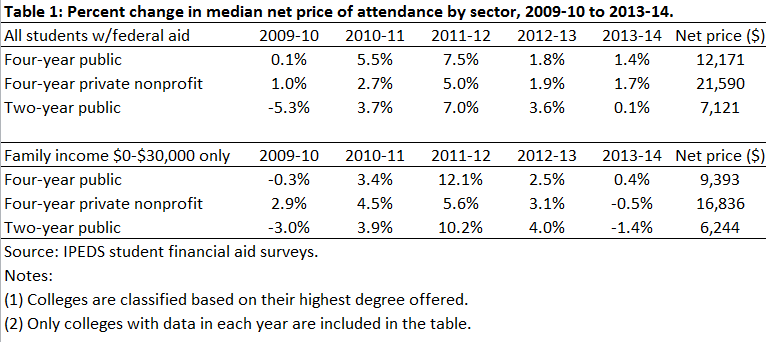
I first examined trends in net prices since the 2009-10 academic year for the 2,621 public two-year, public four-year, and private nonprofit four-year colleges that operate on the traditional academic year calendar. I do this for all students receiving federal financial aid (roughly 70% of all college students nationwide), as well as students with family incomes below $30,000 per year—roughly the lowest income quintile of students. Note that students from different backgrounds qualify for different levels of financial aid from both the federal government and the college they attend (and hence face different net prices). Table 1 shows the annual percentage changes in the median net price by sector over each of the five most recent years, as well as the median net price in 2013-14.

netprice_jan16_table1

The net price trends in the most recent year of data (2012-13 to 2013-14) look pretty good for students and their families. The median net price for all students with financial aid increased by just 0.1% at two-year public colleges, 1.4% at four-year public colleges, and 1.7% at four-year private nonprofit colleges—roughly in line with inflation. The lowest-income students saw lower net prices in 2013-14 at two-year public colleges (-1.4%) and four-year private nonprofit colleges (-0.5%) and a small 0.4% increase at four-year public colleges.

Even with one year of good news, net prices are up about 15% at four-year colleges and 10% at two-year colleges since the beginning of the Great Recession in 2009, with a slightly larger percentage increase for lower-income students. Much of this increase in net prices, particularly for lowest-income students, occurred during the 2011-12 academic year.

Although some may blame the lingering effects of the recession or reduced state funding for the increase, in my view the likely culprit appears to be changes made to the federal Pell Grant program. In 2011-12, the income cutoff for an automatic zero EFC (Expected Family Contribution, and hence automatically qualifying for the maximum Pell Grant) was cut from $31,000 to $23,000. This resulted in a 25% decline in the number of automatic zero EFC students and contributed to the average Pell award falling by $278—the first decline in average Pell awards since 2005.

I next examined potential reasons for colleges’ changes in net prices. As colleges are facing incentives to lower their net price, they can do so in three main ways. Lowering tuition prices or increasing institutional grant aid would both benefit students, but they are difficult for cash-strapped colleges to achieve.

If colleges want to lower their net price without sacrificing tuition or housing revenue, the easiest way to do so is to reduce living allowances for off-campus students. Colleges have wide latitude in setting these living allowances, and research that I’ve conducted with Sara Goldrick-Rab at Wisconsin and Braden Hosch at Stony Brook shows a wide range in living allowances within the same county. Here, I looked at whether colleges’ patterns of changing tuition and fees or their off-campus living allowance seemed to be related to their change in net price.

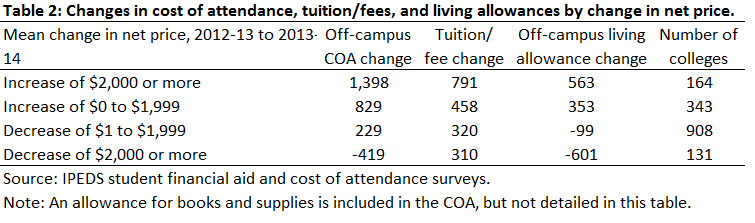
Table 2 shows the change between the 2012-13 and 2013-14 academic years in the total cost of attendance (COA), tuition and fees, and off-campus living allowances (for colleges with off-campus students), broken down by changes in the net price. Colleges with the largest increases in net price (greater than $2,000) increased their COA for off-campus students by $1,398, while colleges with smaller increases (between $0 and $1,999) increased their COA by $829. Both groups of colleges typically increased both tuition and fees and living allowances, which together resulted in the increase in COA.

netprice_jan16_table2

However, colleges with a reported decrease in net price between 2012-13 and 2013-14 had a different pattern of changes. They still increased tuition and fees, but they reduced off-campus living allowances in order to keep the cost of attendance lower. For example, the 131 colleges with a decrease in net price of at least $2,000 had average tuition increases of $310 while living allowances were reduced by $610. Some of these reductions in allowances may be perfectly reasonable (for example, if rent prices around a college fall), but others may deserve additional scrutiny.

The net price data provide useful insights regarding trends in college affordability, but students and their families should not necessarily expect the posted net price to reflect how much money they will need to pay for tuition, fees, and other necessary living expenses during the academic year. These metrics tend to be more accurate for on-campus students (as a college controls room and board prices), but everyone should also look at colleges’ net price calculators for more individualized price estimates as the net price for off-campus students in particular may not reflect their actual expenses.

To Reduce Debt, Give Students More Information to Make Wise College Choice Decisions

This article was originally published at The Conversation.

Higher education has gotten a lot of attention during the early stages of the 2016 presidential campaign. All three major candidates for the Democratic nomination – former New York Senator Hillary Clinton, former Maryland Governor Martin O’Malley and Vermont Senator Bernie Sanders – have proposed different plans to reduce or eliminate student loan debt at public colleges.

However, the price tags of these plans (at least $350 billion over 10 years for Clinton’s proposal) will make free college highly unlikely. Republicans, including leading presidential candidates, have already made their opposition quite clear.

But student loan debt is unlikely to go away anytime soon. What is important for now is that students and their families get better information about tuition costs and college outcomes so they can make more informed decisions, especially as the investments are so large.

What colleges will reveal

Although colleges are required to submit data on hundreds of items to the federal government each year, only a few measures that are currently available are important to most students and their families:

First, colleges must report graduation rates for first-time, full-time students. This does a good job reflecting the outcomes at selective colleges, where most students go full-time.

But full-time students make up only a small percentage of students at some colleges, and data on the graduation rates of part-time students will not be available until 2017.

The price tag of Hillary Clinton’s college plan is too steep.
Marc Nozell, CC BY

Colleges must also report net prices (the cost of attendance less all grant aid received) by different family income brackets. The cost of attendance (defined as tuition and fees, room and board, books and supplies, and other living expenses such as transportation and laundry) and the resulting net price are important measures of affordability.

Because financial aid packages can vary across colleges with similar sticker prices, net prices are important to give students an idea of what they might expect to pay.

Colleges that offer their students federal loans must report the percentage of students who defaulted on their loans within three years of leaving college. This measure reflects whether students are able to make enough money to repay their loans. Colleges must also report average student loan debt burdens, so students can see what their future payments might look like.

In addition, vocationally oriented programs must report debt and earnings metrics under new federal “gainful employment” regulations. This provides students in technical fields a clear idea of what they might expect to make.

The Obama administration has promised that additional information on student outcomes will be made available “later this summer”, although they have not said what will be made available.

What don’t we know?

Despite the availability of information on some key outcomes, more can still be done to help students make wise decisions about which college to attend.

Below are some example of outcomes that would be helpful for students and their families to know about.

Although enormous gaps in college completion rates exist by family income, students and their families cannot currently access data on the graduation rates of low-income students receiving federal Pell Grants. (The federal government is purchasing data from the National Student Clearinghouse to fix this going forward.)

Colleges are required to report the percentage of minority students and the percentage of students receiving Pell Grants, but nothing is known about the percentage of first-generation students.

This is of particular interest given the key policy goal of improving access to American higher education; without this information, it is harder to tell which colleges are engines of social mobility.

Students need to have more information.
Lynda Kuit, CC BY-ND

Private-sector organizations such as PayScale and LinkedIn work to fill this gap, but they can only provide a limited amount of information.

How could we know more?

The data needed to answer many of the questions above are already held by the federal government, but in multiple databases that are not allowed to communicate with each other.

The greatest barrier to better information from the federal government is due to a provision included in the 2008 reauthorization of the Higher Education Act which banned the federal government from creating a “student unit record” data system that would link financial aid, enrollment and employment outcomes for students receiving federal financial aid dollars. This ban was put in place in part due to concerns over data privacy, and in part due to an intense lobbying effort from private nonprofit colleges.

States, in contrast, are allowed to have unit record data systems, and a few of them make detailed information available to anyone at the click of a mouse.

For example, Virginia makes a host of student loan debt information available in a series of convenient tables and graphics.

Senator Rubio has teamed with Democratic Senators Ron Wyden of Oregon and Mark Warner of Virginia to introduce legislation overturning the ban on unit record data, although no action has yet been taken in Congress.

A bipartisan push to make more information available to students and their families has the potential to help students make better decisions.

But getting data is only one part of the challenge. The other is getting that into the hands of students at the right time. For that, it is important for the federal government to work with college access organizations and guidance counselors.

Students should be able to access this information as they begin considering attending college. Although additional information may not allow a student to graduate debt-free, it will help him or her to make a more informed decision about where to attend college and if the price tag is worth paying.

The Conversation

Read the original article.

Examining Trends in Living Allowances for College

The National Center for Education Statistics released a new report and data on trends in the cost of attendance for different types of colleges, including data from the 2012-13 to 2014-15 academic years. The report shows that, among colleges operating on a traditional academic year basis (excluding most vocationally-oriented colleges), tuition and fees generally increased at a rate faster than inflation among public and private nonprofit colleges over the last two years. However, tuition failed to keep up with inflation in the for-profit sector and allowances for other living expenses (such as transportation and laundry) declined over the past two years after taking inflation into account.

I dug deeper into the data, looking at the percentage of colleges by sector that increased, decreased, or held constant each of the cost of attendance components (tuition/fees, room and board, books and supplies, and other living expenses) between 2013-14 and 2014-15—without adjusting for inflation. I focused on students living off-campus without their family, as colleges have the ability to determine the room and board allowance but do not directly receive any housing revenue for off-campus students. (My blog post on the topic last year ended up connecting me to Braden Hosch at Stony Brook and Sara Goldrick-Rab at Wisconsin-Madison, and we’ve dug deeper into the accuracy and consistency of these estimates in a working paper.)

The results (below) show that for-profit colleges were far more likely to lower tuition and fees than public or private nonprofit colleges. While 75% of public colleges and 85% of private nonprofits increased tuition, just 42% of for-profit colleges did so. For-profits were also more likely to lower books/supplies and other living expense allowances, although the typical allowance was still higher than for nonprofit colleges. A majority of colleges across sectors increased room and board, while most colleges did not change their allowances for books and supplies.


Table 1: Changes in COA components by sector, 2013-14 to 2014-15.
Private nonprofit
Characteristic (2014-15) Public For-profit
Cost of attendance, students living off-campus without family
  Median ($) 18,328 37,900 28,796
  Increased from 2013-14 (pct) 77.8 84.9 56.3
  No change from 2013-14 (pct) 7.2 5.8 8.2
  Decreased from 2013-14 (pct) 15.0 9.3 35.5
Tuition and fees
  Median ($) 4,200 24,670 14,040
  Increased from 2013-14 (pct) 74.9 84.6 42.3
  No change from 2013-14 (pct) 19.5 11.0 38.5
  Decreased from 2013-14 (pct) 5.7 4.4 19.2
Room and board
  Median ($) 8,280 9,000 7,574
  Increased from 2013-14 (pct) 55.1 56.4 59.2
  No change from 2013-14 (pct) 34.6 34.5 28.2
  Decreased from 2013-14 (pct) 10.4 9.2 12.5
Books and supplies
  Median ($) 1,265 1,200 1,380
  Increased from 2013-14 (pct) 37.8 23.1 25.7
  No change from 2013-14 (pct) 54.4 69.3 59.1
  Decreased from 2013-14 (pct) 7.8 7.6 15.2
Other living expenses
  Median ($) 3,742 3,150 5,000
  Increased from 2013-14 (pct) 42.0 35.1 35.5
  No change from 2013-14 (pct) 36.8 48.9 27.4
  Decreased from 2013-14 (pct) 21.2 16.0 37.1
Number of colleges 1,573 1,233 719
SOURCE: Integrated Postsecondary Education Data System.
Note: Limited to colleges reporting costs on an academic year basis.

Yet as was noted in last year’s blog post on this topic, some colleges set room and board allowances that are unreasonably low by any standard. This year, I focused on the 27 colleges that reduced their room and board allowance for off-campus students by at least $3,000 between 2013-14 and 2014-15. Some of the changes may be reasonable, such as Thomas University’s drop from $15,200 to $10,530 for nine months of room and board. But many others are unlikely to meet any standard of reasonableness. For example, Emory & Henry College in Virginia reduced its allowance from $11,800 for nine months to just $3,000, while the College of DuPage in Illinois cut its allowance from $8,257 to $2,462. Good luck trying to rent an apartment and eating ramen on that budget!

Table 2: Colleges with large declines in off-campus room and board allowances, 2013-14 to 2014-15.
Name State 2013-14 2014-15 Change
Emory & Henry College VA 11,800 3,000 -8,800
Atlanta Metropolitan State College GA 10,753 3,160 -7,593
Mount Carmel College of Nursing OH 13,392 6,380 -7,012
Vanguard University of Southern California CA 11,286 4,600 -6,686
Louisiana Delta Community College LA 15,322 8,789 -6,533
Trinity College of Nursing & Health Sciences IL 12,346 5,858 -6,488
Arkansas Northeastern College AR 11,969 6,102 -5,867
College of DuPage IL 8,257 2,462 -5,795
College of the Mainland TX 11,330 5,665 -5,665
Randolph-Macon College VA 9,200 3,650 -5,550
The University of Texas at Brownsville TX 11,495 6,250 -5,245
SAE Institute of Technology-Nashville TN 15,000 10,000 -5,000
Bon Secours Memorial College of Nursing VA 15,000 10,000 -5,000
Thomas University GA 15,200 10,530 -4,670
Davenport University MI 8,692 4,340 -4,352
Southwestern Illinois College IL 8,516 4,280 -4,236
Lee University TN 11,650 7,520 -4,130
Grace School of Theology TX 12,684 8,584 -4,100
Prairie View A & M University TX 11,289 7,197 -4,092
NY Methodist Hospital Center for Allied Health Education NY 17,568 13,496 -4,072
College of Business and Technology-Flagler FL 12,000 8,320 -3,680
College of Business and Technology-Miami Gardens FL 12,000 8,320 -3,680
Anoka Technical College MN 10,356 6,994 -3,362
Central Penn College PA 6,855 3,500 -3,355
St Margaret School of Nursing PA 9,960 6,640 -3,320
Fortis Institute-Port Saint Lucie FL 12,732 9,495 -3,237
Southern California Seminary CA 14,616 11,493 -3,123
SOURCE: Integrated Postsecondary Education Data System.
Note: Limited to colleges reporting costs on an academic year basis.

Why do some colleges feel pressures to cut back living allowances? It’s all about accountability. The amount of loan dollars students can borrow is limited by the cost of attendance, meaning that reducing living allowances (and hence the cost of attendance) reduces borrowing—and potentially the risk of a college facing sanctions for high student loan default rates. The cost of attendance also determines the net price (the COA after grants are applied), an important accountability metric. Since colleges don’t directly benefit financially from a higher off-campus living allowance, they have an incentive to reduce the living allowance while continuing to increase tuition.

Unit Record Data Won’t Doom Students

The idea of a national unit record database in higher education, in which the U.S. Department of Education gathers data on individual students’ demographic information, college performance, and later outcomes, has been controversial for years—and not without good reason. Unit record data would represent a big shift in policy from the current institutional-level data collection through the Integrated Postsecondary Education Data System (IPEDS), which excludes part-time, transfer, and most nontraditional students from graduation rate metrics. The Higher Education Act reauthorization in 2008 banned the collection of unit record data, although bipartisan legislation has been introduced (but not advanced) to repeal that law.

Opposition to unit record data tends to fall into three categories: student privacy, the cost to the federal government and colleges, and more philosophical arguments about institutional freedom. The first two points are quite reasonable in my view; even as a general supporter of unit record data, it is still the burden of supporters to show that the benefits outweigh the costs. The federal government doesn’t have a great track record in keeping personally identifiable data private, although I have never heard of data breaches involving the Department of Education’s small student-level datasets collected for research purposes. The cost of collecting unit record data for the federal government is unknown, but colleges state the compliance burden would increase substantially.

I have less sympathy for philosophical arguments that colleges make against unit record data. The National Association of Independent Colleges and Universities (NAICU—the association for private nonprofit institutions) is vehemently opposed to unit record data, stating that “we do not believe that the price for enrolling in college should be permanent entry into a massive data registry.” Amy Laitinen and Clare McCann of the New America Foundation documented NAICU’s role in blocking unit record data, even though the private nonprofit sector is a relatively small segment of higher education and these colleges benefit from federal Title IV student financial aid dollars.

An Inside Higher Ed opinion piece by Bernard Fryshman, professor of physics at the New York Institute of Technology and recent NAICU award winner, opposes unit record data for the typical (and very reasonable) privacy concerns before taking a rather odd turn toward unit record data potentially dooming students later in life. He writes the following:

“The sense of freedom and independence which characterizes youth will be compromised by the albatross of a written record of one’s younger years in the hands of government. Nobody should be sentenced to a lifetime of looking over his/her shoulder as a result of a wrong turn or a difficult term during college. Nobody should be threatened by a loss of personal privacy, and we as a nation should not experience a loss of liberty because our government has decreed that a student unit record is the price to pay for a postsecondary education.”

He also writes that employers will request prospective employees to provide a copy of their student unit record, even if they are not allowed to mandate a copy be provided. This sounds suspiciously like a type of student record that already exists (and employers can ask for)—a college transcript. Graduate faculty responsible for admissions decisions already use transcripts in that process, and applications are typically not considered unless that type of unit record data is provided.

While there are plenty of valid reasons to oppose student unit record data (particularly privacy safeguards and potential costs), Professor Fryshman’s argument doesn’t advance that cause. The information from unit record data is already available for employers to request, making that point moot.

Spring Admissions: Expanding Access or Skirting Accountability?

More than one in five first-year students at the University of Maryland now start their studies in the spring instead of the fall, according to this recent article by Nick Anderson in the Washington Post. This seems to be an unusually high percentage among colleges and universities, but the plan makes a lot of sense. Even at selective institutions, some students will leave at the end of the first semester, and more space opens up on campus after other students graduate, study abroad, or take on internships. It can be a way to maximize revenue by better utilizing facilities throughout the academic year.

However, the article also notes that the SAT scores of spring admits are lower at Maryland. Among students starting in spring 2015, the median score was roughly a 1210 (out of 1500), compared to about 1300 for the most recent available data for fall admits in 2012. These students’ test scores suggest that spring admits are well-qualified to succeed in college, even if they didn’t quite make the cut the first time around. (It’s much less realistic to expect high-SAT students to defer, given the other attractive options they likely have.) This suggests Maryland’s program may have a strong access component.

However, deferring admission to lower-SAT students could be done for other reasons. Currently, colleges only have to report their graduation rates for first-time, full-time students who enrolled in the fall semester to the federal government. (That’s one of the many flaws of the creaky Integrated Postsecondary Education Data System, and one that I would love to see fixed.) If these spring admits do graduate at lower rates, the public will never know. Additionally, many college rankings systems give colleges credit for being more selective. With the intense pressure to rise in the U.S. News rankings, even a small increase in SAT scores can be very important to colleges.

So is Maryland expanding access or trying to skirt accountability systems for a number of students? I would probably say it’s more of the former, but don’t discount the pressure to look good to the federal government and external rankings bodies. This practice is something to watch going forward, even though better federal data systems would reduce its effectiveness of shaping a first-year class.

Let’s Track First-Generation Students’ Outcomes

I’ve recently written about the need to report the outcomes of students based on whether they received a Pell Grant during their first year of college. Given that annual spending on the Pell Grant is about $35 billion, this should be a no-brainer—especially since colleges are already required to collect the data under the Higher Education Opportunity Act. Household income is a strong predictor of educational attainment, so people interested in social mobility should support publishing Pell graduation rates. I’m grateful to get support from Ben Miller of the New America Foundation on this point.

Yet, there has not been a corresponding call to collect information based on parental education, even though there are federal programs targeted to supporting first-generation students. The federal government already collects parental education on the FAFSA, although the choice of “college or beyond” may be unclear. (It would be simple enough to clarify the question if desired.)

My proposal here is simple: track graduation rates by parental education. It can be easily done through the current version of IPEDS, although the usual caveats about IPEDS’s focus on first-time, full-time students still applies. This could be another useful data point for students and their families, as well as policymakers and potentially President Obama’s proposed college ratings. Collecting these data shouldn’t be an enormous burden on institutions, particularly in relationship to their Title IV funds received.

Let’s continue to work to improve IPEDS by collecting more useful data, and this should be a part of the conversation.

Free the Pell Graduation Data!

Today is an exciting data in my little corner of academia, as the end of the partial government shutdown means that federal education datasets are once again available for researchers to use. But the most exciting data to come out today is from Bob Morse, rankings guru for U.S. News and World Report. He has collected graduation rates for Pell Grant recipients, long an unknown for the majority of colleges. Despite the nearly $35 billion per year we spend on the Pell program, we have no idea what the national graduation rate is for Pell recipients. (Richard Vedder, economist of higher education at Ohio University, has mentioned a ballpark estimate of 30%-40% in many public appearances, but he notes that is just a guess.)

Morse notes in his blog post that colleges have been required to collect and disclose graduation rates for Pell recipients since the 2009 renewal of the Higher Education Act. I’ve heard rumors of this for years, but these data have not yet made their way into IPEDS. I have absolutely no problems with him using the data he collects in the proprietary U.S. News rankings, nor do I object to him holding the data very tight—after all, U.S. News did spend time and money collecting it.

However, given that the federal government requires that Pell graduation rates be collected, the Department of Education should collect this data and make it freely and publicly available as soon as possible. This would also be a good place for foundations to step in and help collect this data in the meantime, as it is certainly a potential metric for the President’s proposed college ratings.

Update: An earlier version of this post stated that the Pell graduation data are a part of the Common Data Set. Bob Morse tweeted me to note that they are not a part of that set and are collected by U.S. News. My apologies for the initial error! He also agreed that NCES should collect the data, which only understates the importance of this collection.