Blog (Kelchen on Education)

The U.S. Dept. of Education Should Continue to Collect Benefits Costs by Functional Expense

This is a guest post by my colleague and collaborator Braden Hosch, who is the Assistant Vice President for Institutional Research, Planning & Effectiveness at Stony Brook University. He has served in previous positions as the chief academic officer for the Connecticut Department of Education and the chief policy and research officer for the Connecticut Board of Regents for Higher Education. He has published about higher education benchmarking, and has taught about how to use IPEDS data for benchmarking, including the IPEDS Finance Survey. Email: Braden.Hosch@stonybrook.edu | Twitter: @BradenHosch

Higher education finance is notoriously opaque. College students do not realize they are not paying the same rates as the student sitting next to them in class. Colleges and universities struggle to determine direct and indirect costs of the services they provide. And policymakers (sometimes even the institutions themselves) find it difficult to understand how various revenue sources flow into institutions and how these monies are spent.

All of these factors likely contribute to marked increases in the expense of delivering higher education and point toward a need for more information about how money flows through colleges and universities. But quite unfortunately proposed changes to eliminate detail collected in the IPEDS Finance Survey about benefits costs will make it more difficult to analyze how institutions spend the resources entrusted to them. The National Center for Education Statistics should modify its data collection plan to retain breakouts for benefits costs in addition to salary costs for all functional expense categories. If you’re reading this blog, you can submit comments on or before July 25, 2016 telling them to do just that.

Background

Currently, colleges and universities participating in Title IV student financial aid programs must report to the U.S. Department of Education through the Integrated Postsecondary Education Data System (IPEDS) how they spend money in functional areas such as instruction, student services, institutional support, research, etc. and separate this spending into how much is spent on salaries, benefits, and other expenses, with allocations for depreciation, operations and maintenance, and interest charges. This matrix looks something like this, with minor differences for public and private institutions:
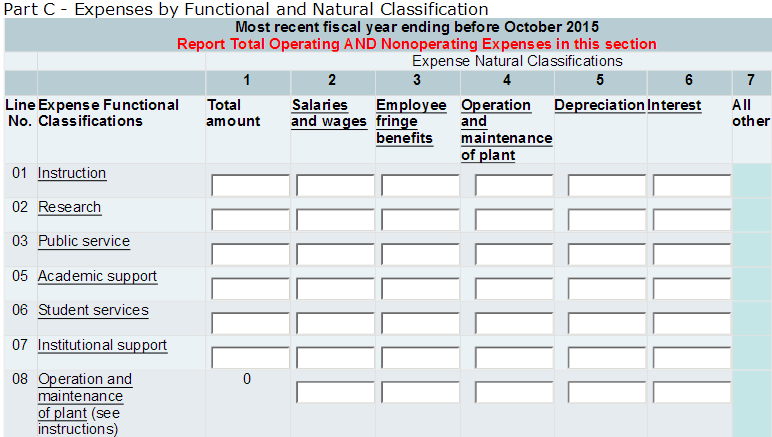
hosch_fig1

The proposed changes, solely in the name of reducing institutional reporting burden, will significantly scale back detail by requiring institutions to report only total expenses by function and total expenses by natural classification, but will not provide the detail of how these areas intersect:
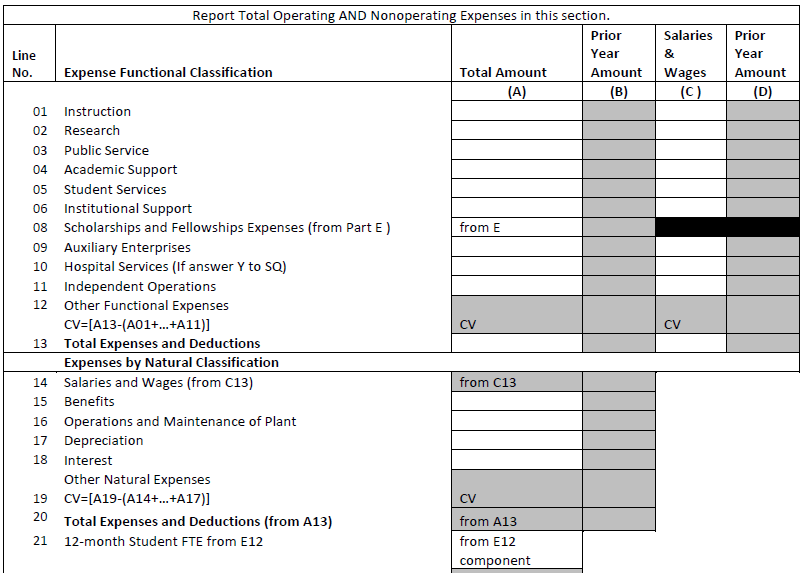
hosch_fig2

Elimination of the allocations for depreciation, interest, and operations & maintenance is a good plan because institutions do not use a consistent method to allocate these costs across functional areas. But elimination of reporting actual benefits costs for each area is problematic.

To be clear, under the proposed changes, institutions must still, capture, maintain, and summarize these data (which is where most effort lies); they are simply saved the burden of creating a pivot table and several fields of data entry.

Why does this matter?

For one thing, the Society for Human Resource Management 2016 survey shows that benefits costs have increased across all economic sectors over the past two decades. IPEDS would continue to collect total benefits costs, but without detail about the areas in which these costs are incurred, it will be impossible to determine in what areas these costs may be increasing more quickly. Thus, a valuable resource for benchmarking and diagnosis would be lost.

Additionally, without specific detail for benefits components of function expenses, the ability to control for uneven benefits costs will be lost; it would be impossible for instance to remove benefits costs from standard metrics like education and general costs or the Delta Cost Project’s education and related costs. Further, benefits costs neither are distributed uniformly across functions like instruction, research, and student services nor are distributed uniformly across sectors or jurisdictions. Thus, to understand how the money flows, at even a basic level, breaking out benefits and other expenses is critical.

Here are two quick examples.

Variation at the institution level

First, as a share of spending on instruction, benefits and other items, benefits expenses are widely variable by institution. I have picked just a few well-known institutions to make this point – it holds across almost all institutions. If spending on benefits were evenly distributed across functions, then the difference among these percentages should be zero, but in fact it’s much higher.
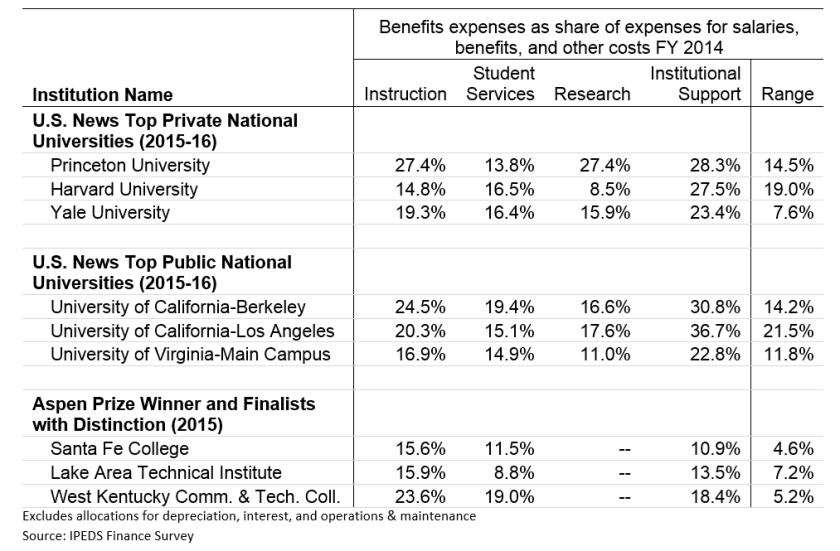
 hosch_fig3

Variation by state

Because benefits costs are currently reported separately across functions, it is possible to analyze how the benefits component of the Delta Cost Project education and related costs metric – spending on student related educational activities while setting aside auxiliary, hospital, and other non-core metrics. Overall, the Delta Cost Project also shows that benefits costs are rising, but a deeper look at the data also show wide variation by state, and in some states, this spending accounts for large amounts on a per student basis.

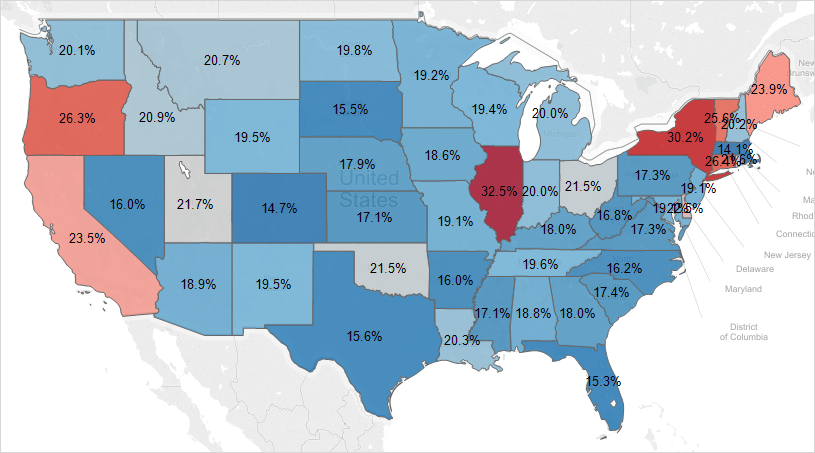
Among 4-year public universities in FY 2014, for instance, spending on benefits comprised 14.1% of E&R in Massachusetts, 20.2% in neighboring New Hampshire to the north, and 30.2% in neighboring New York to the west. The map below illustrates the extent of this variation.

Benefits as a percent of E&R spending, Public, 4-year institutions FY 2014
hosch_fig4

Excludes amounts allocated for depreciation and interest. Source Hosch (2016)

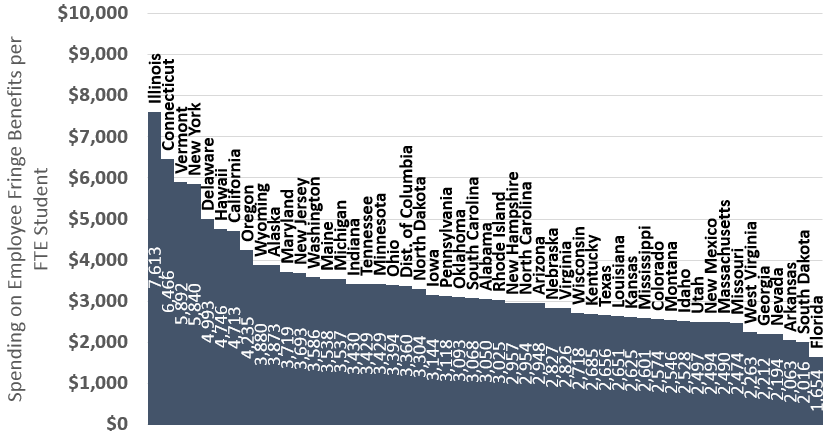
Likewise, on a per student (not per employee) basis these costs ranged from $1,654 per FTE student spent on E&R benefits in Florida, compared to $7,613 per FTE student spent on benefits in Illinois.

E&R benefits spending per FTE student, public 4-year institutions, FY 2014
hosch_fig5

Excludes amounts allocated for depreciation and interest. Source Hosch (2016)

Bottom line: variation is stark, important, and needs to be visible to understand it.

What would perhaps most difficult about not seeing benefits costs by functional area is that benefits expenses in the public sector are generally covered through states. States do not transfer this money to institutions but rather largely negotiate and administer benefits programs and their costs themselves. Even though institutions do not receive these resources, they show up on their expenses statements, and in instances like Illinois and Connecticut in the chart above, the large amount of benefits spending by institutions really reflects state activity to “catch up” on historically underfunded post-retirement benefits. To see what institutions really spend, the benefits costs generally need to be separated out from the analysis.

What you can do

Submit comments on these changes through regulations.gov. Here’s what you can tell NCES through the Federal Register:

  1. We need to know more about spending for colleges and universities, not less
  2. Reporting of functional expenses should retain a breakout for benefits costs, separate from salaries and other costs
  3. Burden to institutions to continue this reporting is minimal, since a) they report these costs now and b) the costs are actual and do not require complex allocation procedures, and c) they must maintain expense data to report total benefits costs.
Examining Trends in Pell Grant Award Data

The U.S. Department of Education recently released its annual report on the federal Pell Grant program, which provides detailed information about the program’s finances and who is receiving grants. The most recent report includes data from the 2014-15 academic year, and I summarize the data and trends over the last two decades in this post. (Very preliminary data on Pell receipt for the first three quarters of the 2015-16 academic year can be found in the Title IV program volume reports on the Office of Federal Student Aid’s website.)

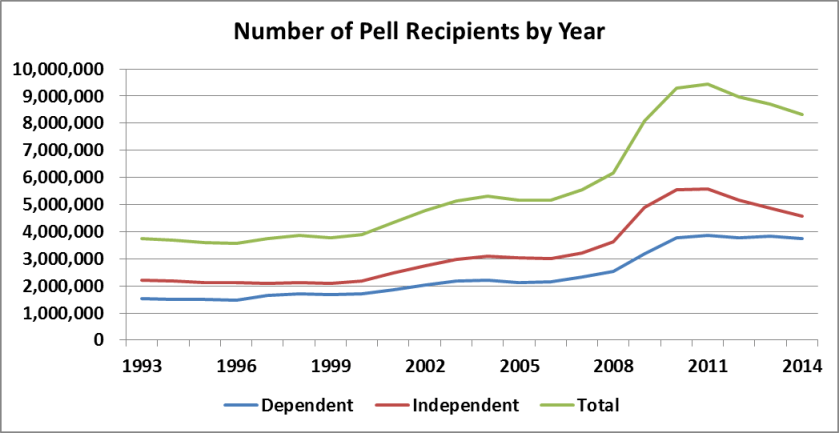
For the third year in a row, the number of Pell recipients fell, going from a peak of 9.44 million students in 2011-12 to 8.32 million in 2014-15 (a 12% decrease). This drop in recipients is almost entirely due to students who are considered independent for financial aid purposes (typically students who are at least 24 years of age, are married, or have a child). The number of independent Pell recipients fell by 18% in the last three years (to 4.56 million), while the number of dependent Pell recipients fell by just 2.7% (to 3.75 million), as shown in the chart below. However, independent students still make up the majority of Pell recipients, as they have every year since 1993.

pell2016_fig1

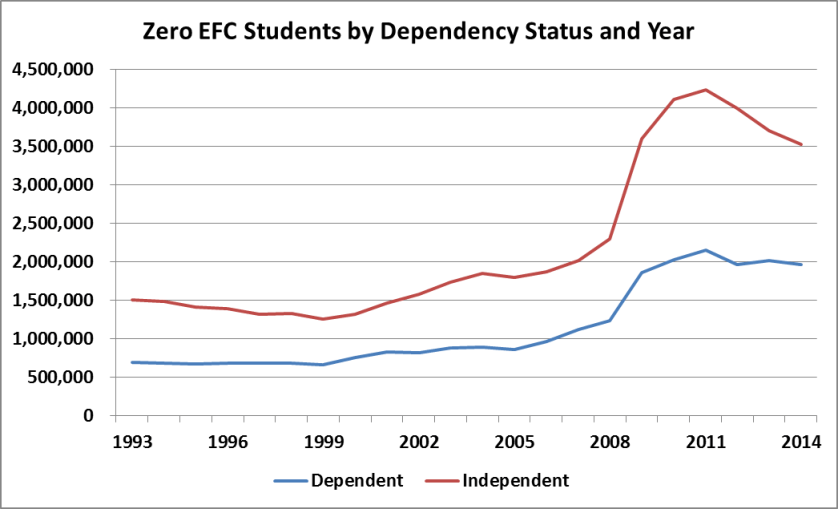
There has been an even larger drop in the number of students with zero expected family contribution, who automatically qualify for the maximum Pell Grant. (For more on these students, check out this article I wrote in the Journal of Student Financial Aid last year.) Nearly 900,000 fewer students received a zero EFC since 2011-12, with decreases of 9% among dependent students and 17% among independent students.

pell2016_fig2

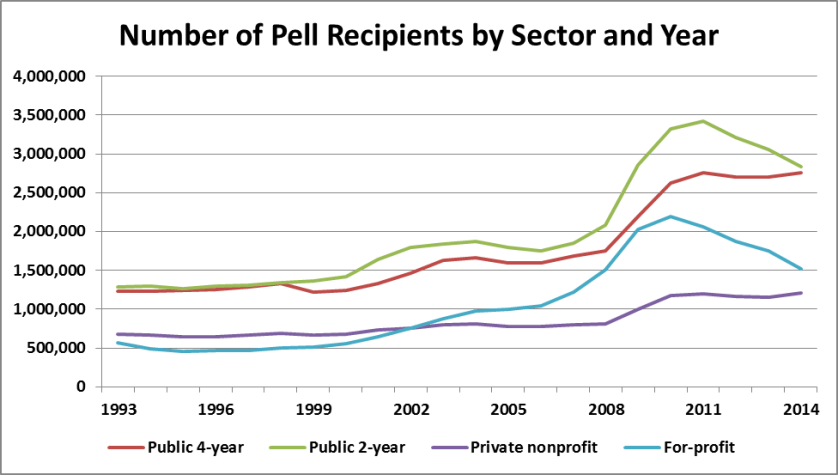
In the next chart, I show the number of students receiving Pell Grants by sector since 1993. The number of Pell recipients dropped by almost 225,000 students at community colleges and 230,000 students at for-profit colleges between 2013-14 and 2014-15, while Pell enrollment at both public four-year and private nonprofit colleges increased by about 55,000 students each. Since 2011-12, community college Pell enrollment is down by 17% and for-profit Pell enrollment is down 26%, while other sectors are basically flat. These trends fit well with economic conditions, as more vocationally-oriented colleges see enrollment spikes during recessions and sizable drops during better times (like today).

pell2016_fig3

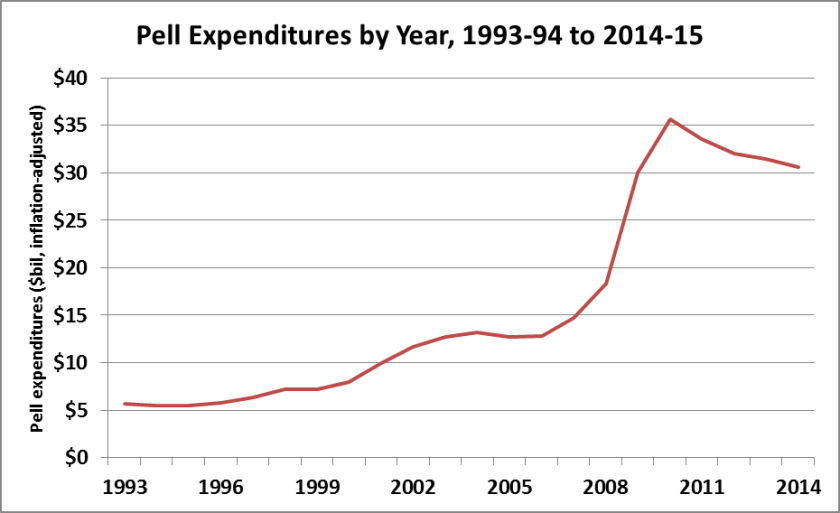
Expenditures for the Pell Grant program declined for a fourth consecutive year, going from $35.7 billion (in nominal dollars) in 2010-11 to $30.6 billion in 2014-15. However, in inflation-adjusted dollars, Pell spending has still more than doubled since 2007-08.

pell2016_fig4

The large decrease in Pell expenditures led to a $7.8 billion surplus in the Pell program going forward, but Congress has plans to spend part of that surplus. A U.S. Senate subcommittee approved bringing back year-round Pell Grants (an idea with strong bipartisan support that would allow students to get Pell Grants for more than two full-time semesters per year) as well as transferring some of the funding to the National Institutes of Health and K-12 education. But will Pell expenditures continue to drop? It’s possible if the economy continues to improve while parts of the for-profit college sector continue to collapse, but the trend toward a more economically diverse group of young adults will likely increase Pell enrollment in future years.

The Tradeoffs of Making Private Student Loan Debt Dischargeable in Bankruptcy

There is an old adage dating back to the 1700s that the two most certain things in life are death and taxes. But for families with certain types of student loans, having to make payments on their loans is another certainty. Students used to be able to discharge educational loans in bankruptcy, but that ability was first restricted in 1976 before being fully eliminated for federal loans by 1998 and private student loans in 2005. The growth of income-driven repayment programs for federal loans reduces the need to discharge these loans in bankruptcy, as payments would instead be zero if a student signs up for this plan and earns below the poverty line.1 But private loans, which are about $10 billion per year, generally do not offer income-based repayment options.

Neal Hutchens of the University of Mississippi and Richard Fossey of the University of Louisiana have an interesting new piece up at The Conversation that argues that private student loan debt should once again be dischargeable in bankruptcy. They contend that more students should be able to meet the “undue hardship” test for paying off private loans, which includes both having low income and making a good-faith effort to repay loans. Senate Democrats, such as Elizabeth Warren of Massachusetts, have pushed for making private loans dischargeable in bankruptcy, and the Obama Administration has expressed interest in the idea.

But making private student loans dischargeable in bankruptcy would likely come with two main drawbacks for borrowers. The first one is that private lenders would significantly increase their standard for creditworthiness, thus rejecting students who need money for college but do not (and their co-signer does not) have outstanding credit. The second one is that interest rates would rise to take into account the increased risk that borrowers do not repay their loans. Currently, the terms on private loans are generally comparable to PLUS loans. If a student gets denied a PLUS loan (or a college doesn’t package a PLUS loan into a student’s financial aid package), the terms on private loans may become so bad that students and parents don’t wish to consider this option—even with the protection that discharging a loan in bankruptcy would offer.

The traditional market for private student loans is at a crossroads right now, with the terms on many types of federal student loans getting much better in recent years while the growing student loan refinancing market and the potential for income share agreements have the potential to threaten traditional lenders’ business models. But in the meantime, advocates for allowing students to discharge private loans in bankruptcy need to carefully consider the tradeoff between protecting some of the most vulnerable students who fall upon hard times and potentially restricting access to needed credit for other students to attend college. Which of these two factors is more important? It’s hard to tell at this time, but both need to be carefully considered by policymakers.

———————————————————————————————————-

1 Parent PLUS loans qualify for a far less generous income-driven repayment plan than all other federal loans, but payments would still be zero if the parent earned below the federal poverty line

Which Factors Affect Student Fees?

Tuition increases tend to get the most focus in discussions about college affordability, but a number of other factors also affect the total price tag of a college education. In addition to researching living allowances for off-campus students, I have looked into the often-confusing world of student fees at public colleges. These fees are used for a variety of purposes, such as supporting core instructional activities, funding athletics, paying for student activities, or even seismic safety. The University of California-Santa Cruz lists over 30 mandatory fees that all undergraduates must pay, ranging from $.75 per year to fund a marine discovery center to $1,020 per year for student services. At the typical four-year public college, student fees were nearly $1,300 in the 2012-13 academic year, roughly 20% of median tuition and nearly double their 1999-2000 rate after adjusting for inflation.

In a new article that was just published in The Review of Higher Education, I used a panel regression framework to explore potential institution-level and state-level factors affecting student fee levels between the 2001-02 and 2012-13 academic years.  For institution-level factors, I included tuition, the percent of nonresident students, measures of selectivity, and per-student athletics expenditures (a proxy for the magnitude of a college’s athletics program). For state-level factors, I considered appropriations and financial aid levels, economic conditions, whether a tuition or fee cap was in place, who had the ability to set tuition or fees (politicians, state or system boards, or the individual college), and partisan political control in the state.

Given that students subsidized athletics at public colleges to the tune of at least $10 billion over five years, I fully expected to find that higher per-student athletics expenditures would be associated with higher student fees. Yet after controlling for other factors, there was no significant relationship between athletics spending and fees. This could be explained by the small number of high-spending colleges in big-time conferences that come close to breaking even on athletics, or it could be due to my data ending in 2012-13 and larger increases in athletics fees occurring since then. The only significant institution-level factor was tuition—as tuition rose, fees fell. This implies that some colleges likely treat tuition and fees as interchangeable.

More of the state-level factors have statistically significant relationships with student fee levels. States that have capped fee levels do have fees about $128 lower than states without fee caps, but I also found evidence that colleges in states with tuition caps have fees $59 higher. This suggests that colleges will substitute fees for tuition where possible. If a state’s governor and/or legislature can set tuition, fees tend to be lower, but if policymakers can set fees, fees tend to be higher. Finally, partisan political control only has a small relationship with fees, as having a Republican governor is associated with slightly lower fee levels and control of the legislature was not significant.

Given the magnitude of student fees and the relatively small body of research in this area, I hope to see more studies (particularly qualitative in nature) digging into how student fees are set and how the money is supposed to be used compared to its actual uses.

Who Exactly is a “Hard Working” Student?

Most people don’t like giving money to slackers. After all, people who work hard for their money don’t want to hand it over to people who aren’t working so hard—a very reasonable position to take. But the challenge is defining what “hard working” actually means, particularly as individuals’ definitions may differ and it is generally difficult or expensive to observe someone’s effort level. (I’m not the only academic to note this challenge.) A classic example of struggling to define hard work comes from the welfare reform debates of the 1980s and 1990s (which eventually resulted in major welfare reform in 1996) and has clear linkages to higher education debates.

Similar to the famous “welfare queen” example that Ronald Reagan first used in 1976 of a woman who defrauded the federal welfare system, there have been concerns about “Pell runners”—people who go from college to college in an effort to defraud taxpayers instead of get an education—for years. While the U.S. Department of Education estimates that 2.5% of Pell dollars are improperly spent (either due to fraud or errors by the college or the federal government), there are concerns that students are not putting in sufficient effort to get support from the federal government. In 2011, then-Representative Denny Rehberg (R-MT) called the Pell program “the welfare of the 21st century,” a concern shared by some who point to the billions of dollars each year going to students who do not graduate (although barriers to graduation may include family or financial issues in addition to academic success or work ethic).

Politicians supporting increased funding for financially needy students have taken great care to explain how their plan helps “hard working” students in an effort to gain political support. For example, President Obama and the White House communications team have repeatedly referred to “hard working” students in describing the administration’s plans for tuition-free community college and other proposals for reform. Obama’s tuition-free community college proposal defines “hard working” as having a 2.5 GPA, enrolled half-time, and making satisfactory progress toward a degree. These requirements are tighter than the Pell Grant’s rules, which require a 2.0 GPA and satisfactory academic progress with no enrollment intensity requirement. Last week, two Democrats on the House Education and the Workforce Committee referred to current Pell recipients as “hard working” in their appeal to use a $7.8 billion surplus in the Pell program to increase awards to current students.

As in most cases in life, it’s worth reading the fine print to see exactly who politicians, advocates, or others consider to be “hard working” students. The term sounds really good, but be wary of people defining the term in such a way that it aligns with their political priorities. I don’t have a perfect definition of what it means to be hard working in college, so I would love your suggestions in the comments section below.

Which Colleges Benefit from Counting More Graduates?

The official graduation rate that colleges must report to the U.S. Department of Education has included only first-time, full-time students who graduate from that college within 150% of normal time (three years for a two-year college or six years for a four-year college). Although part-time and non-first-time students were included in the federal government’s Integrated Postsecondary Education Data System (IPEDS) collection for the first time this year, it will still be about another year or so before those data will be available to the public. (Russell Poulin at WICHE has a nice summary of what the new IPEDS outcome measure data will mean.)

In the meantime, the Student Achievement Measure (SAM)—a coalition of organizations primarily representing public colleges and funded by the Gates Foundation and Carnegie Corporation—has developed in response to calls for more complete tracking of student outcomes. SAM has launched a public relations campaign that has been quite visible in the higher education community using the hashtag #CountAllStudents to show the number of students who aren’t captured in the current graduation rate metric. (Barack Obama and Sarah Palin are two well-known examples.)

But what can be learned from a more complete picture of graduation rates? In this blog post, I examined SAM outcome data for 54 participating colleges in four states (California, Maryland, Missouri, and South Carolina) to see the extent to which graduation rates for first-time, full-time students at four-year universities changed by counting students who transferred and graduated elsewhere as a success, as well as looking at the percentage of students still enrolled after six years. I focused on first-time, full-time students here so I could compare the current graduation rate metrics to alternative metrics; completion rates for part-time students can be a topic for another day. The data can be downloaded here, and a summary is below.

Average graduation rate for first-time, full-time students at the same university within six years: 57%

Average graduation rate for first-time, full-time students anywhere within six years (SAM): 66%

Gain from SAM metric: 9%

Still enrolled anywhere, but no bachelor’s degree: 15%

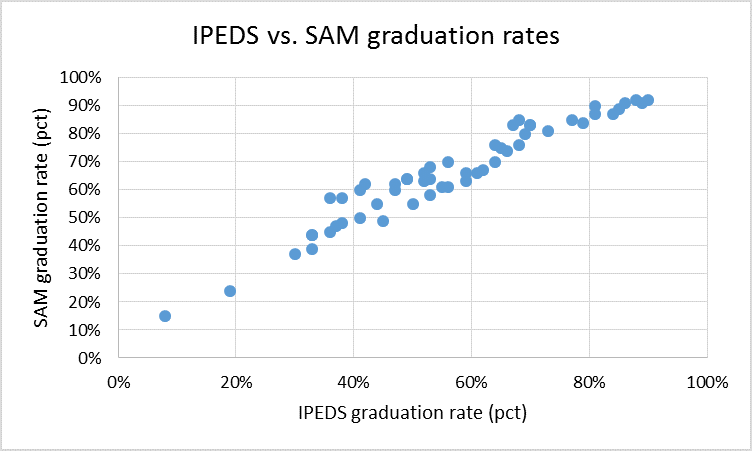
The first figure below shows the distribution of IPEDS and SAM graduation rates, and it shows that they are pretty strongly related. The correlation between the two graduation rates is 0.966, which is a nearly-perfect relationship.

ipeds_sam_fig1

But colleges with lower IPEDS graduation rates did tend to gain more from the SAM graduation rate than those with higher graduation rates, as shown below. Six colleges with IPDS graduation rates between 35% and 70% had at least 15% of students graduate from another college, including five of the six universities participating in SAM from South Carolina. On the other hand, UCLA (with a 90% graduation rate in IPEDS) gained just 2% from the SAM metric. This suggests that a more complete definition of a graduate will help to at least slightly narrow graduation rate gaps.

ipeds_sam_fig2

It is also stunning to see the percentage of students who were still enrolled in college after six years. While the average college in my sample had 15% of its first-time, full-time students still plugging away somewhere, most of the less-selective colleges with higher percentages of lower-income and minority students still had at least 20% of students still enrolled. The new IPEDS metrics will count students through eight years, which should give a better picture of completion rates. I’m excited to see those metrics come out in the future—and hopefully incorporate them in future versions of the Washington Monthly college rankings.

Are Income Share Agreements a Good Way to Pay for College?

This article was originally published on The Conversation. Read the original article.

Millions of Americans are struggling to pay for college. Nearly 10 million students and their families took out almost $100 billion in student loans from the federal government in the 2014-15 academic year, pushing outstanding student loan debt to more than $1.2 trillion by the end of 2015.

The traditional way to repay student loans is to make the same monthly payment each month for 10-20 years, similar to how mortgages work. But this isn’t always the best setup for students, particularly as college doesn’t always pay off immediately in terms of increased earnings.

Newly released government data show that many students are having difficulty repaying their loans after leaving college. About 40 percent of students had not been able to pay any part of the principal within three years of entering repayment.

A new idea in paying for college in the United States is Income Share Agreements (ISAs), in which students agree to pay a percentage of their future income to a private company or lender in exchange for additional money to cover college expenses.

What is an income share agreement and is it a viable option for students?

ISA and past efforts

ISAs function similarly to certain types of federal loans, which allow students to tie their student loan payments to their income.

However, the amount that undergraduates can borrow under income-based repayment plans isn’t always enough to pay for college. The typical college student straight out of high school can borrow only $31,000 from the federal government for college with a current interest rate of 4.29 percent. This means many students may need to turn to expensive private loans as an alternative.

And here is where an ISA can help. Technically, ISAs are not loans since students don’t have to pay any money back if their earnings are not adequate. This means that if students don’t make money, they could pay back less than what they took out in loans. Instead of interest rates, lenders offer students contracts with the percentage of future earnings paid to the ISA provider and the time period based on a student’s major, year in school and amount borrowed.

ISAs have been in use in Latin America for more than a decade with providers such as Lumni financing the college educations of thousands of students. In the United States, there have been a few small efforts to introduce ISAs, but they have largely been unsuccessful.

In 2014, Senator Marco Rubio (R-Florida) and Congressman Tom Petri (R-Wisconsin) introduced legislation for an income share repayment option, with a similar bill introduced in 2015 by Representatives Todd Young (R-Indiana) and Jared Polis (D-Colorado). Lawmakers in Oregon too have been pushing a similar program called Pay it Forward. However, none of these attempts worked.

Purdue plan

More recently, in a first-of-its-kind development, Purdue University launched an Income Share Agreement plan “Back a Boiler” (originally “Bet on a Boiler”) program to help juniors and seniors pay for college. This name plays on Purdue’s mascot of the Boilermaker, a vehicle outfitted to look like the 19th-century steam engines that boilermakers built throughout the country, which fits the STEM-heavy university well.

Under the Purdue plan, students would be offered a contract that would specify, based on their major, what percentage of their earnings would be paid and for how many years. Students can receive money to cover any remaining financial need after grants and scholarships, with payment terms based on the total amount of money needed.

For example, a student majoring in biological engineering and expecting to graduate in 2018 would pay 3.32 percent of her income to Purdue for 96 months after graduation in exchange for $10,000 today, while an elementary education major would pay 4.97 percent of his income back for 116 months after graduation.

Students who make less than $20,000 per year will not need to pay anything back. Their maximum lifetime payment is capped at 2.5 times the initial amount of money provided.

One size does not fit all

Although some students could benefit from ISAs, they certainly aren’t for everyone.
So, who should consider income share agreements?

In my view, income share agreements make the most sense for three groups of students.

First, students in need of additional funds beyond federal loans should consider ISAs as a potential option. Second, since ISAs are technically not loans, they may appeal to students who are particularly averse to taking on debt to pay for college. Loan aversion is particularly common among minority and first-generation students. So a product that doesn’t come with fixed payments might benefit these students.

Finally, not all students can access federal loans. About one million students attend community colleges that do not participate in the federal student loan program. Federal loans also aren’t available for educational opportunities such as bar exam prep for law students or “boot camp” courses designed to teach students particular skills outside the traditional college setting.

ISAs might be particularly well-suited to these types of programs that are closely tied to employment.

Not for high-income earners

Who might not be the right fit?

Students who don’t need to borrow beyond the $31,000 in federal loans for a bachelor’s degree are better off with federal loans.

This is particularly true for students who plan to work in public service fields and could benefit from the federal government’s Public Service Loan Forgiveness program, that can forgive debt not repaid after 10 years. The terms for ISAs likely aren’t as favorable, as private lenders may offer students contracts of longer than 10 years in order to at least break even. The 40 percent of students unable to pay down the principal on their loans are unlikely to get terms as good as with federal loans.

Students who think they’ll make a lot of money after college may not want to consider the ISAs either. ISAs require students to pay a fixed percentage of their income. So, they can be an expensive proposition for students who do really well even if the terms are better than for other majors.

These students would be better off taking on federal and private loans and then consider joining the growing number of students who are getting their loans refinanced by a new generation of private lenders, who are willing to give borrowers with successful careers loans on lower interest.

In theory, ISAs have a market, but whether students take up this new product will determine its success.

The Conversation

Which Colleges’ Students Use Income-Driven Repayment Plans? We Don’t Know

The Obama Administration has made expanding access to income-driven repayment (IDR) plans for federal student loans a key part of its higher education policy agenda. The U.S. Department of Education now offers four different IDR plans, all of which allow former students to tie their payments to their income instead of the traditional system of fixed monthly payments. The newest plan, Revised Pay as You Earn (REPAYE), allows millions of students with federal loans to pay 10% of their income above 150% of the federal poverty line—which can represent a significant decline in monthly payments for students with modest incomes relative to their debt burdens.

As IDR plans have become more generous, more students have signed up for these plans. In the third quarter of Fiscal Year 2013, only $72.3 billion in Direct Loans was tied to income-based plans while $247.3 billion was tied to a traditional payment plan. By the first quarter of Fiscal Year 2016, the amount of loans in IDR tripled to $232.5 billion, while the amount in traditional payment plans increased to $353.3 billion—meaning that a majority of additional Direct Loan debt was being repaid via income-driven plans. Data released by the White House show that about one-fifth of students are enrolled in IDR as of early 2016, double the rate of just two years ago.

Income-driven repayment plans likely benefit two different types of students. The first group of students includes those for whom college simply didn’t work out in terms of increasing their earnings potential. IDR is an important safety net for these students, as it helps to insure against the risk of high student loan payments relative to one’s income. Given that students with less than $5,000 in debt are nearly twice as likely to default on their loans than those with more than $100,000 in debt, the availability of IDR should help these students the most.

But a second group of students appears to be the more common users of income-driven plans—graduate students in relatively low-wage fields, particularly those who qualify for the Public Service Loan Forgiveness (PSLF) program that limits payments to a 10-year period instead of 20-25 years for those working for a qualifying nonprofit or public-sector organization. Jason Delisle of New America (who is moving to the American Enterprise Institute soon) has repeatedly raised concerns about the fiscal impacts of IDR for graduate students, noting that the typical borrower in PSLF has between $60,000 and $70,000 in debt and graduate programs have incentives to further raise tuition as the typical student won’t pay back the additional dollars borrowed. Georgetown Law School actually did this by creating a Loan Repayment Assistance Program that covered the loan payments of students who worked in public service and made less than $75,000 per year.

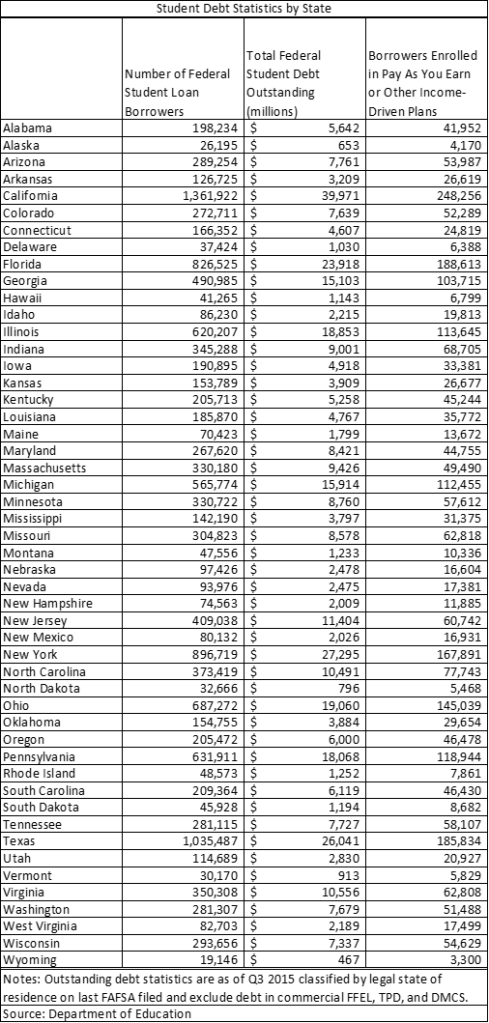
Given the rising cost of IDR programs, it would be useful to know which colleges encourage their students to enroll in income-driven plans or provide assistance to help navigate an often-complex process to annually certify their income. And it would be even more helpful to get this information broken down for undergraduate and graduate students, as the types of students enrolled in IDR likely differ across these two groups. Yet, as with many other important issues (such as graduation rates for Pell Grant recipients or the default rates on PLUS loans), this information is not yet available to the taxpaying public. The White House did release the following chart last week of the number of borrowers in IDR by state, but this chart (released as a picture instead of a spreadsheet!) doesn’t get at the behaviors of individual colleges while also excluding Washington, DC:

state_idr

The Department of Education’s Office of Federal Student Aid has the ability to release data on which colleges’ students use income-based repayment plans and whether those students are undergraduates with low earnings who are hard on their luck or grad students with lots of debt but incomes at or above the national average. Releasing these data would help inform conversations about the value of IDR plans and what colleges and loan servicers can do to help enroll the neediest students in these programs.

(Still) Don’t Dismiss Performance Funding Research

I like the idea of funding public colleges and universities based in part on their former students’ outcomes—and I’m far from the only one. Something in the ballpark of three dozen states have adopted some sort of a performance-based funding (PBF) system, with more states currently discussing the program. Given that many states currently fund colleges based on a combination of enrollment levels and historical allocations that can be woefully out-of-date, tying some funding to outcomes has an intuitive appeal.

However, as a researcher of accountability policies in higher education, I am concerned that some colleges may be responding to PBF in unintended ways. At this point, as I briefly summarized in a recent piece at The Conversation, there is evidence that PBF may adversely affect access to college for moderately prepared students as well as the types of postsecondary credentials awarded. My newest contribution was a recently published article in the Journal of Education Finance that found both two-year and four-year colleges subject to PBF saw less Pell revenue than other colleges not subject to PBF.

Since that article finished the peer review and copy editing processes and was posted online two weeks ago, I’ve been expecting a response from one of the largest organizations advocating for PBF. HCM Strategists, a DC-based advocacy group that is quite effective in lobbying and policy development, has traditionally been a strong supporter of PBF. (Disclaimer: I’ve gotten funding from them for a project on a different topic in the past.) In 2013, an HCM director responded to a high-quality paper by David Tandberg and Nick Hillman (that was later published in JEF) by writing an Inside Higher Ed piece called “Don’t Dismiss Performance Funding.” In this piece, they call the research “flawed” and “simplistic,” neither of which are particularly true. I wrote a blog post called “Don’t Dismiss Performance Funding Research,” in which I wasn’t too pleased with their response.

Today, HCM director Martha Snyder has a much more nuanced IHE essay on my and Luke’s work entitled “Jumping to Conclusions,” saying that our work should not be used “to draw any meaningful conclusions” on PBF. Snyder discusses what she perceives as some of the limitations of our work. The most notable one is that multiple types of PBF policies are lumped together in the analyses. That is necessary due to data limitations—there is no comprehensive archive of the nuances of PBF plans prior to the early 2010s. However, general trends in PBF policies across states are partially captured by the year fixed effects in the regression (standard practice in panel analyses), which also help to account for these factors.

Snyder also suggests that some states have been encouraging students to enroll in community colleges, which is definitely the case (although somewhat less so prior to 2012-13, the last year of our analysis due to the pace at which new data become available). If this were true, it would explain decreases in per-FTE Pell revenue at four-year colleges, but also increase Pell revenues at two-year colleges. Instead, we saw nearly identical negative point estimates, which raise further cause for concern. (Could this affect for-profit enrollment? I can’t really tell with federal data, but a state-level analysis here would be great.)

I appreciate HCM’s work in helping states implement more modern funding programs, but it is imperative that influential policy organizations work with the research community before drawing any meaningful conclusions about the potential unintended consequences of PBF—especially as the stakes become higher for students and colleges alike. The small, but growing, body of literature on colleges’ responses to PBF suggests that collaboration among interested parties would be far more productive than attempting to dismiss findings from peer-reviewed research that suggest caution may be in order. I’m happy to do what I can to summarize the literature on unintended consequences while working to move forward policy discussions on future versions of PBF.

Will Colleges Send Out Financial Aid Packages Earlier Next Year?

I’m looking forward to college students being able to submit the Free Application for Federal Student Aid (FAFSA) three months earlier next year. Instead of being able to submit starting January 1 for the 2017-18 academic year, students will be able to submit beginning October 1—giving students an additional three months to complete the form thanks to using ‘prior prior year’ (PPY) income and asset data. This means that students can get an estimate of their eligibility for federal grants and loans as soon as late fall, which has the potential to help inform the college choice process.

But there is no guarantee that students will get their final financial aid package from the college any earlier as a result of prior prior year. Recognizing this, Undersecretary of Education Ted Mitchell recently sent a letter to college presidents asking colleges to send out their aid packages earlier in order for students to fully benefit from PPY. Will colleges follow suit? I expect that some will, but the colleges with the greatest ability to offer institutional grant aid probably won’t. Below, I explain why.

The types of colleges that can easily respond to PPY by getting aid packages out earlier are those institutions with rolling admissions deadlines. (Essentially, it’s first-come, first-served among students who meet whatever admissions criteria are present—less-selective four-year and virtually all two-year colleges operate in this manner.) Some of these colleges already offer their own grant aid upon admission, but these colleges tend to have less grant aid to offer on account of relatively low sticker prices and fewer institutional resources. Additionally, these colleges often take applications well into the spring and summer—after students can already file the FAFSA under current rules.

It is less likely that the relatively small number of highly-selective colleges that get a disproportionate amount of media coverage will respond to PPY by getting financial aid offers out any earlier. For example, the Ivy League institutions didn’t even release their admissions notifications for students applying through the regular route until the last day of March, which gives students plenty of time to complete the FAFSA under current rules. Moving up the notification date to January is definitely feasible under PPY, but it requires students to apply earlier—and thus take tests like the ACT or SAT earlier. All students are supposed to commit to one college by May 1, giving students one month under current rules to compare aid packages and make a decision. Colleges may oppose extending this decision period as students have more time to compare offers and potentially request more money from colleges.

I suspect the Department of Education sent their letter to colleges in an effort to get the admissions notification dates at selective colleges moved up, but this goes against the incentives in place at some colleges to reduce the comparison shopping period. Prior prior year still allows students to get their federal aid eligibility earlier, which is a good thing. But for quite a few students, they won’t get their complete financial aid package any earlier.