Blog (Kelchen on Education)

Should Campuses be Able to Limit Student Loans?

The National Association of Student Financial Aid Administrators jumped into the financial aid reform debate this week with the release of their policy paper as a part of the Gates Foundation’s Reimagining Aid Delivery and Design (RADD) project. Many of the recommendations are similar to other papers in the panel (including proposals to increase the maximum Pell Grant for certain students and providing more information for students and their families to make better college decisions)—and an additional recommendation of exploring an early commitment program for Pell recipients is informed by some of my research, which is pretty nifty.

The NASFAA report does make one recommendation which will likely prove to be highly controversial—limiting eligibility for student loans for certain groups of students in a clear effort to reduce student loan default rates. First, NASFAA suggests that students who do not meet a baseline level of academic preparation (perhaps a combination of ACT/SAT scores and high school GPA) would not be initially eligible to take out federal student loans. This proposal would be similar to the academic eligibility index used by the NCAA to determine student-athletes’ ability to play college sports. This proposal could have the effect of ending the open-access institution as we know it, depending on exactly where the cutoff is set. While it is true that students with lower standardized test scores are less likely to complete college, I’m very hesitant to place a substantial barrier to college entry—especially for students who did not enroll in college directly after completing high school.

The report also contains a recommendation allowing colleges to restrict groups of students’ ability to borrow if the financial aid officer feels that the loan funds are not needed or risky. For example, education majors’ loans may be limited compared to business majors because of their lower annual earnings (and reduced repayment abilities). Restricting access to loans by program characteristics (instead of individual characteristics) reduces the burden on financial aid officers, but also fails to take individual characteristics into account unless a student appeals for professional judgment.

The proposal to limit student loans will penalize students who cannot pay for college by any other means—especially for dependent students who cannot get parental support to pay for their expected family contribution. Additionally, many students cannot borrow the maximum amount of loans under current rules, which base eligibility in part on the estimated cost of attendance. Research suggests that this posted cost of attendance may be much lower than the actual cost of attending college, as institutions have an incentive to make the college look as affordable as possible.

While I am concerned about these particular portions of NASFAA’s proposal, they raise concerns that are of genuine merit and concern in the financial aid and policy communities. I would be surprised if they become a part of federal rules in any meaningful way, but this does show the diversity of opinions within the RADD group and the importance of listening to as many stakeholders as possible before redesigning the financial aid system.

More on Wisconsin’s Workforce Development Proposal

Today, Wisconsin Governor Scott Walker released more information about his proposal to improve the state’s workforce development system through an additional $100 million in state appropriations. These proposals have the potential to affect the priorities of Wisconsin institutions of higher education, particularly the Wisconsin Technical College System. While most of the key points of the proposal are directly from his special workforce development commission’s report last August (see my analyses here and here), the additional details provided in this press release provide more concrete information about the Governor’s soon-to-be-released budget proposal.

Three items in Gov. Walker’s proposal are in legislation separate from the state budget: workforce training grants to a mix of colleges, businesses and economic development organizations, a new Office of Skills Development to administer the grants, and a labor market information system designed to help link students and workers to available jobs and track labor market trends. The labor market information system has the potential to provide high school and college students with information that can help them decide their course of study, but getting the information to students in a timely manner may be difficult. It can be a useful tool for high school juniors who want to figure out a possible career, but it may be four or five years before the student is ready to go into the workforce. A lot can happen in that period of time. In any case, these records should be linked to K-12 and higher education datasets so the effectiveness of the new system can be evaluated.

The big change in higher education policy comes from the proposed shift to performance-based funding (PBF) in the Wisconsin Technical College System. Under PBF, colleges are funded based on outcomes (such as graduation and job placement rates) instead of based on enrollment or other historical factors. This plan starts with 10% of base funding being used for PBF in 2014-15, rising to 100% by 2020. Although other states have similar plans to completely shift to PBF, I am skeptical that a majority of funding will ever be tied to performance for political reasons. (Note that if Gov. Walker serves a second term and declines to run for a third, he would leave office in January of 2019—before this takes effect.)

Few details are currently available about the proposed funding formula for WTCS, as it will be developed by WTCS and the state Department of Administration. But the press release does note that the formula will prioritize job placement and enrollment in high-demand programs, something which is likely to be opposed by WTCS campuses with strong university transfer programs (such as Madison Area Technical College). These concerns will likely be kept in mind as a PBF system is developed.

Finally, the press release calls for the development of a common core of 30 credits (approximately ten courses) that will be fully transferrable across the UW System, WTCS, and participating Wisconsin private colleges. This will likely be opposed by a number of UW System universities as a loss of autonomy and a perceived lowering of academic standards. I would expect the common core to be mandated, but some colleges will attempt to deny full transferability of certain courses; for example, a college algebra class at a technical college might be classified as an elective math credit at a UW System university instead of as a college algebra class.

Governor Walker’s budget address will take place on February 20, and I will have a complete analysis of his higher education programs later this week. More details may be released before that time, such as in this unusual Sunday press release.

Another Random List of “Best Value” Colleges

Getting a good value for attending college is on the mind of most prospective students and their families, and as a result, numerous publishers of college rankings have come out with lists of “best value” colleges. I have highlighted the best value college lists from Kiplinger’s and U.S. News in previous posts, as well as discussing my work incorporating a cost component into Washington Monthly’s rankings. Today’s entry in this series comes from the Princeton Review,  a company better known for test preparation classes and private counseling, but they are also in the rankings business.

The Princeton Review released its list of its “Best Value Colleges” today in conjunction with USA Today, and the list is heavily populated with a “who’s who” list of selective, wealthy colleges and universities. Among the top ten private colleges, several of them are wealthy enough to be able to waive all tuition and fees for their few students from modest financial backgrounds. The top ten public institutions do tend to attract a fair number of out-of-state and full-pay students, although there is one surprise name on the list (North Carolina State University—well done!). More data on the top 150 colleges can be found here.

My main complaint with this ranking system, as with other best value colleges lists, is with the methodology. They begin by narrowing their sample from about 2,000 colleges to 650—what they call “the nation’s academically best undergraduate institutions.” This effectively limits the utility of these rankings to students who score a 25 or higher on the ACT, or even higher if students wish to qualify for merit-based grant aid. Student selectivity is further awarded in the academic rating, even though this has no guarantee of future academic performance. Much of the academic and financial aid ratings measures come from student surveys, which are fraught with selection bias. Basically, many colleges handpick the students who take these surveys, which results in an optimistic set of opinions being registers. I wish I could say more about their methodology and point values, but no information is available.

The top 150 list (which can be found here by state) certainly favors wealthy, prestigious colleges with a few exceptions (University of South Dakota, University of Tennessee-Martin, and Southern Utah University, for example). In Wisconsin, only Madison and Eau Claire (two of the three most selective universities in the UW System) made the list. In the Big Ten, there are some notable omissions—Iowa (but Iowa State is included), Michigan State (but Michigan is included), Ohio State, and Penn State.

The best value rankings try to provide information about what college will cost, and whether some colleges provide better “bang for the buck” than others. Providing useful information is an important endeavor, as this recent article in the Chronicle emphasizes. However, the Princeton Review’s list provides useful information to only a small number of academically elite students, many of whom have the financial means to pay for college without taking on much debt. This is illustrated by the accompanying USA Today article featuring the rankings, which notes that fewer than half of all students attending Best Value Colleges take on debt, compared to two-thirds of students nationwide. This differential isn’t just a result of the cost of attendance, but instead the student’s ability to pay for college.

Bill Gates on Measuring Educational Effectiveness

The Bill and Melinda Gates Foundation has become a very influential force in shaping research in health and education policy over the past decade, both due to the large sums of money the foundation has spent funding research in these areas and because of the public influence that someone as successful as Bill Gates can have. (Disclaimer: I’ve worked on several projects which have received Gates funding.) In both the health and education fields, the Gates Foundation is focusing on the importance of being able to collect data and measure a program’s effectiveness. This is evidenced by the Gates Foundation’s annual letter to the public, which I recommend reading.

In the education arena, the Gates letter focuses on creating useful and reliable K-12 teacher feedback and evaluation systems. They have funded a project called Measures of Effective Teaching, which finds some evidence that it is possible to measure teacher effectiveness in a repeatable manner that can be used to help teachers improve. (A hat tip to my friend Trey Miller, who worked on the report.) To me, the important part of the MET report is that multiple measures of teacher effectiveness, including evaluations, observations, and student scores, need to be used when consider teaching effectiveness.

The Gates Foundation is also moving into performance measurement in higher education. I have been a part of one of Gates’s efforts in this arena—a project examining best practices in input-adjusted performance metrics. What this essentially means is that colleges should be judged based on some measure of their “value added” instead of the raw performance of their students. Last week, Bill Gates commented to a small group of journalists that college rankings are doing the exact opposite (as reported by Luisa Kroll of Forbes):

“The control metric shouldn’t be that kids aren’t so qualified. It should be whether colleges are doing their job to teach them. I bet there are community colleges and other colleges that do a good job in this area, but US News & World Report rankings pushes you away from that.”

The Forbes article goes on to mention that Gates would like to see metrics that focus on the performance of students from low-income families and the effectiveness of teacher education programs. Both of these measures are currently in progress, and are likely to continue moving forward given the Gates Foundation’s deep pockets and influence.

More Proposed Financial Aid Reforms

The past few months have been an exciting time for financial aid researchers, as many reports proposing changes in federal financial aid policies and practices have been released as a part of the Bill and Melinda Gates Foundation’s Reimagining Aid Design and Delivery (RADD) project. The most recent proposal comes from the Education Policy Program at the New America Foundation, a left-of-center Washington think tank. Their proposal (summary here, full .pdf here) would dramatically shift federal priorities in student financial aid—by prioritizing the federal Pell Grant over all other types of aid and changing loan repayment options—without creating any additional costs to the government. Below, I detail some of the key proposals and offer my comments.

Pell Grant program

(1)     Shift the program from discretionary spending to an entitlement. I’m torn over this proposal. The goal is to guarantee that funding will be present for students in order to provide more certainty in the college planning process (a goal in my work), but moving more items to the entitlement side of the ledger makes cutting spending in any meaningful way exceedingly difficult. A potential compromise would be to authorize spending several years in advance, but not lock us into a program for generations to come.

(2)    Limit Pell eligibility to 125% of program length (five years for a four-year college and three years for a two-year college). Currently, students are allowed 12 full time equivalent semesters of Pell eligibility, which can be used through the bachelor’s degree. This means that students who only seek to earn an associate’s degree can use the Pell for six years in a two-year program. This can safely be cut back (to three years, perhaps), but I’m not sure if cutting all the way back to 125% of stated program length is ideal. I would be concerned about students who can’t quite make it across the finish line financially.

(3)    Create institutional incentives to enroll Pell recipients and graduate students. New America has several prongs in this policy, including bonuses for colleges which enroll and graduate large numbers of Pell recipients. But the most interesting part is a proposed requirement that colleges which enroll few Pell recipients, have high net prices of attendance for Pell recipients, and have substantial endowments have to provide matching funds in order for students to be Pell-eligible. I think this policy has potential and doesn’t punish colleges for actions they can’t control—compared to other proposals, which have sought to tie Pell funding for public and private colleges to state appropriations.

Student loans

(1)    Switch all students to income-based repayment of loans. This would reduce default rates and simplify financial aid, but has the potential to let students attending expensive colleges off the hook. New America shares my concern on this, but switching to IBR could still have substantial upfront costs (which would later be repaid).

(2)    Set student loan interests based on government borrowing costs plus three percentage points. This proposal should result in a revenue-neutral student loan program (after accounting for defaults) and stop the games of reauthorizing artificially low interest rates for political gain. Loan rates would be fixed for each cohort of students, but vary across each incoming cohort.

(3)    Allow colleges to lower federal loan limits “to discourage excessive borrowing.” I’m concerned about this point of the proposal, at least for undergraduate students. Loan limits are currently fairly modest and students should have the right to borrow a sufficient amount of money needed to attend college, whether the college disagrees with that or not.

Other key points

(1)    Pay for the additional Pell expenditures by cutting education tax credits, savings plans, and student loan interest deductions. This is a common call by financial aid researchers, and not just because academia tilts heavily to the left. Economic theory would suggest that plans to reduce the cost of college through grants should work as well as credits and deductions, but this assumes that students and their families fully account for the tax benefits in their decisionmaking and that the students who take up these programs are on the margin of attending college. Neither appears to be true. An additional tax deduction for being a student would likely be more effective than the current credit system.

(2)    Require better data systems and consumer information. I’m fully on board with getting better data systems so researchers can finally figure out whether financial aid works and student outcomes can be better tracked across colleges. I’m a little more concerned about some of the consumer information measures, as colleges should have the ability to tailor materials somewhat.

(3)    Create publicly available accountability standards. Gainful employment, in which for-profit colleges are examined based on job placement rates, could be a model for extending some sort of accountability to all colleges receiving federal funds. Graduation rates, earnings, and other measures could be used—or at the very least, the information could be made public to students, their families, and policymakers.

I don’t agree with everything that New America suggests in their policy proposals, but many of the suggestions would help improve financial aid delivery and our ability to examine whether programs work for students. To me, that is the mark of a successful proposal that could at least partially be adopted by Congress.

An Incomplete Comparison of College Costs and Expenditures

A recent piece by Derek Thompson of The Atlantic shows a provocative chart that suggests that students from the lowest-income families pay much more out-of-pocket to attend college than that college actually spends on their education:

thompson_graph

(From The Atlantic)

This chart comes from data reported in a recent NBER working paper by Caroline Hoxby and Christopher Avery (Table 1). While the premise of the NBER paper is otherwise strong (noting that lower-income, high-achieving students from rural areas are very unlikely to attend highly selective colleges), I do have some concerns about this table and how the broader media are interpreting it. My biggest concern is the following:

The total out-of-pocket cost of attendance is compared to instructional expenses, an incomplete look at how much a college spends on a particular student.

I don’t have a problem with the measure used of the total out-of-pocket cost of attendance—the net price posted for someone at the 20th percentile of family income. But instructional expenses are but a portion of per-student expenditures. The cost of providing room and board to on-campus students is an important part of the expenditure equation, but one can certainly argue that it isn’t directly tied to education. So I will focus on a broader category of educational expenditures, which include expenditures for academic support and student services as well as instruction.

Instructional expenditures (which Hoxby and Avery report and Thompson uses in his chart) include the costs of teaching courses, but do not include the costs of closely related enterprises that enhance the classroom experience and even make it possible. In the 2009-10 academic year, the average four-year university in the Washington Monthly college rankings spent $8,728 per full-time equivalent student.

Academic support expenditures help to keep the university operating and include essential functions such as advising, course development, and libraries, as well as some administrative costs. The average academic support expenditure per student was $6,832 per FTE—nearly as much as direct instructional expenses.

Student service expenditures include financial aid, admissions, and social development in addition to some spending on athletics and transportation. Average expenditures in this category were $2,981 per FTE in 2009-10, although truly necessary expenses may be somewhat lower.

Combining these three categories, the average educational expenditure per full-time equivalent student was $18,542 in 2009-10, more than twice the cost of instructional expenditures and very similar to the out-of-pocket cost for students from lower-income families. In that light (and after accounting for the cost of room and board), these students are receiving at least a modest subsidy.

Hoxby and Avery should add as a caveat that there are other factors that go into educational expenditures besides the cost of teaching classes. This would help the education press not leap to such hasty conclusions that do not pass a smell test.

Another Commission on Improving Graduation Rates

College leaders and policymakers are rightly concerned about the percentage of incoming students who graduate in a reasonable period of time. Although there have been numerous reports and commissions at the university, state, and national level to improve college completion rates, about the same percentage of incoming students graduate college now as a decade ago. This spurred the creation of the National Commission on Higher Education Attainment, a group of college presidents from various types of public and private nonprofit colleges and universities. This group released their report on improving graduation rates today, which offers few new suggestions and repeats many of the same concerns of past commissions.

The report made the following recommendations, with my comments below:

Recommendation 1: Change campus culture to boost student success.

We’ve heard this one before, to say the least. The problem is that few campus-level innovations have been “scalable”—or able to expand to other colleges with the same results. Other programs appear promising, but have never been rigorously evaluated or cost a lot of money. Rigorous evaluation is essential to determine what we can learn from other colleges’ apparent successes.

Recommendation 2: Improve cost-effectiveness and quality.

In theory, this sounds great—and many of the recommendations sound reasonable. But policymakers and college leaders should be concerned about any potential cost savings resulting in a lower-quality education. A slightly less personalized education for a lower price may be a worthwhile tradeoff and pass a cost-effectiveness test, but these concerns should be addressed.

A bigger concern not addressed regarding the cost of education is the actual cost of teaching a given course. First-year students tend to subsidize upper-level undergraduates, and all undergraduates tend to subsidize doctoral students. Much more research needs to be done about the costs of individual courses in order to provide lower-cost offerings to certain groups of students.

Recommendation 3: Make better use of data to boost success.

The commission calls for better use of institutional-level data to identify at-risk students and keep students on track to graduation. They call for more students to be included in the federal IPEDS dataset, which currently only tracks first-time, full-time, traditional-age students at their first institution of attendance. While this would be an improvement, I would like to see a pilot test of a student-level dataset instead of an institutional-level dataset. This would be much better for identifying student success patterns for groups with a lower probability of success.


The report also had a few notable omissions. First of all, the decision to exclude leaders of for-profit colleges is troubling. While many for-profit colleges have low completion rates, their cost structure (in terms of tracking per-student expenditures) is worth examining and they do disproportionately serve at-risk students. There is no reason to leave out an important, if not controversial, sector of higher education. Second, the typical text on declining public support for higher education (on a per-student basis) was present. While it might make college presidents feel good, any requests for additional funding in this political and economic climate need to be more closely tied to improving college completion rates. Finally, little attention was paid to the different sectors of higher education sharing best practices in spite of their often symbiotic relationship.

I don’t expect more than a few months to go by before the next commission issues a very similar report to this one. Stakeholders in the higher education arena need to think of how potential success stories can actually be brought to scale to benefit a meaningful number of students.

Back in the Classroom Again

A lot of things have happened since the spring of 2008—I’ve earned a master’s degree in economics and nearly completed a PhD in education policy, have spent thousands of hours staring at the black and then white backgrounds of Stata, and have been fortunate enough to work with many brilliant scholars and researchers on important policy issues. But I haven’t been in front of a classroom of students since May of 2008, when I completed a year of being a teaching assistant for principles of microeconomics classes. (In the meantime, I have continued to work with undergraduate and graduate students on a one-on-one or small group basis.)

This spring, I have the opportunity to be a teaching assistant for Sara Goldrick-Rab’s class on issues and debates in higher education policy. In this class, I will be giving at least one of the weekly lectures in addition to meeting with individual students while gaining just a small amount of familiarity with the departmental copy machine. This class also gives me the opportunity to think more about possible course preparations for my (hopefully) impending career as a faculty member and how I would advise undergraduate and graduate students with an interest in education.

My teaching philosophy is fairly straightforward, with a goal of helping students get the “so what” of the course material. For the majority of students who will not go on to careers in my fields of interest (higher education policy and challenges in conducting quantitative research in this area), the primary goal of my teaching should be to emphasize why it is important to understand the topics at hand rather than becoming experts in all of the literature and related terminology. Students can become experts in repeating the key points of the day’s readings (I’ve been guilty of that in the past as well), but this doesn’t help them in the long run.

Hopefully, I will be teaching a class or two of my own this fall as I set off on my own academic career. But as I start my twelfth and final semester of graduate school, the opportunity to get back in the teaching mindset among a group of stellar students is quite welcome.

Predicting Student Loan Default Rates

Regular readers of this blog know that there are several concerns to using outcome measures in a higher education accountability system. One of my primary concerns is that outcomes must be adjusted to reflect a college’s inputs—in non-economist language, this means that colleges need to be assessed based on how well they do given their available resources.  I have done quite a bit of work in this area with respect to graduation rates, but this same principle can be applied to many other areas in higher education.

The Education Sector also shares this concern, as evidenced by their recent blog post on the importance of input-adjusted graduation measures. In this post (at the Quick and the Ed), Andrew Gillen examines four-year colleges’ performance in student loan default rates. He adjusts for the percentage of Pell Grant recipients, the percentage of part-time students, and the average student loan size to get a measure of student default rate performance.

I repeat this estimate using the most recent loan default data (through 2009-10) and IPEDS data for the above characteristics for the 2009-10 academic year. This simple model does a fair job predicting loan default rates, with a R-squared value of 0.422. Figure 1 below shows actual vs. predicted loan default rates for 1876 four-year institutions with complete data:

figure1_jan17

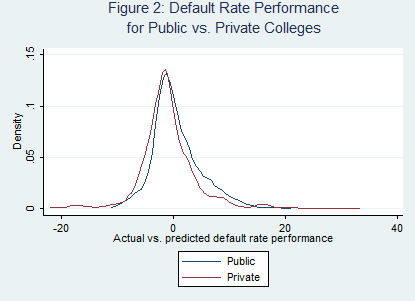
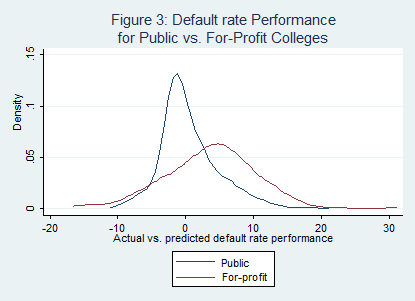
The Education Sector analysis did not break down student default rate performance by important institutional characteristics, such as type of control (public, private not-for-profit, or for-profit) or the cost of attendance. Figures 2 and 3 below the performance between public universities and their private non-profit and for-profit peers:

figure2_jan17figure3_jan17

Note: A positive differential means that default rates are higher than predicted. Negative numbers are good.

The default rate performances of public and private not-for profit colleges do not differ in a meaningful way, but a significant number of for-profit colleges have substantially higher than predicted default rates. This difference is obscured when all colleges’ performances are combined.

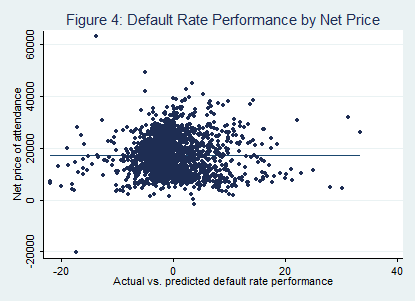
Finally, Figure 4 compares default rate performance by the net price of attendance (the sticker cost of attendance less grant aid) and finds no relationship between the net price and loan default rates:

figure4_jan17

Certainly, more work needs to be done before adopting input-adjusted student loan default rates as an accountability tool. But it does appear that a certain group of colleges tend to have a higher percentage of former students default, which is worth additional investigation.

Is Money from Parents Bad for Students?

Most people would generally consider a student getting money from his or her parents while in college to be a good thing—after all, most traditional-age college students tend to have few resources of their own and additional money from Mom and Dad might help students work fewer hours (generally considered a good thing). But a new paper in the American Sociological Review by Laura Hamilton, an assistant professor of sociology at the University of California-Merced, challenges this assumption. In a paper titled “More Is More or More Is Less? Parental Financial Investments During College” (abstract here), she finds that parental financial assistance increases the likelihood of graduation, but is associated with lower student GPAs.

As a sociologist, Hamilton came to the project with the perspective that more financial resources are a good thing for a student due to the mere availability of resources and social capital. I don’t start from that perspective—and instead look at what students can do with the available funds. But I am also concerned that no-strings-attached gifts from parents might not be a good thing, since they may lack the performance requirements of merit-based financial aid. Additionally, the need for additional funds might reflect the inability of a student from a middle- to upper-income family to secure merit-based aid.

Hamilton uses two old, workhorse datasets in her analysis—the Baccalaureate and Beyond Study (B&B) of students who graduated in 1993 and the Beginning Postsecondary Students Study (BPS) of students who began college in 1990. She uses the B&B to focus on cumulative GPA at graduation as an outcome, which has two main limitations: we don’t know the relationship between parental assistance on dropout or changes in college major which may be associated with GPA. Because of that, she uses the BPS to look at graduation rates. Neither dataset is perfect or free of issues of causality, but it’s not a bad starting point (the datasets have to be appropriate to get into a top-tier journal like ASR).

The positive relationship between parental assistance and graduation rates won’t raise many eyebrows, but her claim that among students who get to graduation, those with higher levels of parental assistance have lower GPAs is more controversial. My biggest concern with the article is that appears that more help from the parents allows some marginal students to stay in school who otherwise would not have appeared in the dataset. If some of the 2.0 GPA students with parental assistance would have dropped out, there may not be differences in the GPAs of students who successfully completed college. Because of this, I have to take the finding on GPAs with a grain of salt.


On another note, this article also can teach scholars quite a bit about how to interact with the media. The mixed conclusion gives the education press and the general public an opportunity to run with a provocative conclusion—parents shouldn’t give their kids money (if they can) because they might just slack off. The headline in today’s Inside Higher Ed piece on the article (“Spoiled Children”) is an example of how research findings can be spun to get more eyeballs. While the media should run more reasonable headlines, it is the responsibility of academics to call out the education press when they play these sorts of games.