
Senator Warren’s Interest Rate Follies

First-term Senator Elizabeth Warren (D-MA) is a darling of the progressive Left, and she has been mentioned as a possible Presidential candidate in 2016 (although she has stated she’s not running). One of the ways she has gained support with the Democratic base is through her many public statements about the federal government’s purported profit on student loans, which she cites to be $51 billion in Fiscal Year 2013. Given the huge profit, she has introduced legislation to drop interest rates to the overnight borrowing rate at the Federal Reserve: 0.75%.

Her argument suffers from one main problem: student loans carry risk for the federal government. (She made my 2013 not-top-ten list for this reason.) The Congressional Budget Office, where the $51 billion estimate came from, uses federal borrowing costs as a discount rate. This discount rate is very low, in part because the federal government is viewed as very unlikely to default (even with the possibility of debt ceiling shenanigans). As a result, numerous groups have suggested the use of fair-value accounting, in which the risk of default is considered. Indeed, the Washington Post’s fact-checking blog gave Senator Warren’s statement of a $51 billion profit “two Pinocchios” because it did not consider fair-value accounting.

[On Twitter, the wonderful Libby Nelson notes that my explanation of fair-value accounting vs. federal regulations is unclear. Here is a nice CBO summary of the different methods.]

With the debate over student loan profits and accounting methods as a backdrop, the release of Friday’s Government Accountability Office report on federal student loans was eagerly anticipated in the higher education community. The title of the report succinctly summarizes the rest of the document: “Borrower Interest Rates Cannot Be Set in Advance to Precisely and Consistently Balance Federal Revenues and Costs.” This resulted in a few howlers from policy analysts, including this gem from Matt Chingos at Brookings:

https://twitter.com/jetpack/status/429271034546499584

Karen Weise at Bloomberg was a little more diplomatic with her summary of the report:

The report itself is fairly dry, but it does emphasize something that should be kept in mind when considering the costs of student loan programs. Due to the growing prevalence of extended payment plans, increased rates of income-based repayment plan usage, and the continued risk of defaults, the actual amount of the subsidy or cost on student loans will not be known for 40 years after disbursement.  Each of these individual variables could also have a large effect on the long-run subsidy or cost; for example, a higher-than-expected rate of income-based repayment participation could increase program costs.

The following paragraph on pages 18 and 19 sums up a key point of the report:

“As of the end of fiscal year 2013, it is estimated that the government will generate about $66 billion in subsidy income from the 2007 to 2012 loan cohorts as a group. However, current estimates for this group of loan cohorts are based predominantly on forecasted cash flow data derived from assumptions about future loan performance. As more information on actual cash flows for these loans becomes available, subsidy cost estimates will change. As a result, it is unclear whether these loan cohorts will ultimately generate subsidy income, as currently estimated, or whether they will result in subsidy costs to the government. This will not be known with certainty until all cash flows have been recorded after loans have been repaid or discharged—which may be as many as 40 years from when the loans were originally disbursed.”

I read this paragraph as providing possible evidence that interest rates may have been set relatively high compared to the federal cost of borrowing. (Recall that the interest rates for subsidized Stafford loans declined from 6.8% in 2007 to 3.4% in 2011, while Treasury rates were at historic lows.) The spread between the 10-year Treasury yield in May versus the interest rate on subsidized Stafford loans has been the following for the past seven years:

Year Stafford (pct) 10-yr T-note (pct) Spread (pct)
2007 6.8 4.75 2.05
2008 6.0 3.88 2.12
2009 5.6 3.29 2.31
2010 4.5 3.42 1.08
2011 3.4 3.17 0.23
2012 3.4 1.80 1.60
2013 3.86 1.93 1.93

This interest rate spread is statutorily set at 2.05% for subsidized Stafford loans in the future, roughly the long-run average. So while future GAO reports a few years after disbursement may find similar results, what we’ll all be waiting for is longer-term data to see if the estimates hold true. The federal government doesn’t necessarily have a great history of long-run cost projections, so I’m expecting this spread to disappear over time. (And keep in mind this report doesn’t fully account for risk.)

Yet Senator Warren and eight other Democrats released a press release on Friday afternoon with the headline of “Democratic Senators Highlight Obscene Government Profits Off Student Loan Program.” They focused entirely on the initial projection of a $66 billion profit over five years and entirely ignored the long-run uncertainty highlighted by the GAO. This press release is a great example of selecting only the most favored parts of a report, while ignoring other important details along the way. Again, the Twittersphere (myself included) expressed its thoughts:

On a more fundamental note, I think that Senator Warren and colleagues are misguided in their efforts to continue lowering student loan interest rates. Given the reality that higher education funding is a zero-sum game, I would much rather see funds used to support the Pell Grant, work-study, and other upfront sources of aid for students than slightly lower loan payments after students have already left college. (The same argument holds against tax credits.) Senator Warren may not be running for President (yet), but she’s in the running for my 2014 not-top-ten list.
The Year of Higher Education Policy in Review

As 2013 draws to a close, it’s time to take a look back at some of the biggest happenings (or non-happenings) of the year. Some of these items would have been on the list for several years, but others (including the top happening of the year) are brand-new for 2013. Enjoy the list!

10. There is still some hope in the academic job market. In spite of continued concerns about the working conditions of adjuncts (as exemplified in the case of former Duquesne adjunct Margaret Mary Vojtko—read both the original op-ed and a thoughtful retelling of her life story), the tenure-track job market may just be springing back to life after a few lean years. I’m thankful to be one of those success stories, as I got a great job offer from Seton Hall University before defending my dissertation at the University of Wisconsin-Madison. (Look at my faculty webpage…I’m bona fide and I love my job!) But, in other disciplines, the rough market continues.

9. We heard more noise about reauthorizing the Higher Education Act, but no action. The HEA, which dates back to 1965, is supposed to be renewed in 2014. And Congress is saying all the right things about renewing the HEA, including holding a series of hearings on reforming the Pell Grant. However, it is hard to find anyone in academia or the policy community who thinks that is likely. After all, No Child Left Behind (the Elementary and Secondary Education Act) expired in 2007. If I had to put money on a reauthorization date, I would go for 2017.

8. The higher ed policy world gets RADDical. During late 2012 and early 2013, 17 organizations and teams released white papers as a part of the Gates Foundation-funded Redesigning Aid Design and Delivery (RADD) project. The recommendations of the groups ranged widely (see this nice summary from the National Association of Student Financial Aid Administrators, one of the participating organizations), but all groups suggested substantial changes from the status quo. It’s worth noting that the recommendation shared across the largest number of reports is stabilizing or increasing Pell funding, which could be a tough political lift in the current fiscal environment. This effort was not without its skeptics, as this well-commented Chronicle piece on the influence of Gates funds details.

7. The FAFSA changes to recognize same-sex parents, but is still complicated. Despite the push among many of the RADD grantees and at least some interest in Congress, the FAFSA ends 2013 as perhaps being more complicated than it was at the beginning of the year. This is because the venerable form changed to recognize the existence of same-sex marriages after this year’s Supreme Court ruling and political pressure before the ruling took place. The net result is that some students will see less aid. I would also be remiss if I didn’t mention my work with NASFAA on the feasibility of using prior prior year financial data to determine aid eligibility. That might get tied into the next HEA authorization.

6. Congress reached a reasonable solution on student loan interest rates. Put your shocked face on, folks—Congress did accomplish something without causing too much pain to students or financial aid offices. Interest rates on undergraduate subsidized Stafford loans were set to increase from 3.4% to 6.8% on July 1 (and actually did for a few weeks), leading to the hashtag #DontDoubleMyRate. The rates ended up being tied to 10-year Treasury notes, yielding a rate of under 4% this year; however, advocates note that the rate is likely to rise over time. Thankfully, Senator Warren’s plan to set interest rates based on the Federal Reserve discount window (which is nearly riskless) never received serious discussion.

5. MOOCs expand, but their outcomes are questioned. Massive open online courses (MOOCs) are seen by some as having the potential to change how higher education is delivered, but it is safe to say that not all faculty support them—as evidenced at San Jose State. MOOCs have also been hammered for low completion rates, which are often below 10%. The always-astute Kevin Carey notes, however, that the low completion rates are partially due to people who sign up for the course but never really attempt to complete them. Additionally, large numbers of students may still be completing the course, even if completion rates are low. This issue will only get hotter during 2014.

4. Student loan debt grows amid possible reforms. The Institute for College Access and Success (TICAS) recently put out its annual report on student debt loads—and the results aren’t pretty. The average debt load of graduates was $29,400 in 2012, and 71% of students took out debt. (Even more concerning is the fact that TICAS can’t even get data on a lot of colleges’ graduates.) Increasing debt loads have led to innovative plans to make college more affordable. The most-discussed plan is Oregon’s Pay it Forward proposal, which would be a type of income-based repayment covering tuition and fees in that state. While I have serious concerns about whether the program could work (but think it’s worth a demonstration program), my dear friend and dissertation mentor Sara Goldrick-Rab makes her opposition clear.

3. One of the nation’s more prominent community colleges might actually lose its accreditation. The City College of San Francisco is currently slated to lose its accreditation next summer if they do not meet 357 goals set by the Accrediting Commission for Junior and Community Colleges. Since students cannot qualify for federal Title IV financial aid if they attend an unaccredited college, this would effectively shut down an institution that had nearly 100,000 students. Students and faculty went after the accreditor and nearly shut it down, although it was recently announced that the accreditor could operate for another year. I still think that CCSF will keep its accreditation, but the damage (in terms of enrollment) may already be done.

2. Gainful employment continues to be a hot political topic. The Obama Administration proposed gainful employment regulations several years ago, in which vocationally-oriented colleges would lose Title IV eligibility if they had poor employment and loan repayment outcomes. These rules have been in and out of court for several years, and a new set is now being developed. The Department of Education tried to reach consensus with stakeholders last week, but failed; this means that ED will write its own rules. For all the developments that will happen in 2014, I’ll defer you to Ben Miller’s great work covering the topic.

1. PIRS roars to the public’s attention, and colleges are not happy. As regular readers of this blog know, I’m the methodologist for Washington Monthly’s annual college rankings. Yet I was completely floored when President Obama announced the impending development of a college ratings system for the 2014-15 academic year. (The official title—Postsecondary Institution Rating System or PIRS—just got released yesterday.) Thankfully, I was able to recover quickly enough to go on MSNBC the next night to talk about the proposal.

The Department of Education has done a lot of listening on the college ratings proposal, and the vast majority of the feedback in the higher education community appears to be negative. A recently released poll of college presidents highlights the opposition amid concerns of the ratings favoring highly selective institutions. (Yet the only measure that a majority of college presidents supported using was graduation rates—a measure strongly tied to selectivity.) This recent conference panel also shows some of the issues facing the ratings.

While the long-term goal is to tie ratings to financial aid by 2018 or so, I don’t see this as being likely to happen given its requirement of Congressional approval. However, the ratings could potentially help students even if institutions don’t like the bright lights of accountability. Let’s just say that the discussion around the release of the first ratings this summer should be spicy.

I’ll post a not-top-ten list of higher education policy issues later this week. Send me your suggestions for that piece, and let me know what you think of this list!

Two and a Half Cheers for Prior Prior Year!

Earlier this week, the National Association of Student Financial Aid Administrators (NASFAA) released a report I wrote with Gigi Jones of NASFAA on the potential to use prior prior year income data (PPY) in determining students’ financial aid awards. Compared to the current policy of prior year (PY) data, students could file the FAFSA up to a year earlier than under current law. (See this previous post for a more detailed summary of PPY.)

Although the use of PPY could advance the timeline for financial aid notification, this could also have the effect of changing some students’ aid packages. For example, if a dependent student’s family had a large decrease in family income the year before entering college, the financial aid award would be more generous under PY. Other students’ aid packages would be more generous under PPY. Although we might expect that the number of aid increases and decreases from a move to PPY would balance each other out, the existence of professional judgments (in which financial aid officers can adjust students’ aid packages based on unusual circumstances) complicates that analysis. As a result, it’s possible that PPY could increase program costs in addition to the burden faced by financial aid offices.

To examine the feasibility and potential distributional effects of PPY, we received student-level FAFSA data from nine colleges and universities from the 2007-08 through the 2012-13 academic years. We then estimated the expected family contribution (EFC) for students using PY and PPY data to see how much Pell Grant awards would vary by the year of financial data used. (This exercise also gave me a much greater appreciation for how complicated it truly is to calculate the EFC…and how much data is currently needed in the FAFSA!)

The primary result of the study is that about two-thirds of students would see the exact same Pell award using PPY as they would using PY. These students tend to fall into two groups—students who would never be eligible for the Pell (and are largely filing the FAFSA to be eligible for federal student loans) and those with zero EFC. Students near the Pell eligibility threshold are the bigger concern, as about one in seven students would see a change in their Pell award of at least $1,000 under PPY compared to PY. However, many of these students would never know their PY eligibility, somewhat reducing concerns about the fairness of the change.

To me, the benefits of PPY are pretty clear. So why two and a half cheers? I have three reasons to knock half a cheer off my assessment of a program that is still quite promising:

(1) We don’t know much about the burden of PPY on financial aid offices. When I’ve presented earlier versions of this work to financial aid administrators, they generally think that the additional burden of professional judgments (students appealing their aid awards due to extenuating circumstances) won’t be too bad. I hope they’re right, but it is worth a note of caution going forward.

(2) If students request professional judgments and are successful in getting a larger Pell award, program costs will increase. Roughly 5-7% of students would see their Pell fall by $1,000 or more under PPY. If about 2% of the Pell population is successful (200,000 students), program costs could rise by something like $300-$500 million per year. Compared to a $34 billion program budget, that’s noticeable, but not enormous.

(3) A perfectly implemented PPY program would let students know their eligibility for certain types of financial aid a year earlier than current rules, so as early as the spring of a traditional-age student’s junior year of high school. While that is an improvement, it may still not be early enough to sufficiently influence students’ academic and financial preparation for college. Early commitment and college promise programs reach students at earlier ages, and thus have more potential to be successful.

Even after noting these caveats, I would like to see PPY get a shot at a demonstration program in the next few years. If it can help at least some students at a reasonable cost, let’s give it a try and see if it does induce students to enroll and persist in college.

Free the Pell Graduation Data!

Today is an exciting data in my little corner of academia, as the end of the partial government shutdown means that federal education datasets are once again available for researchers to use. But the most exciting data to come out today is from Bob Morse, rankings guru for U.S. News and World Report. He has collected graduation rates for Pell Grant recipients, long an unknown for the majority of colleges. Despite the nearly $35 billion per year we spend on the Pell program, we have no idea what the national graduation rate is for Pell recipients. (Richard Vedder, economist of higher education at Ohio University, has mentioned a ballpark estimate of 30%-40% in many public appearances, but he notes that is just a guess.)

Morse notes in his blog post that colleges have been required to collect and disclose graduation rates for Pell recipients since the 2009 renewal of the Higher Education Act. I’ve heard rumors of this for years, but these data have not yet made their way into IPEDS. I have absolutely no problems with him using the data he collects in the proprietary U.S. News rankings, nor do I object to him holding the data very tight—after all, U.S. News did spend time and money collecting it.

However, given that the federal government requires that Pell graduation rates be collected, the Department of Education should collect this data and make it freely and publicly available as soon as possible. This would also be a good place for foundations to step in and help collect this data in the meantime, as it is certainly a potential metric for the President’s proposed college ratings.

Update: An earlier version of this post stated that the Pell graduation data are a part of the Common Data Set. Bob Morse tweeted me to note that they are not a part of that set and are collected by U.S. News. My apologies for the initial error! He also agreed that NCES should collect the data, which only understates the importance of this collection.

State Need and Merit Aid Spending

I’m fortunate to be teaching a class in higher education finance this semester, as it’s a class that I greatly enjoy and is also intertwined with my research interests. I’m working on slides for a lecture on grant aid (both need-based and merit-based) in the next few weeks, which involves creating graphics about trends in aid. In this post, I’m sharing two of my graphics about state-level financial aid.

States have taken different philosophies regarding financial aid. Some states, particularly in the South, have focused more of their resources on merit-based aid, rewarding students with strong pre-college levels of academic achievement. Other states have put their resources into need-based aid, such as Wisconsin and New Jersey. Yet others have chosen to keep the cost of college low instead of providing aid to students.

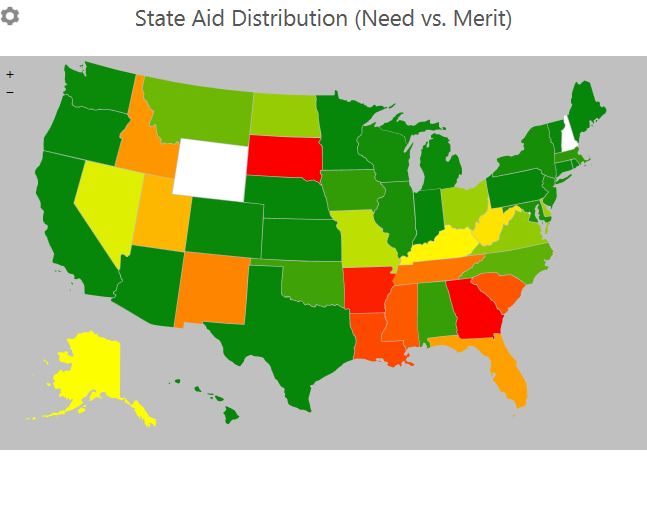
The two charts below demonstrate the states’ differences in philosophies. The state-level data come from the National Association of State Student Aid & Grant Programs (NASSGAP) from the 2011-12 academic year. The first chart shows the percentage of funds given to need-based aid (green) and merit-based aid:

state_aid_distribution

Two states currently have no need-based aid (Georgia and South Dakota), and six other states allocate 75% or more of state aid to merit-based programs. On the other hand, nine states only have need-based aid programs and 16 more allocate 90% or more to need-based aid. Two states (New Hampshire and Wyoming) did not report having student aid programs in 2011-12.

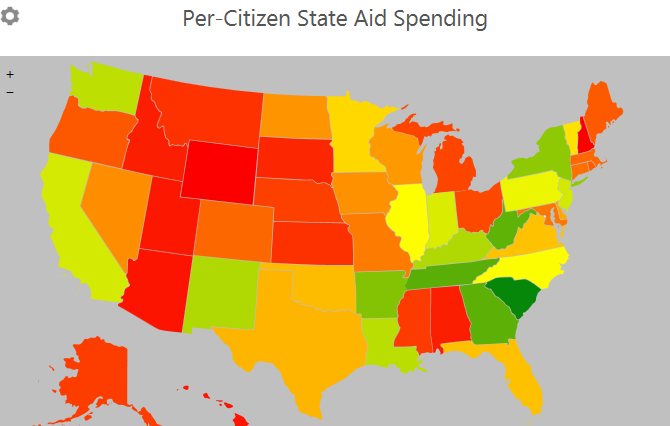
The second chart measures the intensity of spending on state-level student aid. I divide overall spending by the state’s population in 2012, as estimated by the Census Bureau. States with more spending on aid per student are in green, while lower-spending states are in red:

state_aid_spending

South Carolina leads the way in state student aid, with nearly $69 per resident; four other Southern states provide $50 or more per resident. The other extreme sees 15 states spending less than $10 per person on aid.

Notably, states with more of an emphasis on merit aid spend more on per-resident aid. The correlation between the percentage of funds allocated to need-based aid and per-resident spending is -0.33, suggesting that merit-based programs (regardless of their effectiveness) are more capable of generating resources for students.

I’m looking forward to using these graphics (and several others) in my class on grant aid, as the class has been so much fun this semester. I hope my students feel the same way!

Policy Options for Pell Reform: The CBO’s Analysis

The federal Pell Grant program has grown dramatically over the past decade, due to both the effects of the Great Recession and changes to the program that made it more generous to students from low- to middle-income families. As spending has more than doubled since 2006 (although it slightly fell in the most recent year for which data is available), some in Congress have grown concerned about the sustainability of the program. This led Senator Jeff Sessions (R-AL), ranking member of the Senate Budget Committee, to request a review of Pell spending and information about the likely costs of various reform options going forward.

The Congressional Budget Office, the nonpartisan agency charged with “scoring” fiscal proposals, released a report yesterday summarizing the estimated fiscal effects of a host of changes to the Pell program. (Inside Higher Ed has a nice summary of the report.) While the goal of the requesting Senator may have been to find ways to lower spending on the program by better targeting awards, the CBO also looked at proposals to make the Pell program more generous and to simplify Pell eligibility.

While I’m glad that the CBO looked at the fiscal effects of various changes to restrict or expand eligibility, I think that Congress will make those decisions on a year-to-year basis (pending the availability of funds) instead of thinking forward over a ten-year window. However, it is notable that the proposal to restrict Pell Grants to students with an expected family contribution of zero—by far the students with the greatest need—would only cut expenditures by $10 billion per year, or just over one-fourth of the program cost. I am more interested in the CBO’s cost estimates for simplifying eligibility criteria. They propose two possible reforms, which are discussed in more detail on pages 24 and 25 of the report.

Proposal 1: Simplify the FAFSA by only requiring students and their families to provide income data from tax returns instead of pulling in asset and income data from other sources. This would slightly affect targeting, as some resources would be unknown to the government, but research has shown that basic income data predicts Pell awards well for most students. The CBO estimates that about two percent more students would receive the Pell Grant and that about one in five students would see an increase of approximately $350. This is estimated to increase program costs by $1 billion per year, or less than 3% of the annual program cost.

Proposal 2: Tie Pell eligibility to federal poverty guidelines instead of EFCs. I am quite interested in this idea, as it would greatly streamline the financial aid eligibility process—but I’m not sure whether I think it is the best idea out there. Basically, the federal poverty guidelines are calculated based on income, household size, and state of residency, and could be used to calculate Pell eligibility. This is indirectly done right now through means-tested benefit programs; for example, eligibility for the free/reduced price lunch program is based on the poverty line (130% for free, 185% for reduced). Since students who have a family member receiving FRL can qualify for a simpler FAFSA already, this may not be such a leap. The CBO estimates that about one in ten students would have their Pell status affected by their model option and that costs would fall by $1.4 billion per year, but the percent of poverty used (up to 250%) would likely be changed in the legislative process.

In the alternatives section of the report (page 26), the CBO discusses committing Pell funds to students in middle and high school—noting that such a program could increase academic and financial preparation for postsecondary. This sounds very similar to a paper that Sara Goldrick-Rab and I wrote on a possible early commitment Pell program (a citation would have been nice!), but they don’t provide any estimates of the costs of that program. We estimate in our paper that the program will cost about $1.5 billion per year, with the federal government likely to at least break even in the long run via increased tax payments (something not discussed in any of the policy options in the brief).

I’m glad to see this report on possible options to Pell reform and I hope that they will continue to get requests to score and examine innovative ideas to improve and reform the delivery of financial aid.

Financial Aid as a Paycheck?

President Obama is set to make a series of speeches this week addressing college affordability—a hot topic on college campuses as new students move into their dorm rooms. An article in this morning’s New York Times provides some highlights of the plan. While there are other interesting proposals, most notably tying funding to some measure of college success, I’m focusing this brief post on the idea to disburse Pell Grants throughout the semester—“aid like a paycheck.”

The goal of “aid like a paycheck” is to spread grant aid disbursals out through the semester so students take ownership of their education. Sounds great, right? The problem is that it’s only been tested at a small number of community colleges in low-tuition states, such as California. If a student has more financial aid than the cost of attendance, then there is “extra” aid to disburse. But this doesn’t apply to the vast majority of students, particularly those at four-year schools. Spreading out aid awards for students with unmet need creates an even bigger financial gap at the beginning of the semester.

In order for “aid like a paycheck” to work for the vast majority of students, we have to make other costs look like a monthly bill. If students still have to pay for tuition, books, and housing upfront (or face a hefty interest rate), this program will create a yawning financial gap. If colleges want to be accountable to students, perhaps they should bill students per month for their courses—that way, dropped courses hurt the institution’s bottom line more than the student’s. This would delay funds coming in to a college, which can result in a loss of interest given the large amounts of tuition revenue.

Before we try “aid like a paycheck” on a large scale, Mr. President, let’s try making colleges get their funds from students in that same way. And let’s also get some research on how it works for students whose financial need isn’t fully met by the Pell Grant. The feds have the power to try demonstration programs, and this would be worth a shot.

Simplifying the FAFSA–How Far Can We Go?

It is painfully obvious to students, their families, and financial aid administrators alike that the current system of determining federal financial aid eligibility is incredibly complex and time-consuming. Although there should be broad support for changes to the financial aid system, any progress has been halting at best. I have devoted much of my time to researching and discussing potential changes to the financial aid system. Below is some of my work, going from relatively minor to major changes.

I’ve been working on an ongoing study with the National Association of Student Financial Aid Administrators examining the extent to which students’ financial aid packages would change if income data from one year earlier (the “prior-prior year”) than is currently used were to be used in the FAFSA calculations. Although a full report from this study won’t be out until sometime next month, here is a nice summary of the work from the Chronicle of Higher Education. The key point from this work is that, since family resources don’t change that much for students with the greatest financial need, students could file their FAFSA several months earlier using income data from the prior-prior year without a substantial change in aid targeting.

Under a prior-prior year system, students would still have to file the FAFSA each year. Given the fact that many students don’t see that much income volatility, there is a case to be made that students should only have to file the FAFSA once—at the beginning of college—unless their family or financial circumstances change by a considerable margin. In a piece hot off the virtual presses at the Chronicle, Sara Goldrick-Rab and I discuss why it would be better for many students to only have to file the FAFSA once.  I would like to know more about the costs and benefits of such a program (weighing the benefits of reduced complexity and administrative compliance costs versus the likelihood of higher aid spending), but the net fiscal cost is likely to be small or even positive.

So let’s take this one step further. Do we even need to have all students file the FAFSA? Sara and I have looked at the possibility of automatically granting students the maximum Pell Grant if anyone in their family qualifies for means-tested benefits (primarily free and reduced price lunches). We detail the results of our fiscal analysis and simulation in an Institute for Research on Poverty working paper, where we find that such a program is likely to remain reasonably well targeted and pass a cost-benefit test in the long run.

There is a broad menu of options available to simplify the FAFSA, from giving students more time to complete the form to getting rid of it altogether. Let’s talk more about these options (plus many more) and actually get something done that can help all stakeholders in the higher education arena.

Does This Explain Opposition to Market-Based Interest Rates?

As of this writing, it appears that the U.S. Senate has finally reached an agreement on student loan interest rates after subsidized Stafford rates doubled from 3.4% to 6.8% on July 1. The general terms of the agreement are similar to what President Obama proposed in his FY 2014 budget and what the House of Representatives agreed to back in June, with some compromises on each side.

The big difference between current law and the Senate agreement is that interest rates for nearly all student loans will be tied to the 10-year Treasury rate, which currently sits at about 2.5%.  (Undergraduates would pay a 2.05% premium above the Treasury rate on Stafford loans to account for program costs and the risk of offering the loans.) However, the Treasury rate is expected to increase to 5.6% by 2016, pushing the interest rate for undergraduates to 7.65% from less than 5%. The plan includes a cap at 8.25%, which may be reached according to the CBO report.

The Senate agreement is not without its critics, particularly on the political Left. Senator Bernie Sanders, a Vermont independent and a self-described “socialist,” criticized the plan as “dangerous” in an article in The Hill. His criticism lies in the fact that interest rates can rise well above the current 6.8% over time, a very real concern given the interest rate projections. While the plan is expected to pass the Senate (and the House), some other Senate Democrats will likely vote no as well.

At this point in the great interest rate debate, I have to wonder if there is another reason some politicians oppose market-based interest rates. Tying student loan interest rates to the 10-year Treasury note directly connects students’ future payments to the cost of federal borrowing. And that cost of federal borrowing is influenced by the federal government’s fiscal policy.

This connection between federal borrowing and student loan rates could potentially have the following repercussions. If loans are tied to Treasury notes—and there is no way to fix the rate as has been done for the past seven years—students should have an incentive to push for federal policies which lower the federal government’s cost of borrowing. (With the decline in home ownership rates among younger adults, fewer 20- and 30-somethings have mortgages, which are affected by federal borrowing costs.)

The policy that best reduces the cost of borrowing is a balanced budget, which reduces the need for additional borrowing. The passage of the Omnibus Budget Reconciliation Act of 1993, which reduced the budget deficit through a combination of tax hikes and spending cuts, had the effect of driving down long-term interest rates. (For more on this, I highly recommend reading Bob Woodward’s Maestro about Alan Greenspan’s role in the policy discussions.)

My question to readers is whether you think that some politicians may oppose market-based interest rates because more young adults may place pressure on Congress to find some legislative solution to balance the budget—although the solutions certainly vary by political persuasion. Say it’s 2016 and undergraduate Stafford rates are 7.5%, with hitting the 8.25% cap becoming more likely. Could we see student advocacy organizations pushing for a balanced budget to bring down interest rates? I don’t know how many people will think this way, but it’s something to consider.