Clinton and Trump Proposals on Student Debt Explained

This article was originally published on The Conversation. Read the original article.

The high price of attending college has been among the key issues concerning voters in the 2016 presidential election. Both Democratic nominee Hillary Clinton and Republican nominee Donald Trump have called the nearly US$1.3 trillion in student debt a “crisis.” During the third presidential debate on Oct. 19, Democratic nominee Hillary Clinton raised the issue all over again when she said,

“I want to make college debt-free. For families making less than $125,000, you will not get a tuition bill from a public college or a university if the plan that I worked on with Bernie Sanders is enacted.”

Republican nominee Donald Trump has also expressed concerns about college affordability. In a recent campaign speech in Columbus, Ohio, Trump provided a broad framework of his plan for higher education should he be elected president.

In a six-minute segment devoted solely to higher education, Trump proceeded to call student debt a “crisis” – matching Clinton’s language. He also called for colleges to curb rising administrative costs, spend their endowments on making college more affordable and protect students’ academic freedom.

The highlight of Trump’s speech was his proposal to create an income-based repayment system for federal student loans. Under his proposal, students would pay back 12.5 percent of their income for 15 years after leaving college. This is more generous than the typical income-based plan available today (which requires paying 10 percent of income for 20 to 25 years). The remaining balance of the loan is forgiven after that period, although this amount is subject to income taxes.

As a researcher of higher education finance, I question whether these proposals on student debt will benefit a significant number of the over 10 million college-going voters struggling to repay loans.

How student loan interest rates work

Typically, students pay interest rates set by Congress and the president on their federal student loans.

Over the last decade, interest rates for undergraduate students have fluctuated between 3.4 percent and 6.8 percent. Rates for federal PLUS loans have ranged from 6.3 percent to 8.5 percent. Federal PLUS loans require a credit check and are often cosigned by a parent or spouse. Federal student loans do not have those requirements.

While students pay this high a rate of interest, rates on 15-year mortgages are currently below three percent.

It is also important to note the role of private loan companies that have recently entered this market. In the last several years, private companies such as CommonBond, Earnest and SoFi as well as traditional banks have offered to refinance select students’ loans at interest rates that range from two percent to eight percent based on a student’s earnings and their credit history.

However, unlike federal loans (which are available to nearly everyone attending colleges participating in the federal financial aid programs), private companies limit refinancing to students who have already graduated from college, have a job and earn a high income relative to the monthly loan payments.

Analysts have estimated that $150 billion of the federal government’s $1.25 trillion student loan portfolio – or more than 10 percent of all loan dollars – is likely eligible for refinancing through the private market.

Many Democrats, such as Senator Elizabeth Warren of Massachusetts, have pushed for years, for all students to receive lower interest rates on their federal loans. In the past Republican nominee Donald Trump too has questioned why the federal government profits on student loans – although whether the government actually profits is less clear.

Issues with refinancing of loans

The truth is that students with the most debt are typically college graduates and are the least likely to struggle to repay their loans. In addition, they can often refinance through the private market at rates comparable to what the federal government would offer.

Struggling borrowers, on the other hand, already have a range of income-driven repayment options through the federal government that can help them manage their loans. Some of their loans could also be forgiven after 10 to 25 years of payments.

Furthermore, the majority of the growth in federal student loans is now in income-driven plans, making refinancing far less beneficial than it would have been 10 years ago. Under income-driven plans, monthly payments are not tied to interest rates.

So, on the face of it, as Clinton has proposed, allowing students to refinance federal loans would appear to be beneficial. But, in reality, because of the growth of private refinancing for higher-income students and the availability of income-driven plans for lower-income students, relatively few students would likely benefit.

Focus needed on most in need students

In my view, Clinton’s idea of allowing students to refinance their loans at lower rates through the federal government is unlikely to benefit that many students. However, streamlining income-based repayment programs (supported by both candidates) has the potential to help struggling students get help in managing their loans.

Nearly 60 percent of students who were enrolled in income-driven repayment plans fail to file the annual paperwork. That paperwork is necessary if students are to stay in those programs. And failure to do so results in many students facing higher monthly payments.

At this stage, we know many details of Clinton’s college plan. Her debt-free public college proposal (if enacted) would benefit families in financial need, but her loan refinancing proposal would primarily benefit more affluent individuals with higher levels of student debt.

In order to access Trump’s plan we need more details. For example, the current income-based repayment system exempts income below 150 percent of the poverty line (about $18,000 for a single borrower) and allows students working in public service fields to get complete forgiveness after ten years of payments. The extent to which Trump’s plan helps struggling borrowers depends on these important details.

The Conversation

The Relationship Between Student Debt and Earnings

Note: This piece first appeared on the Brookings Institution’s Brown Center Chalkboard blog.

Student loan debt in the United States is now over $1.25 trillion, nearly three times as much as just a decade ago. The typical student graduating with a bachelor’s degree with debt (about 70 percent of all students) now owes between $30,000 and $40,000 for their education, about twice as much as a decade ago. Although taking on modest amounts of debt in order to pay for college is generally a good bet in the long run, colleges with similar admissions standards and resource levels leave students with different amounts of debt.

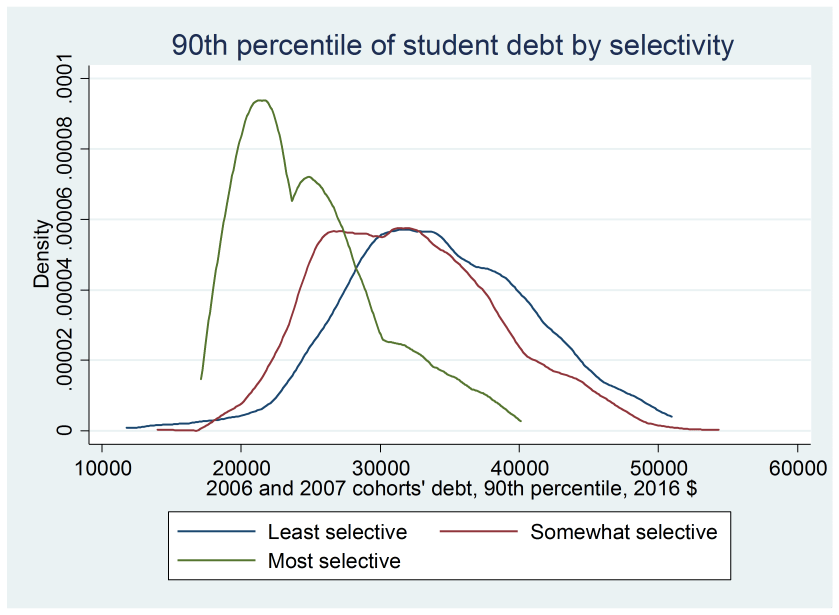
College Scorecard data highlight the large amount of variation in what high-debt undergraduate students borrow across colleges with similar admissions criteria.1 The figure below shows the distribution of the 90th percentiles of debt burdens (in 2016 dollars) for students who left 1,156 four-year public and private nonprofit colleges in 2006 or 2007, broken down into three selectivity categories.2 Not surprisingly, the most selective colleges, which have the resources to offer more scholarships and fewer students with financial need, have lower debt burdens than somewhat selective or less selective colleges. These differences in borrowing by selectivity are larger than by type of college, as median debt at public colleges was only about $2,400 more than at private nonprofit colleges.

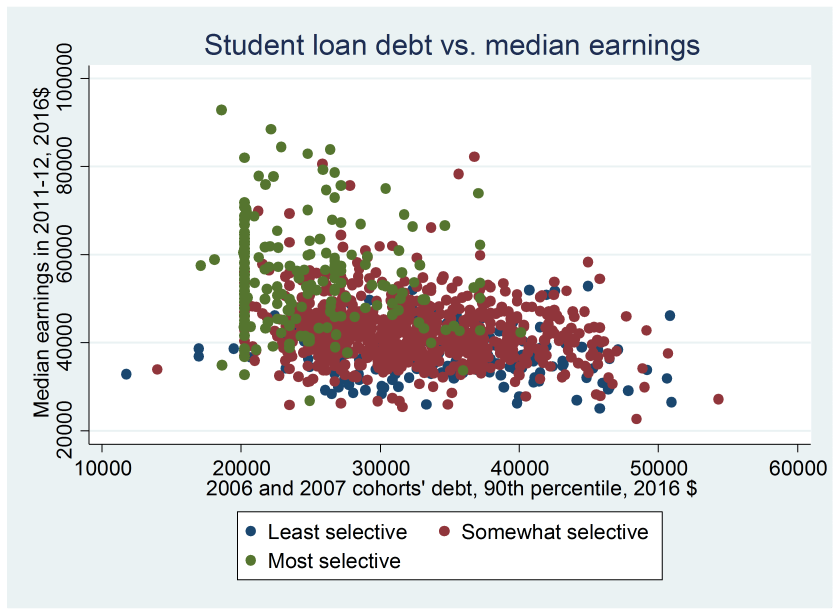
brookings_fig1_sep16Attending college and taking on $40,000 or even $50,000 in debt can be an outstanding investment in a student’s future—but only if students from that college actually end up getting good jobs. I then examined the relationship between 90th percentile debt burdens upon leaving college in 2006 and 2007 and the median earnings of students in 2011 and 2012 who began college in 2001 and 2002.3 The figure below shows that colleges that tend to have higher amounts of student debt also tend to have lower earnings in later years, which is in part due to student characteristics and their prior family income rather than the causal impact of the college. The correlation coefficient between debt and earnings is about -0.35 overall, but between -0.10 and -0.20 within each selectivity group. This suggests that colleges with higher debt burdens also have higher earnings, but much of the relationship between debt and earnings can be explained by selectivity.

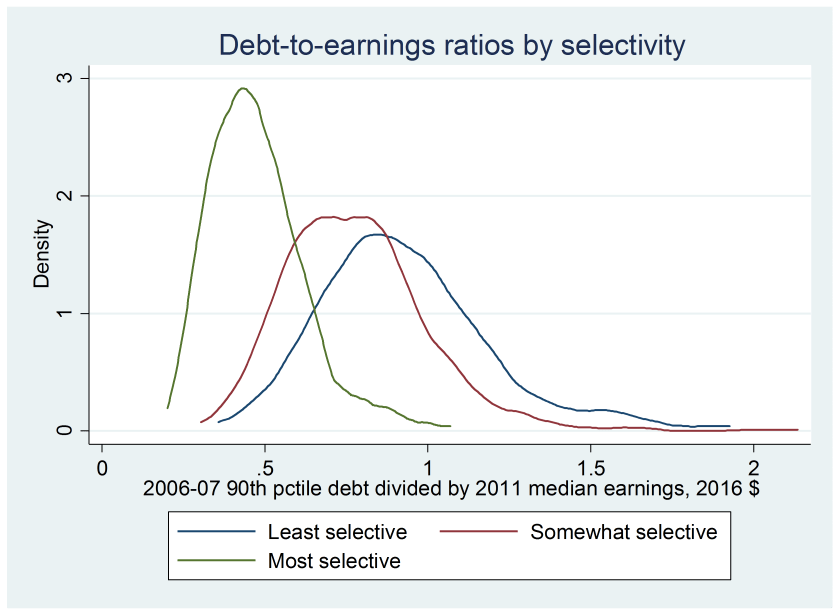
brookings_fig2_sep16An old rule of thumb in paying for college is that students should not borrow more for a bachelor’s degree than they expect to earn one year after graduation. Although the presence of income-driven repayment programs allows students to repay their federal student loans even if they make less money, the debt-to-income ratio is still a useful way to judge colleges. The final figure shows the distribution of colleges’ debt-to-income ratios using the initial debt upon leaving college for high-debt students and annual earnings approximately five years later. A ratio over 1 at this point is a major concern, as earnings should grow considerably during a student’s first few years after college.

brookings_fig3_sep16Few high-debt students at the most selective colleges likely have issues making enough money to repay their loans, as just one of the 191 colleges in this category had a debt-to-earnings ratio above 1. Just under 15 percent of the somewhat selective colleges had ratios above 1, while about one-third of the least selective colleges had ratios above 1. This reflects the fact that financially-struggling students who attend less selective colleges (roughly 13% of the undergraduates in my sample, or about 800,000 students) take on more debt and earn less money than high-debt students at highly-selective colleges.

With student debt being a growing concern among Americans and playing a key role in the presidential campaign, students and their families are wise to consider the likely return on their investment in higher education. As the data show, some colleges do leave their former students with less debt than other similar colleges. But among less-selective colleges that enroll large numbers of lower-income or minority students, some amount of debt is almost unavoidable. Students should not seek to avoid all debt, but they should be mindful that even among broad-access institutions, colleges vary in how much debt their students take on.

———————————————————-

1 Debt and earnings data from the College Scorecard combine students who graduate with those who dropped out.

2 Colleges in the Barron’s categories of special, noncompetitive, and less competitive are in my lowest selectivity tier (n=195), colleges in the competitive, competitive-plus, and very competitive categories are in the middle tier (n=770), and all others are in the highest tier (n=191).

3 The College Scorecard does not track debt burdens by when students started college (only when they left), so I estimated that students either graduated or left college in about five years.

Students Shouldn’t Be Terrified of Borrowing for College

I wrote the below letter to the editor of the Star-Ledger, New Jersey’s largest newspaper, in response to a truly woeful editorial piece that they recently published on student loan debt. (Note: They eventually ran the letter, but here is a slightly revised version for your enjoyment.)

—————————————————————————

As a college professor who researches the implications of student loan debt, I was dismayed to read the Star-Ledger Editorial Board’s recent piece titled “Why we should all be terrified of student loans.” Yes, the $1.25 trillion in outstanding student loan debt is a concern, but the typical amount borrowed for a bachelor’s degree is more manageable—about $30,000 per student. Students who borrow from the federal government can also enroll in income-driven repayment programs that allow them to make small or no payments if their income is low.

The “terrified” headline has the potential to scare students and their families away from making a worthwhile investment in college. Research shows that low-income, first-generation, and minority students are particularly averse to borrowing for college, even when borrowing a reasonable amount of money would help them attend and graduate college. Students and their families should be careful about taking on too much debt, particularly from programs like New Jersey’s state student loan system that do not allow payments to be tied to the student’s income. But students should not be terrified of taking out modest loans from the federal government to make college a reality.

Income-Driven Repayment Plans Continue to Grow

The traditional way to repay federal student loans was for students to pay back their loans over a ten-year period of time, generally by making the same payment each month. But as student loan debt has generally risen over time (although falling ever so slightly in the most recent quarter), paying off larger loans in a short period of time has become more difficult for many borrowers. This has made income-driven repayment plans, expanded during both the Bush and Obama Administrations, an appealing option for more students (although the future price tag of the programs is something to watch closely in the future).

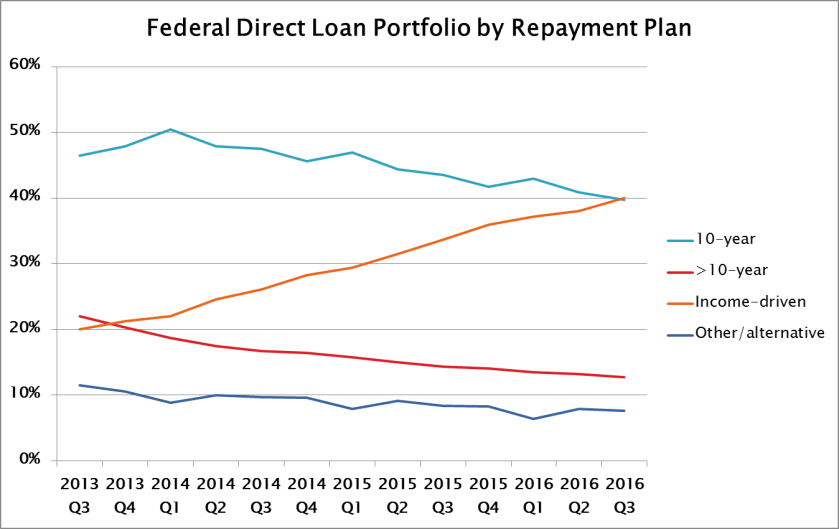
The U.S. Department of Education recently released new data (updated every three months) on the federal student loan portfolio showing the growth in income-driven plans. The chart below shows the percentage of dollars in the Direct Loan program that are in one of four broad categories: 10-year payment plans not tied to income, longer payment plans not tied to income, income-driven plans, and miscellaneous plans that don’t fit well in any of the above three categories.1

repay_aug16

Since 2013 (when repayment plan data first became available), the federal government’s holdings in the Direct Loan program have risen from $361 billion to $673 billion. The amount of loans in the standard ten-year repayment plan rose from $168 billion to $267 billion during this time, but the amount in income-driven plans rose from $72 billion to $269 billion in just three years. Income-driven plans now make up 40.0% of all Direct Loan dollars, while 39.7% of dollars are now in ten-year plans.

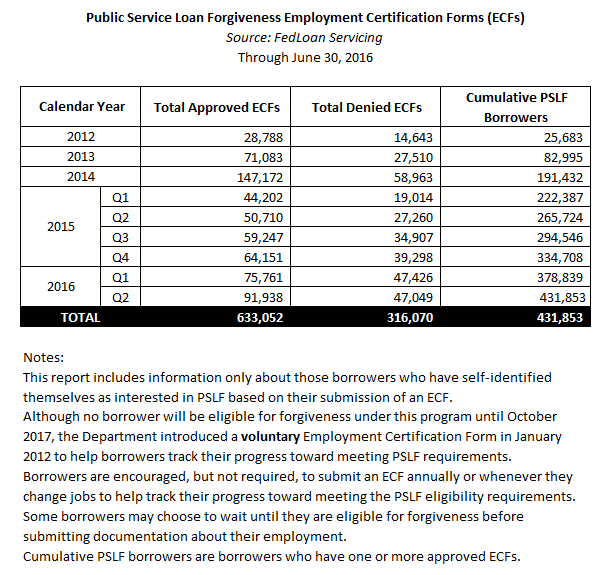
The Department of Education also released data for the first time on the number of students seeking employment certification in the Public Service Loan Forgiveness (PSLF) program, which will allow students working in approved fields to make ten years of payments instead of 20-25 years under other income-driven plans. While students aren’t officially in PSLF until they complete ten years of payments (the first students will do so in October 2017), this is an interesting measure of potential interest in PSLF. The below figure (from Federal Student Aid) shows the number of students who have submitted employment certification forms in possible preparation for receiving PSLF.

ecf_aug16

Notably, about one-third of all requests have been denied to this date, suggesting that quite a few students will get an unpleasant surprise when they go apply for PSLF in the next few years. But at least 430,000 students look to be on track for PSLF at this point—a number that is likely a significant understatement of the number of applications that the federal government will receive.


1 The Direct Loan program represents about 90% of all loans held by the federal government. The other 10% are in the older Federal Family Education Loan (FFEL) program, which has not disbursed new loans in years but has about one-third of its loan dollars in income-based plans. I excluded FFEL here because repayment plan data are only available for 2016.

On Student Loan Debt and Negative Wealth

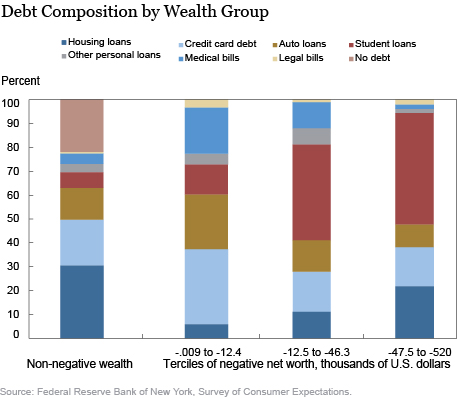
A recent analysis by economists at the Federal Reserve Bank of New York looked at the approximately 14% of American households that had negative wealth in 2015 and pointed out student loan debt as a key driver of negative wealth. As a key figure from the report (which is reprinted below) shows, student loan debt is responsible for between 40% and 50% of total negative wealth among households with a net worth of below -$12,500.

nyfed

This isn’t a tremendously surprising finding, although it’s always helpful to document something intuitive with actual data (although self-reported data always come with caveats). Student loans are one of the few types of debt aside from medical or legal bills that can be taken on in large amounts without having outstanding credit or collateral. Credit card debt is another way to take on debt, but most people with negative wealth won’t be able to access large lines of credit this way. It’s also possible to be underwater on a house (by owing more than its current value), but this affects a relatively small percentage of households.

The authors of the analysis then wrote the following about the implications of student loan debt:

“It is likely that the steady growth in student debt and borrowing, combined with the very slow rate of student loan repayment we have documented elsewhere, has materially contributed and will continue to contribute to negative household wealth and wealth inequality.”

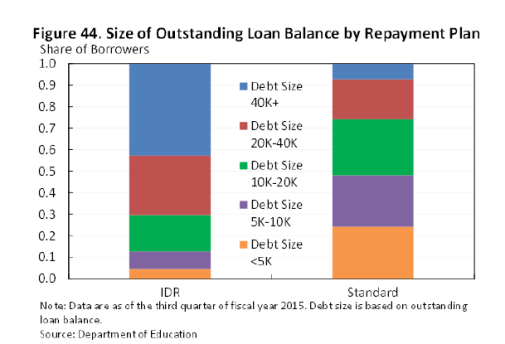
As I told Inside Higher Ed in their summary of the analysis, I only partially agree with that assessment. The challenge with this analysis is that it combines students who completed and did not complete a degree (likely due to sample size issues, as the dataset includes questions about educational attainment). As the authors note, households with a bachelor’s degree or higher and negative net worth tend to have a young head of household. For example, my household is just now leaving negative net worth territory, five years after our head of household completed law school.1 Paying off student loan debt is difficult, but the rapid growth in takeup of income-driven repayment plans among high-debt individuals (as shown in this recent White House report and in the chart below) has the potential to reduce this burden.

cea

I’m far more concerned about the implications for wealth inequality among students who did not complete a degree and are unaware of income-driven repayment options. Although there are positive economic returns on average for students who attend college but do not graduate, they are far smaller than students who finish. A better measure of wealth inequality would look at how wealth progresses over a ten-year window after a student leaves college. If he or she is able to repay loans and build assets, the picture is far less bleak than if a student still has negative wealth due to student loans and other types of debt.

———————————————————————————————————

1 In 2016, the term “head of household” is outdated. In households where both adults work, it’s far from clear who should be the head and who isn’t. It would be better to know the highest educational attainment of either of the adults.

Clinton’s New College Compact Plan Explained

This article was originally published on The Conversation.

Ahead of the Democratic National Convention – on July 5 – Hillary Clinton announced a set of new proposals on higher education. Key measures included eliminating college tuition for families with annual incomes under US$125,000 and a three-month moratorium on federal student loan payments.

Clinton’s original plan had called for the federal government and states to fund public colleges so students wouldn’t have to borrow to cover tuition if they worked at least 10 hours per week.

The revised higher education plan represents a clear leftward shift and is likely an effort to solidify her support among still-skeptical young supporters of Bernie Sanders.

As a researcher of higher education finance, my question is whether these proposals, estimated to cost $450 billion over the next 10 years, will benefit enough of the over 10 million college-going voters struggling to repay loans.

How student loan interest rates work

Typically, students pay interest rates set by Congress and the president on their federal student loans.

Over the last decade, interest rates for undergraduate students have fluctuated between 3.4 percent and 6.8 percent. Rates for federal PLUS loans have ranged from 6.3 percent to 8.5 percent. Federal PLUS loans require a credit check and are often cosigned by a parent or spouse. Federal student loans do not have those requirements.

While students pay this high a rate of interest, rates on 15-year mortgages are currently below three percent.

Several private companies have entered the student loan market.
Application form image via www.shutterstock.com

It is also important to note the role of private loan companies that have recently entered this market. In the last several years, private companies such as CommonBond, Earnest and SoFi as well as traditional banks have offered to refinance select students’ loans at interest rates that range from two percent to eight percent based on a student’s earnings and their credit history.

However, unlike federal loans (which are available to nearly everyone attending colleges participating in the federal financial aid programs), private companies limit refinancing to students who have already graduated from college, have a job and earn a high income relative to the monthly loan payments.

Analysts have estimated that $150 billion of the federal government’s $1.25 trillion student loan portfolio – or more than 10 percent of all loan dollars – is likely eligible for refinancing through the private market – much of it likely for graduate school.

Many Democrats, such as Senator Elizabeth Warren of Massachusetts, have pushed for all students to receive lower interest rates on their federal loans for years. Republican nominee Donald Trump too has questioned why the federal government profits on student loans – although whether the government actually profits is less clear.

Issues with refinancing of loans

Interest rates on student loans were far higher five to 10 years ago (ranging from 6.8 percent to 8.5 percent based on the type of loan). Allowing students to refinance at current rates ranging from 3.76 percent to 6.31 percent would mean that some students could possibly lower their monthly payments.

But the question is, how many students will benefit from the refinance?

Struggling borrowers are likely the ones with least debt.
Robert Galbraith/Reuters

Students with the most debt are typically college graduates and are the least likely to struggle to repay their loans. In addition, they can often refinance through the private market at rates comparable to what the federal government would offer.

Struggling borrowers, on the other hand, already have a range of income-driven repayment options through the federal government that can help them manage their loans. Some of their loans could also be forgiven after 10 to 25 years of payments.

Furthermore, the majority of the growth in federal student loans is now in income-driven plans, making refinancing far less beneficial than it would have been 10 years ago. Under income-driven plans, monthly payments are not tied to interest rates.

So, on the face of it, allowing students to refinance federal loans would appear to be beneficial. But, in reality, because of the growth of private refinancing for higher-income students and the availability of income-driven plans for lower-income students, relatively few students would likely benefit.

Why implementing a moratorium will be hard

On the proposed three-month moratorium, Clinton has said she could proceed on it via executive action as soon as she takes office – potentially making it the most important part of her plan.

During these three months, the Department of Education and companies servicing student loans would reach out to borrowers to help them enroll in income-driven plans that would reduce monthly payments.

So, would a moratorium on student loan payments help struggling borrowers?

The challenge is that reaching out to each and every one of the estimated 41.7 million students with federal student loans in a three-month period would be a Herculean task given the Department of Education’s available resources.

Currently, about one-fifth of the federal government’s student loan portfolio, or $260 billion is in deferment or forbearance, meaning that students are deferring payments until later.

To put this another way, about 3.5 million loans are at least 30 days behind on payments, and eight million loans are in default. This could mean that those students haven’t made a payment in at least a year.

Just trying to contact 3.5 million students in a three-month window would be a difficult proposition, let alone contacting the millions of additional students who are putting off payments until later.

Currently eight million loans are in default.
Andrew Burton/Reuters

There are also other issues that Department of Education staffers and loan servicers must deal with that may be more important than an overall repayment moratorium.

Nearly 60 percent of students who were enrolled in income-driven repayment plans fail to file the annual paperwork. That paperwork is necessary if students are to stay in those programs. And failure to do so results in many students facing higher monthly payments.

Focus needed on most in need students

In my view, Clinton’s proposals of allowing students to refinance their loans at lower rates through the federal government and a three-month moratorium on payments are unlikely to benefit that many students.

Hopefully, the Clinton campaign will focus later versions of the proposal on borrowers most in need of assistance. If not, this could present an opportunity for the Trump campaign to release a coherent higher education agenda.

The Conversation

The Tradeoffs of Making Private Student Loan Debt Dischargeable in Bankruptcy

There is an old adage dating back to the 1700s that the two most certain things in life are death and taxes. But for families with certain types of student loans, having to make payments on their loans is another certainty. Students used to be able to discharge educational loans in bankruptcy, but that ability was first restricted in 1976 before being fully eliminated for federal loans by 1998 and private student loans in 2005. The growth of income-driven repayment programs for federal loans reduces the need to discharge these loans in bankruptcy, as payments would instead be zero if a student signs up for this plan and earns below the poverty line.1 But private loans, which are about $10 billion per year, generally do not offer income-based repayment options.

Neal Hutchens of the University of Mississippi and Richard Fossey of the University of Louisiana have an interesting new piece up at The Conversation that argues that private student loan debt should once again be dischargeable in bankruptcy. They contend that more students should be able to meet the “undue hardship” test for paying off private loans, which includes both having low income and making a good-faith effort to repay loans. Senate Democrats, such as Elizabeth Warren of Massachusetts, have pushed for making private loans dischargeable in bankruptcy, and the Obama Administration has expressed interest in the idea.

But making private student loans dischargeable in bankruptcy would likely come with two main drawbacks for borrowers. The first one is that private lenders would significantly increase their standard for creditworthiness, thus rejecting students who need money for college but do not (and their co-signer does not) have outstanding credit. The second one is that interest rates would rise to take into account the increased risk that borrowers do not repay their loans. Currently, the terms on private loans are generally comparable to PLUS loans. If a student gets denied a PLUS loan (or a college doesn’t package a PLUS loan into a student’s financial aid package), the terms on private loans may become so bad that students and parents don’t wish to consider this option—even with the protection that discharging a loan in bankruptcy would offer.

The traditional market for private student loans is at a crossroads right now, with the terms on many types of federal student loans getting much better in recent years while the growing student loan refinancing market and the potential for income share agreements have the potential to threaten traditional lenders’ business models. But in the meantime, advocates for allowing students to discharge private loans in bankruptcy need to carefully consider the tradeoff between protecting some of the most vulnerable students who fall upon hard times and potentially restricting access to needed credit for other students to attend college. Which of these two factors is more important? It’s hard to tell at this time, but both need to be carefully considered by policymakers.

———————————————————————————————————-

1 Parent PLUS loans qualify for a far less generous income-driven repayment plan than all other federal loans, but payments would still be zero if the parent earned below the federal poverty line

Are Income Share Agreements a Good Way to Pay for College?

This article was originally published on The Conversation. Read the original article.

Millions of Americans are struggling to pay for college. Nearly 10 million students and their families took out almost $100 billion in student loans from the federal government in the 2014-15 academic year, pushing outstanding student loan debt to more than $1.2 trillion by the end of 2015.

The traditional way to repay student loans is to make the same monthly payment each month for 10-20 years, similar to how mortgages work. But this isn’t always the best setup for students, particularly as college doesn’t always pay off immediately in terms of increased earnings.

Newly released government data show that many students are having difficulty repaying their loans after leaving college. About 40 percent of students had not been able to pay any part of the principal within three years of entering repayment.

A new idea in paying for college in the United States is Income Share Agreements (ISAs), in which students agree to pay a percentage of their future income to a private company or lender in exchange for additional money to cover college expenses.

What is an income share agreement and is it a viable option for students?

ISA and past efforts

ISAs function similarly to certain types of federal loans, which allow students to tie their student loan payments to their income.

However, the amount that undergraduates can borrow under income-based repayment plans isn’t always enough to pay for college. The typical college student straight out of high school can borrow only $31,000 from the federal government for college with a current interest rate of 4.29 percent. This means many students may need to turn to expensive private loans as an alternative.

And here is where an ISA can help. Technically, ISAs are not loans since students don’t have to pay any money back if their earnings are not adequate. This means that if students don’t make money, they could pay back less than what they took out in loans. Instead of interest rates, lenders offer students contracts with the percentage of future earnings paid to the ISA provider and the time period based on a student’s major, year in school and amount borrowed.

ISAs have been in use in Latin America for more than a decade with providers such as Lumni financing the college educations of thousands of students. In the United States, there have been a few small efforts to introduce ISAs, but they have largely been unsuccessful.

In 2014, Senator Marco Rubio (R-Florida) and Congressman Tom Petri (R-Wisconsin) introduced legislation for an income share repayment option, with a similar bill introduced in 2015 by Representatives Todd Young (R-Indiana) and Jared Polis (D-Colorado). Lawmakers in Oregon too have been pushing a similar program called Pay it Forward. However, none of these attempts worked.

Purdue plan

More recently, in a first-of-its-kind development, Purdue University launched an Income Share Agreement plan “Back a Boiler” (originally “Bet on a Boiler”) program to help juniors and seniors pay for college. This name plays on Purdue’s mascot of the Boilermaker, a vehicle outfitted to look like the 19th-century steam engines that boilermakers built throughout the country, which fits the STEM-heavy university well.

Under the Purdue plan, students would be offered a contract that would specify, based on their major, what percentage of their earnings would be paid and for how many years. Students can receive money to cover any remaining financial need after grants and scholarships, with payment terms based on the total amount of money needed.

For example, a student majoring in biological engineering and expecting to graduate in 2018 would pay 3.32 percent of her income to Purdue for 96 months after graduation in exchange for $10,000 today, while an elementary education major would pay 4.97 percent of his income back for 116 months after graduation.

Students who make less than $20,000 per year will not need to pay anything back. Their maximum lifetime payment is capped at 2.5 times the initial amount of money provided.

One size does not fit all

Although some students could benefit from ISAs, they certainly aren’t for everyone.
So, who should consider income share agreements?

In my view, income share agreements make the most sense for three groups of students.

First, students in need of additional funds beyond federal loans should consider ISAs as a potential option. Second, since ISAs are technically not loans, they may appeal to students who are particularly averse to taking on debt to pay for college. Loan aversion is particularly common among minority and first-generation students. So a product that doesn’t come with fixed payments might benefit these students.

Finally, not all students can access federal loans. About one million students attend community colleges that do not participate in the federal student loan program. Federal loans also aren’t available for educational opportunities such as bar exam prep for law students or “boot camp” courses designed to teach students particular skills outside the traditional college setting.

ISAs might be particularly well-suited to these types of programs that are closely tied to employment.

Not for high-income earners

Who might not be the right fit?

Students who don’t need to borrow beyond the $31,000 in federal loans for a bachelor’s degree are better off with federal loans.

This is particularly true for students who plan to work in public service fields and could benefit from the federal government’s Public Service Loan Forgiveness program, that can forgive debt not repaid after 10 years. The terms for ISAs likely aren’t as favorable, as private lenders may offer students contracts of longer than 10 years in order to at least break even. The 40 percent of students unable to pay down the principal on their loans are unlikely to get terms as good as with federal loans.

Students who think they’ll make a lot of money after college may not want to consider the ISAs either. ISAs require students to pay a fixed percentage of their income. So, they can be an expensive proposition for students who do really well even if the terms are better than for other majors.

These students would be better off taking on federal and private loans and then consider joining the growing number of students who are getting their loans refinanced by a new generation of private lenders, who are willing to give borrowers with successful careers loans on lower interest.

In theory, ISAs have a market, but whether students take up this new product will determine its success.

The Conversation

Should States Offer Student Loan Refinancing Programs?

As outstanding student loan debt has roughly tripled in the past decade to reach $1.2 trillion, many people have pushed for measures that would reduce the repayment burden on former students. In the last few years, there were efforts to stop subsidized student loan interest rates from doubling (which were largely successful) and more generous income-based repayment programs on federal loans, as well as efforts for tuition-free and/or debt-free public college that have taken center stage in the Democratic presidential primary.

The latest effort to reduce debt burdens has been allowing students to refinance their student loan debt at a lower rate. Private companies such as SoFi and Earnest are expected to refinance between $10 billion and $20 billion in loans in the next few years, primarily of well-paid professionals who are extremely unlikely to default on their obligations. (By doing this, loans become private—so this isn’t a great idea for people who would qualify for Public Service Loan Forgiveness.) But for people who have lots of debt and a steady job, refinancing can save tens of thousands of dollars.

Spurred by the #InTheRed hashtag on Twitter and support from some leading Democrats, the next move is to consider allowing all students to refinance their loans through the government. Any legislation in Congress to do so is unlikely to go anywhere with Republican control and concerns about increasing the deficit. As a result, efforts have moved to the state level, with at least seven states having adopted refinancing plans for some loans and others considering plans. But is this a good policy to explore?

While states are free to do whatever they want—particularly if they issued the loans instead of the federal government—I view state refinancing efforts as an inefficient way to help struggling borrowers. Sue Dynarski at the University of Michigan sums up my concerns nicely in 140 characters:

Essentially, further subsidizing interest rates rewards borrowers with larger debt burdens (particularly those with graduate degrees who rarely default on loans) at the expense of students with debt but no degree represents a transfer of resources from lower-income to higher-income families. For a group that draws most of its support from the Left, supporting regressive taxation like this is rather surprising. Additionally, to keep the price tag down, some states are heavily restricting who can refinance and acting more like private companies. Minnesota, for example, will only allow graduates to refinance—and only in that case if they have a good credit score or a co-signer. This could potentially help keep some talented graduates in state, but the magnitude of the benefit is often outweighed by differences in income taxes, property taxes, or job offers across states.

I would encourage states to take whatever money they plan to use on refinancing loans and directing it toward grant aid for students from lower-income families who have stopped out of college and wish to return. Scarce resources should be directed toward getting students through college at a reasonable price instead of trying to make graduates’ payments slightly lower later on.

Come See Me at AERA!

I’m involved in two presentations at this weekend’s gigantic American Educational Research Association conference in Philadelphia. (And I’m not kidding about the gigantic part. There are often more than 100 sessions going on at any particular time!)

“Making Sense of Loan Aversion: Evidence from Wisconsin.” (Friday, 2:15-3:45, Marriott, 407) I’ve worked on this paper with Sara Goldrick-Rab of the University of Wisconsin-Madison (this year’s recipient of an early career award from AERA), who will be giving the presentation. In this presentation, she will talk about our work looking at loantaking patterns among a sample of Pell recipients from the state of Wisconsin.

“Financial Need and Income Volatility among Students with Zero Expected Family Contribution.” (Sunday, 10:35-12:05, Marriott, Fourth Level, Franklin 11) In this paper, I look at students with zero EFC using both nationally representative data and student-level FAFSA data from nine colleges and universities. I examine trends in zero EFC receipt, as well as breaking down zero EFC students into groups based on how the EFC was calculated (full FAFSA, simplified FAFSA excluding assets, and automatic zero EFC). Here are the slides from this presentation.

I hope to see you at AERA, and please send along any sessions that I should attend between Friday and Sunday!