How Colleges’ Net Prices Fluctuate Over Time

This piece first appeared at the Brookings Institution’s Brown Center Chalkboard blog.

As student loan debt has exceeded $1.2 trillion and many colleges continue to raise tuition prices faster than inflation, students, their families, and policymakers have further scrutinized how much money students pay to attend college. A key metric of affordability is the net price of attendance, defined as the total cost of attendance (tuition and fees, books and supplies, and a living allowance) less all grants and scholarships received by students with federal financial aid. The net price is a key accountability metric used in tools such as the federal government’s College Scorecard and the annual Washington Monthly college rankings that I compile. In this post, I am focusing on newly released net price data from the U.S. Department of Education through the 2013-14 academic year.

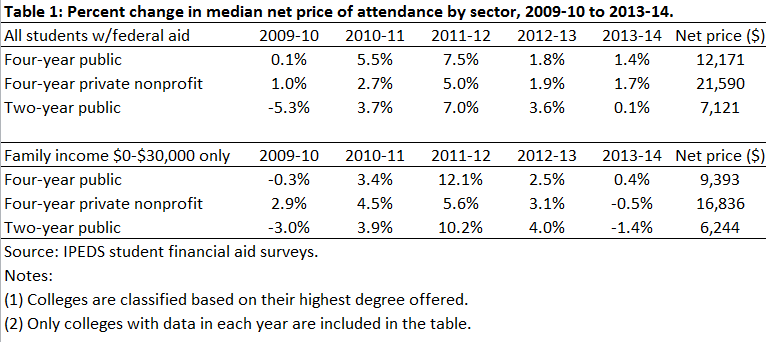
I first examined trends in net prices since the 2009-10 academic year for the 2,621 public two-year, public four-year, and private nonprofit four-year colleges that operate on the traditional academic year calendar. I do this for all students receiving federal financial aid (roughly 70% of all college students nationwide), as well as students with family incomes below $30,000 per year—roughly the lowest income quintile of students. Note that students from different backgrounds qualify for different levels of financial aid from both the federal government and the college they attend (and hence face different net prices). Table 1 shows the annual percentage changes in the median net price by sector over each of the five most recent years, as well as the median net price in 2013-14.
netprice_jan16_table1

The net price trends in the most recent year of data (2012-13 to 2013-14) look pretty good for students and their families. The median net price for all students with financial aid increased by just 0.1% at two-year public colleges, 1.4% at four-year public colleges, and 1.7% at four-year private nonprofit colleges—roughly in line with inflation. The lowest-income students saw lower net prices in 2013-14 at two-year public colleges (-1.4%) and four-year private nonprofit colleges (-0.5%) and a small 0.4% increase at four-year public colleges.

Even with one year of good news, net prices are up about 15% at four-year colleges and 10% at two-year colleges since the beginning of the Great Recession in 2009, with a slightly larger percentage increase for lower-income students. Much of this increase in net prices, particularly for lowest-income students, occurred during the 2011-12 academic year.

Although some may blame the lingering effects of the recession or reduced state funding for the increase, in my view the likely culprit appears to be changes made to the federal Pell Grant program. In 2011-12, the income cutoff for an automatic zero EFC (Expected Family Contribution, and hence automatically qualifying for the maximum Pell Grant) was cut from $31,000 to $23,000. This resulted in a 25% decline in the number of automatic zero EFC students and contributed to the average Pell award falling by $278—the first decline in average Pell awards since 2005.

I next examined potential reasons for colleges’ changes in net prices. As colleges are facing incentives to lower their net price, they can do so in three main ways. Lowering tuition prices or increasing institutional grant aid would both benefit students, but they are difficult for cash-strapped colleges to achieve.

If colleges want to lower their net price without sacrificing tuition or housing revenue, the easiest way to do so is to reduce living allowances for off-campus students. Colleges have wide latitude in setting these living allowances, and research that I’ve conducted with Sara Goldrick-Rab at Wisconsin and Braden Hosch at Stony Brook shows a wide range in living allowances within the same county. Here, I looked at whether colleges’ patterns of changing tuition and fees or their off-campus living allowance seemed to be related to their change in net price.

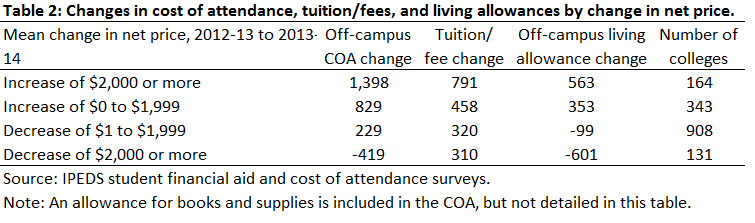
Table 2 shows the change between the 2012-13 and 2013-14 academic years in the total cost of attendance (COA), tuition and fees, and off-campus living allowances (for colleges with off-campus students), broken down by changes in the net price. Colleges with the largest increases in net price (greater than $2,000) increased their COA for off-campus students by $1,398, while colleges with smaller increases (between $0 and $1,999) increased their COA by $829. Both groups of colleges typically increased both tuition and fees and living allowances, which together resulted in the increase in COA.
netprice_jan16_table2

However, colleges with a reported decrease in net price between 2012-13 and 2013-14 had a different pattern of changes. They still increased tuition and fees, but they reduced off-campus living allowances in order to keep the cost of attendance lower. For example, the 131 colleges with a decrease in net price of at least $2,000 had average tuition increases of $310 while living allowances were reduced by $610. Some of these reductions in allowances may be perfectly reasonable (for example, if rent prices around a college fall), but others may deserve additional scrutiny.

The net price data provide useful insights regarding trends in college affordability, but students and their families should not necessarily expect the posted net price to reflect how much money they will need to pay for tuition, fees, and other necessary living expenses during the academic year. These metrics tend to be more accurate for on-campus students (as a college controls room and board prices), but everyone should also look at colleges’ net price calculators for more individualized price estimates as the net price for off-campus students in particular may not reflect their actual expenses.
Comments on the Bush Higher Education Proposal

The three Democratic candidates for president all released their plans for higher education fairly early in the campaign cycle, with Sen. Clinton, Gov. O’Malley, and Sen. Sanders’s plans all including some variation of tuition-free or debt-free public college. These plans are all likely dead on arrival in Congress due to their price tags ($350 billion for the Clinton plan) and the high probability that Republicans hold the House of Representatives through 2020, but the candidates deserve credit for making higher education a key part of their domestic policy platforms.

On the Republican side, higher education has been much less important during the campaign, with only Sen. Rubio having a framework (with a good number of components that may enjoy bipartisan support) in place for higher education before now. But Gov. Bush’s newly released proposal for education reform (as summarized in this piece written by Jason Delisle and Andrew Kelly, two informal advisors to the Bush campaign and people I greatly respect) reflects the most detailed proposal from any of the Republican candidates. (Gov. Bush’s summary on Medium is available here.) And like Rubio’s plan, there are components that will likely get bipartisan support in Congress—while other parts are likely to face opposition from within his own party. Below are the key planks of Bush’s higher education platform, along with my comments on whether they are likely to be effective and feasible.

Proposal 1: Replace the current financial aid system with education savings accounts and a line of credit. If one thing unites all presidential candidates, it’s that the Free Application for Federal Student Aid needs to be either incredibly simple or eliminated. The Bush proposal would replace the FAFSA for most students with an education savings account based on the tax code. All students would get a $50,000 line of credit (roughly the same as what independent students can borrow for a bachelor’s degree today), and low-income students would get an additional account with need-based aid based on their family’s income in high school. Adults would also qualify for grant aid, likely by filling out some new version of the FAFSA. Tax credits would also disappear in the Bush proposal, which will probably upset some people although they have not been proven to induce students to enroll in or graduate from college.

This proposal represents a modest—but likely helpful—improvement over the current system for undergraduate students. This would give students at least some additional flexibility in using their financial aid, with the potential for students to accelerate their progress by taking summer courses that would not be aid-eligible under current rules. Getting students information about their likely aid eligibility in eighth grade is a plus, as shown in my research. But I’d like to see students get money deposited in their account at a slightly earlier age to make the commitment seem more tangible.

It appears that the $50,000 line of credit will be the new lifetime limit for federal student loans. For undergraduate students, this makes a lot of sense. The typical student with debt has between $30,000 and $35,000 in debt for a bachelor’s degree, so $50,000 seems like a reasonable upper bound for most students. However, it doesn’t look like graduate students would qualify for additional credit—which could curtail enrollment in master’s degree programs or doctoral programs in less-lucrative fields. This could create an opportunity for the expanded use of income share agreements with the private sector.

Proposal 2: Impose “risk sharing” on federal student loan dollars by holding colleges responsible for a portion of loans that are not repaid. The general principal of risk sharing makes sense—if a college’s former students can’t pay the bills, then the college should be responsible for partially reimbursing taxpayers. And the idea has at least some bipartisan support, as evidenced by 2015 legislation introduced by Senators Hatch (R) and Shaheen (D). But putting together a risk sharing proposal that doesn’t punish colleges for serving at-risk students while protecting taxpayer funds is far more difficult than it would first appear. I’ve tangled with some of these issues in my prior work (see my proposed framework for a risk sharing system), and the Bush team will have to do the same if their candidate pulls off an improbable comeback.

Proposal 3: Allow new providers to receive federal financial aid dollars. Right now, students can take their federal financial aid dollars to any of the approximately 7,500 colleges and universities nationwide that are eligible for and participate in programs under Title IV of the Higher Education Act. Conservatives have frequently called for other non-college providers (such as boot camps, apprenticeship programs, and single-course providers) to be eligible for federal financial aid to promote competition and potentially place downward pressure on the price tag of traditional programs. However, making this sort of change would likely require a significant overhaul of the current accreditation system, which has been deemed a cartel by some Republicans.

Bush’s proposal echoes these calls, but also proposes that prior learning assessments qualify for federal financial aid. This would allow students to use Pell Grant or student loan dollars to pay for taking tests such as the College Level Examination Program (CLEP) that can result in college credit if a student can demonstrate subject mastery. It could also potentially be used to help pay for portfolio assessments of previous academic or work experience, which can cost hundreds of dollars at some colleges. Even if the entire accreditation system isn’t blown to smithereens, a relatively modest change of allowing vetted prior learning assessment providers to accept federal aid would benefit students.

Proposal 4: Get outcome data into the hands of students and families. Florida has one of the most comprehensive education data systems in the country, allowing students and their families to access detailed data on earnings by field of study. The Bush proposal calls for each state to develop a similar system in order to provide outcome data to the public. However, given the way the pendulum has swung regarding student privacy (a substantial part of both the GOP and Democratic primary bases), it will be difficult to include incentives or sanctions that would encourage states to develop these databases. But even if such a proposal were to be adopted, it’s far from clear whether 50 separate databases would make more sense from a logistical or privacy perspective than a federal College Scorecard with program-level data.

Proposal 5: Reform the student loan repayment system. Both Republicans and Democrats seem to be moving toward a consensus that income-based repayment models (where loan payments are tied to a former student’s income and debt burden) are superior to the traditional 10-year fixed payment plan. Bush’s plan would make income-based repayment the only option for new borrowers, with payments equal to 1% of income per each $10,000 borrowed for up to 25 years, with the maximum lifetime payment being $17,500 per $10,000 borrowed. His proposal would also encourage current borrowers to shift into income-based repayment, which is currently a headache for many students. Although people will likely disagree with the exact terms Bush’s proposal sets forth, the general principles match up with conservative proposals as well as President Obama’s REPAYE program.

Although Gov. Bush is badly lagging in the polls, his campaign’s higher education proposals are serious, generally well-considered (although lacking for most details), and represent an important starting point for federal higher education policy discussions. Given that large infusions of federal funds into higher education are unlikely regardless of who becomes the next President, some pieces in the Bush plan (such as increased flexibility in how students use Pell Grants) are worth considering as low-cost plans that have the potential to positively impact students. Other ideas (such as risk sharing) sound promising in principle, but have the potential to do harm if they are improperly implemented. But even if the Bush campaign doesn’t make it past the first few primary states, many of the ideas included in the plan should be strongly considered by other candidates.

Why is College So Expensive? (Nearly) Everyone is to Blame

“Why is college so expensive?” “Why does college cost so much?” If I had a dollar for every time I’ve been asked that type of question, I could probably pay the roughly $15,000 it takes to provide a year of college for the typical student at a four-year regional public university. This is the true cost of college—how much the college spends on a given student each year. The public is often more concerned with the price (what students and their families pay), but barring additional massive public spending on higher education, the cost of providing a college education must be brought under control in order for students to see lower price tags.

Any piece written by a member of the higher education community for the general public about college costs is likely to reach a large audience due to deep public concerns about college affordability. A recent piece in the Washington Post by Steven Pearlstein, former journalist and current professor at George Mason University, offers four potential solutions to bending the college cost curve. Below, I discuss each of his four ideas and whether they are feasible. (Note that because the focus is on reducing the cost of educating a student, state funding and additional financial aid aren’t relevant here—although they would reduce the price faced by students.)

Proposal #1: Cap administrative costs. This one seems like a no-brainer; if the goal is to educate students, more money should be spent on instruction compared to various “deanlets” and other administrators. But there are legitimate reasons for additional administrators. First, as Pearlstein notes, increasingly complex government regulations, such as for how financial aid is disbursed, do need specialized individuals. As the college-going population has become more diverse, at least some additional student services are required to serve a student body with different academic and social needs than decades ago.

However, the blame for rising administrative costs can also be shared among students and faculty in addition to administrators and regulators. Some students’ preferences for intercollegiate athletics and recreation facilities (such the infamous climbing walls and lazy rivers) also require a number of additional staff members and administrators to run these endeavors. Additionally, as Andrew Kelly of the American Enterprise Institute noted last week, even student protesters’ demands for additional services at places such as the University of Missouri and Yale could increase total costs. Faculty are also to blame—each time we give up a former part of our jobs (such as advising students, making admissions decisions, or even making copies), someone else does it.

Proposal #2: Use a year-round teaching schedule, five days per week. It’s really hard to argue that college facilities are being used in an efficient manner. Fridays tend to be ghost towns at many colleges, although many less-selective colleges do hold quite a few evening and weekend classes. But residential students tend not to like Friday classes, and faculty with demanding travel schedules also prefer to keep Fridays free for travel. I teach Monday and Wednesday evenings, and I’ll use about half of the Fridays in a given semester to go to meetings and conferences. Technology has the ability to help solve this problem through the use of hybrid classes. Faculty can teach online a few weeks each semester while they are traveling, something which I do on occasion as well as when the weather is bad.

Moving to a year-round teaching schedule, however, is likely to have significant budgetary implications. Most faculty with teaching obligations are on a 9-month or 10-month contract, meaning that they are not expected to work with students during the summer period—let alone teach. Asking faculty to teach in the summer would likely result in contracts needing to be 11 or 12 months per year, which would probably mean increased salaries. After all, if teaching is added to a professor’s schedule in the summer, she probably won’t work for free.

Proposal #3: Teach more and research less. Pearlstein notes that much research is never cited by any other academics, as well as noting that the incentive structure often favors research (which is far easier to quantify than teaching). The blame for the focus on research can be placed on both administrators and faculty, as both groups often prefer research over teaching and may both have input into the tenure and promotion process.

However, Pearlstein’s mention of research showing that “teaching loads at research universities have declined almost 50 percent in the past 30 years” is incorrect. That study, which used the National Study of Postsecondary Faculty, was rescinded in 2013 due to concerns about the wording of faculty workload questions changing during the length of the study. While it’s probably the case that faculty teaching loads at more selective institutions have declined somewhat, Pearlstein shouldn’t have used a study that was rescinded a month after it was released.

Proposal #4: Cheaper, better general education. In this section, Pearlstein pushes for more online and hybrid courses to better engage students in the material. This sounds good, but it is far from a certainty that online courses are actually less expensive than in-person courses. (Research on this is nascent and inconclusive.) Additionally, Pearlstein cites government data stating that “more than three-quarters of students at four-year colleges and universities have never taken an online or hybrid course.” As Russ Poulin at WCET notes, 27% of students took a distance education course in 2013 alone, meaning that the percentage of students with some online experience at some point in college is likely far larger than 25%. I’ll be the first to admit that general education is not my strong point as a member of the graduate faculty, but there are lots of good people working on issues of general education.

As the discussion above suggests, nearly everyone (except woefully underpaid adjuncts) is to blame for the rising costs—and prices—of a college education. The challenge is that any solution is likely to be fairly complex and involve negotiations among faculty, administrators, students, and taxpayers. This is why college costs tend to get lip service from the higher education community until revenue sources dry up. But the financial struggles of many small private colleges (let alone many cash-strapped public colleges) make cost-cutting measures necessary, and hopefully the rest of the higher education community can learn from their experiences.

How Well Do Default Rates Reflect Student Loan Repayment?

This post initially appeared at the Brown Center Chalkboard blog.

The U.S. Department of Education released new data this week on colleges’ cohort default rates (CDR)—reflecting the percentage of a college’s former students with federal student loans who entered repayment in Fiscal Year 2012 and defaulted by the end of Fiscal Year 2014. The average CDR dropped to 11.8 percent in Fiscal Year 2012, down from 13.7 percent in FY 2011 and 14.7 percent in FY 2010. Eight colleges had a CDR over 30 percent for three consecutive years, subjecting them to the loss of all federal financial aid dollars. Over 100 additional colleges had a CDR over 30 percent in the 2012 cohort, putting them at risk of losing funds if their performance does not improve.

Yet although CDRs are important for accountability purposes, they do not necessarily reflect whether students are repaying their loans.  As of June 30, 2015, just over half of the $623 billion in Direct Loans made to students who have entered repayment are in current repayment. In addition to the $48 billion in loans in default, an additional $63 billion are more than 30 days delinquent and $180 billion are in deferment and forbearance. Deferment and forbearance are not always bad things, as students can qualify for either by being in the military or pursuing graduate studies. However, students can also request deferment and forbearance for economic hardship, while interest still accrues. The presence of income-based repayment plans, in which students making below 150 percent of the federal poverty line can make no payments while still remaining current on their loan, further complicates any analyses. All of these complications make cohort default rates a weak metric of whether students are actually paying back their loans.

Are students repaying their loans? A look using College Scorecard data

The Department of Education’s recent release of College Scorecard data provides new insights into whether students are repaying their loans, while also allowing for comparisons to be made to the current CDR metric. The Scorecard contains a new measure of the percentage of students whose student loan balance was lower than when entering repayment, which reflects the percentage of students who have been able to pay down at least some principal.

Using this new metric on declining student loan balances to compare with colleges’ CDRs, I come to three new findings.  Please note that for the purposes of this blog post, I consider the three-year cohort default rate for students who entered repayment in FY 2011 compared to the one-year and three-year repayment rates for students who entered repayment in FY 2010 and 2011. The key findings are below.

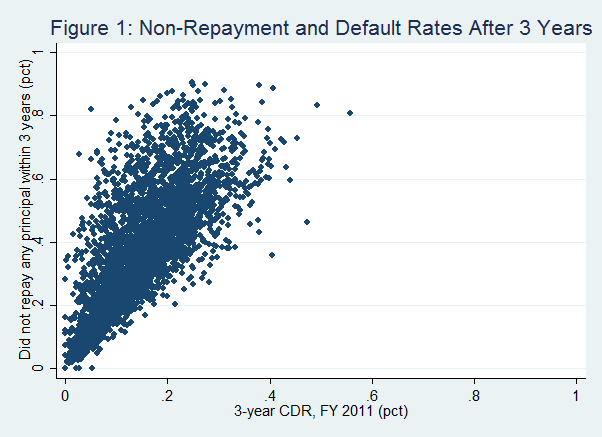
(1) Cohort default rates substantially underestimate the percent of students who have been unable to lower their loan balances. Of the nearly 5,700 colleges with data on both CDRs and repayment rates, the median college had a 14.9 percent three-year CDR while 40.8 percent of students did not repay any principal in the first three years after leaving college. This means that one in four exiting students was not in default, yet did not make a dent in their loan balance in the first three years after entering repayment. Figure 1 below shows the relationship between CDRs and repayment rates. A low CDR for a college is associated with higher rates of repayment (with a correlation coefficient of 0.76), but there are plenty of exceptions. For example, 25 percent of the colleges with default rates below 10% had more than one-fourth of all students failing to repay any principal.

brookings_fig1

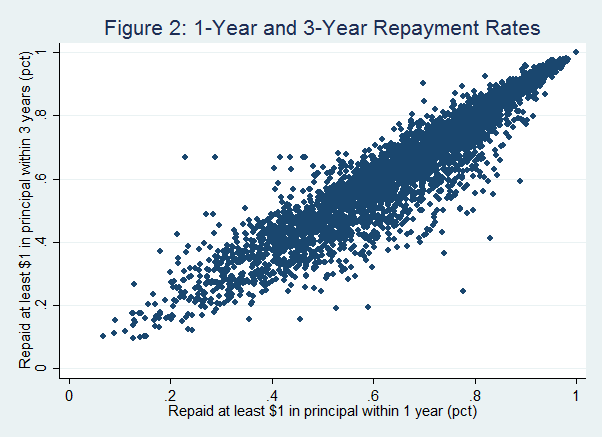
(2) The percentage of students paying down principal doesn’t change much between one year and three years since entering repayment. One year after entering repayment, 62.8 percent of students at the median college had paid down at least $1 in principal, though that percentage dipped slightly to 59.2 percent within three years (see Figure 2 for the distribution of repayment rates). This drop is likely due to some students either falling behind on their payments while enrolled in the standard repayment plan as well as payments under income-based plans being insufficient to cover accumulating interest. In either case, stagnant or falling repayment rates should raise red flags regarding students’ ability to eventually pay off the loan within 10-20 years.

brookings_fig2


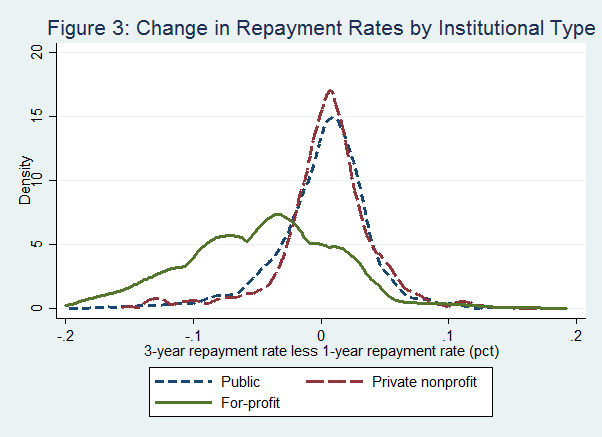
(3) As a whole, repayment outcomes make a turn for the worse at for-profit colleges compared with public or private nonprofit colleges. This can be best illustrated by showing the difference in repayment rates between one and three years of entering repayment by institutional type. As Figure 3 below shows, for-profit colleges tended to have lower repayment rates after three years than one year, a red flag that their borrowers are not doing well, while public and private nonprofit colleges saw similar repayment rates over time. Only one in four for-profit colleges had more students paying down principal three years after completion, which points to potential problems for students and taxpayers alike. Although for-profit colleges have somewhat lower CDRs than community colleges, community colleges do not see drops in the repayment rates that exist in the for-profit sector.

brookings_fig3

The new loan repayment rate data provides an additional tool   for policymakers to use when holding colleges accountable for their performance. Although this metric represents a substantial improvement over CDRs by including students who are struggling to make payments, the presence of income-based repayment plans (where students can stay current on their loans by making small payments if their income is sufficiently low) complicates any accountability efforts. Further research is needed to examine the implications of income-based repayment programs on principal repayment rates.

Which Colleges Enroll First-Generation Students?

The higher education world is abuzz over the Obama Administration’s Saturday morning release of a new College Scorecard tool (and underlying trove of data). In my initial reaction piece, I discussed some of the new elements that are available for the first time. Earnings of former students are getting the most attention (and have been frequently misinterpreted as being the earnings of graduates only), but today I am focusing on a new data element that should be of interest to students, researchers, and policymakers alike.

The Free Application for Federal Student Aid has included a question about the highest education level of the student’s parent(s), but this information was never included in publicly available data. (And, yes, the FAFSA application period will be moved up three months starting in 2016—and my research on the topic may have played a small role in it!) In my blog post on Saturday, I showed the distribution of the percentage of first-generation students (as defined as not having a parent with at least some college) among students receiving federal financial aid dollars. Here it is again:

firstgen

I dug deeper into the data to highlight the ten four-year public and private nonprofit colleges with the lowest and highest percentages of first-generation students (among those receiving federal aid) in 2013. The results are below:

Four-year private nonprofit colleges with the fewest first-generation students, 2013.
Name Pct First Gen
California Institute of Technology 5.9
Wheaton College (IL) 8.3
Oberlin College (OH) 8.5
Elon University (NC) 8.6
Dickinson College (PA) 9.0
Macalester College (MN) 9.1
University of Notre Dame (IN) 9.7
Carnegie Mellon University (PA) 9.8
Hobart William Smith Colleges (NY) 9.8
Rhode Island School of Design 10.6
Source: College Scorecard/NSLDS.
Note: Only includes students receiving Title IV aid, excludes specialty colleges.
Four-year public colleges with the fewest first-generation students, 2013.
Name Pct First Gen
College of William and Mary (VA) 13.2
University of Vermont 14.1
Georgia Institute of Technology 16.5
University of North Carolina School of the Arts 17.4
University of Virginia 17.6
New College of Florida 18.0
University of Michigan-Ann Arbor 18.0
SUNY College at Geneseo 18.4
Clemson University 18.5
University of Wisconsin-Madison 19.1
Source: College Scorecard/NSLDS.
Note: Only includes students receiving Title IV aid, excludes specialty colleges.

Just 5.9% of students receiving federal financial aid at the California Institute of Technology were defined as first-generation in 2013, and eight other private nonprofit colleges were under 10% (including Oberlin, Notre Dame, and Carnegie Mellon). The lowest public college was the College of William and Mary, where just 13% of students were first-generation. Several flagships check in on the list, including Vermont, Virginia, Michigan, and Wisconsin (where I got my PhD).

The list of colleges with the highest percentage of first-generation students is quite different:

Four-year private nonprofit colleges with the most first-generation students, 2013.
Name Pct First Gen
Colorado Heights University 75.6
Beulah Heights University (GA) 66.0
Heritage University (WA) 64.3
Grace Mission University (CA) 64.1
Hodges University (FL) 63.3
Humphreys College (CA) 60.5
Selma University (AL) 59.8
Mid-Continent University (KY) 59.7
Sojourner-Douglass College (MD) 59.2
University of Rio Grande (OH) 58.5
Source: College Scorecard/NSLDS.
Note: Only includes students receiving Title IV aid, excludes specialty colleges.
Four-year public colleges with the most first-generation students, 2013.
Name Pct First Gen
Cal State University-Los Angeles 64.0
Cal State University-Dominguez Hills 60.2
Cal State University-Stanislaus 60.2
Cal State University-San Bernardino 59.4
Cal State University-Bakersfield 58.2
University of Texas-Pan American* 56.9
University of Arkansas at Monticello 56.1
University of Texas at Brownsville* 55.2
Cal State University-Fresno 53.4
Cal State University-Northridge 53.1
Source: College Scorecard/NSLDS.
Note: Only includes students receiving Title IV aid, excludes specialty colleges.
* These two colleges are now UT-Rio Grande Valley as of Sept. 1.

Six private nonprofit and three public four-year colleges had at least three-fifths of their federal aid recipients classified as first-generation students, ten times the rate of Caltech. The top-ten lists for both public and private colleges include many minority-serving institutions, as well as a good chunk of the Cal State University System. These engines of social mobility deserve credit, as do some flagship institutions that do far better than average in enrolling first-generation students. UC-Berkeley, where 37% of aided students are first-generation, also deserves special commendation.

There are a lot of great data elements present in the College Scorecard data that go beyond earnings. I hope that they get attention from researchers and are disseminated to the public.

Comments on the New College Scorecard Data

The Obama Administration’s two-year effort to develop a federal college ratings system appeared to have hit a dead-end in June, with the announcement that no ratings would actually be released before the start of the 2015-2016 academic year. At that point in time, Department of Education officials promised to instead focus on creating a consumer-friendly website with new data elements that had never before been released to the public. I was skeptical, as there were significant political hurdles to overcome before releasing data on employment rates, the percentage of students paying down their federal loans, and graduation rates for low-income students.

But things changed this week. First, a great new paper out of the Brookings Institution by Adam Looney and Constantine Yannelis showed trends in student loan defaults over time—going well beyond the typical three-year cohort default rate measure. They also included earning data, something which was not previously available. But, although they made summary tables of results available to the public, these tables only included a small number of individual institutions. It’s great for researchers, but not so great for students choosing among colleges.

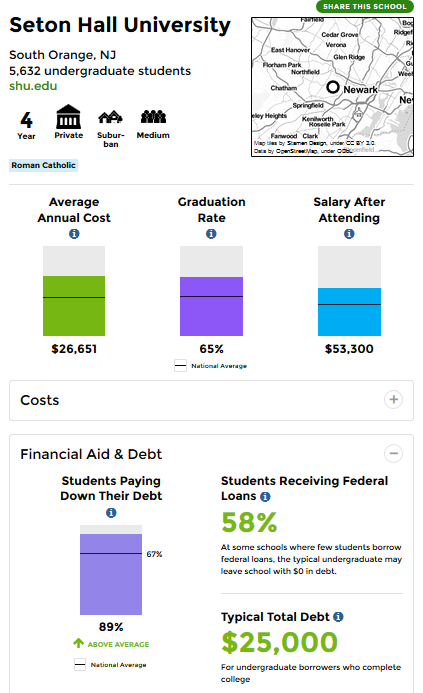
The big bombshell dropped this morning. In an extremely rare Saturday morning release (something that frustrates journalists and the higher education community to no end), the Department of Education released a massive trove of data (fully downloadable!) underlying the new College Scorecard. The consumer-facing Scorecard is fairly simple (see below for what Seton Hall’s entry looks like), and I look forward to hearing about whether students and their families use this new version more than previous ones. I also recommend ProPublica’s great new data tool for low-income students.

shu

But my focus today is on the new data. Some of the key new data elements include the following:

  • Transfer rates: The percentage of students who transfer from a two-year to a four-year college. This helps community colleges, given their mission of transfer, but still puts colleges at a disadvantage if they serve a more transient student body.
  • Earnings: The distribution of earnings 10 years after starting college and the percentage earning more than those with a high school diploma. This comes from federal tax return data and is a huge step forward. However, given very reasonable concerns about a focus on earnings hurting colleges with public service missions, there is also a metric for the percentage of students making more than $25,000 per year. Plenty of people will focus on presenting earnings data, so I’ll leave the graphics to others. (This is a big step forward over the admirable work done by Payscale in this area.)
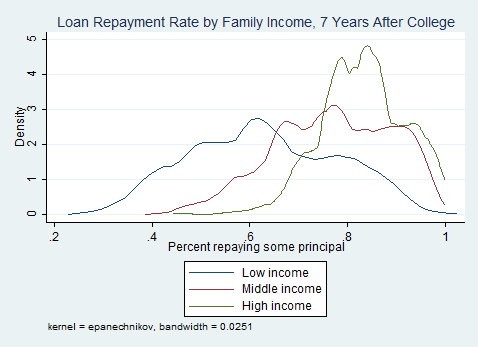
  • Student loan repayment: The percentage of students (both completers and non-completers) who are able to pay down some principal on loans within a certain period of time. Seven-year loan repayment data are available, as illustrated here:

loan_repayment

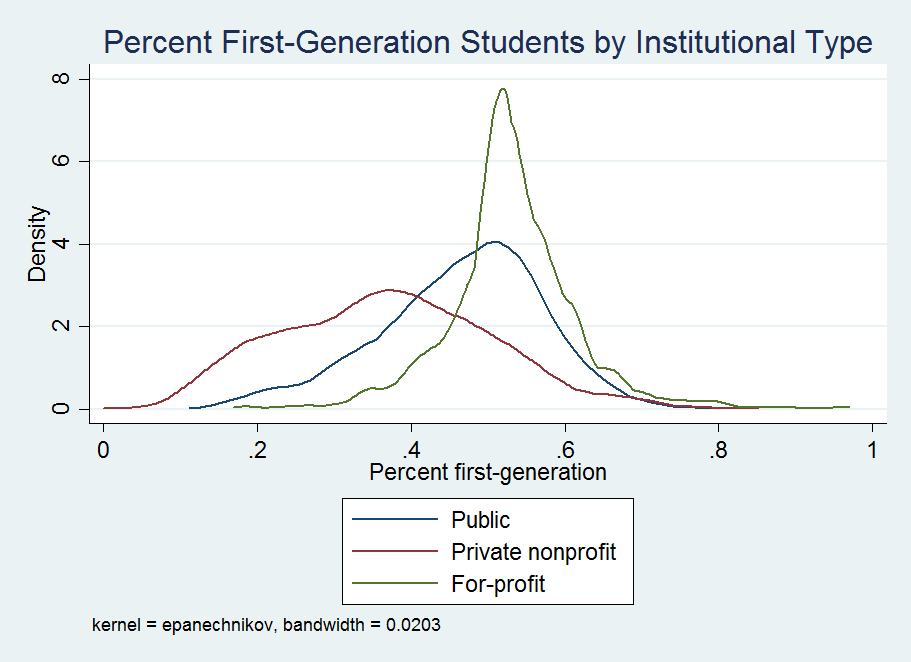
In the master data file, many of these outcomes are available by family income, first-generation status, and Pell receipt. First-generation status is a new data element to be made available to the public; although the question is on the FAFSA, it’s never been made available to researchers. For those who are curious, here’s what the breakdown of the percentage of first-generation students (typically defined as students whose parents don’t have a bachelor’s degree) by institutional type:

firstgen

There are a lot of data elements to explore here, and expect lots of great work from the higher education research community in upcoming months and years using these data. In the short term, it will be fascinating to watch colleges and politicians respond to this game-changing release of outcome data on students receiving federal financial aid.

Do SAT-Mandatory States Explain Declining Scores?

Yesterday, I wrote about how it was likely the case that some of the decline in SAT scores  was due to states and districts requiring students to take the SAT. At the request of several esteemed readers, I did a back-of-the-envelope calculation to see how much of the change in SAT scores over the last five years is due to states requiring all students to take the SAT (hat tip to Kan-Ye Test (love the name!) for pointing me to the data). Between 2011 and 2015, Delaware, the District of Columbia, and Idaho moved from having some of their students take the SAT (14,765) to having all of their students (32,236) take the SAT. Meanwhile, the average SAT score fell from 1500 to 1490.

Based on 2011 state-by-state data, I recalculated average 2015 SAT scores while substituting 2011 participation levels and scores for 2015  levels and scores in those three states. Erasing the additional 17,471 test-takers (and their average SAT of 1292) from those three states was enough to raise the average SAT score of 1.6 million other test-takers by 2.1 points. These three states explain approximately 21% of the decline in SAT scores, as outlined below.

Required SAT states explain at least 21% of the decline in SAT scores since 2011
States Num. students Avg. SAT
DC, DE, & ID (2011) 14,765 1445
DC, DE, & ID (2015) 32,236 1362
All others (2015) 1,614,887 1493
Total (using ’11 DC, DE, & ID) 1,629,652 1492
Total (using ’15 DC, DE, & ID) 1,647,123 1490

I’d still love to see the College Board pull out data from the districts which moved to require the SAT, as it’s entirely possible that half of the decline in SAT scores could just be due to students who were required to take the test. They’ve got the data, and I hope they take a look!

Why SAT Scores Going Down May Be Just Fine

The average score for students taking the venerable SAT exam in 2014-2015 was 1490, seven points below last year’s scores and the lowest score since the writing section was added in 2005. Not surprisingly, this drop is generating a lot of media coverage—much of it focused on how high schools are failing America’s children. But while high schools may very well be a concern (and those of us in colleges shouldn’t get off without criticism, either), I contend that the decline in SAT scores may be just fine.

The simple reason for my lack of concern is that the decline may very well be due to more students taking the exams in response to new state laws and district rules in several states requiring or encouraging testing. For example, Idaho required beginning in 2012 that students had to take the ACT or SAT to graduate—and that the state would cover SAT costs for students. In 2011-2012, 27% of Idaho students took the SAT and got an average score of 1613, while practically all Idaho students in 2014-2015 took the SAT and got an average score of 1372. (The District of Columbia, Delaware, and Maine—the other three jurisdictions where basically everyone takes the SAT—had similarly low scores.) Either Idaho high schools imploded over a three-year window, or the types of students who weren’t previously taking the test didn’t have the same level of ability on standardized tests as the 27% of students who were likely considering selective four-year colleges.

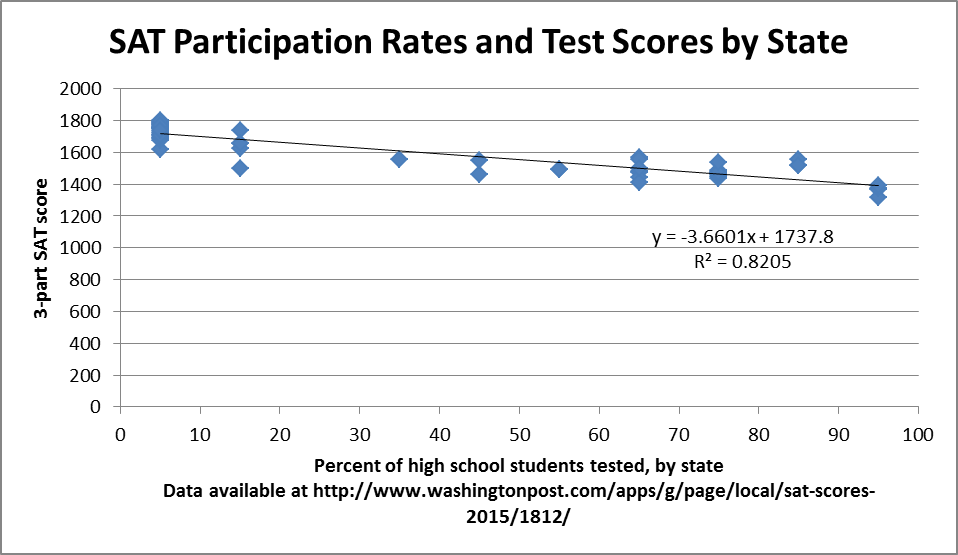
The chart below shows the relationship between the percentage of students taking the SAT and scores (data available via the Washington Post). The R-squared is 0.82, suggesting that 82% of the variation in state-level test scores can be explained by the percentage of students tested in each state.

sat_2015

What I would like to see is some comparisons across similar types of students over time. Among students who signal a clear intent to go to a four-year college, are SAT scores declining? Or is the entire decline driven by different students taking the test? And are students considering college for the first time because they took the SAT and did reasonably well? There is value to everyone taking a standardized test across states (given the differences in state high school exams), but it’s inappropriate to look at trends over time with such large differences in the types of students taking the test.

Trends in Federal Student Loan and Pell Grant Awards

The U.S. Department of Education’s Office of Federal Student Aid released its newest quarterly update on federal student loan and Pell Grant awards on Friday, and the data (through the end of the 2014-15 academic year) are nothing short of stunning. As shown in the table below, federal student loan volume dropped by nearly $11 billion in 2014-15 to $89.4 billion, the lowest level since before the federal government ended the old bank-based lending program in 2010. Total Pell Grant awards also declined in 2014-15 to $30.3 billion, more than $5 billion below 2010-11 levels. (For more on trends in Pell awards over the last two decades, see my recent post on the topic.)

aid

What could explain such sharp drops in student loan and Pell Grant dollars? Four factors could be at work:

(1) As America slowly continues to climb out of the Great Recession, more students and families may be earning enough money not to qualify for Pell Grants or need to borrow as much in student loans. Unemployment rates are down sharply since 2010, but median real household income has been nearly flat—so this is probably a minor contributing factor.

(2) Americans may be less willing to borrow for college than they were a few years ago, leading to less student loan debt. I’m more concerned about undergraduate students underborrowing for college than overborrowing, particularly as students react to stories about other people’s (atypical) debt loads and concerns about their financial strength. But this is difficult to prove empirically given current data.

(3) Part of the decline in total Pell awards is likely due to changes in the FAFSA formula that reduced the number of students automatically receiving the maximum Pell Grant in 2012-13 and beyond. But this would not explain continued declines in Pell dollars received.

(4) The most likely explanation to me is decreased enrollment due to an improved labor market inducing some individuals to work instead of attend college combined with the collapse of some of the large for-profit college chains. The most up-to-date data from the National Student Clearinghouse (which is available well ahead of federal estimates) show that enrollment has declined at degree-granting colleges each of the past three years, with the largest declines taking place at community colleges and in the for-profit sector. Lower enrollment, particularly among adult students, leads to fewer students taking out loans and receiving Pell Grants.

As the economy continues to slowly strengthen and the for-profit sector continues to sort itself out, I would expect enrollment (and the number of students receiving Pell Grants) to very slowly increase over the next several years. Future trends in student loan debt are less clear. Given the explosion of students enrolling in income-based repayment programs, students (particularly in graduate programs) might have less of an incentive to keep loan amounts in check. Yet, to this point, there doesn’t seem to be a boom in graduate school loans across the board. It would be worth looking at particular colleges with large programs in fields that are especially likely to qualify for Public Service Loan Forgiveness to see if loan amounts there are up by large amounts.

To Reduce Debt, Give Students More Information to Make Wise College Choice Decisions

This article was originally published at The Conversation.

Higher education has gotten a lot of attention during the early stages of the 2016 presidential campaign. All three major candidates for the Democratic nomination – former New York Senator Hillary Clinton, former Maryland Governor Martin O’Malley and Vermont Senator Bernie Sanders – have proposed different plans to reduce or eliminate student loan debt at public colleges.

However, the price tags of these plans (at least $350 billion over 10 years for Clinton’s proposal) will make free college highly unlikely. Republicans, including leading presidential candidates, have already made their opposition quite clear.

But student loan debt is unlikely to go away anytime soon. What is important for now is that students and their families get better information about tuition costs and college outcomes so they can make more informed decisions, especially as the investments are so large.

What colleges will reveal

Although colleges are required to submit data on hundreds of items to the federal government each year, only a few measures that are currently available are important to most students and their families:

First, colleges must report graduation rates for first-time, full-time students. This does a good job reflecting the outcomes at selective colleges, where most students go full-time.

But full-time students make up only a small percentage of students at some colleges, and data on the graduation rates of part-time students will not be available until 2017.

The price tag of Hillary Clinton’s college plan is too steep.
Marc Nozell, CC BY

Colleges must also report net prices (the cost of attendance less all grant aid received) by different family income brackets. The cost of attendance (defined as tuition and fees, room and board, books and supplies, and other living expenses such as transportation and laundry) and the resulting net price are important measures of affordability.

Because financial aid packages can vary across colleges with similar sticker prices, net prices are important to give students an idea of what they might expect to pay.

Colleges that offer their students federal loans must report the percentage of students who defaulted on their loans within three years of leaving college. This measure reflects whether students are able to make enough money to repay their loans. Colleges must also report average student loan debt burdens, so students can see what their future payments might look like.

In addition, vocationally oriented programs must report debt and earnings metrics under new federal “gainful employment” regulations. This provides students in technical fields a clear idea of what they might expect to make.

The Obama administration has promised that additional information on student outcomes will be made available “later this summer”, although they have not said what will be made available.

What don’t we know?

Despite the availability of information on some key outcomes, more can still be done to help students make wise decisions about which college to attend.

Below are some example of outcomes that would be helpful for students and their families to know about.

Although enormous gaps in college completion rates exist by family income, students and their families cannot currently access data on the graduation rates of low-income students receiving federal Pell Grants. (The federal government is purchasing data from the National Student Clearinghouse to fix this going forward.)

Colleges are required to report the percentage of minority students and the percentage of students receiving Pell Grants, but nothing is known about the percentage of first-generation students.

This is of particular interest given the key policy goal of improving access to American higher education; without this information, it is harder to tell which colleges are engines of social mobility.

Students need to have more information.
Lynda Kuit, CC BY-ND

Private-sector organizations such as PayScale and LinkedIn work to fill this gap, but they can only provide a limited amount of information.

How could we know more?

The data needed to answer many of the questions above are already held by the federal government, but in multiple databases that are not allowed to communicate with each other.

The greatest barrier to better information from the federal government is due to a provision included in the 2008 reauthorization of the Higher Education Act which banned the federal government from creating a “student unit record” data system that would link financial aid, enrollment and employment outcomes for students receiving federal financial aid dollars. This ban was put in place in part due to concerns over data privacy, and in part due to an intense lobbying effort from private nonprofit colleges.

States, in contrast, are allowed to have unit record data systems, and a few of them make detailed information available to anyone at the click of a mouse.

For example, Virginia makes a host of student loan debt information available in a series of convenient tables and graphics.

Senator Rubio has teamed with Democratic Senators Ron Wyden of Oregon and Mark Warner of Virginia to introduce legislation overturning the ban on unit record data, although no action has yet been taken in Congress.

A bipartisan push to make more information available to students and their families has the potential to help students make better decisions.

But getting data is only one part of the challenge. The other is getting that into the hands of students at the right time. For that, it is important for the federal government to work with college access organizations and guidance counselors.

Students should be able to access this information as they begin considering attending college. Although additional information may not allow a student to graduate debt-free, it will help him or her to make a more informed decision about where to attend college and if the price tag is worth paying.

The Conversation

Read the original article.