Blog (Kelchen on Education)

Don’t Expect a Wave of Private Nonprofit College Closures

American higher education certainly faces its share of challenges. Overall higher education enrollment has dropped from its post-recession high, students and their families are increasingly skeptical of the value of higher education, and the credit rating agency Moody’s recently downgraded the sector to negative from neutral over revenue concerns. These challenges have led to some doomsday predictions regarding college closures; Clayton Christensen of Harvard predicted back in 2011 that half of all colleges would close within 10 to 15 years and since doubled down on his prediction.

To this point, the data tell a different story. While a sizable number of for-profit colleges merge or close in a given year, nonprofit higher education is remarkably stable (and public colleges rarely ever close). According to the U.S. Department of Education, eight degree-granting private nonprofit colleges closed in 2015-16 (the most recent year of data available). Yet the number of degree-granting private nonprofit colleges increased from 1,672 to 1,701—the largest number in 20 years.

Among private nonprofit colleges, there are a few clear risk factors for closure. Small, less-selective institutions with tiny endowments are at a higher risk of closure, particularly if they are located in parts of the country where the pool of traditional-age students is drying up. But these risk factors have existed for decades, yet there is rarely a year in which ten private nonprofit colleges close. (Moody’s expects the number to rise to about 15 per year going forward.)

A recent article published in The Journal of Higher Education helps to provide some data on how resilient small private colleges can be. Melissa Tarrant of the University of West Georgia led a team of researchers who looked back at a 1972 paper by Alexander Astin and Calvin Lee called “The Invisible Colleges.” In that paper, Astin and Calvin identified 491 private, broad-access institutions with fewer than 2,500 students—exactly the type of college that is of greater risk of closure. Yet Tarrant and colleagues showed that 354 of the colleges (more than 70%) were still operating as standalone private nonprofit institutions and only 80 had closed in the following four decades. A failure rate of less than 20% over 40 years does not bode well for predictions that higher education as we know it is going away anytime soon.

A case can be made that the current number of small private colleges is more than would exist if the higher education system were to be designed from scratch to meet the needs of today’s students. But Christensen misses the loyalty of campus communities and alumni (the saga of Sweet Briar College was a great recent example) and the sheer tenacity of institutions as they face extreme financial difficulties. More colleges may consider mergers and strategic alliances, but the rate of college closures in nonprofit higher education is likely to only tick up slightly in the coming decade.

New Higher Education Policy Voice: Chris Marsicano

First of all, a big thank you to my readers for responding to my previous blog post with a great list of advanced graduate students, postdocs, and new assistant professors who are on the frontiers of higher education research and public engagement. I’m still taking nominations (self or other), and will run a piece on a new voice every week for as long as it takes to cover the entire list.

This is particularly timely, as Rick Hess of the American Enterprise Institute just released his annual Edu-Scholar Public Influence Rankings that attempt to highlight university faculty who share the same goals as Chris and the other scholars that I will highlight in this series. Five years from now, expect to see a number of these individuals on that list for the contributions to higher education policy discussions!

The first person I am pleased to highlight is Chris Marsicano (@ChrisMarsicano), a PhD student in the Department of Leadership and Policy Studies at Vanderbilt University. Chris is putting the finishing touches on his dissertation this spring, and he could not have chosen a more policy-relevant topic. He is examining the higher education lobbying process in Washington using both quantitative and qualitative methods (see more about his research here). This has come in handy as small items like tax reform and Higher Education Act reauthorization have percolated in the nation’s capital.

In addition to studying a policy-relevant topic, Chris has been able to project his research out to the general public through his blog and through writing for a broad audience. He used his lobbying experience to advise graduate students who opposed the proposed tax on tuition waivers in the tax bill, starting a Twitter thread that got over 5,000 retweets—and the attention of the Los Angeles Times. The newspaper asked him to write an opinion piece on the topic, which prominently ran in the print edition. That’s pretty darn unusual for a graduate student and highlights why Chris is a great person to lead off this series.

The 2017 “Not Top Ten” List in Higher Education

Yesterday, I unveiled my fifth annual list of the top ten events in American higher education in 2017. Now it’s time for the annual list of the “not top ten” events—which are a mix of puzzling decisions and epic fails that leave most of us wondering what people were thinking. Enjoy the list—and send along any feedback that you have!

(10) Sorority rush consultants are apparently a real thing. Higher education is no stranger to consultants—they are used to help with presidential searches, deal with tough budget issues, and conduct research for colleges and universities. The college admissions process for higher-income families is also full of consultants, including private admissions counselors, test prep agencies, and tutors. But I had never thought about the need for “sorority rush consultants” before reading this fascinating piece in Town and Country magazine (which prominently features a “society” section). There seems to be no limit to how much money wealthy families are willing to pay for their children to have every possible advantage—or alternatively, it’s quite easy to part people from their money when something college-related is at stake.

 (9) 71% of college presidents oppose giving the public basic information about student outcomes via the College Scorecard. Inside Higher Ed’s annual survey of college presidents found deep disdain for the College Scorecard—the first time that college-level outcomes such as student loan repayment rates, debt burdens, and earnings were available to the general public. Opposition was strongest among private college presidents (who are the only sector of higher education to oppose a federal student-level dataset), but a majority of public college presidents also opposed the Scorecard. To me, federal financial aid access in exchange for basic outcomes data seems like a reasonable trade-off, but there is probably a reason why I’m not a college president.

(8) Rutgers chancellor says rankings are the university’s biggest problem. As someone who compiles a set of college rankings each year, it may be strange for me to argue with the chancellor of Rutgers University’s flagship New Brunswick campus for saying the following:

“The No. 1 problem is how does Rutgers reflect itself accurately in all the national rankings?”

I still can’t believe that Debasish Dutta thinks that rankings are that big of a concern, given issues about affordability, a decline in high school graduates in the Northeast, and a struggling state pension system that Rutgers participates in. But again, there is probably a reason why I’m not a college president.

(7) Two women face 20 years in prison for swindling $24 million in GI Bill benefits from taxpayers through a correspondence course scam. A former associate dean at Caldwell University and an employee of a company called Ed4Mil were able to concoct a scheme worthy of a made-for-TV movie. They would together supposedly enroll veterans in Caldwell’s online classes, but actually place them into correspondence courses that didn’t qualify for GI Bill benefits. Over five years, the two women were able to pocket $24 million in taxpayer funds through this scheme without the university—or its accreditor—finding out about it. But justice finally arrived with the two pleading guilty to wire fraud charges and potentially facing 20 years in prison. Moral of the story: It’s generally a bad idea to try to run fake classes (more on that later).

(6) Monocles everywhere dropped as Harvard suffered the humiliation of having a program fail gainful employment regulations. The initial release of gainful employment data in January showed that 98% of the programs that failed based on debt-to-earnings ratios were at for-profit colleges. But among the nondegree programs at public and private nonprofit colleges that were subject to gainful employment, there were a few surprises. Harvard, Johns Hopkins, and USC all had one program fail, with Harvard choosing to close down its two-year graduate certificate program in theater. Of course, the university could have also used its very limited resources to fully fund students, but they chose to go in a different direction.

(5) College basketball—and the University of Louisville in particular—had a rough year. It’s good for a university’s basketball team to be in the top ten two years in a row—but it’s bad for a university to be in my “not top ten” list in two consecutive years. Yet the University of Louisville claims that dubious honor after the mess regarding its men’s basketball program. Louisville was one of several universities ensnared in a FBI bribery investigation involving shoe companies, which led the university to fire longtime coach Rick Pitino (who got 98% of the proceeds of Louisville’s current apparel contract with Adidas). Pitino then sued the university for $35 million for breach of contract, ensuring this sad saga continues on for a while. On the bright side, at least this scandal doesn’t involve prostitutes.

(4) The Department of Education revealed a monumental coding error in the College Scorecard in the final weekend of the Obama administration. Friday afternoon news dumps have a long and sordid history in the eyes of journalists and the general public, with the goal being to bury bad news when no one else is watching or on duty. In the political world, these news dumps are bipartisan in nature and often expected to happen. On the final Friday of the Obama administration (right before a three-day weekend), a reporter tipped me off to an announcement on the Department of Education’s website about a coding error on the College Scorecard’s loan repayment rate metric that ED deemed “modest.” I frantically started working through the updated data…and the error wasn’t modest. (And according to one report, the error was discovered back in August 2016.) It turns out that the percentage of students listed as repaying at least $1 on principal on their loans dropped by between ten and 20 percentage points after fixing the error. Instead of agreeing this error was modest, I told the Wall Street Journal this represented a “quality control issue” that needed to be fixed going forward.

(3) The NCAA and SACS both failed to hold the University of North Carolina truly accountable for a fake classes scandal. The University of North Carolina at Chapel Hill has received well-deserved negative publicity for somehow allowing student-athletes (and some enterprising fraternity brothers) to take phony classes in the African-American studies program for almost 20 years. In October, the NCAA found there was no evidence it violated their policies because non-athletes also took the fake classes (and because colleges can set their own definitions of academic fraud). So surely SACS (UNC’s accreditor) would step in, right? SACS did put UNC on probation in 2015, but then lifted the sanctions after one year (even as some SACS members wanted to terminate UNC’s accreditation). But then UNC apparently made statements to the NCAA in 2017 that violated its agreement with SACS to not count any credits from the fake classes, briefly leading SACS to reconsider UNC’s statements in November. Within a week, SACS apologized for seeming to open a new investigation into UNC, so the university is officially off the hook for the scandal.

(2) Senate majority leader Mitch McConnell tried to protect one of his state’s community colleges from facing cohort default rate sanctions. Policymakers and oversight bodies like to talk about holding colleges accountable for their performance, but these same people tend to back off considerably when a college’s funding is actually hanging in the balance. This is particularly true when a college is a constituent—whether of an accrediting agency (see UNC above) or of a member of Congress. Cohort default rates (for which colleges can lose all federal financial aid if their rates cross a certain threshold) are a great example. The Obama administration let a number of colleges pass in 2014 by making controversial changes to how certain loans with multiple servicers were treated. Senate Majority Leader Mitch McConnell (R-KY) went even farther by adding language to an appropriations bill that would allow one community college in his state to avoid sanctions (and not apply to any other colleges). This is why all-or-nothing accountability systems rarely work as well as designers think they will.

(1) Only “halfway decent” colleges have tuition above $50,000 per year. The rest of us might as well shut down right now. Some years, it’s hard to pick a standout event to top the year’s not top ten list. This year’s decision was obvious as soon as I made the mistake of clicking on this woeful piece from the Rolling Stone (which apparently still has fact-checking issues) called “The Great College Loan Swindle.” The Bard College alumnus who wrote the piece included this lovely snippet.
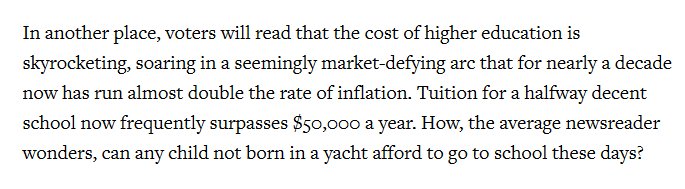
As soon as I got to that part of the piece, I stopped reading. If all public universities and most of private nonprofit higher education is garbage, then why am I a professor again?

(Dis)honorable mentions (athletics division): Dartmouth football assistant coach punches out a window in Harvard’s press box, Oregon football assistant coach collects $63,750 for one day of work after being arrested for a DUI, Kentucky basketball fans send death threats to a referee following a close loss, three UCLA basketball players are lucky to not be in a Chinese jail after a shoplifting arrest (plus a bizarre feud between LaVar Ball and Donald Trump), colleges offering athletic scholarships to preteens, football coach heads to third job in 12 months (without sitting out a year like most players must).

(Dis)honorable mentions (non-athletics division): Allowing your university Twitter account to be hacked with profane messages, higher ed official claiming that genetics contribute to pay disparities by gender, selectively showing results to support an advocacy agenda, passing off descriptive statistics as causal research, typos of “casual inference” and “pubic education” abounding in published research.

With this post now being online, I’m planning to take a hiatus from blogging over the holiday season (unless something monumental happens in the higher education policy arena). I’ll see you all again in January—and if you can’t get enough of my takes on higher education, pre-order my book Higher Education Accountability for shipment in January. (Use promo code HDPD to get 30% off from Johns Hopkins University Press!)

A previous version of this post incorrectly referred to Debasish Dutta as the president of Rutgers University. He is in fact the chancellor of Rutgers-New Brunswick. The error has been corrected.

The 2017 Higher Education Top Ten List

It’s safe to say that 2017 has been one of the most fascinating years in the realm of higher education policy in a long while. With the Trump administration seeking to reverse many Obama-era policies and both states and the private sector taking bold actions, there has been no shortage of high-impact events over the last year. (It’s a big enough year that the tax reform bill doesn’t even make my top ten!)

In my fifth annual top ten list (see past lists here), I present the ten events of the year that I consider to be the most important or influential. (My slightly irreverent list of “not top ten” events comes out tomorrow.) As always, I’d love to hear your thoughts about the list and what I missed!

(10) The IRS Data Retrieval Tool was taken offline in March due to security concerns. The IRS Data Retrieval Tool was first unveiled in September 2010 to allow students to directly transfer financial information from their income tax forms to the FAFSA. This helped improve data accuracy and further streamlined the process of filing for federal financial aid. But on March 3, the popular tool suddenly disappeared, with no explanation given for six days. It turns out that the outage may have been a result of someone trying to access President Trump’s tax information using the tool (the person is now facing up to five years in prison), which alerted the IRS to security issues. Access was finally restored for the start of the 2018-19 FAFSA season in October, and it does not look like President Trump actually received any federal financial aid thanks to the hacking attempt.

(9) Faculty tenure faces skepticism in a number of statehouses. As Republicans have become more skeptical of higher education in recent years, conservative legislators in Iowa and Missouri introduced legislation in 2017 to limit or end the practice of faculty tenure. These bills, which did not pass, would have gone much farther than Wisconsin’s changes that made it easier to fire tenured faculty if financial issues occurred. (Another bill in Iowa would have required universities to roughly balance the number of registered Republicans and Democrats on the faculty.) Notably, University of Iowa president Bruce Harreld—no favorite of facultyhas forcefully spoken in favor of tenure. As I go up for tenure next fall, it’s becoming clear that the ranks of tenured faculty will continue to diminish outside star faculty at elite institutions. The question to me is how quickly tenure falls off—not whether it continues to happen.

(8) Two Obama administration alumni take key higher education leadership roles. Together, Jamienne Studley and Ted Mitchell served as undersecretary of education for most of President Obama’s second term in office. They had an outsized influence on higher education policy during their tenure, including issues such as gainful employment, college ratings, and the collapse of several for-profit college chains. In 2017, they both took on new roles. Studley became president of the regional accreditor WASC, while Mitchell became president of the influential American Council on Education. It will be interesting to see how the ex-Obama officials will handle the transition to heading groups they once had influence over, and it will be even more interesting to see how Republicans in Washington treat these two leaders.

(7) The Charlotte School of Law closed after suffering a series of setbacks. Part of the for-profit InfiLaw chain, Charlotte once enrolled more than 1,400 students in its early 2010s peak. But the school ran into issues with its accreditor over the its low bar exam passage rates, which led to the Obama administration cutting off Charlotte’s access to federal student loans at the end of 2016. Without this lifeblood (Charlotte students took out over $48 million in loans in 2015-16 alone) and the school’s future being unclear, students began to leave in droves. Of the 700 students who started in fall 2016, only about 100 students were left by the time Charlotte officially closed on August 10. Under federal rules for a closed school discharge of student loans, only students who were still enrolled as of April 12 were eligible for a full discharge of loans. Other students could (and did) file for relief under borrower defense to repayment—which requires a higher burden of proof. Democratic members of Congress have asked for a longer closed school discharge window, but that has not yet happened.

The InfiLaw chain was the rough basis for John Grisham’s newest book, The Rooster Bar. It’s a worthwhile read over the holidays, even when it veers far away from higher education policy.

(6) It was a great year for data on higher education outcomes. The release of the College Scorecard in 2015 was a big step forward for researchers, policymakers, and the public—providing the first comprehensive institutional-level data on earnings and student loan repayment rates. (And the Department of Education recently signed a five-year agreement to keep getting earnings data from Treasury, allaying the fears of some about data in the Trump administration.) This year also saw the long-awaited release of graduation rates for Pell Grant recipients and part-time/transfer students via the Integrated Postsecondary Education Data System.

But the data release that stole the show in 2017 was from the Equality of Opportunity Project, a tremendous and well-funded collaboration by several top economists. With a well-coordinated release in the New York Times, the team made available its college-level data on the percentage of students from lower-income families who reached higher income quintiles by their early 30s. This highlighted the good work of many moderately-selective public and private nonprofit colleges, as well as the incredible share of super-wealthy students at Ivy League institutions. (The dataset also has marriage rates by college, which I had fun playing around with.) One caution: since the data come from tax records, some colleges are aggregated in strange ways. Be mindful of that when using this great dataset.

(5) The first people are eligible to receive Public Service Loan Forgiveness benefits, but who will actually qualify? President Bush signed the College Cost Reduction and Access Act in 2007, creating the Public Service Loan Forgiveness (PSLF) program. Under PSLF, students working in a range of nonprofit or government agencies are eligible to have their federal loans forgiven after making 120 qualified payments under an income-driven repayment plan. October 1 marked the first date that borrowers could actually qualify and fill out the application for forgiveness. Nearly 700,000 borrowers have filled out voluntary employment certification forms (and more will probably file for forgiveness later on), but expect to see chaos in 2018 as borrowers who think they met all the criteria get denied forgiveness for various reasons. President Trump’s budget and the House’s draft Higher Education Act reauthorization bill also have proposed ending PSLF for new borrowers, so stay tuned about the future of PSLF.

(4) “Free college” programs continue to grow, but also face growing pains. Inspired by the generally successful (and politically popular) Tennessee Promise program, other states and communities have adopted various tuition-free college models. New York’s Excelsior Scholarship program, which covered nearly all tuition (but not fees) at four-year public colleges beginning in fall 2017, got a lot of attention. Unfortunately, much of this was negative due to all of the strings attached to the funds in order for the budget numbers to work, including a requirement that students stay in state after college or the grant converts to a loan. (Rhode Island adopted the same type of post-college residency requirement in its new plan.) Meanwhile, Oregon’s existing program had to scale back somewhat as not enough funds were available, creating the possibility of disappointment effects among students who did not get the money they were expecting. Tennessee’s program has an endowment from state lottery funds—which many states cannot do, but provides extra stability.

(3) A number of colleges saw unrest due to protests and disliked speakers—and then the neo-Nazis came to Charlottesville. The tensions between higher education and other parts of American society have been growing over the last several years, with campus protests over racism continuing in 2017 (and contributing to the protests that briefly closed Evergreen State College in Washington). Some colleges also saw protests related to campus speeches by right-wing professional provocateur Milo Yiannopoulos (which drew the ire of President Trump) and anti-Trump libertarian scholar Charles Murray, leading to the House’s Higher Education Act reauthorization bill requiring public colleges to protect free speech.

Campus tensions reached new heights in August, when neo-Nazis gathered at the University of Virginia in Charlottesville and committed a terrorist attack by driving into a crowd of counterprotestors and killing one person. Well-known “white nationalist” Richard Spencer has sparked near-riots on several campuses by attempting to speak, even when nobody on campus wants him to attend. These deplorable individuals will continue to try to speak on college campuses (and they have the constitutional right to do so, in my view), but I wish that nobody would pay attention to these people—thus denying them the attention they seek.

(2) Purdue University announces it will purchase for-profit Kaplan University for $1. It takes a lot to render me at a loss for words, but the April 27 announcement that Purdue and Kaplan had agreed to a contract that would transfer Kaplan’s nearly 32,000 students (who are mostly online) to a Purdue-owned “New U” did exactly that. (Kaplan would continue to operate most of the non-academic parts of the university.) Faculty members at Purdue are strongly opposed to the deal, which was enabled by a quiet change to state law made as negotiations were occurring. The deal has gotten approval from state and federal regulators, but the deal will ultimately hinge on receiving approval from Purdue’s accreditor. A decision is expected in the next few months. This deal bears watching due to its magnitude and the potential for public universities to greatly expand their outreach to nontraditional students if the partnership is successful.

(1) Congressional Republicans and the Trump administration try to undo a host of Obama-era regulations. It is no secret that conservatives seethed as the Obama administration implemented regulations on topics such as gainful employment, borrower defense to repayment, and the definition of a credit hour for financial aid purposes. Now that they hold the House, Senate, and White House, Republicans are trying to undo these regulations amid fierce opposition from Democrats. The Department of Education has postponed the effective date of borrower defense to repayment regulations and has delayed data collection for gainful employment. There are currently negotiated rulemaking panels to reconsider both borrower defense to repayment and gainful employment, while the Higher Education Act reauthorization bill from House Republicans would effectively salt the earth on regulations by pulling the Department of Education’s ability to ever revisit these and other topics. Expect to see lawsuits galore as these efforts moves forward.

Honorable mentions: Elite colleges face pressures over their endowment sizes and usage (and will likely face a tax going forward), Cheyney University keeps its accreditation, Cardale Jones graduates from Ohio State years after questioning the value of an education, faculty start their own scholarship funds to support students, international student enrollments dip.

Key Takeaways from the House Higher Education Act Reauthorization Bill

Majority Republicans on the U.S. House Committee on Education and the Workforce unveiled their draft legislation today to reauthorize the Higher Education Act—the most important piece of legislation affecting American higher education. The Promoting Real Opportunity, Success, and Prosperity through Education Reform (PROSPER) Act checks in at a hefty 542 pages and touches many important aspects of higher education. I live-tweeted my first read through the bill (read the thread here), and in this blog post I am sharing some thoughts on the key themes of the legislation.

Takeaway 1: This bill would undo many Obama-era regulations and salt the earth on future regulations. It’s no secret that Republicans didn’t care for regulations such as gainful employment, borrower defense to repayment, or providing a federal definition of the credit hour. The PROSPER Act would not only undo the regulations, but prohibit the Secretary of Education from promulgating any future regulations (meaning that Congress would have to pass legislation to create any new rules). The Secretary of Education would also be prohibited from creating a federal college ratings system, even though the Obama-era effort to do so was unsuccessful.

Takeaway 2: The federal student loan system would be radically overhauled. Instead of the array of loans that are now available, there would be three flavors of a federal ONE Loan—for undergraduates, parents, and graduate students. The key details are below.


  Undergrad (dependent) Undergrad (independent) Parent Grad student
Annual limit (current) $5,500-$7,500 $9,500-$12,500 Cost of attendance Cost of attendance
Annual limit (PROSPER) $7,500-$11,500 $11,500-$14,500 $12,500 $28,500
Lifetime limit (current) $31,000 $57,500 Cost of attendance Cost of attendance
Lifetime limit (PROSPER) $39,000 $60,250 $56,250 $150,000

Note: Medical students have higher loan limits than what is listed above.

Undergraduate students actually have higher loan limits, but the PROSPER Act would also allow colleges to limit borrowing by student major if they feel students are unlikely to repay their obligations. Financial aid administrators have sought this authority for years, which means that students could actually see lower loan limits. Graduate students, on the other hand, would be limited to $28,500 per year and $150,000 overall in federal loans. Given that tuition alone often exceeds this number, expect students to turn to the private market (when possible) to finance their education.

The PROSPER Act also drastically changes income-driven repayment programs. Instead of the range of programs available now, future borrowers could choose between the standard ten-year payment plan or an income-driven plan that would allow them to pay 15% of their discretionary income (over 150% of the federal poverty line) for as long as necessary to repay the loan. There would be no ending date to payments, and payments for married couples would be based on both spouses’ incomes even if they file their taxes separately. (Both of these provisions differ from current law.) The Public Service Loan Forgiveness program, which was only mentioned once in passing in the entire bill, would also end. However, people in the program now would be grandfathered in.

Takeaway 3: Colleges would be held accountable for their outcomes in new ways. The cohort default rate metric (which I’m no fan of) would be replaced by a repayment rate metric. If a program (not a college) had more than 45% of its borrowers at least 90 days delinquent or in certain types of deferment for three consecutive years, it would lose access to all federal financial aid. This is a more generous definition of repayment for colleges than the College Scorecard’s definition (repaying at least $1 in principal), so I can’t say how many colleges would actually be affected.

Another interesting piece is that colleges would have to repay at least a portion of federal financial aid dollars given to students who left college during a semester. Right now, colleges can try to claw back those funds, but this proposal would limit colleges to trying to collect 10% of the amount owed back from students. This is similar to what Matt Chingos and Kristin Blagg have proposed in a policy brief.

There are so many other interesting points in this legislation, but I think these are the three most important ones that I can speak to based on my experience and research. Keep in mind that the Senate will also introduce a Higher Education Act reauthorization bill sometime in 2018, and that the two bills may differ significantly from each other.

Downloadable Dataset of Marriage Rates by College

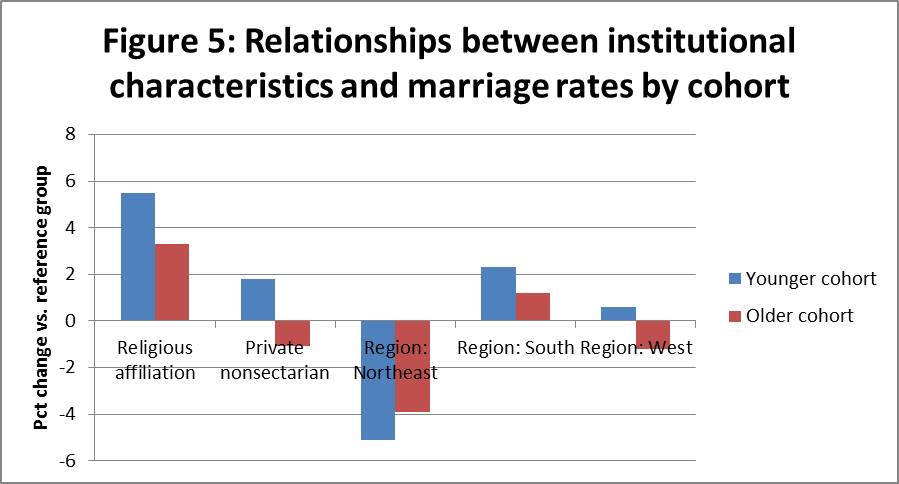
I enjoyed reading this recent piece in the Chronicle of Higher Education that looked at the “ring by spring” pressures that students at some Christian colleges face to be engaged by graduation. I looked into factors affecting marriage rates across colleges in a blog post earlier this year and found a nearly six percentage point increase in marriage rates at religiously-affiliated colleges between ages 23 and 25 relative to public institutions, as shown in the figure below.

As a data person—and someone who married his college sweetheart only three years after graduation—I wanted to share a dataset that I had already compiled for that piece so people can look through to their heart’s content. It contains data on 820 public and private nonprofit four-year colleges from the Equality of Opportunity Project, with marriage rates for cohorts ages 23-25 and 32-34 in 2014. The three colleges featured in the Chronicle piece all have higher-than-average marriage rates by age 25, with Cedarville University having a 41% marriage rate, Houghton College having a 34% marriage rate, and Baylor University having a 18% marriage rate.

You can download the dataset here, and have fun exploring the data!

A special thanks to Carol Meinhart for catching a silly error in an earlier version of the dataset, where the two marriage rate column headings were switched. It has since been fixed.

A Poor Way to Tie the Pell Grant to Performance

“Groan” is a word that is typically used to describe something that is unpleasant or bad. But in the language of student financial aid, “groan” has a second meaning—a grant that converts to a loan if students fail to meet certain criteria. The federal TEACH Grant to prospective teachers and New York’s Excelsior Scholarship program both have these clawback requirements, and a 2015 GAO report estimated that one-third of TEACH Grants had already converted into loans for students who did not teach in high-need subjects in low-income schools for four years.

Republican Reps. Francis Rooney (FL) and Ralph Norman (SC) propose turning the Pell Grant into a groan program through their Pell for Performance Act, which would turn Pell Grants into unsubsidized loans if students fail to graduate within six years. While I understand the representatives’ concerns about students not graduating (and thus reducing—but not eliminating—the return on investment to taxpayers), I see this bill as a negative for students and taxpayers alike.

Setting aside the merits of the idea for a minute, I’m deeply skeptical that the Department of Education and student loan servicers can accurately manage such a program. With a fair amount of difficulty managing TEACH Grants and income-driven repayment plans, I would expect a sizable number of students to incorrectly have Pell Grants convert to loans (and vice versa). I appreciate these two representatives’ faith in Federal Student Aid and servicers to get everything right, but that is a difficult ask.

Moving on to the merits of the idea, I am concerned about the implications of converting Pell Grants to a loan for students who left college because they got a job. Think about this for a minute—a community college student who has completed nearly all of her coursework gets a job offer with family-sustaining wages. She now faces a tough choice: forgo a good, solid job until she completes (and hope she can get another one) or take the job and owe an additional $10,000 to the federal government? If one of the purposes of higher education is to help students move up the economic ladder, this is a bad idea.

This could also have additional negative ramifications for students who stop out of college due to family issues, the need to support a family, or simply realizing that they weren’t college ready at the time. Asking a 30-year-old adult to repay additional student loans (when he may have left in good standing) under this groan program would probably reduce the number of working adults who go back and finish their education.

If the representatives’ concern is that students make very slow progress through college and waste taxpayer funds, a better option would be to gradually ramp up the current performance requirements for satisfactory academic progress. These requirements, which are typically defined as a 2.0 GPA and completing two-thirds of attempted credits, already trip up a significant share of students. But on the other hand, research by Doug Webber of Temple University and his colleagues finds significant economic benefits to students who barely keep a 2.0 GPA and are thus able to stay in college.

Finally, although I think this proposal is shortsighted, I have to chuckle at a take going around on social media noting that one of the representatives owns a construction company that helped build residence halls. Wouldn’t that induce a member of Congress to support policies that get more students into college (and create demand for his company’s services)? It seems like he is going against his best interest if this legislation scares students away from attending college.

Is There Evidence of the Bennett Hypothesis in Legal Education?

“If anything, increases in financial aid in recent years have enabled colleges and universities blithely to raise their tuitions, confident that Federal loan subsidies would help cushion the increase…Federal student aid policies do not cause college price inflation, but there is little doubt that they help make it possible.”

In what year was the above quote first printed in The New York Times? Given concerns about college affordability and the ever-rising price tag of a college education, it’s reasonable to assume that the quote comes from the last few years. Yet this quote came from William Bennett (who was President Reagan’s Secretary of Education) way back in 1987. Bennett is now a conservative commentator and occasional advisor to the Trump administration, and his higher education views likely get traction in key federal policy circles.

Since 1987, what came to be known as the Bennett Hypothesis has been vigorously debated in the research and policy communities. As I detailed in two previous blog posts, the evidence to support the Bennett Hypothesis is generally modest among undergraduate students—with stronger evidence at private nonprofit and for-profit colleges than community colleges. However, prior research often looks at small changes in student loan borrowing limits or Pell Grant award amounts since there have been no large-scale changes in financial aid for undergraduate students over the past several decades.

Many graduate and professional students, on the other hand, saw a large increase in their federal student loan limits in 2006 (from $18,500 per year up to the full cost of attendance) due to the creation of the Grad PLUS loan program. This increase, which could be in the tens of thousands of dollars for students, provides a rare opportunity to test how colleges responded to a large change in potential federal revenue. This is particularly salient for students in master’s and professional degree programs, as institutional financial aid is far less common than in PhD programs.

Thanks to support from the AccessLex Institute and the Association for Institutional Research, I have spent much of the last year examining whether professional programs responded to the creation of the Grad PLUS program and the following expansion of income-driven repayment programs by increasing tuition and fees and/or living allowances. I also looked at whether student debt burdens of graduates increased. Today, I am releasing a SSRN working paper examining these questions for law schools, with additional analyses for business and medical schools to come at some point in the future.

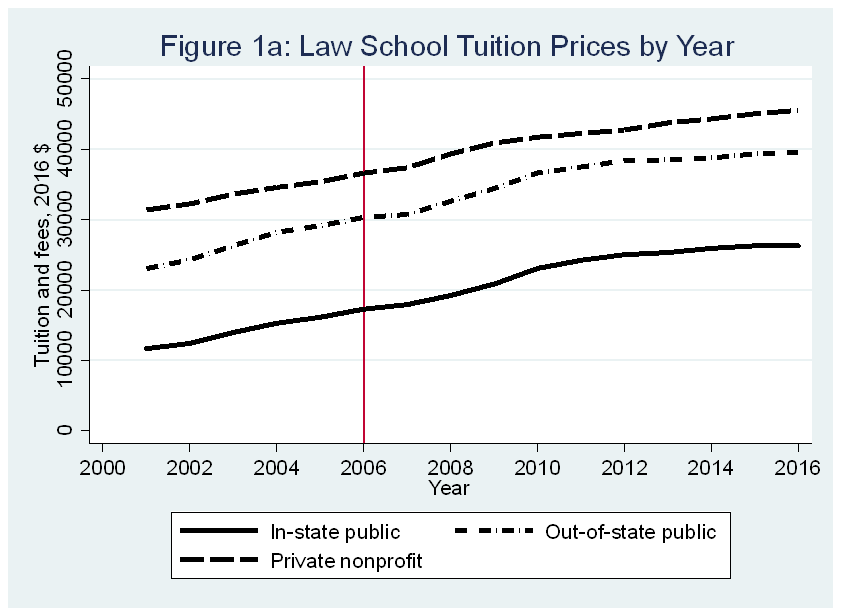
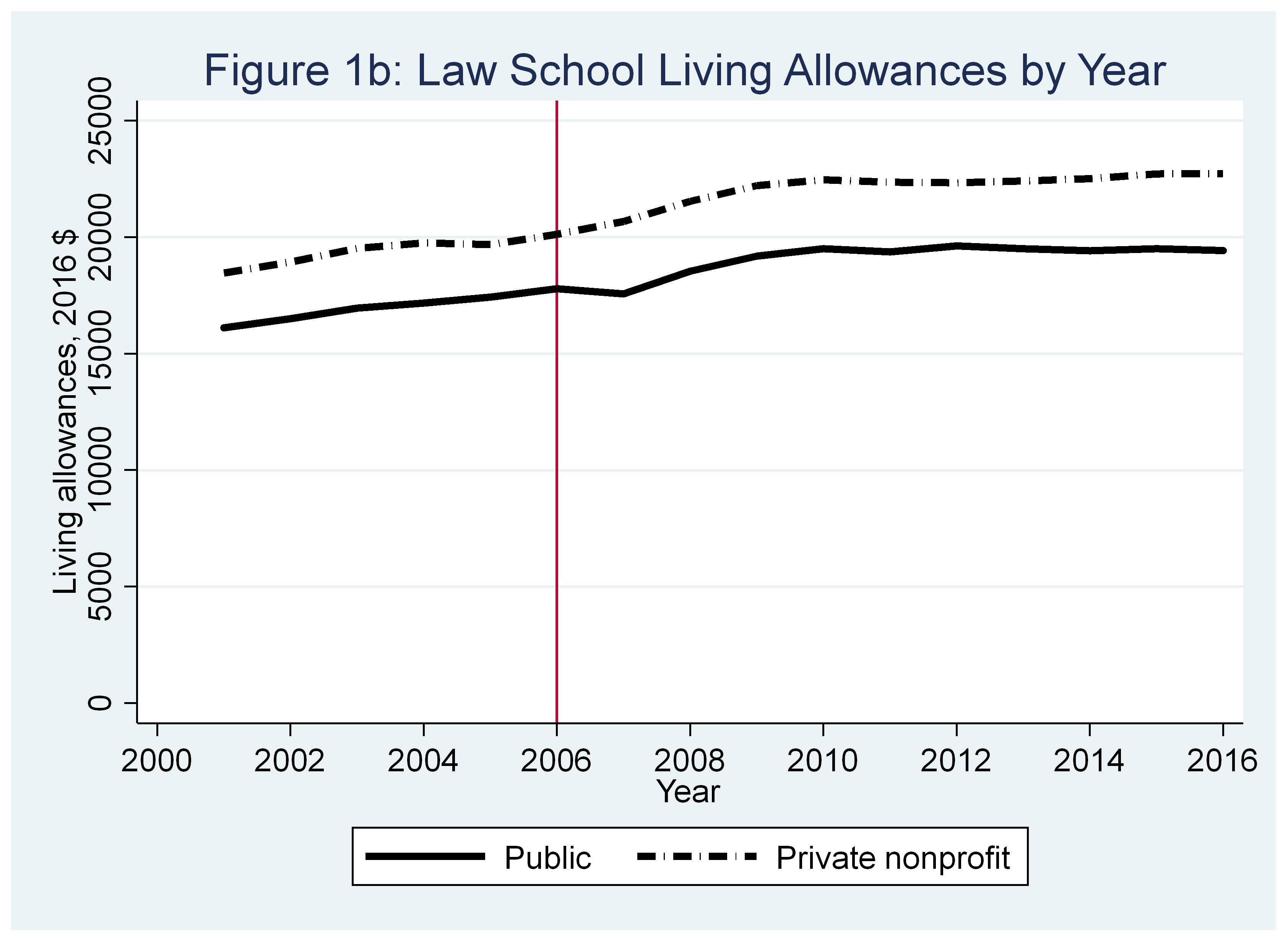
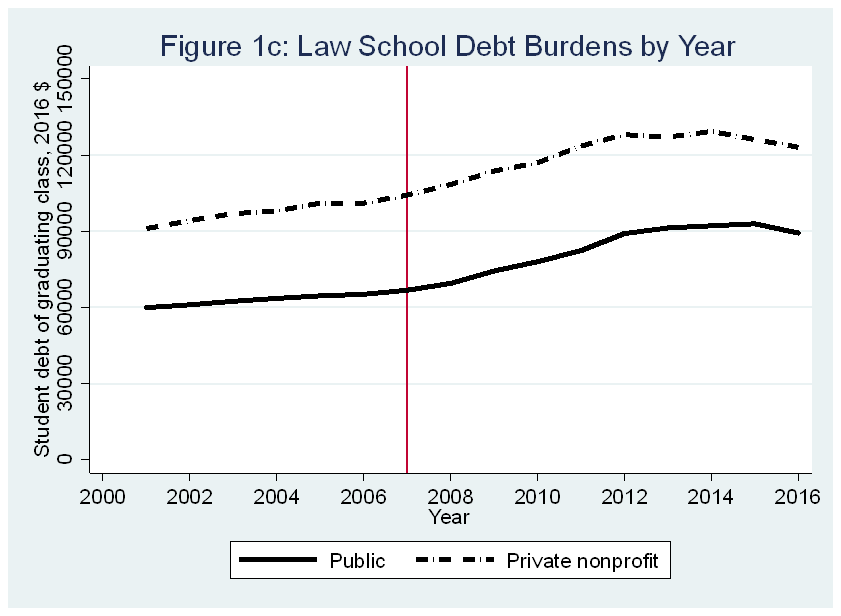
In the seven months of tedious data compilation, coding, and cleaning that preceded any analyses (a big thanks to my sharp research assistants Joe Fresco and Olga Komissarova for their hard work!), I fully expected to find a great deal of evidence to support the Bennett Hypothesis due to the entrepreneurial nature of law schools and the sheer amount of federal student loan dollars that became available in 2006. Yet as the graphics below show, there was no immediate smoking gun in the descriptive data (focus on the red line at 2006).

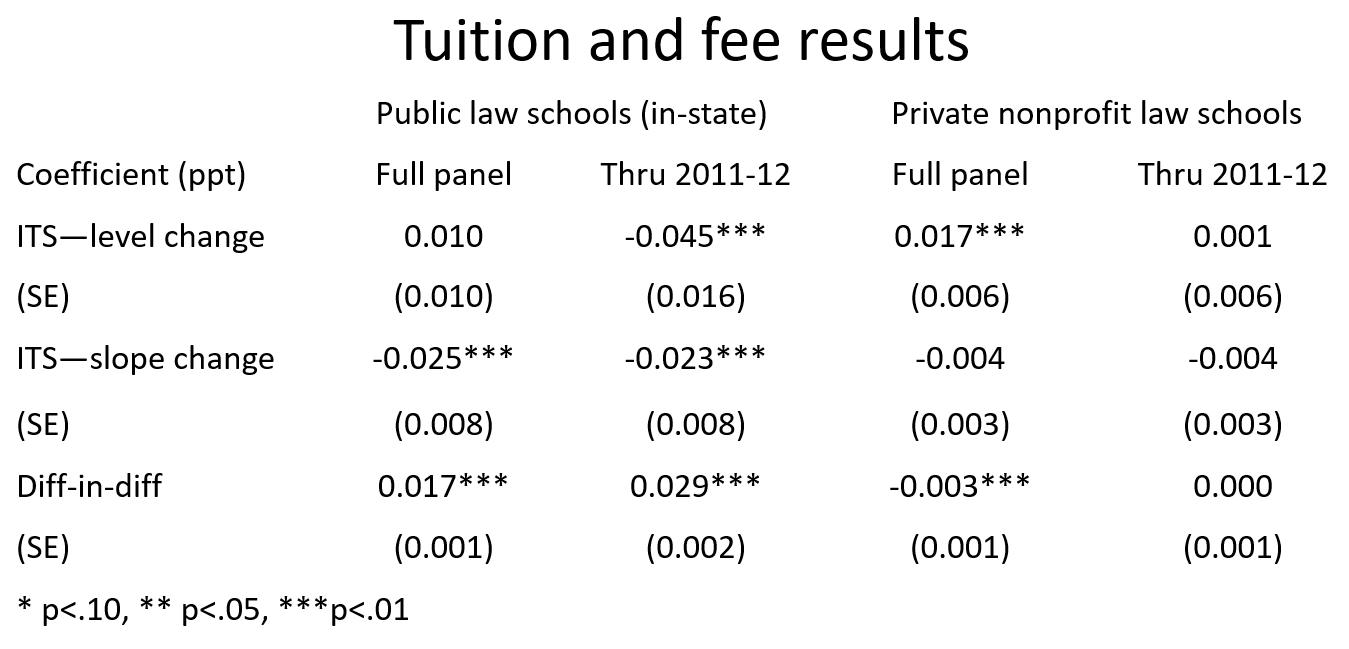
But because graphics do not prove that there is (or is not) a relationship between federal student loan availability and law schools’ prices, I used two analytic strategies to try to draw causal inferences. I used an interrupted time series model that compared law schools before and after the 2006 implementation of Grad PLUS and a difference-in-differences model that looked at the difference between law schools and undergraduate institutions before and after 2006. Both of these models showed generally null or small positive coefficients, suggesting that law schools did not react by raising tuition prices or living allowances by massive amounts. (These findings generally match the conclusions from the literature at the undergraduate level, and are robust across a range of model specifications.) Below are the coefficients for tuition and fees, with the coefficients for living allowances and debt burdens available in the paper.

So why was there far less evidence for the Bennett Hypothesis than I expected to see? I offer three potential explanations.

Explanation 1: Law schools didn’t strategically increase prices in response to increased federal financial aid availability. Yes, law school tuition is expensive, and it’s certainly true that colleges have viewed law schools as potential revenue centers. But law schools may have thought that their price increases were already substantial enough to fund their operations.

Explanation 2: Any law school that increased tuition by more than their competitors may have seen a decline in applicants and/or revenue. This is somewhat similar to the classic prisoner’s dilemma in game theory, in which cooperating with other players (to raise prices) would result in a better solution than going alone. But to collude here would be price fixing—and illegal. Thus law schools stick to the norm of sizable (but not absurd) tuition increases.

Explanation 3: Students shifted from private loans to PLUS loans and thus already had access for loans up to the full cost of attendance. There is some evidence to support this logic, as 36% of law students took out private loans in 2003-04 compared to just 5% in 2011-12. Yet this would not hold for the majority of students who didn’t take out private loans.

I would love to get your comments on this working paper before it undergoes the formal peer review process in a few weeks (it’s already been informally reviewed). Send me your thoughts!

Downloadable Dataset of Pell Recipient Graduation Rates

Earlier this week, my blog post summarizing new data on Pell Grant recipients’ graduation rates at four-year colleges was released through the Brookings Institution’s Brown Center Chalkboard blog. I have since received several questions about the data and requests for detailed data for specific colleges, showing the interest within the higher education community for better data on social mobility.

I put together a downloadable Excel file of six-year graduation rates and cohort sizes by Pell Grant receipt in the first year of college (yes/no) and race/ethnicity (black/white/Hispanic). One tab has all of the data, while the “Read Me” tab includes some additional details and caveats that users should be aware of. Hopefully, this dataset can be useful to others!